
An Employee Self Service App That Runs on Top of Your Current System
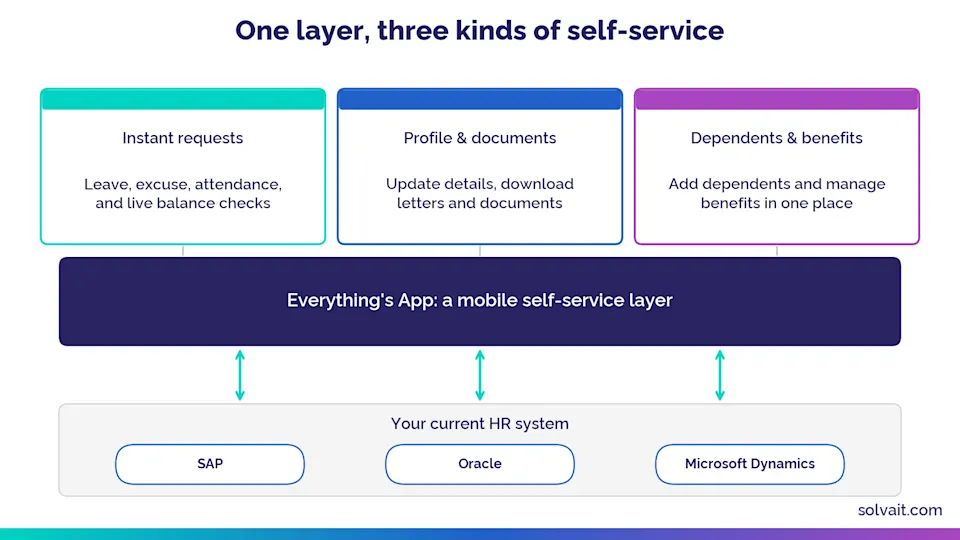
You can give your people a modern mobile HR app without touching your core system. Everything's App from Solvait is an employee self service layer that sits on top of SAP, Oracle or Microsoft Dynamics, reading from it and writing back to it. Your employee requests leave, updates a profile, and checks a balance from a phone, while your data and records stay exactly where they are. No migration. No months long replacement project. The system your company was built on stays the system of record, and the app becomes the daily interface your employees actually use.
This matters because most companies don't need a new HR system. They need a better employee experience. And the gap between those two paths is large, in time, cost and risk.
Key takeaways
An employee self service app runs on top of your current system (SAP, Oracle or Dynamics) without replacing it, so a modern experience reaches employees in weeks, not months.
Modules are configurable: switch on what you need and switch off what you don't, and the same app scales from 100 employees to 100,000 without added complexity.
Self service is wider than leave requests. It covers profile, documents, dependents, benefits, and instant balance and report inquiries.
The core system stays the source of truth while the app reads from it and writes back, so the risk to payroll and records is lower than a full replacement.
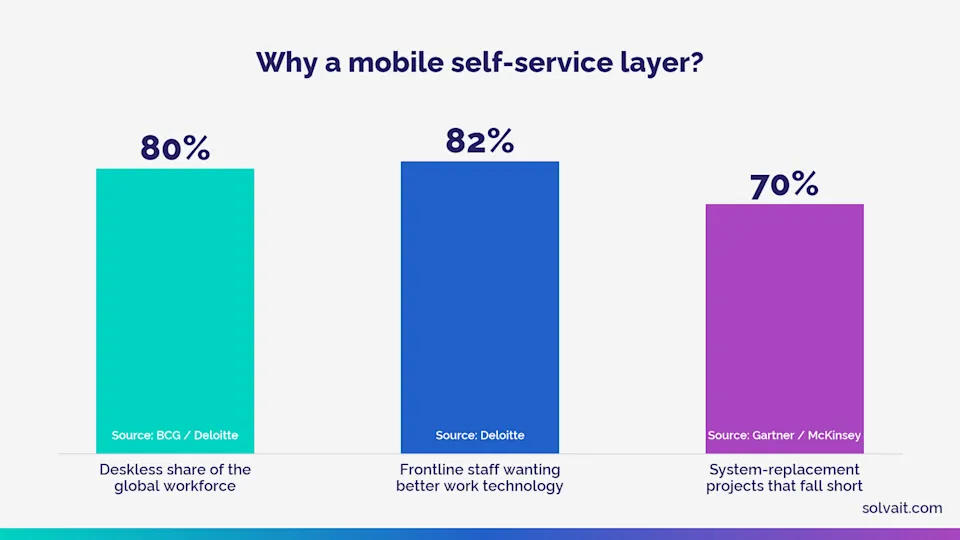
About 80% of the global workforce works away from a desk, on shop floors, in branches, out in the field, according to Emergence Capital (about 2.7 billion workers). These people don't sit at a computer to open an HR portal, but nearly all of them carry a phone. As Saudi Arabia accelerates its digital shift under Vision 2030, with overall unemployment at 3.4% in Q3 2025 (7.5% among Saudi nationals) per the General Authority for Statistics (GASTAT), employee experience has become a factor in attracting and keeping talent, not an administrative nicety.
Do you have to replace SAP or Oracle to give staff a modern app?
The short answer is no. The problem you're trying to solve isn't in the engine, it's in the interface your employee sees. The payroll and records engine inside SAP or Oracle may run fine. What the employee complains about is having to open a complex desktop screen just to request a day off.
Replacing the system to fix an interface is an expensive decision. Gartner research puts the share of core system replacement projects that fail to meet their stated objectives at 55% to 75%, and McKinsey finds that more than 70% of digital transformations fall short. These aren't small projects. They're multimillion riyal initiatives led by large firms. And the usual reason for failure isn't the technology, it's the scale of change the project forces onto the organization.
A layer avoids all of that. It keeps your core system as-is and adds one mobile interface on top. The employee gets a modern experience, you skip the migration risk, and your IT team doesn't spend half its year on a project that eats its capacity.
Criterion | Add the Everything's App layer | Rip and replace the system |
What changes for the core system | Nothing, it keeps running | Full migration and re-testing |
Time to go live | Weeks | Often 12 months or more |
Risk to payroll and records | Low, data stays in place | High during cutover |
What employees get | One mobile app for requests | A new portal to relearn |
Cost profile | Add a layer | Re-buy the whole stack |
Here's the part worth being clear about: a layer and a replacement aren't two answers to the same question. Replacement fixes an engine that doesn't work. A layer fixes an interface that feels dated. If your engine is sound, the layer is the cheaper, faster, lower risk answer.
How does the app stay simple for 100 employees or 100,000?
The answer is one word: configuration. Everything's App is built from independent modules. You switch on the ones your company needs and leave the rest off. A 100 person company might use only leave, excuse and attendance. A 100,000 person group across several entities might add dependent management, documents and multi level approval chains on top.
The benefit is that each employee sees only what applies to them. Nobody is buried under screens that don't concern them, so the experience stays simple no matter how large the organization gets. That's a practical point, not a slogan: the app a field worker opens in a store should be the size of a single task, not a full dashboard.
And scaling up doesn't mean rebuilding. When the company grows or adds an entity, you switch on the module you need and point it at the right group, with no fresh project. The same module that serves a hundred people serves a hundred thousand. What changes is the scope you activate, not the app.
Because most of the workforce is away from a desk, this mobile simplicity isn't a detail. Deloitte reports that 82% of frontline workers say better technology would improve their productivity. One light app, opened between tasks, speaks directly to that need.
What can an employee do in the app beyond requesting leave?
Requesting leave is the usual starting point, and it's the narrowest slice of self service. The wider idea is that an employee runs all their day to day HR from one place, without calling HR and without WhatsApp messages that get forgotten. In practice, the app covers four kinds of work:
Requests: Leave, excuse, clock in and clock out. The employee submits, and the request moves through a clear approval chain instead of a message a manager might miss.
Instant inquiries: How much leave is left? Where did the request get to? What were the details of the last payslip? The app answers straight from your system's data, which cuts the repeat questions that reach your team every day.
Profile and documents: The employee updates their details and pulls the letters and documents they need, ready to download, without a manual request each time.
Dependents and benefits: The employee adds dependents and manages the benefits tied to them from the same app, so their records stay current and accurate.
When these four move to self service, your team's load changes shape. The repeat questions that used to fill a day become instant answers in the employee's pocket, and the team is freed for work that genuinely needs a human decision. Data accuracy improves too, because an employee who owns their profile corrects it themselves.
Where does Everything's App sit within Solvait?
Everything's App is the sixth product in the Solvait suite. It's a mobile employee self service app that connects to any HR system: SAP, Oracle or Microsoft Dynamics. Its job is clear: requests (leave, excuse, attendance), instant inquiries on balances and reports, profile, document, dependent and benefit management, and configurable approval chains that route each request to the right approver. It's a self-service app for simplifying requests and inquiries, not a payroll system and not an autonomous agent. Your core system stays the source of truth, and the app is the employee's interface on top of it.
You can explore Everything's App to see the available modules and how you switch them on for different groups of staff. More than 260 organizations run Solvait solutions today at 99.9% uptime, and these are Solvait's own verified figures.
If you want to see the app working on top of your current system with your own data, book a demo and we'll show you how self-service reaches your employees in weeks, not months.
FAQ
Do I have to replace SAP or Oracle to use Everything's App?
No. Everything's App is a self service layer that runs on top of your current system and connects to it directly, whether that's SAP, Oracle or Microsoft Dynamics. Your system stays the source of truth for payroll and data, and the app becomes the employee's daily mobile interface, with no migration and no replacement project.
What can an employee actually do in the app?
Employees submit leave and excuse requests and record attendance, check balances and reports instantly, update their profile and pull their documents, and add dependents and manage benefits. Your company switches on only the modules it needs, so each employee's interface stays simple.
Does Everything's App suit both large and small companies?
Yes. The modules are configurable, so you activate what fits your size: from basic requests for a small company to dependent management and multi level approval chains for a large group across several entities. The same app serves 100 employees or 100,000 without rebuilding.
Is Everything's App a payroll system or an agentic AI tool?
No. Everything's App is a self service app for simplifying requests and inquiries. It is not a payroll system and not an autonomous agent. Payroll processing and compliance stay in your core system or in Solvait's Agentic AI HR platform, while the app focuses on the daily employee experience.
References
Emergence Capital: Deskless share of the global workforce (~80%), 2018 (supports the deskless workforce figure).
Deloitte: 82% of frontline workers say better technology would improve productivity, 2024 (supports frontline demand for technology).
Gartner: 55% to 75% of core-system replacement projects fail to meet objectives, 2026 (supports replacement risk).
McKinsey: More than 70% of digital transformations fall short, 2026 (supports replacement risk).
General Authority for Statistics (GASTAT): Saudi unemployment at 3.4% in Q3 2025, 2026 (Saudi labour-market context).
Solvait: 260+ organizations and 99.9% uptime, 2026 (Solvait first-party figures).
Ready to see Solvait in action?
Book a personalized demo and see how Solvait's AI-powered HR platform can transform the way your team works.
Tags
Related Posts
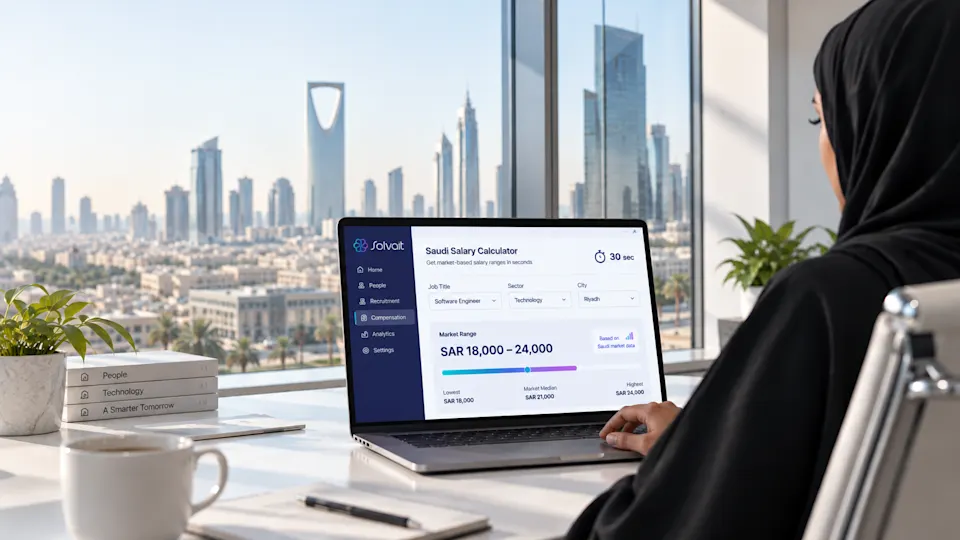
Benchmark Any Saudi Salary in 30 Seconds (Free Tool)
Solvait's free salary calculator gives you the Saudi market range by role, sector and city in 30 seconds. Benchmark any offer before you hire or raise pay.
Sep 13, 2026
Arabic First Employee Self Service Portal Guide
How to build an Arabic first employee self service portal your staff actually use in Saudi Arabia: the 5 layers, adoption benchmarks, and where AI fits.
Sep 1, 2026
Saudi Labour Law Automation: 9 Clauses to Enforce
Nine Saudi labour law clauses your HR system should enforce automatically after the 2025 reforms, from probation caps to WPS files.
Aug 30, 2026