
HR that moves at the speed of the project.
Mass onboarding, site attendance, overtime-heavy payroll, safety certifications and end-of-service at project close. HR for how construction actually works.
Ask for the mobilization-to-demobilization walkthrough. We will run it on one of your projects.
Sound familiar?
Not a list of HR challenges. This is the six weeks after the award letter, and after the handover certificate.
You won the award, and now you have six weeks to put four hundred men on site, run out of one spreadsheet and a WhatsApp group.
Attendance arrives as a device export from one project and photographs of paper sheets from another, and somebody retypes both.
Payroll is overtime-heavy, so one wrong rate compounds across hundreds of workers before anybody notices.
Project close is a demobilization wave: hundreds of end-of-service calculations at the moment the project team has moved on.
Mobilize. Operate. Move. Demobilize.
A construction workforce does not sit still long enough for an HR system built around a head office. Every part of Solvait on this page hangs off one of these four phases.
- 01
Mobilize
Import the manpower list once: employee records, contracts, QID and residence permit tracking.
- 02
Operate
Rosters by site and shift. Attendance from gate devices and geo-fenced phones into one engine.
- 03
Move
Transfer a crew between projects and the cost centre, roster and access move in one action.
- 04
Demobilize
Exit waves: end-of-service computed under Article 54 of the Labour Law, from each worker’s own record.
Attendance stops being an office reconstruction.
Your sites do not share one clock. Solvait takes all of it into one time and attendance engine.
- Geo-fenced mobile check-in: a punch only counts inside the site boundary, and the site is stamped on the record.
- Gate and biometric devices feed the same engine as the phones. One rule set, one timesheet.
- Rosters, night shifts, Ramadan hours and rest days handled as policy, not a month-end adjustment.
- The hour that reaches payroll is the hour recorded on site. Nobody retypes it, so nobody can mistype it.
Every line on the payslip opens onto the hour that produced it.
Overtime is where construction payroll breaks. Rawatib runs the monthly cycle at labor scale, and it keeps the working behind every figure.
- Overtime, rest-day and holiday rates applied by rule, per site and per grade.
- Social insurance for Qatari staff and the WPS salary file come out of the same run as the payslips, so they cannot drift apart.
- Open any payslip line and it shows the timesheet, the rule and the approval behind it, dated and named.
- When a worker disputes his pay, the site manager can show him the answer on the spot.
Nothing on the payslip is an opinion. Every figure has an hour, a rule and a person attached to it.
Solvait payroll & compensationThe certificate that expired is the one the auditor asks for.
Mutaba'aa watches every date attached to a worker and every requirement attached to the site he is standing on.
Per worker
- Safety induction and refresher dates
- Trade and equipment certificates
- Medical fitness validity
- QID and passport expiry
Per site
- Who is inducted for this project
- Certificates the project owner requires
- Toolbox talk attendance
- Workers flagged before they reach the gate
Ahead of the date
- Alerts weeks out, not the morning of
- Renewal assigned to a named owner
- Escalation when a date is missed
- Work permit and health card dates too
When the auditor arrives
- Current status per worker, per site
- Evidence exportable per project
- Full renewal history, dated
- HR and HSE reading the same record
Hours land against the project, not against a department.
Every hour captured on site carries its project and WBS code from the moment it is recorded, so labor cost per project, phase and element is a report rather than a month-end reconstruction.
- Cost by project, phase and WBS element, from the same timesheet that produced the payslips.
- Labor cost visible while the project is still running, not discovered when it closes.
- Solvait Wise turns it into dashboards: headcount by site, overtime concentration, Qatarization by entity.
- Hours carry their project code from the site, so labor cost can be reviewed against the project before payroll is submitted.
One chain from the gate to the ledger. Break it anywhere and project cost becomes an estimate.
End of service, computed to the article. Three hundred times.
Demobilization is where a labor-heavy company finds out what its HR system is worth. Solvait computes end-of-service under Article 54 of the Qatar Labour Law, for every worker in the wave.
- At least three weeks of basic pay for each year of service, and contracts that give more are applied at the contract rate.
- Service computed on actual dates, part years in proportion, with unpaid leave accounted for.
- The settlement pulls in unused leave, outstanding overtime and open deductions, so one statement closes the file.
- The worker receives the working, not just the total. That is what stops a dispute reaching the labor office.
- Article 54 → three weeks of basic pay per year, at least
- Service period, part years in proportion
- End-of-service award, computed to the article
- Unused leave balance
- Outstanding overtime from the last cycle
- Open deductions and advances cleared
Issued as a statement the worker can read, in Arabic, with every component shown separately.
Every request, from every site, in one queue.
A construction HR office answers people it never sees, on sites that change every quarter. AI HR works the routine overnight against your own policy, and puts only what needs a human decision in front of someone in the morning.
- Overnight actions summarized every morning, across leave, payroll and compliance.
- Exceptions escalated for human judgment, with the reason and the record attached.
- Workers still ask in Arabic from their phones — Khidmat answers on WhatsApp, and the request lands here.
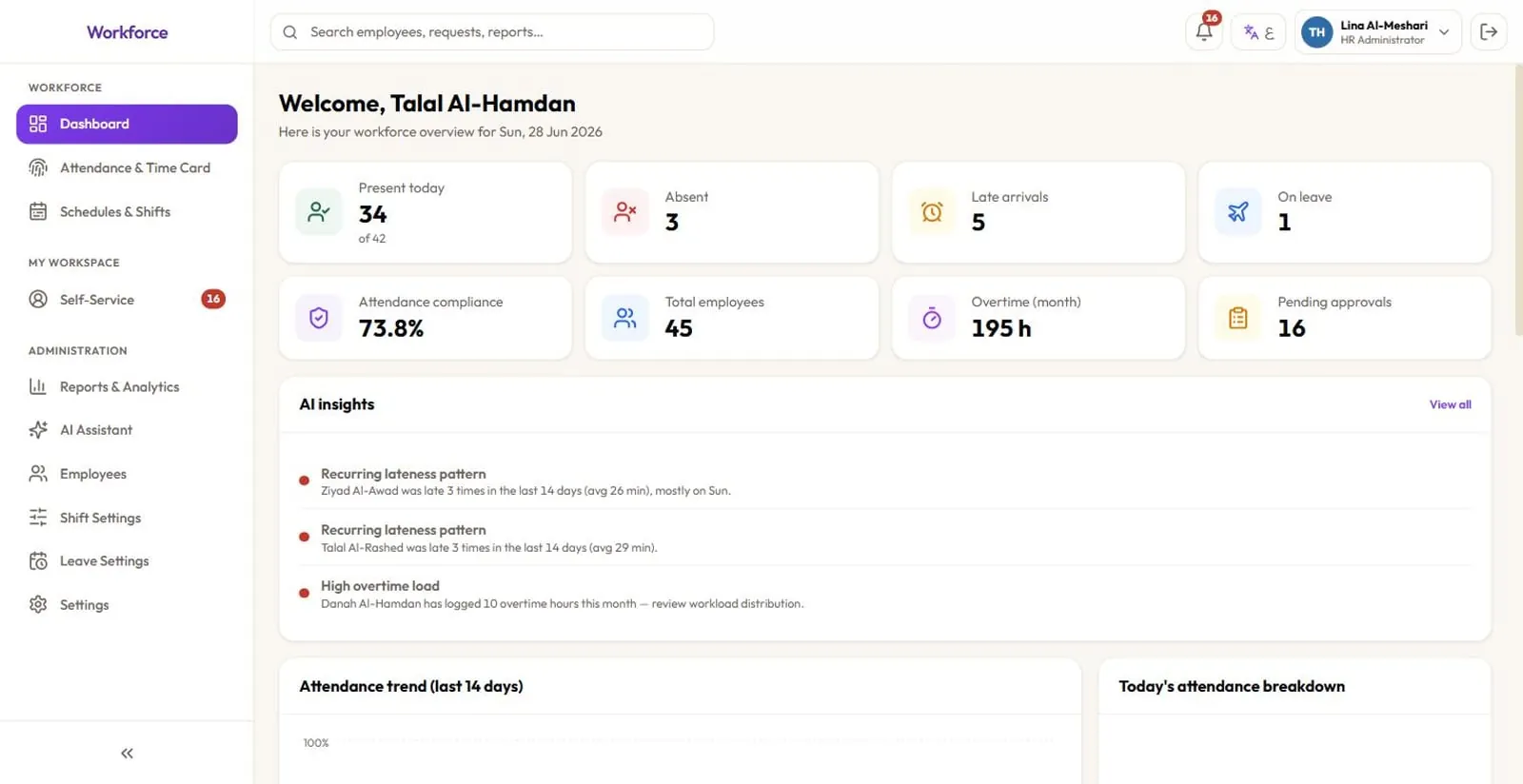
AI insights: lateness and overtime patterns flagged across every site, and the approvals waiting on a person.
The compliance that keeps every site working.
On a construction workforce these are not back-office formalities. They all come out of the same records that run your payroll.
Qatarization
The Qatari share of headcount, hiring and progression, live against the target you set, with alerts when it slips.
Social insurance (GRSIA)
Contributions for your Qatari employees calculated in payroll, employer and employee shares kept separate from end-of-service gratuity, with the monthly file prepared for HR to submit.
WPS salary file (SIF)
The salary information file produced by the payroll run itself, in the format your bank accepts, with a reminder before the seven-day payment window closes.
End of service (Article 54)
At least three weeks of basic pay for each year of service, part years in proportion, calculated from each worker’s record and shown line by line.
QID and residence permits
QID, passport, visa, work permit and health card dates tracked from the day a worker is mobilized, with alerts before each runs out.
Ramadan hours and holidays
Ramadan working hours and Qatar’s public holidays applied to the site calendar, attendance and overtime automatically.
Organisations already running on Solvait
Organisations whose HR runs on the platform.
Qatar Charity, Dar Al-Handasah, Katara Hospitality.



Questions buyers actually ask
Walk one project from mobilization to demobilization.
Bring a real project: the manpower plan, the sites, the shift pattern, the close-out date. We will run it through Solvait end to end, so you see your own project rather than a demo tenant.