
AI in HR: How It Actually Works in the Saudi Market
AI in HR is the use of intelligent systems to run or support human resources work: screening CVs, forecasting turnover, checking payroll, writing job descriptions, and increasingly, agents that execute whole processes under human oversight. This isn't a future trend anymore. In Saudi Arabia specifically, AI tool adoption among internet users passed 45% in 2025 alone, and most of that came from people under thirty. This guide walks through how AI layers into HR, what it actually changes in daily work, and where a simple tool like a digital business card fits into the broader shift.
Here's the part most people get wrong. They treat AI in HR as one thing you buy and switch on. It's actually a sequence of stages, each building on the last, and skipping to the final one without passing through the first is why most projects fail.
The numbers: where AI in HR actually stands
Before we talk about the future, the present deserves an honest look. Adoption is broad but shallow in a lot of organizations.
Globally, McKinsey finds that 88% of companies now use AI in at least one business function as of late 2025. But the gap between installation and impact is real: a Gartner survey of HR leaders found that 88% of them had yet to see significant business value from their AI tools. Adoption inside HR specifically reached 39% of organizations by the end of 2025 per SHRM, up from 26% a year earlier.
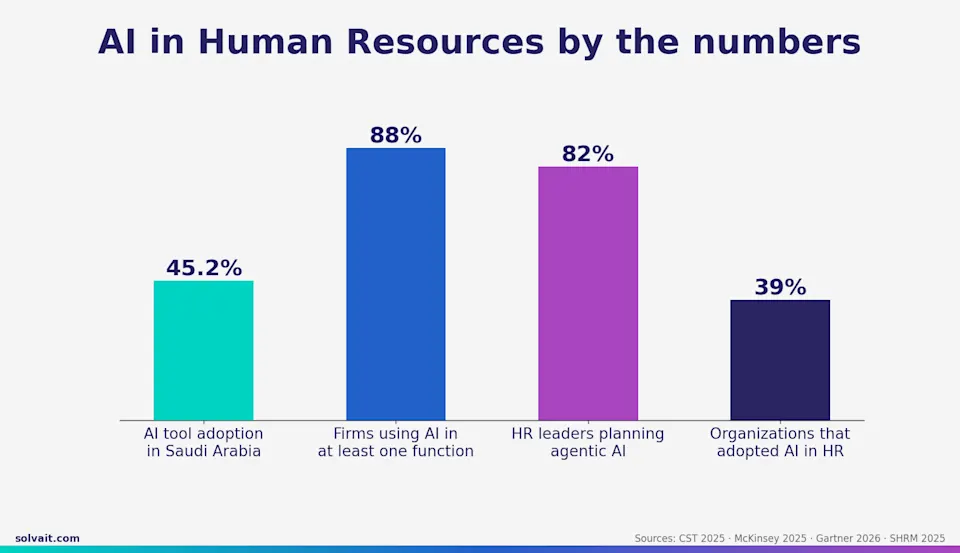
The next wave is agentic. Gartner reports that 82% of HR leaders plan to deploy agentic AI within twelve months. In the same breath, it warns that more than 40% of agentic AI projects may be scrapped before 2027. The lesson isn't to hesitate. It's to start from the right foundation instead of leaping straight to the most complex layer.
In Saudi Arabia, the context pushes in one direction. AI tool adoption among internet users more than doubled in 2025 to reach 45.2%, according to the Saudi Internet Report from the Communications, Space and Technology Commission, and it ran highest among people aged 20 to 29 at 55.7%. A young population that adopts tools fast, with national scaffolding behind it: the SAMAI AI literacy initiative passed one million participants in its first wave alone.
The four stages: from automation to AI agents
The best way to understand AI in HR is to see it as a four rung ladder, not a single switch. Each rung solves a different problem and demands a different maturity in your data and processes.
Stage one, automation: Fixed rules run repetitive tasks: payroll runs, Iqama-expiry reminders, leave notifications. There's no real intelligence here, just time saved on dull manual work. It's the cheapest, safest win, and companies that skip it usually come back to it.
Stage two, predictive analytics: Models read patterns to forecast what's coming: which departments are heading for high turnover, where the skill gaps sit before they become a hiring crisis. The value here is time. You spot the problem months before it shows up in the resignation report.
Stage three, generative AI: An assistant drafts a job description, summarizes dozens of performance reviews into a page, answers the repetitive employee questions about leave and allowances. This is where an ordinary employee first touches AI in their day.
Stage four, agentic AI: Agents run a whole process end to end under human oversight. The agent takes in applications, screens them, ranks candidates, schedules interviews, then hands the shortlist to the hiring manager to decide. Humans steer and decide; the agent runs the repetitive steps in between.
Order matters. An organization trying to run an agent on top of messy HR data and inconsistent processes is building on sand. Start with automation, clean your data, then climb.
What actually changes in daily work
The theory is tidy, but an HR director wants to know one thing: what's different on my desk tomorrow? The shift isn't that AI eliminates jobs. It's that it moves the team from doing the work to deciding on it.
Task | Traditional way | With AI |
CV screening | Days of manual review | Ranked in minutes, with a reason per candidate |
Job descriptions | An old template, copied and tweaked | A compliant draft built in one click |
Turnover forecasting | Seen after the person resigns | Early warning months ahead |
Payroll checks | Errors caught after payday | Anomalies flagged before the run |
Employee questions | A queue at the HR desk | Instant answers to the repetitive ones |
Take CV screening. A company hiring for twenty open roles might receive two thousand CVs. Manual review means the first hundred get full attention and the rest get a glance. AI ranks all two thousand against the role's requirements, so your team spends its attention where it counts. That doesn't mean handing the decision to a machine. The decision stays human; the machine shortens the path to it.
And here's an honest concession: AI won't fix a bad job description. If your requirements are vague, it will rank candidates against vague criteria. Output quality starts with input quality. The tool multiplies your effort, it doesn't substitute for its absence.
Where the digital business card fits
Everything above happens deep in the stack: systems, data, processes. But digital transformation also shows up in the small details, and none is smaller than how you introduce yourself.
A digital business card is an electronic card carrying your name, title, and contact links in a single URL and QR code, saved to the other person's phone with a tap or a scan. Avery's research finds that 88% of paper cards are thrown out within a week of being handed over, so the information you meant to pass along is lost, and the chance to connect with it. The digital version fixes that: it's saved instantly, updates the moment you change a detail, and never runs out.
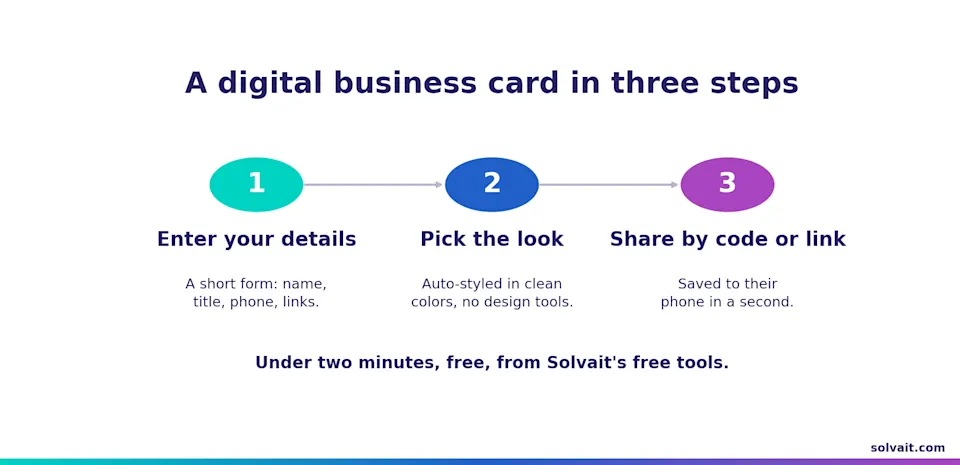
Solvait's free tool builds you one in under two minutes. You enter your details in a short form, pick a look that the tool styles automatically in clean colors, and get a QR code and a link ready to share. Try it from Solvait's free tools.
Why put a simple card next to a discussion of AI agents? Because they're two faces of the same logic. A paper card fails at the one thing it's supposed to do, keep the connection alive after the meeting, the same way manual payroll spreadsheets fail at guaranteeing accuracy. When a population lives on its phone, paper becomes the odd exception, not the rule. And Saudi Arabia is one of the best-fit markets: smartphone penetration sits near 95%, with a young population that shares its details digitally without hesitation. The digital card isn't a revolution in HR. It's a simple entry point into a wider logic the organization builds at a deeper level.
Where Solvait fits
The digital business card is one of several free tools Solvait offers teams and individuals across Saudi Arabia and the Gulf, alongside a salary calculator, an end-of-service calculator, and a job description generator. These tools are a window onto what Solvait builds underneath.
The Solvait human capital management platform runs entirely on Microsoft Dynamics 365: from recruitment to WPS and GOSI compliant payroll to employee self service. And when the conversation reaches the upper layers of AI, performance, talent, and retention, that's where Solvait Wise comes in: AI for performance and goals that strengthens your existing system rather than replacing it. The digital card is a starting point; the rest builds on it, rung by rung, in the right order.
If you want to see how AI-driven HR would run on your own data, book a demo with Solvait.
FAQ
What is AI in HR?
AI in HR is the use of intelligent systems to run or support human resources tasks: CV screening, turnover forecasting, payroll checks, job description writing, and answering employee questions. It ranges from simple automation to AI agents that execute whole processes under human oversight, with the final decision staying in human hands.
What is the difference between HR automation and agentic AI?
Automation runs fixed rules: a salary is calculated, a reminder is sent. Agentic AI is several stages higher: an agent runs a whole process end to end, taking in applications, screening them, ranking candidates, and scheduling interviews under human oversight that steers and decides. Automation runs a step; an agent manages a chain of steps.
Does AI replace HR teams in Saudi Arabia?
No. AI moves the team from doing the work to deciding on it, it doesn't eliminate them. It takes over repetitive tasks like CV screening and payroll checks, freeing the team for decisions that need human judgment. With a young population and AI tool adoption past 45% in 2025, the direction in Saudi Arabia is toward enabling teams, not replacing them.
How do I create a free digital business card?
Open Solvait's digital card tool, fill in a short form with your name, title, phone, email, and links, choose a look, and you get a card with a QR code and a shareable link. It takes under two minutes, needs no design experience and no cost, and saves straight into the other person's phone.
Where should an organization start with AI in HR?
At the foundation, not the summit. Begin by automating repetitive tasks, clean your HR data, and standardize your processes, then climb to analytics, generative AI, and agents. Organizations that leap to agents on top of messy data usually fail, which is why Gartner expects more than 40% of agentic AI projects to be scrapped before 2027.
References
McKinsey & Company: The State of AI in 2025, 2025 (88% of companies use AI in at least one function).
Gartner: CHRO Priorities and Agentic AI in HR, 2025 to 2026 (88% of HR leaders see no significant value yet; 82% plan agentic AI within a year; 40%+ of projects expected to be scrapped before 2027).
SHRM: The State of AI in HR 2026, December 2025 (AI in HR adoption reached 39%, up from 26%).
Communications, Space and Technology Commission (CST): Saudi Internet Report 2025 via Arab News, 2025 (AI tool adoption 45.2%, highest among ages 20 to 29 at 55.7%).
SDAIA: National Strategy for Data and AI, 2026 (SAMAI initiative passed one million participants in its first wave).
Avery: Business Card Statistics, 2025 (88% of paper cards discarded within a week).
Ready to see Solvait in action?
Book a personalized demo and see how Solvait's AI-powered HR platform can transform the way your team works.
Tags
Related Posts

From Free Tool to Full Agentic HR: 3 Case Studies
How three Saudi companies moved from a free HR tool to full agentic HR. A practical story about the gap between AI adoption and real value.
Aug 10, 2026
When AI Stops Answering and Acts
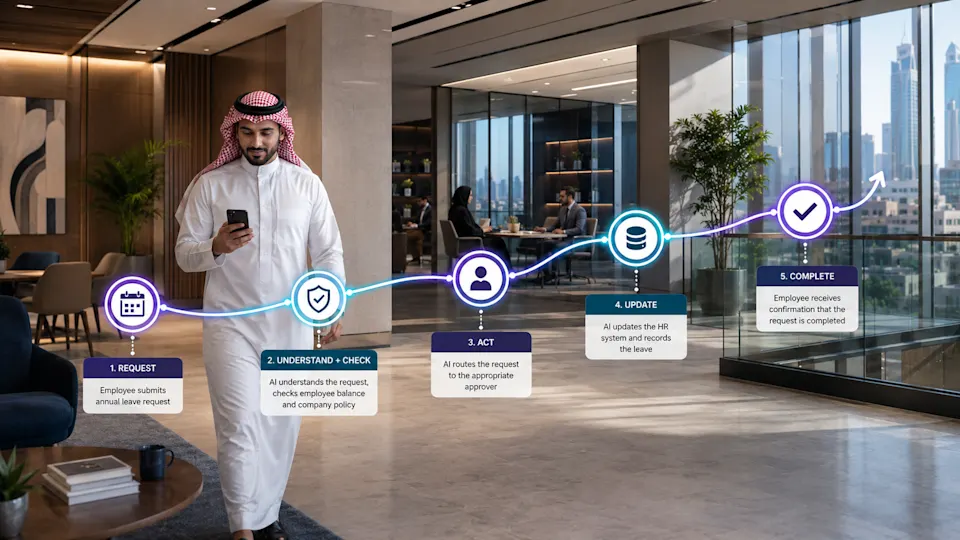
The difference between HR AI that answers employee questions and agentic AI that completes the request end to end under human oversight, with the numbers.
Aug 18, 2026
How Agentic AI Eliminates HR Team Burdens
How agentic AI is reshaping HR team size in Saudi Arabia and the GCC. What agents take over, what humans keep, and the ROI behind a leaner HR team.
Aug 2, 2026