

Inside the Operations Agent (Tashghil): Automating the HR Busywork
Tashghil is the agentic AI operations agent inside Solvait AI HR. It runs your routine HR transactions end to end: leave requests, advances and loans, and end of service processing. It takes the transaction, routes it between the people involved, proposes the output within the platform's guardrails, and then stops at one clear line. The call that matters stays with a human.
The problem it solves sits around the decisions, not in them. Deloitte estimates that HR teams spend up to 57% of their time on administrative, routine tasks. That's more than half the working day lost to routing requests, sending reminders, and chasing approvals. This is where the agent works. It absorbs the repetitive processing so what reaches your team is a decision ready to approve, not a transaction to track down.
Key takeaways
Tashghil, the operations agent, runs leave, advance and end-of-service transactions automatically, from request to updated record.
The real load on an ops team comes from processing transactions by hand, not from making decisions. Deloitte puts routine admin at 57% of HR time.
The agent proposes within Saudi Arabia's statutory floor, and never changes a sensitive number without explicit human approval.
The governing rule: the AI does the work, and your team makes the calls.
The result is a change in the role itself, from processing transactions to deciding, with more capacity and no extra headcount.
What HR busywork actually costs your operations team
The load doesn't come from hard decisions. It comes from running transactions by hand, one step at a time. Approving a leave request takes seconds. Processing it stretches across days: routing between the employee, the manager and HR, nudging whoever forgot, tracking where the request stalled, then updating the record at the end.
These are the actual transactions Tashghil handles. Each one looks trivial until you multiply it by your headcount and the days in a month:
Transaction | The manual routing steps today |
Leave approvals | Route the request between employee, manager and HR, check the balance, follow each step to approval |
Advance and loan requests | Verify eligibility, calculate within the approved caps, then pass on for final sign-off |
End of service processing | Run the calculation under labour law, and build the path from request to payout |
The pattern is the same across all three: routing, reminders, chasing approvals. Work that needs no human judgment, yet eats the time of the people who hold that judgment. So the team spends the day on transactions instead of decisions.
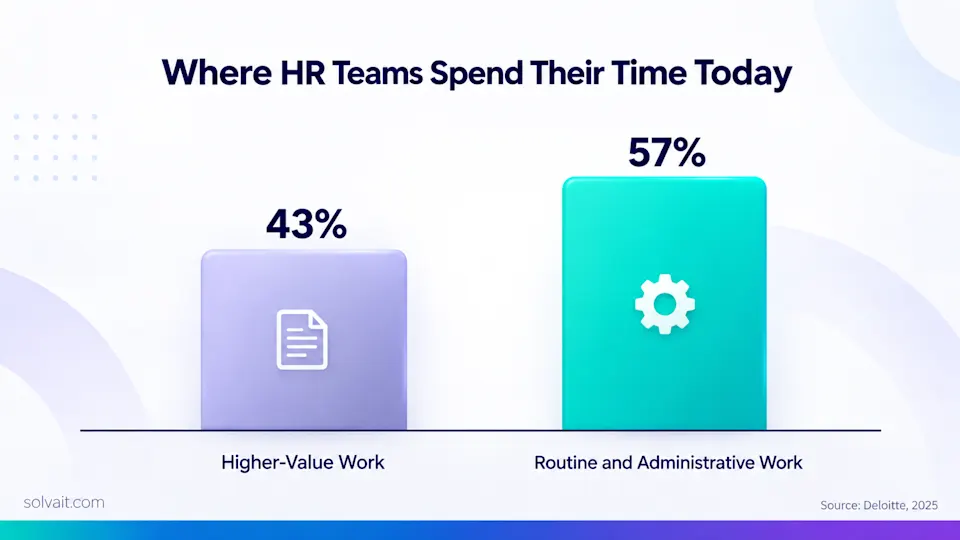
This is a global pattern, not just a local one. McKinsey finds that agentic HR operating models are emerging but adoption is still early, and concentrated in administrative areas specifically. In other words, the place best positioned to capture AI's value is the same place your team loses its time today.
How the Operations Agent works, and where you stay in control
An agentic system isn't a black box, and it isn't blind automation. The difference is that it executes, routes and proposes within guardrails, while the human approves. Here's the mechanism, in four principles.
It routes and orchestrates: The agent takes the leave, advance or end of service transaction and runs its routing steps instead of the team. What reaches HR is a decision, not a transaction to chase.
It proposes within a statutory floor: The numeric outputs are bound by Saudi Arabia's statutory minimum. The agent proposes and routes for review; it does not step over the law. An end of service benefit, for instance, is computed under Articles 84 and 85 of the Labour Law, and stays a proposal until a human confirms it. You can try the same calculation logic through our free end of service calculator.
Anchors keep it from drifting: Any sensitive figure, such as an end of service benefit, total payroll, or a leave balance, does not change without explicit human approval. Those values are anchored, and the agent won't touch them on its own.
Routine cases are settled by deterministic rules: A leave request that exceeds the balance is rejected by a clear rule, so it never reaches a person at all. The point is that your team sees only the real decisions, not every transaction. But any action with real impact still runs on human approval.
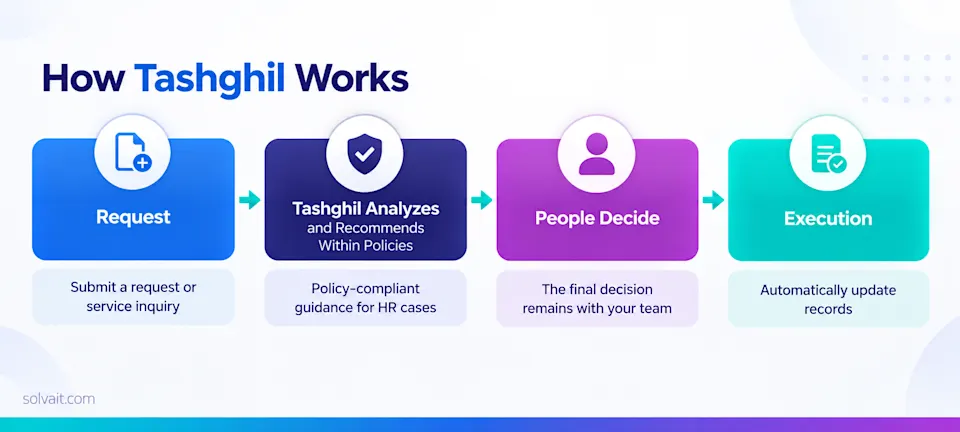
This is the line between conventional automation and agentic AI. PwC describes an agentic system as one that executes multi step workflows, coordinates across systems, and collaborates with humans toward defined outcomes. The table below turns that into daily transactions:
Task | What Tashghil does automatically | What stays a human decision |
Leave approval | Checks the balance, routes to the approver, updates the record | Approve exceptions and edge cases |
Advance request | Calculates within the cap, prepares the proposal | Final approval to disburse |
End of service | Computes per Articles 84 and 85, builds the path | Sign off the amount before payout |
This split isn't a loss of control. It's a sharper definition of it. Gartner advises that as agentic AI scales, the manager's role shifts toward auditor, reviewer and escalation point, keeping the human in the loop at every impactful decision. Tashghil is built on that principle from the start: the AI does the work, and your team makes the calls.
What changes for your ops team: from processing to deciding
When the agent absorbs the repetitive processing, the employee's role changes with it. They move from manual entry and routing to oversight and judgment. Their time goes to reviewing decisions and exceptions, not chasing approvals. That's what Solvait's line means: decisions, not transactions.
The direct effect is more capacity without extra hiring. The agent takes on the repetitive work, which frees the team for the cases that genuinely need human judgment. McKinsey notes that the traditional ratio of roughly one HR employee per 80 staff could be improved considerably at this level of automation. That sits at the heart of Vision 2030 efficiency: more output from the same capacity.
Here's the shift in the role, side by side:
Dimension | Before (manual processing) | After (with the operations agent) |
Team focus | Entering and routing transactions | Reviewing decisions and exceptions |
Cycle time | Days, with approval chasing | Faster, with a clear path |
Energy | Spent on routine | Freed for the cases that matter |
The Saudi trend backs this shift. According to the General Authority for Statistics (GASTAT), 33.1% of establishments in the Kingdom used AI technologies in 2025, up 20% on the year before. PwC estimates AI could contribute around 12.4% of Saudi GDP by 2030, while roughly 60% of Saudi companies report measurable productivity gains from AI, above the global average.
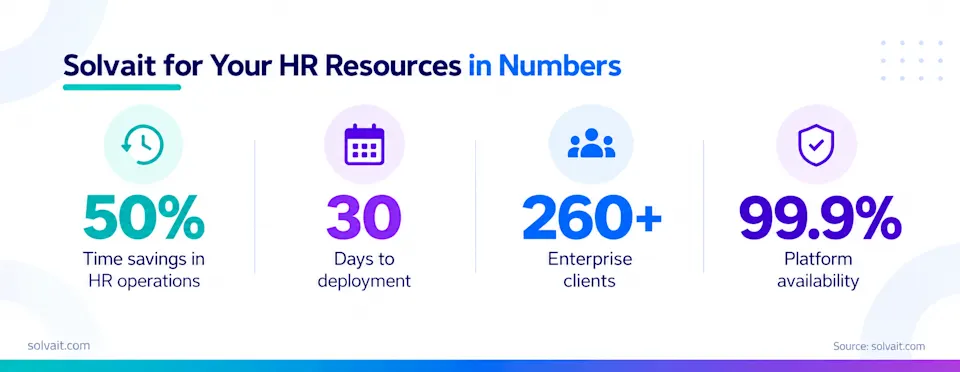
As for the platform's own results, they're documented on solvait.com: 50% time savings, go-live in 30 days, 260+ enterprise clients, and 99.9% uptime. We stop at these figures on purpose, because they're verified. We don't put forward unconfirmed numbers just because they sound good.
Where Tashghil sits inside Solvait
The operations agent isn't a standalone tool. It's one of four agents inside Solvait AI HR, the platform built on Microsoft Dynamics 365: Khidmat (Concierge, Arabic WhatsApp self service), Tashghil for operations, Rawatib for payroll and the Wage Protection System, and Mutaba'aa for compliance. All of them run under human oversight, and each does real work in its lane. To see the full platform, explore Solvait AI HR.
The agent doesn't replace your team. It lifts their role from processing transactions to making decisions. To see Tashghil run on your own data, book a demo.
FAQ
What is the Tashghil operations agent?
It's the agentic AI operations agent inside Solvait AI HR. It runs routine HR transactions like leave, advances and end of service, from the request to the updated record. It routes and proposes within the system's guardrails, while the decision that matters stays with a human.
Does the agent make end-of-service decisions on its own?
No. The agent computes the end of service benefit under Articles 84 and 85 of the Saudi Labour Law, builds the path, and presents the amount as a proposal. Signing off that amount before payout stays an explicit human decision.
How does the agent stay within Saudi labour law?
The numeric outputs are bound by Saudi Arabia's statutory floor, and sensitive values are anchored so they can't change without human approval. The agent proposes and routes for review, and never steps over the law.
What's the difference between conventional automation and agentic AI?
Conventional automation runs a fixed rule when a set event fires. An agentic system runs a multi step workflow, coordinates between the parties, and proposes outputs within guardrails, while the human stays in the decision loop.
How much time does it save an operations team?
Solvait's verified figures point to time savings of up to 50% on HR operations, with go live in 30 days. The actual saving depends on which transactions you automate and how well the platform integrates with your systems.
References
Deloitte: AI in HR, 2025 (HR teams spend up to 57% of time on administrative work).
McKinsey: HR Monitor 2026, 2026 (agentic HR operating models emerging, adoption concentrated in admin).
McKinsey: A new operating model for people management, 2025 (HR-to-employee ratio and how far it can improve).
Gartner: Agentic AI: How CHROs Can Redefine Manager Oversight, 2026 (manager as auditor and escalation point, human in the loop).
PwC Middle East: The potential impact of AI in the Middle East, 2025 (AI could contribute around 12.4% of Saudi GDP by 2030).
PwC Middle East: Saudi Arabia AI maturity and value, 2026 (around 60% of Saudi companies report productivity gains).
General Authority for Statistics (GASTAT): AI use among establishments, 2025 (33.1% of establishments used AI technologies).
Ready to see Solvait in action?
Book a personalized demo and see how Solvait's AI-powered HR platform can transform the way your team works.
Tags
Related Posts

Vision 2030 Is Rewriting the Saudi HR Stack
Vision 2030 changed Saudi Arabia's labour market and compliance faster than legacy systems can keep up. Why Saudi CHROs have to rethink the HR stack now.
Sep 21, 2026
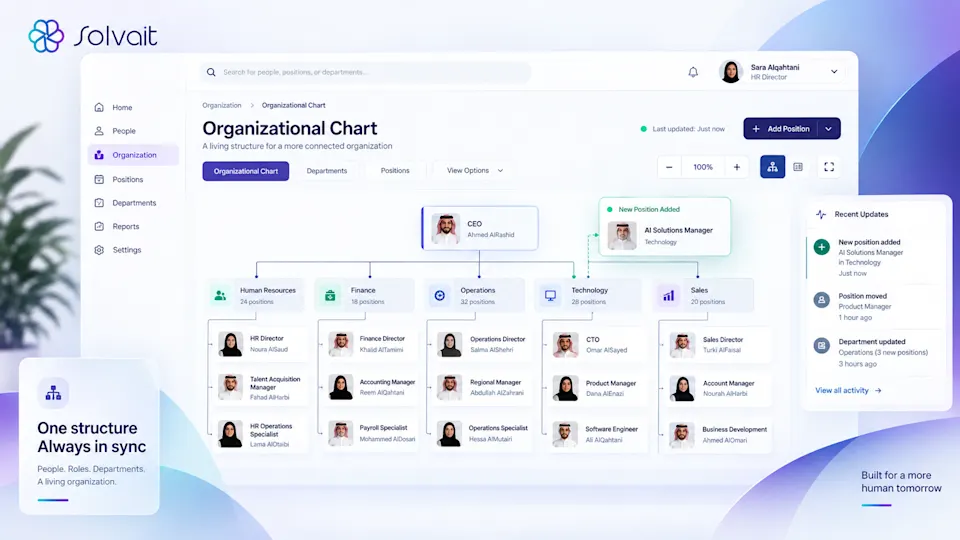
How to Map a Clear Org Structure in Wise's Org Chart
A practical guide to mapping your org structure in Wise's interactive org chart in one living chart that updates on every change.
Sep 20, 2026

AI CV Screening: How It Ranks Arabic and English CVs
How AI CV screening reads Arabic and English CVs, scores each applicant with strengths and gaps, and what Saudi recruiters should still decide themselves.
Sep 17, 2026