

AI Workload Analysis: Spot the Imbalance Before Burnout Hits
AI workload analysis is the automated, continuous reading of workforce data, things like hours, tasks, overtime, leave and headcount, that shows which department is carrying too much and which has idle capacity, before the pressure turns into burnout and resignations. The idea is simple. Instead of learning that your operations team was overloaded when its second person quits in a month, you see the imbalance forming and you act on a number, not a complaint.
Most HR teams in Saudi Arabia manage workload by gut feel and a spreadsheet updated at month end. The trouble is that overload doesn't announce itself. It shows up late: a slipped deadline, then repeated absences, then a resignation that leaves the rest of the team splitting the same work between fewer people. That starts the loop. Every departure raises the load on whoever stays, which speeds up the next one.
This guide is written for the people who read the numbers and make the call: the HR director, the CEO, the COO. It covers three things: why a workload imbalance comes before burnout and turnover, how AI actually detects it, and how you act while there's still time.
Why does a workload imbalance come before burnout and turnover?
Because workload is the variable that moves first. Burnout and resignation are late results of a cause that starts weeks or months earlier: one person working over capacity while a colleague one department over has room. The research ties this together directly. High workload intensity and constant time pressure are among the strongest predictors of emotional exhaustion and lower job satisfaction.
The global numbers show the scale. Gallup's 2025 report estimates that falling employee engagement cost the world economy about $438 billion in lost productivity, and that 41% of employees feel a lot of stress on any given day. Deloitte's research found that 77% of employees have experienced burnout at their current job.
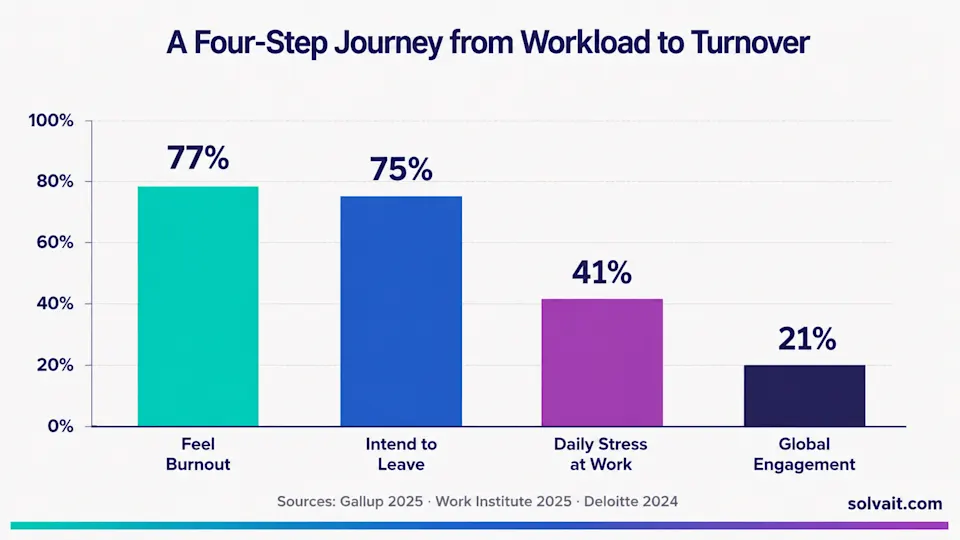
The financial cost of turnover isn't a guess either. SHRM estimates that replacing one employee costs between 50% and 200% of their annual salary, depending on the seniority of the role and how hard it is to backfill. And most of that waste is avoidable. The Work Institute's 2025 report found that 75% of voluntary exits were preventable. Three of every four people who quit left for reasons that would have been visible had someone looked at the numbers in time.
The Saudi context raises the stakes. The labor market is tight: unemployment sat at 3.5% in the last quarter of 2025, per the General Authority for Statistics, which makes strong performers harder and costlier to replace. In PwC's Kingdom survey, 67% of employees said upskilling would help them perform better. That's an ambitious group, and ambitious people leave quickly when their effort is wasted on an uneven load.
How does AI detect a workload imbalance in practice?
In four connected stages that start with data you already own and end in a decision. There's no magic to it. It's turning scattered signals into one number you can read.
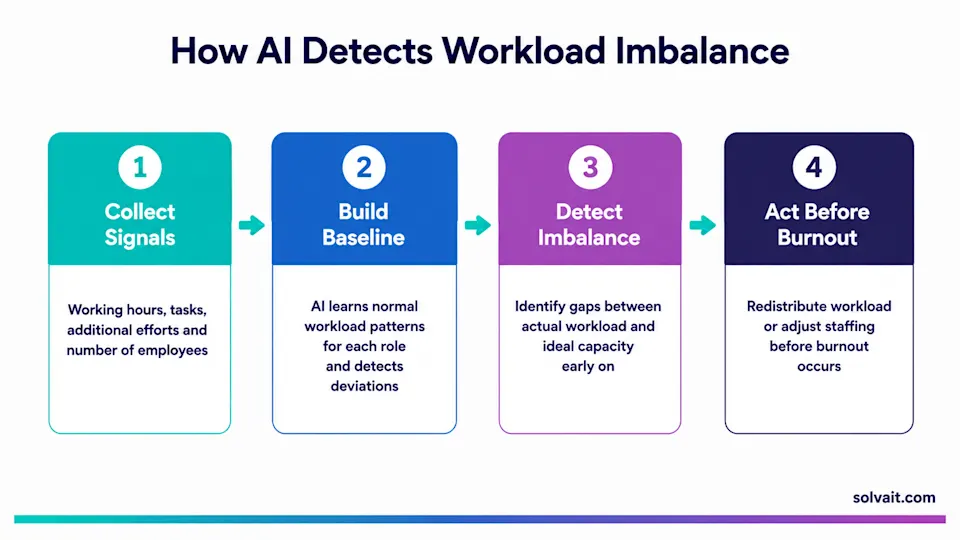
Stage one: ingest the signals
The system starts by pulling what your tools already log every day: attendance hours, open tasks or tickets, overtime hours, accrued leave balances, and headcount per department. Each signal alone is incomplete. Together they draw the real picture of load.
Stage two: model the baseline
Here the AI learns what "normal" looks like for each role. A payroll accountant's normal load at month-end differs from mid month, and both differ from a recruiter's load in hiring season. The system builds that baseline, then watches for drift away from it, not just the raw number.
Stage three: surface the imbalance
At this point the picture appears: which teams run above their baseline consistently, and which sit below capacity, ranked by risk. This is what Solvait Wise does when it analyzes workload distribution, span of control, and competency gaps together surfacing overloaded departments, idle capacity, and performance risks as early signals that precede burnout, so the manager can act before it's too late.
Stage four: act before burnout
Detection without action is just a report. The real output is a decision: move tasks from an overloaded team to one with room, accelerate a hire, or adjust the structure. The difference is that the decision now rests on a number a CFO will accept, not an anecdote.
What's the difference between manual tracking and AI workload analytics?
The difference isn't "technology." It's when you know and what you build the decision on. The table below sums up the shift.
What you're measuring | Manual / spreadsheet | AI workload analytics |
Signal source | Monthly reports, gut feel | Live hours, tasks, leave, headcount |
When you notice | After someone resigns | Weeks before, as load drifts |
Coverage | The teams that complain loudest | Every department, ranked by risk |
Basis for action | Anecdote and office politics | Evidence a CFO will accept |
To be fair, the manual spreadsheet isn't worthless. In a twenty-person company where the manager knows every person by name, gut feel and a simple sheet may be enough. AI proves its worth once headcount grows past what one person can track, or once teams spread across multiple sites and shifts. It also won't fix a load that's genuinely broken. If a team is truly understaffed, the analysis exposes that, but it won't do the hiring for you.
What data do you need to start?
Less than you'd think. Most companies already hold this data, scattered across separate systems, and the first step is pulling it into one place: time and attendance records, the task or project system, leave balances, and org structure data with headcount per manager. When Solvait HCM connects those sources on one platform, the AI has a full picture to read, instead of four spreadsheets that never talk to each other.
That's where Solvait Wise works on top of the data. While the agents handle operational work, Wise reads workforce data and giving each manager a clear picture: which overloaded department is nearing its red line, where idle capacity can be redirected, and which roles are showing early performance risk. Explore Solvait Wise to see how those signals become a decision on your own data.
The next step is simple. If you'd rather see this on your company's numbers than on examples, book a demo and we'll show you how workload analysis catches the imbalance before it costs you a good employee.
FAQ
What is AI workload analysis?
It's the automated, continuous reading of workforce data such as hours, tasks, overtime, leave and headcount, which shows which department is over capacity and which has spare capacity. The goal is to catch a workload imbalance early, before it becomes burnout or resignations, and to act on a data signal rather than a late complaint.
How does AI help reduce employee turnover?
By surfacing risk indicators early. AI links rising workload, performance gaps, and span of control strain to highlight overloaded departments and at risk roles factors associated with burnout and turnover enabling early intervention through workload rebalancing or development. Work Institute's 2025 report found 75% of voluntary turnover is preventable.
Do I need a whole new system to start?
Usually not. Most companies already have the required data spread across time, task and leave systems. The first step is connecting those sources in one place so the AI reads them as a single picture. A platform like Solvait HCM unifies that data, and Solvait Wise works on top of it for the analysis, without necessarily replacing what you have.
How much does employee turnover actually cost?
SHRM estimates that replacing one employee costs between 50% and 200% of their annual salary, depending on the role. The cost goes beyond recruiting and training to lost knowledge, reduced team output during the vacancy, and the ramp up time of a replacement. In a tight Saudi market, that figure climbs because strong talent is harder to replace.
Does this work for small companies?
It depends on size and spread. In a small team one manager watches closely, gut feel may be enough. The real value shows once headcount grows past what one person can track, or teams spread across sites and shifts, where AI sees what manual tracking misses.
References
Gallup: State of the Global Workplace: 2025 Report, 2025 (supports engagement, stress, and the $438B figure).
Society for Human Resource Management (SHRM): Turnover and Cost-to-Replace Estimates, 2024 (supports the 50% to 200% replacement cost).
Work Institute: 2025 Retention Report, 2025 (supports 75% of exits being preventable).
General Authority for Statistics (GASTAT): Labour Market Statistics Q4 2025, 2026 (supports the 3.5% unemployment figure).
PwC Middle East: Hopes and Fears: Saudi Arabia, 2023 (supports the 67% upskilling figure).
Ready to see Solvait in action?
Book a personalized demo and see how Solvait's AI-powered HR platform can transform the way your team works.
Tags
Related Posts

Holding Company Workforce Intelligence in Saudi Arabia
How a Saudi holding company unifies eight subsidiaries into one workforce intelligence view. A practical four layer guide for multi entity groups.
Sep 9, 2026
Free Performance Appraisal Goal Generator | Solvait
Generate professional performance appraisal goals for any role in under a minute. Free tool, SMART framed, editable, built for Saudi HR teams.
Aug 27, 2026

Performance Appraisal Calibration: Why Ratings Differ
Two managers, same work, different scores-how performance appraisal calibration keeps every rating fair and defensible in Saudi Arabia.
Sep 29, 2026