
Holding Company Workforce Intelligence: 8 Subsidiaries, One View
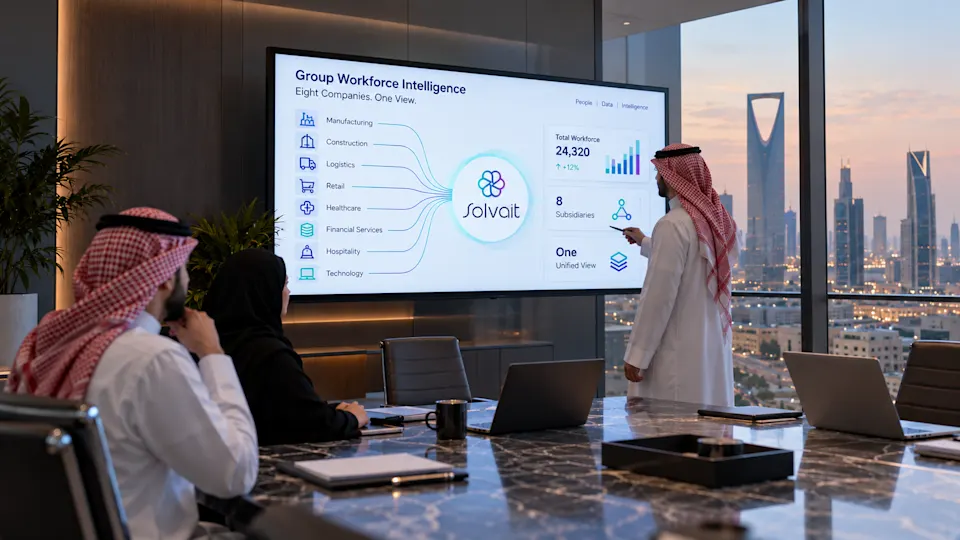
Holding company workforce intelligence is a single analytics layer that pulls employee data from every subsidiary onto one unified data model, then shows performance, attrition, Saudization, and cost on one dashboard instead of five separate systems. A group that owns this layer answers "how many Saudis do we employ across the whole group today?" in seconds, not in a week of exporting spreadsheets. A group that doesn't runs eight companies half blind.
This isn't a rare problem. The Public Investment Fund itself grew from a domestic holding company into one of the world's largest sovereign wealth funds, and around it dozens of groups now run portfolios of companies across retail, tourism, technology, and industry. Each of these groups inherits the same thing: every subsidiary arrived in the portfolio with its own payroll system, its own way of logging attendance, its own Saudization file. The result is one group on paper and eight data islands in practice.
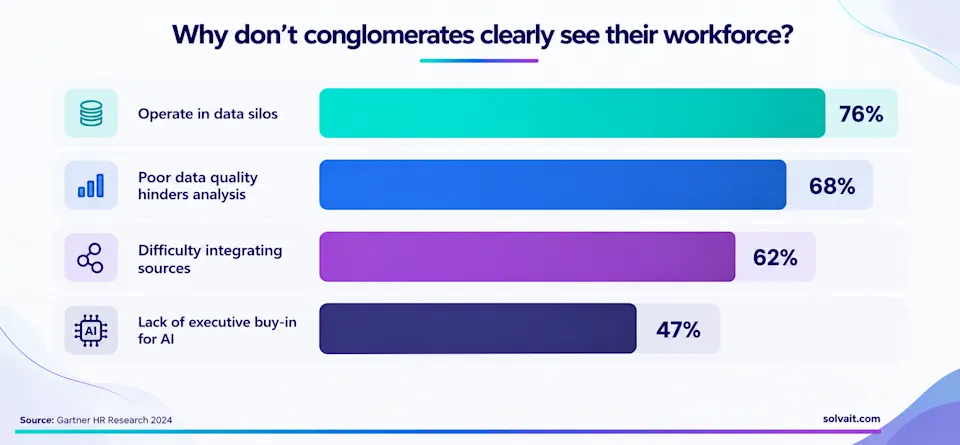
Why can't a holding company see its own workforce?
The problem isn't a shortage of data. It's that the data sits in silos that don't talk to each other. According to Gartner's 2024 HR research, 76% of organizations struggle with data silos across their HR systems, and 47% name integration difficulty as the biggest barrier to adopting AI in HR. In a group with eight subsidiaries, multiply that by eight.
The cost shows up in daily details every group HR director recognizes. The board wants Saudization rates compared across subsidiaries before the noon meeting, so the team spends half a day stitching files from eight sources in eight formats. An employee moves from one subsidiary to another and gets re-entered from scratch because the two records never speak. A manager at one company resigns, and the group had no early warning because that person's engagement and performance data stayed locked inside that company's system alone.
None of this is a tools problem. Most of these groups run respectable payroll systems in each subsidiary. The problem is that nobody sees across the top.
What's the difference between five separate systems and one view?
The difference isn't the number of systems. It's whether a layer sits on top of all of them. When every subsidiary runs in isolation, every group level task becomes manual labor. When one unification layer exists, that same task becomes a live query.
Here's the difference on the tasks that occupy any holding group's leadership:
Task | Five separate systems | One unified view |
Group level reporting | Assembled by hand each quarter | Live on one dashboard |
Cross entity Saudization comparison | Impossible without exports | Ready any time |
Moving staff between entities | Full data re-entry | One record travels |
Workload imbalance | Only shows up as an individual complaint | Appears as a group level pattern |
Single source of truth | Doesn't exist | Default |
That's the whole point of workforce intelligence. It doesn't replace the subsidiaries' payroll systems. It sits above them and reads from them. The technology exists today: Visier alone connects to more than 200 HR apps to act as a vendor agnostic insights layer over heterogeneous stacks. The idea isn't new. What's new is that it's now within reach for Saudi groups without a year long integration project.
How do you actually build a workforce intelligence stack?
The stack has four layers, read bottom to top. Each layer depends on the one beneath it, and you can't skip any of them.
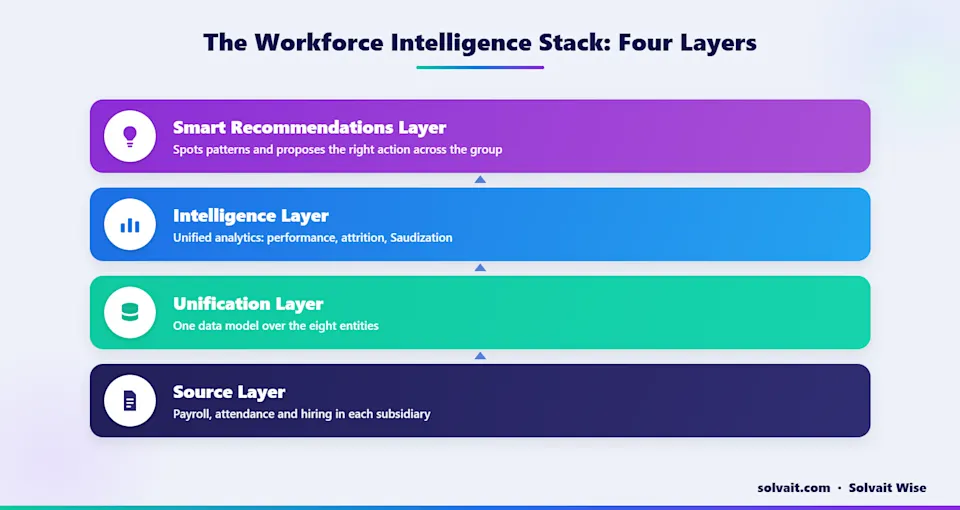
Source layer: Each subsidiary's systems stay exactly as they are: payroll, attendance, hiring, employee records. Nothing gets ripped out or replaced. A group that tries to consolidate everything into one system at once pays an enormous cost and risks breaking eight payroll runs simultaneously. The smarter move is to leave the source running and build above it.
Unification layer: Here you build one data model that translates each subsidiary's labels into a shared language. "Base salary" at one company might be "fixed wage" at another; the unification layer reconciles them. This is the hardest step technically and the most important, because analytics over unreconciled data produce wrong numbers that look right. 2025 workforce analytics reports tie weak system integration directly to lost confidence in the analytics themselves. A pretty number on top of messy data is worse than no number.
Intelligence layer: This is where unified dashboards and analytics appear: Saudization rates across the group, attrition by company and role, workforce cost, performance gaps. Deloitte's 2025 research found that AI enabled, skills based organizations are 79% more likely to drive positive workforce experiences and 63% more likely to achieve their organizational outcomes. A unified view isn't a management luxury. It's the precondition for making a sound group level decision.
Smart Recommendations layer: The most advanced layer. Here AI doesn't just show the number it spots patterns in the unified data and proposes the right action. It might notice that one team in a subsidiary carries twice the group's average number of goals per employee and surface that workload imbalance so the manager can act on data. SHRM's December 2025 survey of 1,908 HR professionals found that 39% now have AI deployed specifically within their HR functions. This layer is what makes analytics genuinely actionable: clear insights and practical recommendations within defined limits, not just dashboards of numbers. The four layers work together. Without the bottom two, the top two are just promises on a slide.
Where does Solvait fit?
This is exactly what Solvait Wise was built for. It isn't a new payroll system that asks you to abandon your subsidiaries' tools. It's a workforce intelligence layer that sits on top of what you have. It reads from multiple sources, unifies the data into one model, and gives group leadership one view across every entity, with analytics that surface patterns and imbalances in your current data and recommend practical actions.
For groups that also want to consolidate the core, Solvait HCM offers a full human capital management platform built on Microsoft Dynamics 365, ready for Wage Protection System and GOSI requirements. But the beauty of an intelligence layer is that it doesn't force that. It starts from where you are.
If you run a workforce spread across several entities and want to see how tangled your current picture really is, start with a lightweight analytics view before committing to anything. Explore Solvait Wise to see what one view looks like in practice.
And when you're ready to see the full stack running on your group's own data, book a demo with our team.
FAQ
What is holding company workforce intelligence?
It's a single analytics layer that pulls employee data from every subsidiary into one unified data model, then shows group level performance, attrition, Saudization, and cost on one dashboard. The goal is one view across multiple entities instead of manual stitching from separate systems.
Does a holding company need to consolidate all subsidiary systems into one?
No. The smarter approach is to leave each subsidiary's systems running and build a unification and intelligence layer above them that reads from all of them. Consolidating everything into one system at once is expensive and risks breaking multiple payroll runs at the same time.
How does workforce intelligence help with cross entity Saudization?
When every subsidiary's data is unified in one layer, comparing Saudization rates across entities becomes a live query rather than an export project. The group can spot the company closest to changing its Nitaqat band and act before it affects the group's rating.
What's the difference between traditional reports and advanced workforce intelligence?
Traditional reports show what happened and what's happening now. Advanced workforce intelligence goes further: it spots patterns in the unified data and proposes the right action within clear limits for example, surfacing a workload imbalance or a drop in one company's Saudization rate so it can be addressed early.
Is workforce intelligence only for large groups, or mid-size ones too?
It's now within reach for mid size groups. Modern insights platforms connect to multiple HR systems without a long integration project, which removed the barrier that once limited this capability to the largest enterprises.
References
Deloitte - 2025 HR Tech Marketplace research, 2025 (backs the 79% and 63% skills-based-organization figures)
SHRM - State of the Workplace / AI in HR survey, December 2025 (backs the 39% AI-in-HR deployment figure)
Insight222 - People Analytics Trends study, 2025/26 (backs the link between people-analytics maturity and business outcomes)
Mordor Intelligence - HR Analytics Market Report, 2026 (backs Visier's 200+ app connectivity)
Vision 2030 - National Strategy Overview, 2026 (backs the PIF and holding-group context)
Ready to see Solvait in action?
Book a personalized demo and see how Solvait's AI-powered HR platform can transform the way your team works.
Tags
Related Posts
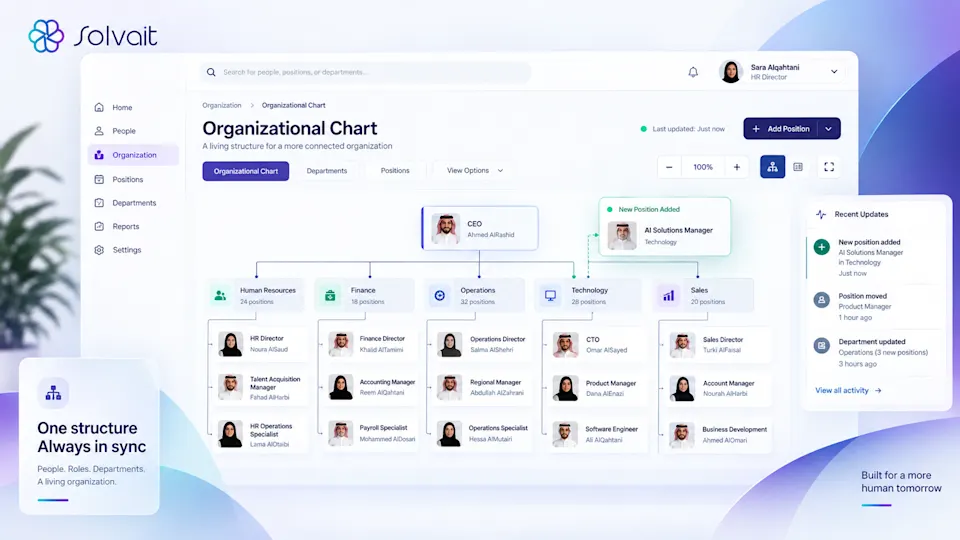
How to Map a Clear Org Structure in Wise's Org Chart
A practical guide to mapping your org structure in Wise's interactive org chart in one living chart that updates on every change.
Sep 20, 2026
How to Choose an AI HR System in Saudi Arabia
A buyer's checklist of 7 questions that expose the real difference between AI HR systems in Saudi Arabia, before you sign the contract.
Oct 8, 2026
Vision 2030 Is Forcing Saudi CHROs to Rebuild HR
Why Saudi CHROs are rebuilding their entire HR stack for Vision 2030: automation, compliance, and agentic AI, with the numbers that explain it.
Aug 23, 2026