
Why Saudi Candidates Ghost After the First Interview, and the AI Fix
Candidates don't ghost because they lost interest. They ghost because the silence after an interview tells them they've stopped being a priority, so they give their priority to an employer who replied faster. Candidate ghosting is when a candidate suddenly stops responding during hiring, most often right after the first interview. And the main cause isn't the candidate's behavior. It's slow communication on the employer's side and long gaps between stages.
This is now the norm, not the exception. In Indeed's 2026 report, 61% of candidates said they were ghosted after an interview, up nine percentage points since early 2024. And it runs both ways: SHRM's 2025 Talent Trends Report found 41% of organizations watching candidates vanish during the interview stage. Each side blames the other's silence, and the loop feeds itself.
Where does candidate ghosting actually happen?
Ghosting isn't spread evenly across the process. It clusters around the first interview. iHire's 2026 data breaks it into clear stages: 28% of candidates ghost after applying, 16% after a phone screen, 20% after one full interview, 12% after several interviews, and 9% after finishing an assessment or task.
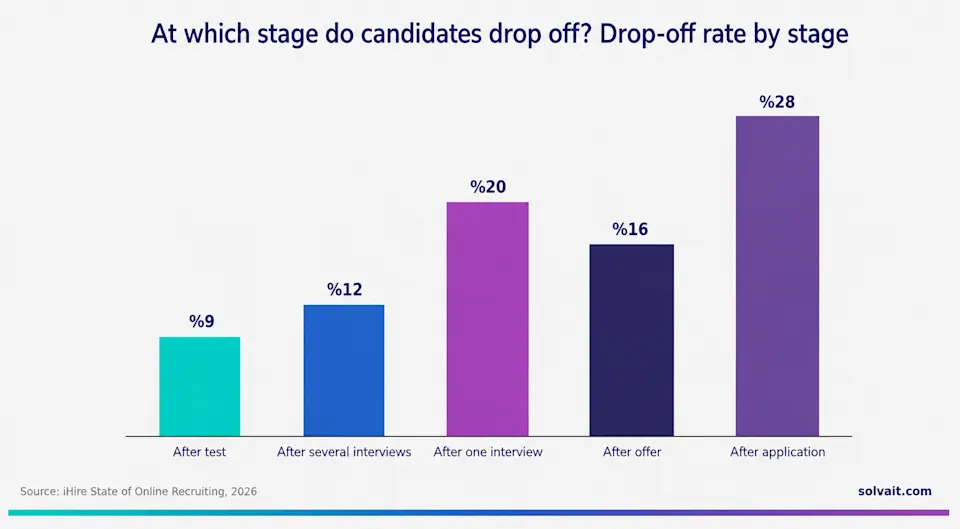
Look at the jump. The rate climbs from 16% after the phone screen to 20% after the first full interview. That's the moment both sides have invested real time, and then the candidate drops into silence. The first interview isn't the end of screening. It's the start of a race for the candidate's attention, and whoever replies first wins.
Why is this harder in the Saudi market specifically?
The Saudi market pairs high demand for talent with a slow hiring cycle, and that combination is perfect for pushing candidates to ghost. The average time to hire in the Kingdom runs from three to ten weeks depending on the role and sector, per TASC's 2025 to 2026 benchmarks. Ten weeks is long enough for any strong candidate to receive and accept another offer.
Volume makes it worse. According to Elevatus's 2026 analysis of the Gulf market, every successful hire now takes an average of 291 to more than 300 inbound applications. What sharpens the effect here is Vision 2030: it has scaled projects in aviation, healthcare, and tech faster than the supply of qualified talent has grown, so the candidate you want is scarce and being courted by several employers at once.
There's a Saudi-specific layer too: Saudization targets. A team drowning in hundreds of applications tends to shortcut toward the "keyword matched" candidate and can miss promising Saudi nationals who need a closer read. Delay your reply to exactly those candidates and you lose them to a faster competitor, and you lose ground on your Nitaqat band at the same time.
Is silence really what makes candidates ghost?
Yes, and the numbers are blunt. A candidate isn't asking for an instant yes. They're asking to know where they stand. When that update goes missing, they read the absence as a quiet no and move on.
62% of candidates lose interest in a role after two weeks with no post-interview update, per RecruitBPM's 2026 data.
47% say poor communication alone is enough to make them withdraw from an active process.
61% accept the first offer they receive, which ties process speed directly to who wins the candidate.
The practical benchmark is simple: a first response within 48 hours, with top employers replying within 24. In manual hiring the first reply can take days, and the post interview update often never arrives at all. That's precisely the gap candidates fall through.
How does AI actually fix candidate ghosting?
AI in recruitment doesn't just make the hiring decision faster. It closes the silence gaps that cause ghosting in the first place. The point isn't to replace the recruiter. It's to hand off the repetitive follow through: the first reply, the update after every stage, the reminder before anyone forgets anyone.
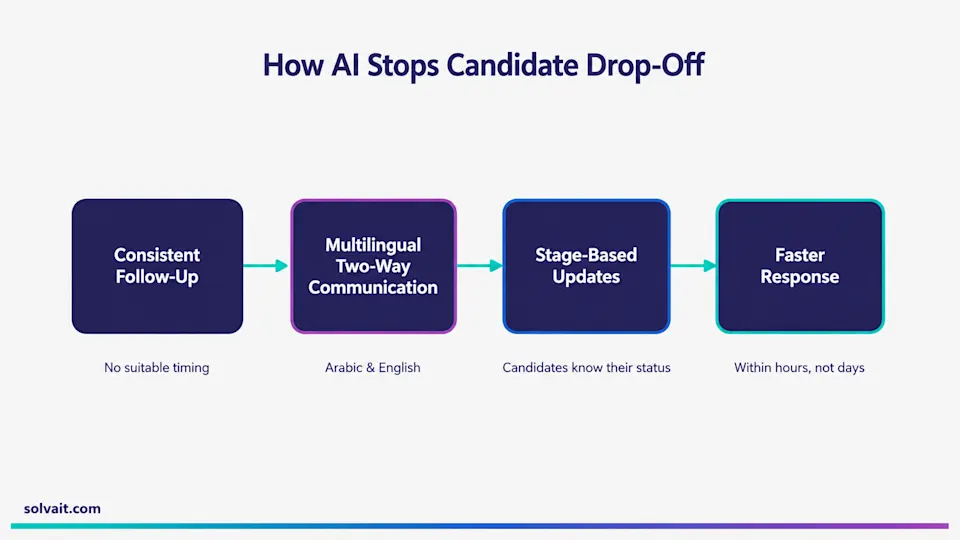
In a modern applicant tracking system like Solvait Attract, AI sorts hundreds of applications in minutes instead of days, so the first reply reaches the candidate within hours. After each interview an automatic update keeps the candidate informed of where they stand, and the system handles the follow up reminder rather than relying on the memory of an overloaded recruiter. Bilingual outreach, Arabic and English together, removes a daily friction point in the Saudi market where candidates expect to be addressed in their own language without the team needing two separate desks to do it.
Manual hiring vs AI assisted hiring
Stage | Manual hiring | AI assisted hiring |
First response to candidate | 3 to 10 days | Within hours |
Post interview update | Often never sent | Automatic, instant |
Communication language | Arabic-only or English-only | Arabic and English together |
Candidate follow up | Depends on recruiter memory | Automated reminders |
Sorting hundreds of applications | Days of manual work | Minutes |
Worth saying plainly: AI on its own is not a magic fix. Used for silent filtering with no human contact, it increases ghosting rather than reducing it. Elevatus's own analysis notes that roughly half of job seekers were rejected in 2026 without a single word from a human, and that one in three candidates will walk away rather than sit through a fully automated screening. The real value is letting the system own speed and reminders while human judgment stays with the team.
Where the market stands: a fair comparison
Solvait Attract isn't the only option in the region. Platforms like Elevatus offer enterprise and government focused AI hiring across the Gulf, and they're strong at recruitment governance at large scale. Solvait is the agentic HR company. Founded in Riyadh in 2010, it serves 300+ clients across Saudi Arabia and the GCC with six products, led by its flagship, AIHR, alongside Attract, Wise, HR Assistant, Everything's App and Solvait HCM, the core HR and payroll product, which runs on Microsoft Dynamics 365. The difference is that Attract is integrated with the full HR stack (hiring, payroll, performance) inside one system. That helps a company that wants to fix ghosting within the context of the whole employee lifecycle, not as a standalone hiring tool. If your only concern is large scale government recruitment, a specialist like Elevatus may suit you. If you're building an integrated HR system that starts at hiring, the integration is what saves you from jumping between platforms.
FAQ
What is candidate ghosting in recruitment?
Candidate ghosting is when a candidate suddenly stops responding, without notice, during the hiring process, most often after the first interview or between two stages. It happens when candidates feel the process is slow or the employer has gone quiet, so they turn to a faster-responding opportunity instead.
Why do candidates ghost specifically after the first interview?
Because the first interview is the first point where both sides invest real time, which raises the candidate's expectation of a fast update. iHire's 2026 data shows 20% of ghosting happens after one full interview. When no reply arrives within days, candidates read it as a quiet rejection and move on.
How fast should you respond to a candidate to avoid ghosting?
The practical benchmark is a first response within 48 hours, with top employers replying within 24. That said, the average time to hire in Saudi Arabia runs three to ten weeks, so regular updates between stages matter more than the speed of the final decision itself.
Does AI increase or reduce candidate ghosting?
It depends on how you use it. Used for silent filtering with no communication, AI increases ghosting. Used for fast replies and automated updates after every stage, it reduces ghosting by closing the silence gaps that push candidates to withdraw in the first place.
Next step
Try Solvait Attract to see how it cuts application sorting to minutes and sends candidate updates automatically in Arabic and English.
Ready to stop candidate ghosting on your team? Book a Solvait demo and see how AI assisted hiring keeps your candidates engaged all the way to yes.
References
Indeed, Ghosting in Hiring Report, 2026: 61% ghosted after an interview (supports the 61% figure)
SHRM, Talent Trends Report, 2025: 41% of organizations see candidates ghost (supports the two-way nature of ghosting)
Ready to see Solvait in action?
Book a personalized demo and see how Solvait's AI-powered HR platform can transform the way your team works.
Tags
Related Posts

AI CV Screening: How It Ranks Arabic and English CVs
How AI CV screening reads Arabic and English CVs, scores each applicant with strengths and gaps, and what Saudi recruiters should still decide themselves.
Sep 17, 2026

Bilingual Recruitment in Saudi Arabia, One Team
Run a bilingual Arabic English recruitment process with one team using AI: practical steps, a manual vs unified comparison, and a five stage hiring pipeline.
Aug 25, 2026
ATS and Time to Fill in Saudi Arabia: Where Time Goes
The global time to fill a role is about 44 days, and most of it is lost screening CVs by hand. See how an ATS reads and ranks resumes in minutes.
Oct 5, 2026