

Run a Bilingual Arabic English Hiring Process With One Team
You can run a bilingual recruitment process in Saudi Arabia with one team once an AI layer handles the translation, screening, and replies that separate teams keep duplicating. A bilingual recruitment process is a single hiring workflow that takes candidates in Arabic and English together, generates the job ads, ranks the CVs, and answers each candidate in their own language, with a human signing off at every stage. In practice that means you write the job description once, review one shortlist, and keep one Arabic compliance record instead of running two parallel tracks.
This matters more now than it used to. Saudi Arabia's labour market is tightening: the overall unemployment rate fell to 3.1% in the first quarter of 2026 according to the General Authority for Statistics, so every qualified candidate is contested. At the same time, fluency in both Arabic and English has become close to mandatory for leadership and customer-facing roles. A team that handles the two languages on separate tracks pays twice, once in time and once in the candidates who slip through the gap between them.
Why splitting the languages costs you double
Here is the familiar version in a lot of Saudi TA teams. A coordinator writes the ad in English, a colleague rewrites it in Arabic, CVs get sorted into two piles by the language they arrived in, and candidates hear back whenever someone who reads their language is free. Every step happens twice, and every repeat is a chance to slow down or slip.
The numbers show the size of the waste. Average time-to-fill has climbed to roughly 42 days according to SHRM's 2025 data, and hiring teams now run about twenty interviews per hire, which means more scheduling, more feedback loops, more days before anyone signs. Layer the language split on top of that and a full week of team effort disappears into moving the same information between two languages.
Heavier than the time is the candidate leak. When an Arabic speaking candidate gets a late reply in English only, or an English writing candidate waits for someone to read their CV, the strongest people go to a faster employer. Preferring your own language is not a courtesy. CSA Research surveyed 8,709 consumers across 29 countries and found 76% prefer information in their native language, and 40% won't proceed when the content is in another language. A candidate behaves exactly like a consumer here: they trust the party that speaks to them in their language.
How AI merges the two tracks into one
The idea isn't bolting a translation button onto your old workflow. It's running a single pipeline that treats language as a property of the data, not a wall between two teams. Five stages, each with a concrete gain.
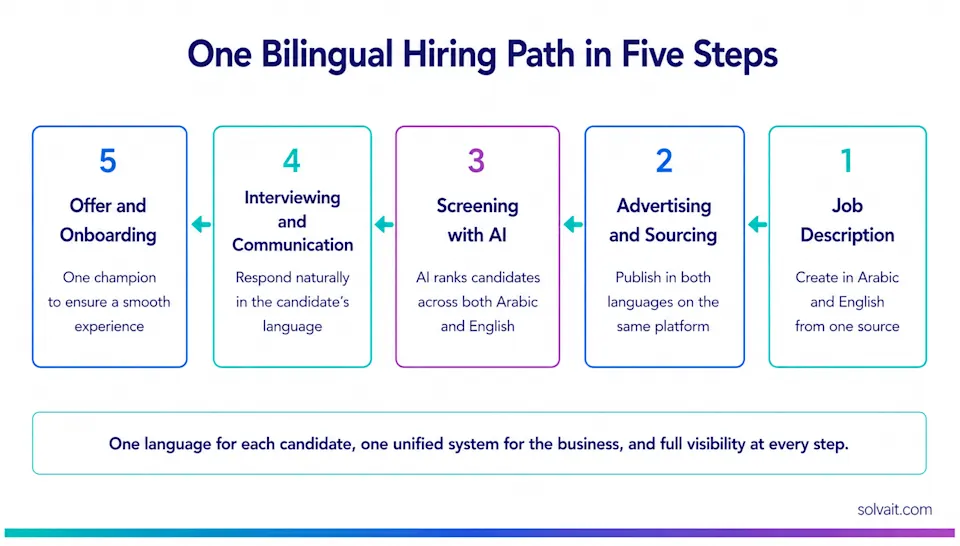
1. Job description: You write one brief for the role, and the system produces an Arabic version and an English version that match in meaning and fit the Saudi context. You post both at once, so nobody waits for a rewrite.
2. Sourcing and ads: The ad goes live in both languages into the same funnel, so a candidate who applies in Arabic and one who applies in English land on the same list, not two.
3. AI screening: The system reads CVs in either language and ranks them against the role's requirements in one shortlist. Language stops being a reason to split the pile and becomes a field on the candidate's profile.
4. Interview and comms: The system replies to each candidate in their language automatically, schedules interviews, and sends reminders without the candidate waiting for the right speaker to free up. This is where the leak from the last section stops.
5. Offer and onboarding: The hired candidate comes out as one record, ready to map to Wage Protection System and GOSI requirements, not two records that need reconciling.
Human oversight stays at every stage. The system ranks, suggests, and drafts; the final hiring call belongs to a person. That isn't a compromise, it's a quality control: research consistently finds that pairing AI with human review produces fairer outcomes than leaving the decision to the machine alone.
Two separate teams versus one team
Step | Two separate teams | One bilingual workflow |
Job ad creation | Written twice, by hand | Generated once, both languages |
CV screening | Split by CV language | One shortlist, either language |
Candidate replies | Language gaps, delays | Instant, in the candidate's language |
Compliance and audit | Two record sets | One Arabic audit trail |
Headcount to run it | Two sub-teams | One team |
A free tool takes half the manual load off stage one: Solvait's Job Description Generator writes a professional, Saudi context description in Arabic and English in sixty seconds, with no signup and no data captured.
What the team actually gains from unifying
The payoff isn't a feeling of tidiness, it's numbers in the funnel. When AI takes over screening and scheduling, time to hire drops by up to half according to Deloitte's 2024 estimates, and cost per hire falls 20% to 40% according to SHRM. On throughput, a 2025 survey of 380 recruiters found AI enabled teams complete 66% more candidate screens per week and spend 41% less time on documentation and admin.
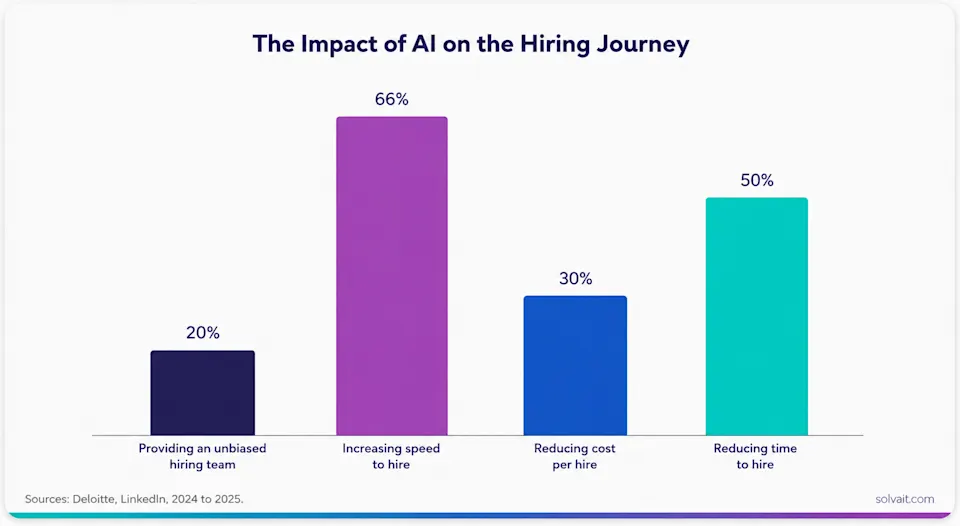
These gains aren't reserved for large enterprises. LinkedIn's Future of Recruiting 2025 report, based on 1,271 TA professionals across 23 countries, found that using generative AI cuts overall workload by about 20%, the equivalent of one full workday per week. And McKinsey estimates that the largest share of generative AI value in HR, roughly 20% of the total, sits specifically in talent acquisition.
One honest caveat before you get carried away: speed alone doesn't make a good hire. AI hiring won't fix a bad job description, and if you feed the system biased criteria, it will accelerate the bias rather than the fairness. Automated screening saves hours of reading, but human judgement on cultural fit and genuine intent stays essential. That's why human oversight is built into the design, not tacked on.
Where Solvait fits
The unified pipeline described above is what Solvait Attract, the talent acquisition module in the Solvait platform, is built to run. It takes candidates in Arabic and English into one funnel, generates ads in both languages, ranks CVs into one shortlist regardless of CV language, and replies to each candidate in their language. Because Solvait is built on Microsoft Dynamics 365, a hired candidate moves into the human capital management system as one record, ready for Saudi compliance requirements, rather than two records needing manual reconciliation.
The language split turns from an operational burden into a detail the system handles in the background, which frees your team for the work nothing else can do: judging people, not moving text between two languages.
Want to see how this runs on your own roles? Book a Solvait demo and watch a full bilingual hiring pipeline work on your actual job data.
FAQ
Can you really run Arabic English recruitment with one team?
Yes. Once AI generates the ads, screens the CVs, and replies to candidates in their language, you no longer need two separate language teams. One team runs a single workflow that treats language as a data property, with the final hiring decision still made by a person.
How much time does AI save in recruitment?
Deloitte's 2024 estimates suggest AI can cut time to hire by up to half, with the biggest impact in screening and scheduling. Cost per hire also falls 20% to 40% according to SHRM when the system handles screening and coordination rather than people doing it by hand.
Can AI screen Arabic and English CVs together?
Yes. The system reads CVs in either language and ranks them against the same role requirements in one shortlist, so the pile isn't split by language. A CV's language becomes a field on the profile, not a reason for a separate track.
Does the system replace the recruiter?
No. It ranks, suggests, and drafts, but the calls on cultural fit, candidate intent, and the final hire stay human. Pairing AI with human review produces fairer results than relying on either one alone.
How does a unified pipeline help with Saudi compliance?
Because every candidate moves through one pipeline, a hire comes out as a single Arabic record ready to map to Wage Protection System and GOSI requirements, rather than two records that need reconciling. One record means a clearer audit and less room for error.
References
General Authority for Statistics (GASTAT): Saudi Arabia's unemployment rate falls to 3.1% in Q1 2026, 2026 (supports the 3.1% unemployment figure).
CSA Research: Can't Read, Won't Buy, B2C: 76% prefer their own language, 2020 (supports the 76% and 40% figures).
Ready to see Solvait in action?
Book a personalized demo and see how Solvait's AI-powered HR platform can transform the way your team works.
Tags
Related Posts

AI CV Screening: How It Ranks Arabic and English CVs
How AI CV screening reads Arabic and English CVs, scores each applicant with strengths and gaps, and what Saudi recruiters should still decide themselves.
Sep 17, 2026

Why Candidates Ghost After the Interview (And the AI Fix)
Saudi candidates ghost after the first interview because of silence and slow replies, not lost interest. Here are the numbers and the AI fix that works.
Sep 7, 2026

How to Choose an AI HR System in Saudi Arabia
A buyer's checklist of 7 questions that expose the real difference between AI HR systems in Saudi Arabia, before you sign the contract.
Oct 8, 2026