
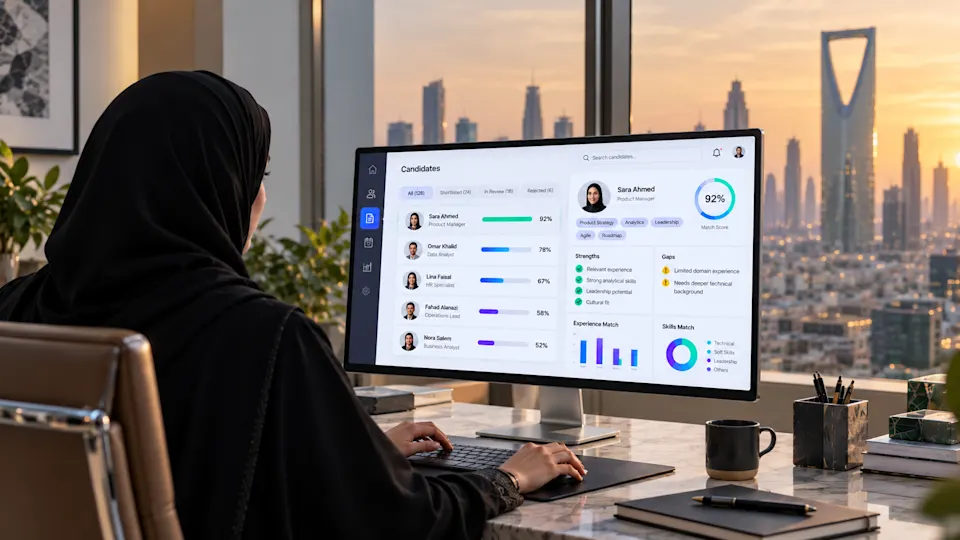
How AI CV Screening Ranks Applicants in Arabic and English
AI CV screening ranks applicants in three passes: it turns each CV into structured data, matches that data against the job's requirements, and gives every candidate a match score with strengths, gaps and a recommendation. A bilingual system treats "B.Sc. in Accounting" and "بكالوريوس محاسبة" as the same degree, so both CVs land on the same shortlist. AI CV screening is the use of language models to read CVs, evaluate them against a job description, and hand the recruiter a ranked, explained shortlist to review. The recruiter still makes the call. The payoff is time. LinkedIn's Future of Recruiting 2025 report found that talent teams experimenting with or integrating generative AI save about 20% of their work week. That's a full day back, every week.
Why do Saudi employers need bilingual CV screening?
Saudi hiring runs in two languages. The same candidate might send an Arabic CV to a semi government entity on Sunday and an English one to a multinational on Tuesday.
And the volume lands on you. The General Authority for Statistics (GASTAT) Q2 2025 labor market release shows 72.4% of Saudi job seekers apply directly to employers, and 56.3% use the national Jadarat platform. Those applications arrive in your inbox in both languages and dozens of formats.
The market is tight, too. Unemployment among Saudi nationals stood at 6.4% in Q1 2026, per GASTAT figures reported by Arab News. Qualified Saudi candidates have options, and you can't afford to drop one because your system couldn't read their CV.
Saudization raises the stakes further. The Ministry of Human Resources and Social Development launched a new three year phase of the Nitaqat Mutawar program starting in 2026, aimed at localizing more than 340,000 additional private sector jobs. Every qualified Saudi applicant lost at screening is one you'll have to find again.
How does AI read an Arabic or English CV?
Before it scores anything, a good system runs four steps:
Extraction: It pulls text out of the PDF or Word file and splits it into sections: experience, education, skills, certifications.
Normalization: It converts Eastern Arabic numerals (٢٠٢١ becomes 2021), reads Hijri dates alongside Gregorian ones, and merges name variants so "KSU" and "جامعة الملك سعود" count as one university.
Semantic mapping: It knows "month-end close" and "إقفال الحسابات الشهري" describe the same work, and that "SOCPA Fellowship" is the credential an Arabic CV calls "زمالة الهيئة السعودية للمراجعين والمحاسبين".
One profile: It produces a single, consistent candidate profile, whatever language the original CV used.
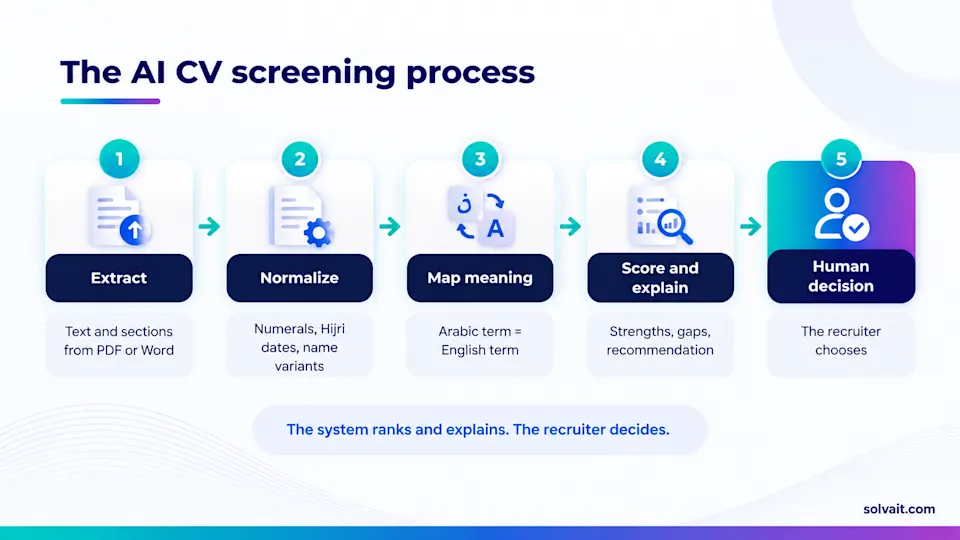
Diagram of the AI CV screening process from text extraction to the recruiter's decision Step two is where weak systems lose the most people. A parser that reads ٢٠٢١ as noise will miscount a candidate's experience and push them to the bottom of the list without anyone noticing. One honest limitation: CVs designed as images, or laid out in two column tables, still trip up extraction in most systems. Ask applicants for a text based PDF on your application page. You'll avoid a large share of parsing errors.
How does AI score and rank applicants against a job?
Scoring starts with the job description. The system splits requirements into must haves, which a candidate needs to qualify, and nice to haves, which lift the score without disqualifying anyone. Then it compares each profile to both lists.
Every candidate comes back with four things:
Match score: the number that orders the list.
Strengths: requirements the CV meets, with the evidence quoted from it.
Gaps: what's missing, or what the CV doesn't state.
Recommendation: a suggested next step, such as interview, skills test, or decline with a reason.
Take a Senior Accountant role in Riyadh. The candidate below is an illustrative example, not real data:
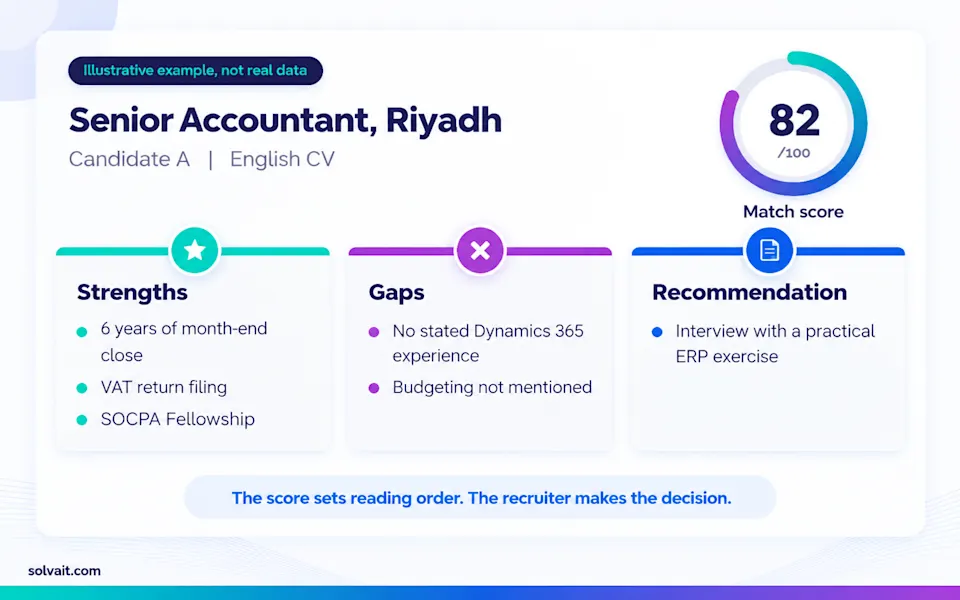
The gap line is what makes the card useful. The recruiter knows at a glance that the interview should probe ERP experience, and nobody wastes 20 minutes asking questions the CV already answered.
LinkedIn's data backs a skills first approach. In the same report, companies running the most skills-based searches were 12% more likely to make a quality hire, and 93% of talent professionals said accurate skills assessment is crucial to hire quality. Semantic screening finds the skill wherever the candidate wrote it, in either language.
How is AI CV screening different from manual review and keyword filters?
Criteria | Manual review | Keyword filter | AI CV screening |
Time for 300 CVs | Days of reading | Minutes | Minutes |
Arabic and English CVs together | Depends on the reviewer | Matches strings, misses synonyms | Matches meaning across both |
Consistency across reviewers | Varies by person | Consistent but literal | Consistent and explained |
Explanation of the result | Scattered notes | Pass or fail, no reason | Strengths, gaps, recommendation |
Biggest risk | Fatigue and uneven judgment | Rejecting qualified people over wording | Blind trust in the score |
Row two is the whole argument. A keyword filter searching for "Accounting" will never see "محاسبة". The problem is well documented. The Harvard Business School and Accenture "Hidden Workers" study found 88% of employers agree their systems screen out qualified, high skill candidates because the CVs don't match the job description's exact criteria. The study dates from 2021; we cite it because it remains the primary source for that figure. To be fair to the old way: if you have ten CVs for an executive role, read them yourself. AI earns its place when volume outgrows your team.
What should the recruiter still decide?
Everything that matters. The system ranks and explains; the recruiter chooses who to interview and who to decline.
Human review also protects candidate trust. A 2025 Gartner survey of 2,918 job candidates found only 26% trust AI to evaluate them fairly, and 25% said they trust an employer less when it uses AI to assess their information.
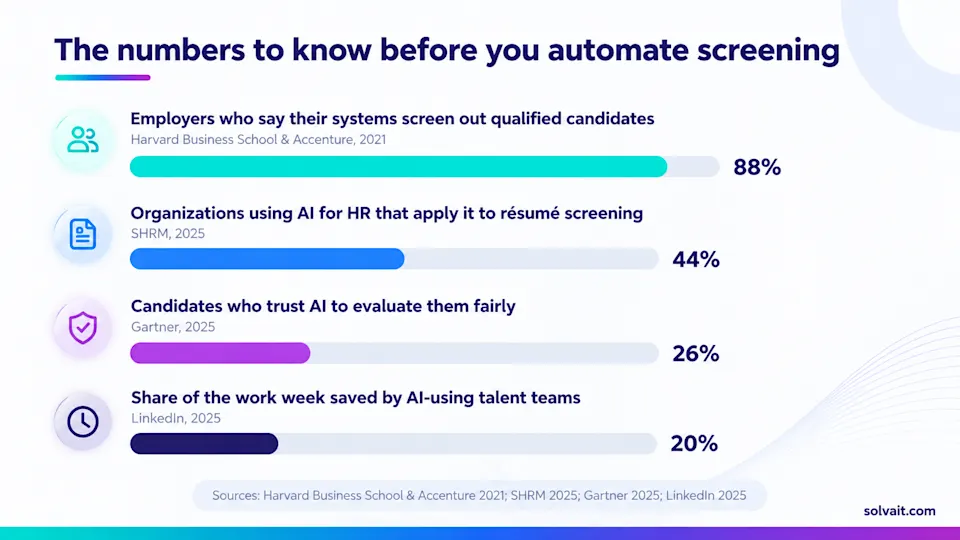
Adoption is climbing anyway. SHRM's 2025 Talent Trends research shows 43% of organizations now use AI for HR tasks, up from 26% in 2024. According to SHRM's analysis of the findings, 44% use it to screen résumés, and 89% of HR professionals using AI in recruiting say it saves time or improves efficiency.
Four rules keep speed and trust in balance:
Audit below the cutoff : Open five CVs from the bottom of the list every hiring cycle. If you find a qualified person there, fix the job description or the settings.
Record a reason for every decline : The gaps the system lists give you a written starting point.
Tell candidates : One line on the application page does it: AI helps sort applications, and a person on the team reviews the results.
Stay within the PDPL : Saudi Arabia's Personal Data Protection Law has been fully enforceable since September 14, 2024, according to IAPP, with the Saudi Data and AI Authority (SDAIA) as regulator. Use candidate data for the stated hiring purpose only, and review your setup with legal counsel.
What mistakes break AI CV screening?
A bloated job description: Twenty "must haves" means nobody scores well. Keep three to five true requirements and move the rest to nice to haves. If you need a clean starting draft, the free Saudi context job description generator gets you there in about a minute.
Treating the score as a verdict: A 71 can outperform an 84 in the interview room. The score sets reading order. It isn't an exam result.
Ignoring scanned CVs: If your system can't read them, those applicants never reach the list, and you'll never know. Check how your tool handles scans before the job goes live.
Posting in one language, screening in another: An Arabic job ad attracts Arabic CVs. Screen only in English and you'll lose your best applicants.
Staying silent with candidates: Gartner's number means three in four applicants doubt automated assessment. A short, plain explanation goes a long way.
How does Solvait Attract handle bilingual CV screening?
Solvait is a Saudi HR technology company whose platform is built on Microsoft Dynamics 365, trusted by more than 260 enterprise clients according to solvait.com. Solvait Attract is its AI powered applicant tracking system (ATS), built for recruiting teams in Saudi Arabia and the GCC.
At the screening stage, Attract parses Arabic and English CVs, scores each candidate, and ranks the list with strengths, gaps and recommendations. Your recruiter reviews a ranked shortlist instead of a stack and chooses who to interview.
Around screening, Attract covers the rest of the hiring flow:
AI assisted job descriptions inside the job requisition and its approval workflow.
Built in assessments with a question builder and automatic scoring.
A candidate pipeline in Kanban or list view, with Teams and WhatsApp alerts for hiring managers.
A branded careers portal, plus a self service portal where candidates track their applications.
Attract is AI assisted by design. It suggests and explains; your team decides.
Want to see the idea in 30 seconds? Paste any CV and any job description into the free CV Match Analyzer and get an AI match score. Free. No signup. No data captured.
Ready to see bilingual screening on your own roles? Request a Solvait Attract demo and we'll run screening live on a real job description from your company.
Frequently asked questions
Can AI read an Arabic CV as well as an English one?
Yes, if the system is built on language models with real Arabic support. A capable system normalizes Eastern Arabic numerals and Hijri dates, and maps Arabic terms to their English equivalents, such as "إعداد القوائم المالية" and "financial reporting." Test it before you buy: submit the same CV in both languages and check that the two scores come out close.
Does AI CV screening reject applicants automatically?
Not in Solvait Attract. The system ranks applicants and shows strengths, gaps and a recommendation for each one, and the recruiter decides who to interview or decline. We recommend reviewing a sample from the bottom of the list every hiring cycle to confirm your settings aren't filtering out qualified people.
How should I write a job description for AI screening?
List three to five must have requirements and put everything else under nice to haves. Write skills the way the Saudi market phrases them, and name professional credentials by their official titles, such as SOCPA or CIPD. Avoid rigid conditions like "exactly five years of experience," which drop a strong candidate with four and a half.
Is AI CV screening compliant with Saudi Arabia's PDPL?
It can be, if you use candidate data only for the stated hiring purpose, tell applicants how you process it, and set a retention period. The Personal Data Protection Law has been fully enforceable since September 14, 2024, under SDAIA's supervision. Review your configuration and privacy notice with legal counsel before going live.
What's the difference between Solvait Attract and the free CV Match Analyzer?
The CV Match Analyzer is a free tool that compares one CV with one job description, with no signup and no data captured. Solvait Attract is a full applicant tracking system: it receives applications, ranks hundreds of candidates in Arabic and English, and runs interviews, offers and onboarding in one pipeline with your team.
References
LinkedIn: The Future of Recruiting 2025, 2025 (about 20% of the work week saved; +12% quality-of-hire likelihood with skills-based search;93% say skills assessment is crucial)
Gartner: Just 26% of Job Applicants Trust AI Will Fairly Evaluate Them, 2025 (26% trust AI evaluation; 25% trust employers less)
SHRM: 2025 Talent Trends, 2025 (43% use AI for HR tasks, up from 26% in 2024)
SHRM: AI Hasn't Lived Up to the Hype, but Companies Aren't Giving Up, 2025 (44% use AI to screen résumés; 89% report time savings)
Harvard Business School & Accenture: Hidden Workers: Untapped Talent, 2021 (88% say qualified candidates are screened out; canonical source despite its age)
GASTAT: Labor Market Statistics, Q2 2025, 2025 (72.4% apply directly to employers; 56.3% use Jadarat)
Arab News, citing GASTAT: Saudi Arabia's unemployment rate falls to 3.1%, 2026 (Saudi national unemployment 6.4% in Q1 2026)
Ministry of Human Resources and Social Development: New phase of the Nitaqat Mutawar program (340,000+ jobs to localize over three years)
IAPP:Saudi PDPL's first anniversary, 2025 (full enforcement from September 14, 2024)
SDAIA: Laws and Regulations (PDPL regulator)
Solvait: Solvait Attract (Attract capabilities described above)
Ready to see Solvait in action?
Book a personalized demo and see how Solvait's AI-powered HR platform can transform the way your team works.
Tags
Related Posts
Agentic AI in HR: What "Self Running HR" Really Means
Agentic AI in HR means AI agents execute HR work under human oversight. Here is what that changes for Saudi HR teams, and what it does not.
Sep 16, 2026
AI Employee Data Validation: A Pre-Payroll Readiness Scan
Solvait's AI Employee Data Validation scans employee data before payroll . Built into Solvait HCM.
Sep 15, 2026
Nestlé Waters KSA Chooses Solvait for HCM: Kick-off
Nestlé Waters Saudi Arabia has chosen Solvait to build its HCM platform on Microsoft Dynamics 365. The implementation project kicks off.
Sep 14, 2026