

The Saudi Recruiter Burnout Crisis: The Warning Signs and How AI Fixes It
Recruiter burnout is professional exhaustion that hard decisions don't cause. The busywork around those decisions does. On Saudi talent teams in particular, that exhaustion comes from three repeating drains: screening piles of CVs by hand, chasing candidates message by message, and writing the same roles twice, in Arabic and English.
The good news is that those three drains are exactly what AI is good at. Tools like an AI-driven applicant tracking system absorb the repetitive work, which leaves the recruiter with what can't be automated: judging the candidate, building the relationship, and making the hire. Gartner reports that 81% of HR leaders experience burnout, and the pressure in Saudi Arabia is climbing under a Vision 2030 hiring surge and Saudization targets. This article walks through the warning signs, then breaks down the three drains and the fix for each.
Key takeaways
Recruiter burnout is a structural problem in how work flows, not a personal weakness. Its source is busywork, not decisions.
Three drains drive it: manual screening, chasing candidates and ghosting, and repetitive bilingual writing.
The Saudi context multiplies the pressure: a plan to localize more than 340,000 jobs between 2026 and 2028, in a market that runs on Arabic and English at once.
AI removes the busywork, but the decision stays human: who gets interviewed, and who gets hired.
The governing rule: the AI does the work, and your team makes the calls.
What are the warning signs of recruiter burnout, and why is Saudi Arabia hit hardest?
Burnout is rarely announced. It shows up in the metrics before it shows up in words. Here are the signs worth watching at the team level:
The sign | What it looks like on the ground |
Time to hire stretches | Roles stay open longer, approvals slip |
Quality of hire drops | Rushed picks to fill a seat, rather than the best fit |
Emotional exhaustion | Detachment from candidates, delayed outreach, small repeated errors |
Workload piles up | More roles per recruiter, no room to plan ahead |
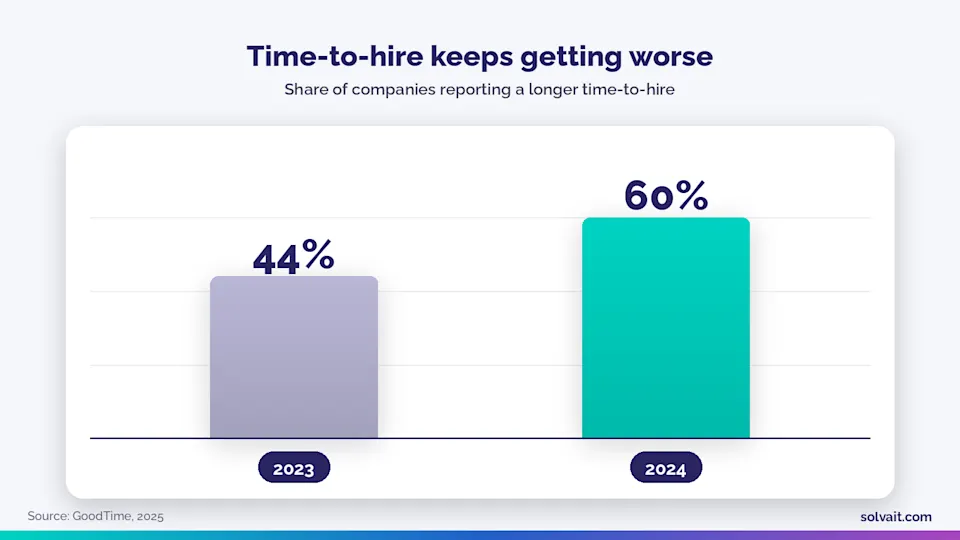
These signs are not individual. GoodTime finds that 27% of talent acquisition leaders describe their teams' workloads as unmanageable, up from 20% the year before, and that 60% of companies reported a longer time to hire in 2024, against 44% in 2023.
In Saudi Arabia the pressure intensifies for two reasons. The first is hiring volume: the Ministry of Human Resources and Social Development supported roughly 143,000 Saudis into private sector jobs in the first quarter of 2025 alone, and a plan is under way to localize more than 340,000 jobs between 2026 and 2028. The second is language: a market that runs on Arabic and English together, which doubles the writing and communication load on the same team.
So the load piles up at three specific points. Let's take them one at a time.
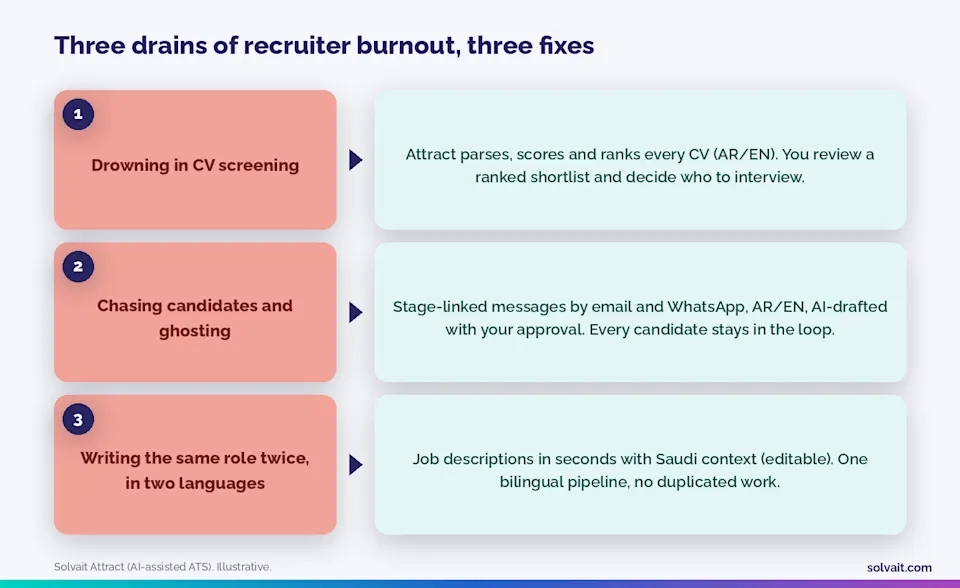
The first drain: drowning in CV screening
This is where the exhaustion starts. A recruiter opens dozens or hundreds of CVs per role and reads each one for a handful of signals. Bullhorn finds that recruiters spend 14.6 hours a week just searching for candidates, before any interview or decision. That time isn't spent on judgment. It's spent on sorting.
This is where AI works. An AI recruitment system parses, scores and ranks every CV, surfacing strengths, gaps and recommendations in Arabic and English. The recruiter doesn't face a pile. They face a short, ranked shortlist, and the decision stays theirs: who to interview.
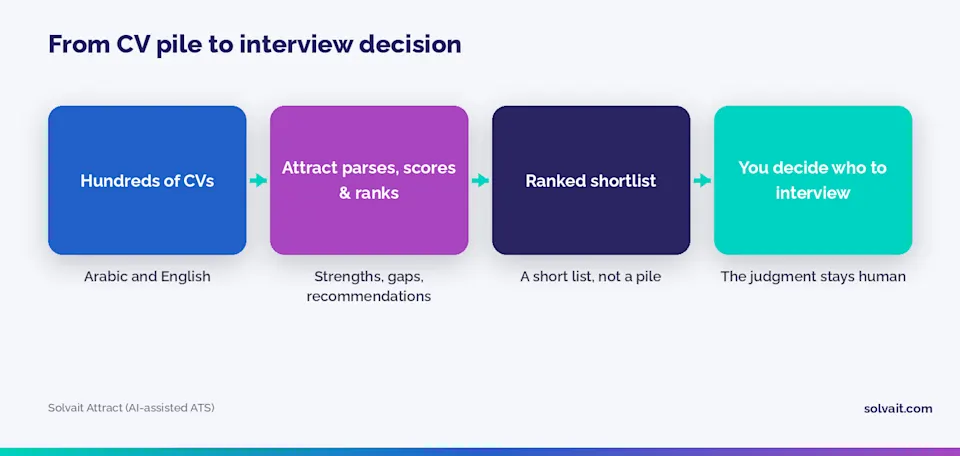
Task | Manual screening today | With Attract |
Reading | Every CV from scratch | A summary of strengths and gaps |
Ranking | Impression and memory | A list ordered by fit |
Output | A pile to sift | A shortlist ready to decide on |
You can try the same matching logic through our free CV match analyzer.
The second drain: chasing candidates and the ghosting spiral
After screening comes communication, which is invisible work with a visible failure mode. Manual messages at every stage, in two languages, plus follow ups to whoever went quiet. Then the worst part: the candidate ghosts. Aptitude Research's 2025 Talent Trends finds that 41% of organizations experience candidates ghosting during the interview process. Every ghost is a role back to square one, and energy gone with it.
The fix isn't more manual messaging. It's stage linked messages sent by email and WhatsApp, in Arabic and English, AI drafted with human approval. Every candidate stays in the loop without manual effort, and the silence that pushes candidates to disappear gets shorter.
Communication stage | Manual | With Attract |
After applying | A message written by hand for each candidate | A stage message ready in both languages |
Between stages | Follow-up forgotten under pressure | A stage linked reminder, on your approval |
Result | Silence and ghosting | Continuous contact, no manual effort |
The same rule governs this drain: the AI drafts and sends within a defined path, and the approval stays with you.
The third drain: writing the same thing twice, in two languages
The last drain is exhausting context switching. Writing each job description from scratch, then running the process in two languages, wears down a single team and splits its focus between two repetitive tasks all day.
Here AI closes the distance. It generates a job description with Saudi context in seconds, editable, and runs one bilingual recruitment pipeline with one team and no duplicated work. The recruiter starts from a ready draft to refine, not a blank page to fill twice. Try the free job description generator to see the idea in practice.
What this means for your team, and for Vision 2030
Removing these three drains doesn't mean fewer people. It means a higher role for the same people. But there's a trap: Gartner finds that only 7% of organizations give their teams any guidance on what to do with the time AI frees up. Freed time, left undirected, refills with more coordination. The real value is to redirect it to what makes the difference: deeper interviews, a stronger candidate relationship, and a closer partnership with hiring managers. That sits at the heart of Vision 2030 efficiency, more output from the same capacity, with the human decision intact.
Solvait Attract is an AI assisted recruitment system that addresses all three drains in one pipeline: job description generation, CV parsing and ranking, and stage-driven candidate communication, in Arabic and English. To explore the platform, see Solvait Attract.
AI doesn't replace the recruiter. It returns them to their real work. To see Attract run on your own roles, book a demo.
FAQ
What is recruiter burnout?
It's professional exhaustion caused by accumulated operational load in the hiring process: manual screening, chasing candidates, and repetitive bilingual writing. Its source is usually how the work flows rather than the volume of decisions, and it shows up as a stretching time-to-hire, dropping quality of hire, and emotional exhaustion.
Does AI make the hiring decisions instead of the recruiter?
No. Attract is AI assisted: it parses and ranks CVs, and drafts messages and job descriptions as proposals. But the decision on who to interview and who to hire, and the approval of any message, stays with the recruiter.
How does AI reduce candidate ghosting?
Through stage linked messages sent automatically in Arabic and English with human approval, so every candidate stays in contact without manual effort. Shortening the silence reduces the ghosting that usually begins when communication drops.
Does Attract support Arabic and English?
Yes. Job description generation, CV parsing and ranking, and candidate communication all work in Arabic and English within one pipeline, which removes the duplicated work that wears out teams in the Saudi market.
How much time does AI save in hiring?
It compresses the biggest time sinks: manual screening, repetitive communication, and writing descriptions. The Solvait platform delivers documented time savings of up to 50% across HR operations, with go-live in 30 days. The actual value depends on hiring volume and how well the system integrates with your tools.
References
Gartner: Employee burnout and HR leaders, 2023 (81% of HR leaders experience burnout).
Gartner: Redirecting the time AI frees up, 2026 (only 7% of organizations guide teams on using freed-up time).
GoodTime: 2025 Hiring Insights Report, 2025 (27% unmanageable workloads, 60% longer time-to-hire in 2024).
Aptitude Research: 2025 Talent Trends, 2025 (41% of organizations experience candidate ghosting).
Bullhorn: GRID 2025 Industry Trends Report, 2025 (14.6 hours a week searching for candidates).
Ministry of Human Resources and Social Development (MHRSD): Progress in the Saudi labor market, 2025 (roughly 143,000 Saudis into private-sector jobs in Q1 2025).
Ready to see Solvait in action?
Book a personalized demo and see how Solvait's AI-powered HR platform can transform the way your team works.
Tags
Related Posts
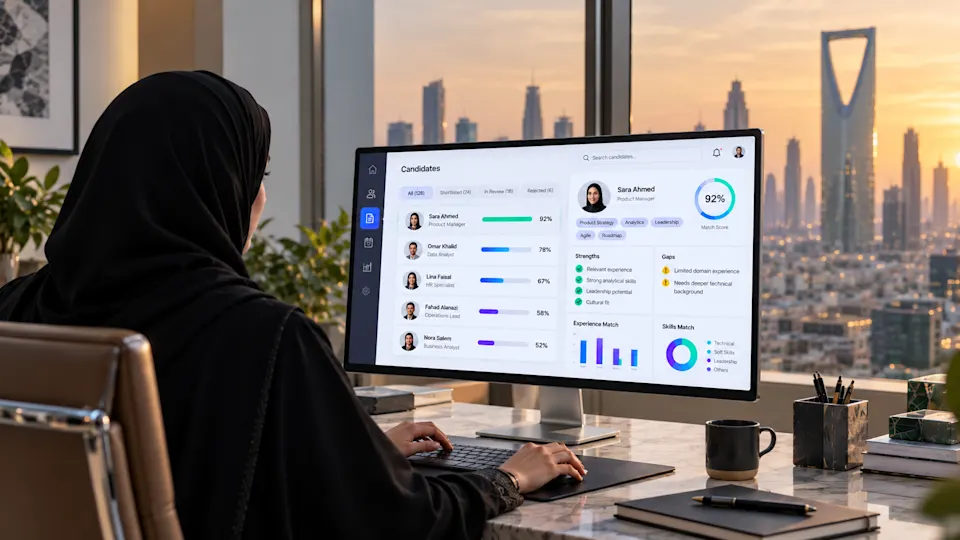
AI CV Screening: How It Ranks Arabic and English CVs
How AI CV screening reads Arabic and English CVs, scores each applicant with strengths and gaps, and what Saudi recruiters should still decide themselves.
Sep 17, 2026

Why Candidates Ghost After the Interview (And the AI Fix)
Saudi candidates ghost after the first interview because of silence and slow replies, not lost interest. Here are the numbers and the AI fix that works.
Sep 7, 2026
HR AI Trends GCC 2026: State of Market Report
State of Market report: what GCC HR leaders say about AI in 2026, with sourced numbers on adoption, impact, and the gap between them across the Gulf.
Aug 4, 2026