
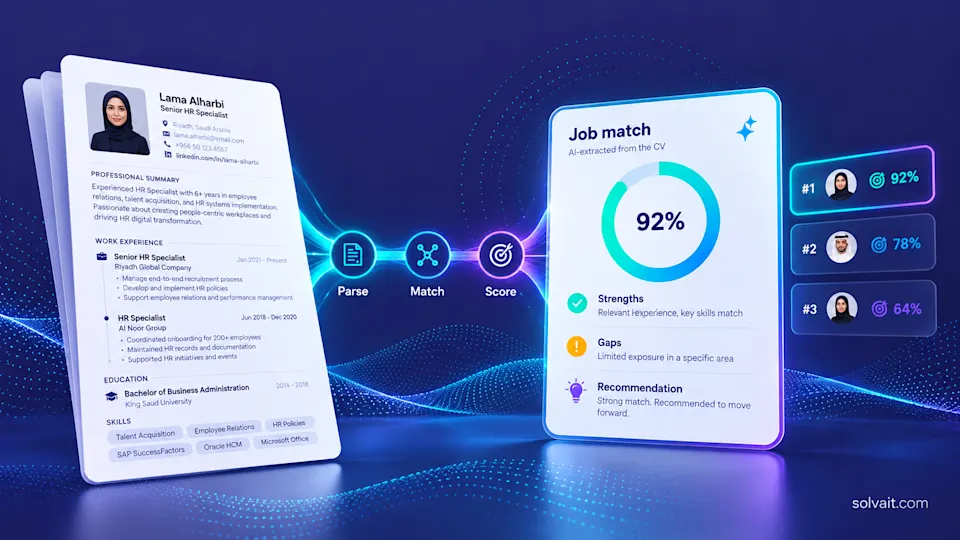
CV ATS Score: Why Did the AI Rank This Candidate #1?
By the Solvait HR Team Last updated: 27 October 2026
A CV ATS score is a number, usually between 0 and 100%, that an applicant tracking system assigns to a résumé to measure how closely it matches one specific job. The number ranks the list. The reason behind it is what you defend in the selection meeting.
When a hiring manager asks "why is this candidate first?", answering "the system ranked them" convinces nobody. A decision you can't explain is a decision you can't defend. A good system doesn't hand you a bare number. It hands you the strengths and the gaps behind that number, tied to the criteria you wrote into the job.
This article covers three things: how a system reads a CV and turns it into a score, how that score becomes a ranking you can stand behind, and how to read a low or ambiguous score instead of trusting it blindly.
Key takeaways
A CV ATS score turns each résumé into a 0 to 100% match against one specific job, not a verdict on the person.
A score with no reason is a risk, not a tool. Only 26% of candidates trust AI to evaluate them fairly (Gartner, 2025).
A defensible ranking needs three things: a score, a reason per point (strength or gap), and an explicit link to the job's criteria.
A 60% match isn't a rejection. It's a flag for human review, because the candidate is strong on one axis and short on another.
Solvait Attract gives each CV a match score with strengths, gaps, and a recommendation, so the ranking is explainable rather than a black box.
How does an ATS read a CV and turn it into a score?
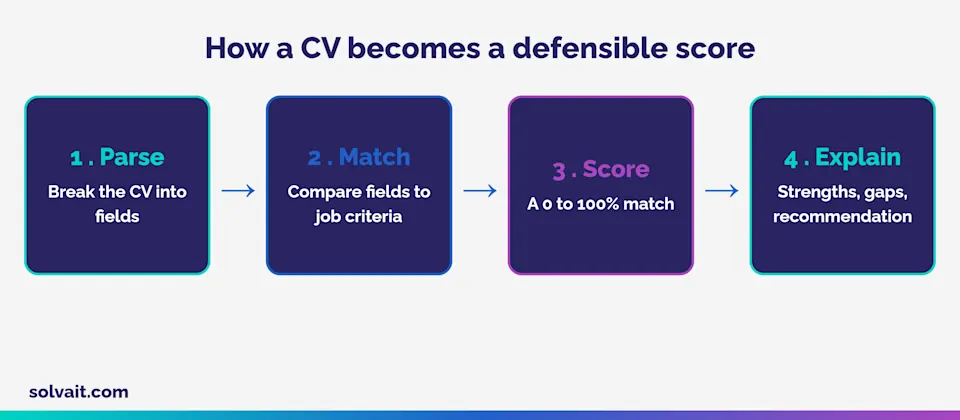
Before any number appears, the system runs three stages. Understanding them explains why a great CV sometimes lands a low score.
Stage one: parsing. The system breaks the CV file into structured fields: name, education, experience, skills, certifications. This is where the ats parse rate matters, meaning the share of the CV the system read correctly. A file built from complex tables or text-inside-images drops that rate, so real information is lost before anything is even measured.
Stage two: matching against the job's criteria. The system compares the extracted fields to the requirements you wrote: required skills, years of experience, sector, qualification. Each criterion carries a weight, and the match is scored criterion by criterion. This is the core of the score, not a keyword count.
Stage three: the score. The system rolls the weighted matches into one number between 0 and 100%. That number is what you see next to each CV.
Here's the part most people miss. The score is not a judgment of the candidate in the abstract. It measures how close they are to one job. The same résumé can score 88% on one role and 40% on another. So the quality of your job description sets the quality of the score. A vague job gives you vague scores.
CV reading stage | What happens | Where accuracy is lost |
|---|---|---|
Parsing | File broken into structured fields | Tables, images, text inside graphics |
Matching | Fields compared to job criteria | Vague or incomplete job description |
Scoring | Weighted matches rolled into one % | Criteria weights left untuned |
Recruiters feel the value of that speed. In LinkedIn's Future of Recruiting 2025 report, 61% of talent acquisition professionals believe AI will help them measure quality of hire more effectively, while only 25% feel confident measuring it today. The gap between those two numbers is exactly what a criteria-based score helps close.
How does a score become a ranking you defend to a hiring manager?
The number ranks the list. The explanation is what protects you in the selection meeting.
A 92% next to a name means nothing to a hiring manager unless you can say: "first because they're highest on the skills and experience we defined, and their only gap is the professional certificate." That's the line between a useful score and a black box.
A good system shows three things next to every score:
Strengths: where the candidate matches the job strongly.
Gaps: where they fall short, stated plainly, not hidden.
Recommendation: one line that sums up the suggested call.
And the score itself reads by colour, to speed up triage:
Score band | Colour | What it means in practice |
|---|---|---|
80% and above | Green | Strong match, shortlist for interview |
60% to 79% | Amber | Partial match, needs a human read |
Below 60% | Red | Weak match for this specific job |
Why does the explanation matter this much? Because trust in the machine isn't a given. Only 26% of candidates trust AI to evaluate them fairly, even though 52% believe AI screens their applications (Gartner, 2025). When you can explain the score with clear criteria, you protect the decision in front of your manager and the candidate alike.
AI CV screening doesn't remove the human. It clears the path. The system reads 200 CVs in minutes and ranks them with reasons. The final call stays yours.
Common mistakes: how to read a low or ambiguous score
Here's where most teams get it wrong. The score is a decision aid, not the decision. The costliest mistake is treating it as the whole truth.
Mistake one: treating anything under 70% as a rejection. A 64% can hide an excellent candidate with strong skills and a single gap in years of experience. Open the gaps before you rule anyone out. The number guides your eye; it doesn't decide for you.
Mistake two: trusting a score built on a bad job description. If the job is written vaguely, the scores will be vague. Fix the description first, then re-score. That's the fastest way to improve an ats resume score.
Mistake three: ignoring the parse rate. If the system read only 60% of a CV because of its formatting, the score is built on half the story. A low-scoring CV may be a badly formatted CV, not a weak candidate.
Mistake four: not recording the reason. Even with a clear score, write one line on why you ranked a candidate where you did. That's what protects you when the decision gets questioned a month later.
Before every selection meeting, run this quick check: is the score built on a fully read CV? Are the gaps understood? Can I explain the ranking in one sentence? If any answer is no, go back to the CV itself.
And one honest limit. AI won't fix a poor job description, and it won't read between the lines of a carelessly written CV. It speeds up reading and ranking, but it reflects the quality of what you feed it.
Three approaches to ranking candidates
To see the value of an explainable score, compare it to the common alternatives. There's no magic approach. Each has a cost.
Approach | How it ranks | The cost |
|---|---|---|
Fully manual screening | Reading every CV by eye | Slow, and judgment drifts day to day |
Keyword-only check (cv ats checker style) | Searching the text for set words | Rejects good CVs when wording differs |
Explainable match score | A % per criterion, with a reason | Needs a good job description to work well |
This matters in the Saudi market specifically. With unemployment among Saudis down to 7.2% in Q4 2025 (GASTAT, 2026), hiring has grown more competitive, and the speed and accuracy of screening are a real difference in who you reach first.
How does Solvait Attract handle CV scoring and candidate ranking?
Solvait Attract is Solvait's AI recruitment system. It matches each CV to the job requirements you write and turns it into a score with a reason for every point.
What it does for this exact problem:
A match score per CV, built on the criteria you defined, not a generic benchmark.
An explainable breakdown: strengths, gaps, and a single recommendation next to each score.
An AI-extracted candidate profile from the CV, organised into clear sections: overview, education, experience, skills, certifications, projects, documents.
A ranking you can explain to your manager in one sentence, instead of leaning on a number with no backstory.
Attract is AI-assisted recruitment software. It ranks and explains, and the decision stays with you. Its tools connect to the HR system you already run, without replacing your stack.
Before you build a full process, try the idea yourself. The free ATS CV checker shows how the system reads and scores a single CV in minutes. To match a CV against a specific job, the CV match analyzer shows you the score and the reasons.
When you're ready to see explainable ranking inside a full hiring process, book a demo with Solvait and we'll show you how it works on your own roles.
Frequently asked questions
What does "grade" mean on a CV in an ATS? The grade is the match score: a number from 0 to 100% measuring how close a CV is to a specific job's requirements. It isn't a rating of the candidate in the abstract, only of their fit for that one job. The same CV earns different grades on different roles.
What does a 60% match actually mean? It means a partial match: the candidate is strong on some criteria and short on others. A 60% is not a rejection, it's a flag for human review. Open the strengths and gaps before you decide, because the number can hide a strong candidate with a single gap.
Does an ATS reject good CVs? Yes, if the formatting makes the text hard to read or if the job description is vague. A CV with complex tables or text inside images has a lower parse rate, so real information is lost. The fix is simple CV formatting and a precise job description.
What's the difference between an evaluation generator and a candidate-ranking system? An evaluation generator produces ready-made text for a performance review or an interview. A candidate-ranking system reads CVs, measures their fit to a job, and ranks them with reasons. One writes; the other reads, compares, and ranks. Their jobs are entirely different.
Does the score replace the recruiter's decision? No. The score ranks the list and explains its reasons, but the final call is human. Read the gaps, check the parse rate, and record why you ranked each candidate. The system saves hours of reading, not the responsibility of choosing.
References
Gartner - Gartner Survey Shows Only 26% of Job Candidates Trust AI Will Fairly Evaluate Them, 2025 (candidate trust in AI and the share who believe AI screens their applications).
SHRM - Fresh SHRM Research Explores Use of Automation and AI in HR, 2024 (talent acquisition is the leading area for AI deployment in HR, with résumé screening among top uses).
GASTAT - Labor Market Statistics, Q4 2025, 2026 (unemployment among Saudis at 7.2%, overall 3.5%).
See agentic HR in action
Solvait AI HR and its agents prepare Saudi labor-law work so HR can review it before anything is submitted.
Tags
Related Posts

Applicant Tracking System (ATS): Employer's Guide
An applicant tracking system reads and ranks CVs before a recruiter sees them. Here's how an ATS works from the employer's side .
Oct 21, 2026

Recruiter Burnout in Saudi Arabia: The AI Fix
Recruiter burnout in Saudi Arabia comes from three busywork drains: screening, chasing candidates, and bilingual writing. Here are how AI removes each.
Sep 23, 2026

AI CV Screening: How It Ranks Arabic and English CVs
How AI CV screening reads Arabic and English CVs, scores each applicant with strengths and gaps, and what Saudi recruiters should still decide themselves.
Sep 17, 2026