

Applicant Tracking System (ATS): How It Screens and Ranks CVs from the Employer's Side
An applicant tracking system (ATS) is recruitment software that receives CVs, parses them into structured data, ranks them, and then tracks every candidate through your hiring stages to offer. In plain terms, it's where each applicant's file lives, and it's how your team decides who gets interviewed and who waits. The candidate sees a "CV check." The employer sees something completely different: a ranked list, filters, and reports that tell you where hiring is stuck.
This guide is for you, the employer. We'll cover how the system actually reads a CV, what "parse rate" and "filters" really mean, how to choose a system that fits Saudi Arabia, and which numbers a good one must give you back.
Key takeaways
An applicant tracking system doesn't auto reject CVs. It ranks them and surfaces the closest matches first. A human recruiter still makes the call.
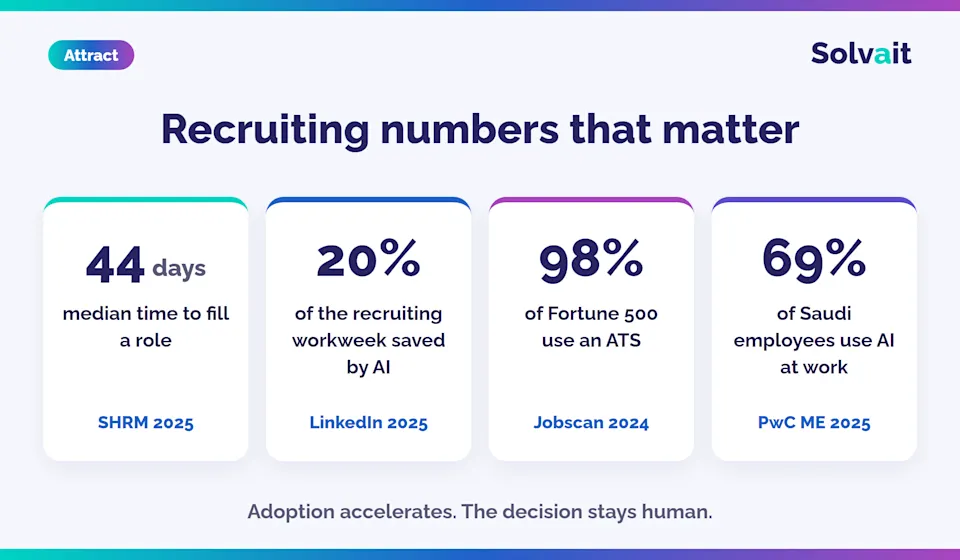
98.4% of Fortune 500 companies use an ATS (Jobscan, 2024). A CV is read by software before it reaches a person.
The median time to fill a role is about 44 days (SHRM, 2025). A good system shortens that because it removes repetitive manual work.
In Saudi Arabia, three criteria decide the choice: Arabic and English parsing accuracy, Saudization tracking, and candidate consent under the Personal Data Protection Law (PDPL).
Ask the system for numbers, not just screens: time to hire, offer acceptance rate, Saudization percentage, and stage to stage convergence rate.
How does an applicant tracking system actually read a CV?
Every file moves through five clear stages inside the system. Understanding them makes every other decision easier.
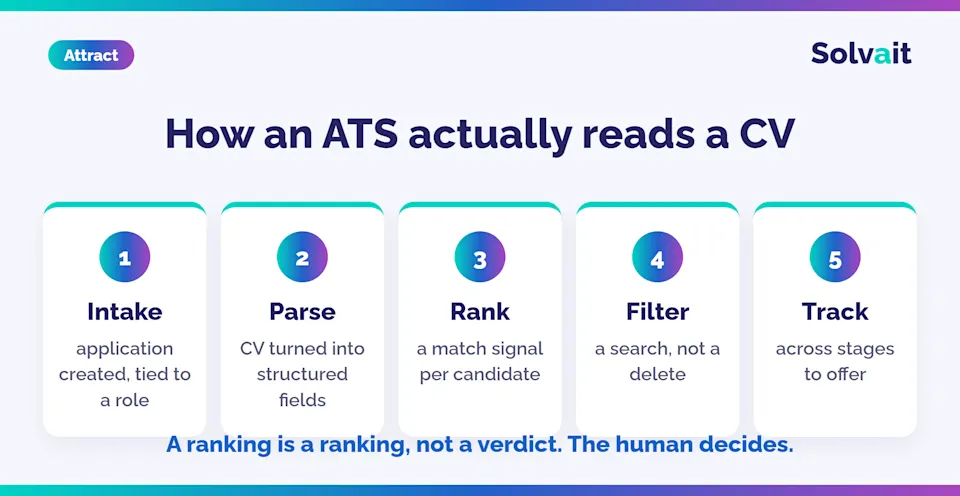
1. Intake: The CV arrives from the job ad, an email, or an apply link, and the system creates an "application" tied to a specific role. Everything sits in one place, not in scattered inboxes.
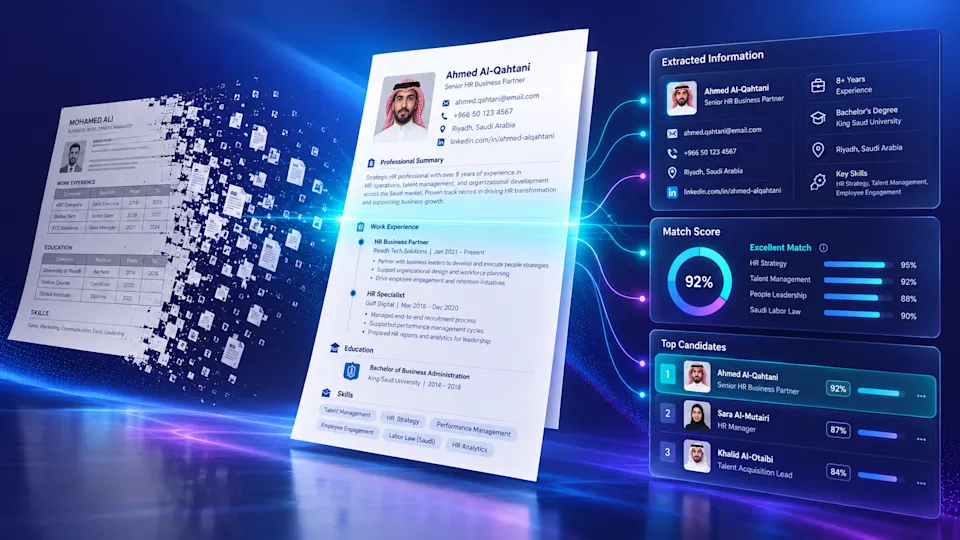
2. Parsing: This is where the system turns a PDF or Word file into structured fields: name, experience, skills, education, work dates. What people call the "parse rate" is simply the share of fields the system read correctly. A weak parse rate means good candidates show up with missing data. With Arabic CVs especially, parsing accuracy makes a real difference.
3. Ranking: The system compares each CV against the role's requirements and gives a match signal: who's closest, where the strengths are, where the gaps are. This part gets misread a lot, so let's be clear. A ranking is a ranking, not a final verdict.
4. Filtering: Filters are search tools, not execution orders. You ask for "3 years of experience in Riyadh with a valid licence," and the system shows who fits. Change the filter and the list updates instantly. Nobody is permanently removed. The view is simply reordered around what you're looking for right now.
5. Tracking across stages: A candidate moves from "new" to "screening" to "interview" to "offer," and the whole team sees the full path. You can tie candidate messages to the stage, so replies go out on time and nobody gets lost in an inbox.
The most common myth: "the system rejected my CV"
There's a widespread belief that an ATS auto rejects most CVs. It isn't accurate. The system ranks and surfaces; the human decides. When a strong candidate disappears, the cause is usually not some "smart rejection." It's a bad parse of a poorly formatted CV, or a narrow filter the recruiter set themselves. That's a setup problem, not an algorithmic conspiracy.
How do you choose an applicant tracking system for Saudi Arabia?
Most systems look alike in a demo. The difference shows up in the details that matter to a Saudi company specifically. Here's what's worth checking before you buy.
Arabic and English parsing accuracy: CVs here come in both languages, sometimes in one file. Ask for a live test: upload ten real CVs and see how many fields the system read correctly. That's a more honest test than any slide deck.
Saudization tracking: A Saudi company manages its localization rate within Nitaqat bands. A good system shows the effect of each hire on your Saudization percentage before you send the offer, not after it's too late.
Candidate consent and data protection: Saudi Arabia's Personal Data Protection Law (PDPL) is in force, with fines up to SAR 5 million (SDAIA, 2024). A candidate is a data subject. Ask: does the system record candidate consent with a date and time stamp? Does it set a retention period for the data?
Working with recruitment agencies: Many companies use external agencies. Look for a system that lets an agency submit candidates through a separate portal, without seeing your internal data or other agencies' candidates.
Reporting: A system that produces no numbers is just a storage box. We'll detail the metrics you need in a moment.
So where does the system stand against the alternatives? Here's an honest picture:
Criterion | Manual, by email | Spreadsheet | Applicant tracking system |
|---|---|---|---|
Reading the CV | By hand, one by one | Manual copy and paste | Auto-parsed into fields |
Ranking by fit | Recruiter's memory | Basic column sort | Match signal per candidate |
Stage tracking | Not really possible | Manual, always lagging | Live path per candidate |
Candidate messaging | One-off replies, forgotten | Separate templates | Messages tied to the stage |
Data protection and consent | Scattered emails | Copyable file | Consent record and permissions |
Reporting | Near impossible | Painful manual rollup | Ready and exportable |
Honesty is due here. A recruitment system is not a magic fix. A weak job description gives you weak candidates no matter how smart the system is. And the system costs setup time at the start. But once it's tuned, it removes the repetitive manual work that eats your team's week today. Generative AI saved recruiting teams about 20% of their workweek, roughly a full workday (LinkedIn, Future of Recruiting 2025).
Which metrics must a recruitment system give you?
A pretty screen doesn't run hiring. Numbers do. A system worth its budget gives you at least these metrics.
Time to hire. How many days from opening the role to an accepted offer? The market median is about 44 days (SHRM, 2025), so make that your baseline.
Offer acceptance rate. How many offers get accepted per hundred? A drop signals uncompetitive pay or slow decisions.
Saudization percentage. Does each hire move you toward your target band or away from it?
Stage to stage convergence rate. Of the people who entered screening, what share reached the interview? This number shows exactly where the process stalls.
Quality and cost of hire. Does the new hire stay and succeed? And what did the hire cost?
Common mistakes when reading the numbers
First mistake: looking at applicant volume alone. A thousand applicants for one role isn't a win if none of them are qualified. Second mistake: ignoring the stall stage. If 80% of candidates drop between screening and interview, the problem is in your screening criteria or your job description, not the market. Third mistake: measuring everything and changing nothing. A number with no decision behind it is decoration.
For the wider context: 69% of Saudi employees use AI at work (PwC Middle East, 2025), higher than the global average. Your team is readier for smarter hiring tools than you might think.
Where does Solvait Attract fit?
Solvait Attract is Solvait's applicant tracking system, built for Saudi Arabia and bilingual in Arabic and English. It reads a CV and turns it into structured fields, scores it against the role with clear strengths, gaps, and a recommendation, then ties candidate messaging to the stage (email and WhatsApp). For agency work, a separate agency portal keeps your internal data private. For measurement, a report builder exports ready data to Excel, including convergence rate, Saudization percentage, and time to hire.
One honest point: Attract is an AI assisted system, not an agentic one. It parses, ranks, and suggests, but the decision stays with your team. The smart scoring cuts hours of screening; the human keeps the final word. Want to see how Attract screens CVs against your real roles? Book a demo and we'll parse and rank ten real CVs in front of you.
FAQ
What is an applicant tracking system (ATS)?
An applicant tracking system is recruitment software that receives CVs, parses them into structured data, ranks them by fit for the role, and tracks every candidate through the hiring stages to offer. It's the core workspace for a recruiting team on the employer's side, not just a place to store files.
Does an ATS auto reject CVs?
No. The system ranks CVs and surfaces the closest matches first, but it doesn't delete anyone on its own. The decision stays with a human recruiter. When a strong candidate disappears, it's usually a bad parse of a poorly formatted CV or a narrow filter the user set.
What does "parse rate" mean?
Parse rate is the share of fields the system read correctly from a CV, such as name, experience, and skills. A high parse rate means clean data and more accurate ranking. It matters especially for Arabic and bilingual CVs in the Saudi market.
What makes an ATS right for a Saudi company?
Three things: accurate parsing of Arabic and English CVs, tracking the Saudization percentage within Nitaqat bands, and respecting the Personal Data Protection Law (PDPL) by recording candidate consent and setting a data retention period. Qiwa ecosystem integration and agency collaboration are useful extras.
What's the difference between an ATS and a spreadsheet?
A spreadsheet stores names; a system runs a process. The system parses the CV automatically, ranks it by fit, tracks each candidate through stages, ties messaging to the stage, keeps a consent record, and exports ready reports. A spreadsheet can't do any of that and always lags on manual updates.
References
SHRM: 2025 Talent Acquisition Benchmarking Report, 2025 (median time to fill about 44 days).
LinkedIn: The Future of Recruiting 2025, 2025 (generative AI saved recruiting teams about 20% of the workweek).
Jobscan: 99% of Fortune 500 Companies Use an ATS, 2024 (98.4% of Fortune 500 companies use an applicant tracking system).
PwC Middle East: Workforce Hopes and Fears Survey 2025, 2025 (69% of Saudi employees use AI at work).
Saudi Data and AI Authority (SDAIA): Personal Data Protection Law (PDPL), in force 2024 (fines up to SAR 5 million; a candidate is a data subject).
Ready to see Solvait in action?
Book a personalized demo and see how Solvait's AI-powered HR platform can transform the way your team works.
Tags
Related Posts

CV to Job Match Score: What 60% Really Means
What a CV to job match score is, what a 60% ATS match really means for a hiring decision, and how AI resume screening ranks hundreds of CVs fairly.
Oct 15, 2026

ATS and Time to Fill in Saudi Arabia: Where Time Goes
The global time to fill a role is about 44 days, and most of it is lost screening CVs by hand. See how an ATS reads and ranks resumes in minutes.
Oct 5, 2026
ATS CV Scan: 7 Formatting Mistakes That Reject a Good CV
An ATS rejects strong candidates for format, not talent. Learn the 7 CV ATS formatting mistakes, how to fix them, and how to test your CV for free.
Oct 13, 2026