

CV to Job Match Score: What a 60% Match Really Means for a Hiring Decision
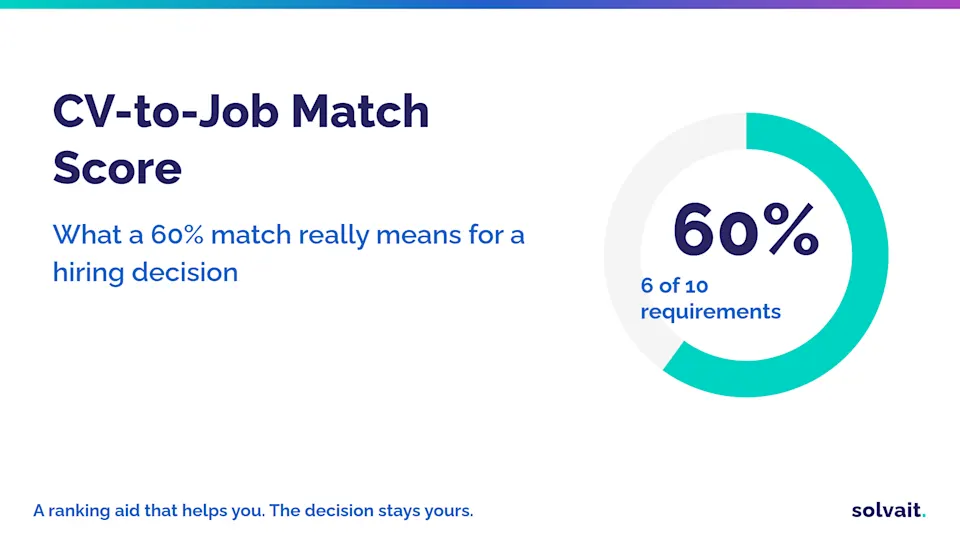
CV to job match score is a percentage that measures how closely a candidate's qualifications line up with a job's stated requirements. A 60% score simply means the CV met 6 of 10 core requirements. But the number alone won't make the decision for you. The real question is which 6 were met, and which 4 were missing. A candidate at 60% who is missing an easy to learn skill can beat a candidate at 80% who is missing the core competency the role is built on.This article explains how an ats cv match score is calculated, what the percentage means in a real hiring call, and how automated resume screening software applies the same logic across hundreds of CVs in minutes. The decision stays with you, not the system.
Key takeaways
• A CV to job match score is a percentage: how many of the job's requirements a CV actually met.
• A 60% score means 6 of 10 requirements. Its weight depends on which 6 were met and which 4 were missing, not on the number alone.
• The score is a ranking aid to help you, not a verdict that auto rejects a candidate.
• Good systems separate must-have requirements from nice to have ones, which earn points.
• At scale, AI ranks CVs with a transparent match score, and the human call remains the deciding factor.
What is a CV to job match score, and how does a system calculate it?
A match score is the system's way of answering one question: how close is this CV to the job description? The software reads the CV, extracts the data (titles, years of experience, skills, certifications), then compares it against the role's requirements. Each requirement met adds points, and the total becomes a percentage.That is the job of an applicant tracking system (ATS), the software companies use to receive and sort applications. It is now standard in enterprise hiring: a 2025 analysis by Jobscan found that 97.8% of Fortune 500 companies use an ATS. In large firms, a CV is read by the system before any human sees it.Why do companies need this ranking at all? Because the time available per CV is now a handful of seconds. In a 2024 ResumeGo survey, 47% of recruiters said they spend 30 seconds to 1 minute per CV in the initial screen, and 33% spend only 10 to 30 seconds. With hundreds of applications per role, reading every CV in full is close to impossible.
How the score is built, step by step
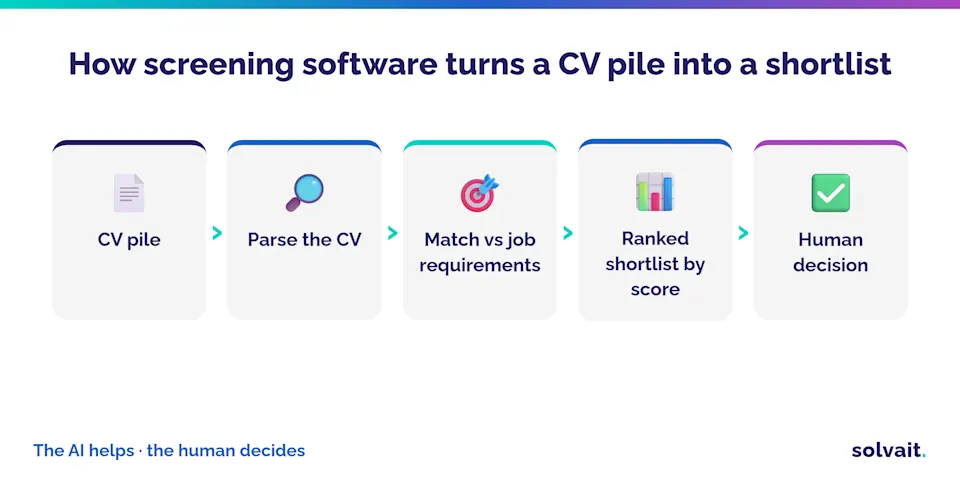
The idea is simpler than it sounds. Think of it as four steps:
Parse the CV: The system turns the file into structured data. This is why a clean, machine readable CV matters: a complex layout loses data the parser can't read.
Read the job: The system extracts the requirements from the job description and classifies them.
Compare and score: Each requirement met adds its weight. A must have carries more weight than a nice to have.
Return the result: A percentage match, with a breakdown of what was met and what was missing.
Here's the part people get wrong. An ats cv parser score is not an intelligence test for the candidate. It measures how close one CV is to one job description. The same candidate might match one role at 85% and another at 40%. The job is the reference point, not the CV on its own.
What does a 60% match really mean for a hiring decision?
Take a worked example. A role has 10 requirements, and a CV meets 6 of them, so the score is 60%. What that 60% means changes completely depending on which items were met.
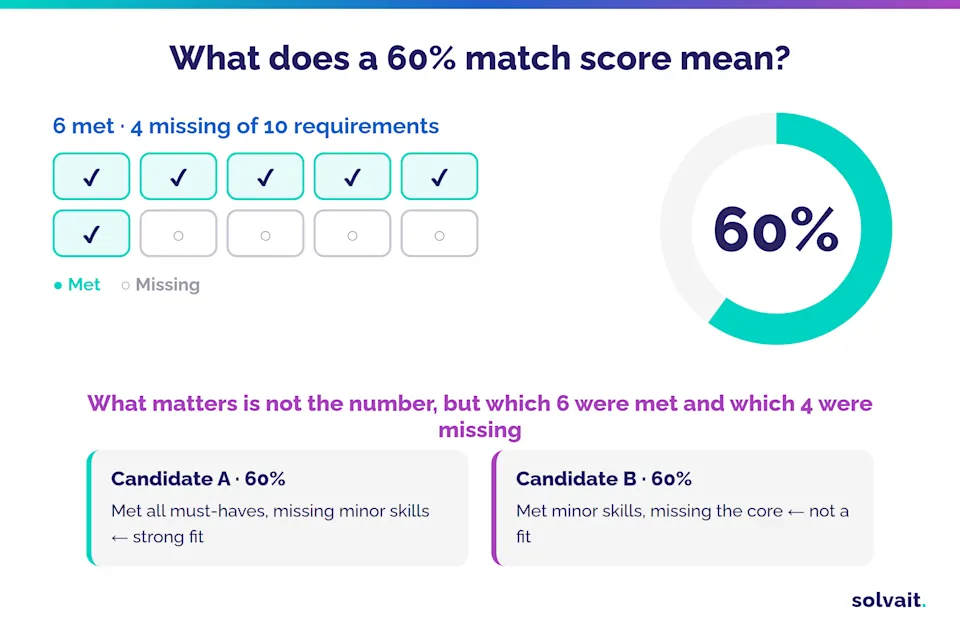
The first met every must have (experience, core technical competency, language) and is missing four secondary skills that are easy to pick up. A strong candidate, despite the middling number.
The second met six secondary skills but is missing the core competency the role is built on. Not a fit, even though the score is identical.
Same number. Two completely different calls. This is why a good cv tracking system gives you more than a percentage. It gives you the breakdown: which 6 were met and which 4 were missing. That breakdown is what you actually decide on.
Table: how to read a match score
Match score | What it usually means | Suggested action |
|---|---|---|
85% and above | Strong match on must-haves and nice to haves | Interview early |
60% to 84% | Good match, with a gap to review | Check which items are missing before deciding |
40% to 59% | Partial match | Interview only if the gap is in learnable skills |
Below 40% | Weak match on the essentials | Usually not a fit for this role |
Treat this as a guide, not a hard rule. A rare skill role may be worth interviewing at 50%, and a role flooded with applicants may raise the bar.
The mistake everyone makes: the score doesn't auto-reject
For years, a claim circulated that "ATS software auto rejects 75% of CVs." That claim is a myth with no real study behind it. It traces back to a piece of marketing material from 2012. A 2025 report by IT Brief shows that systems rarely auto reject CVs, and that most recruiters said their systems don't auto reject at all.The takeaway matters: a match score is a ranking tool, not a guillotine. Its job is to lift the closest CVs to the top so a human can start there, not to eliminate anyone. Treat the number as a final verdict and you'll lose good candidates. Use it as a fast review aid and you save time without sacrificing quality. It helps candidates too: running a quick review my cv ai check before applying confirms the data reads the way it should.
How does resume screening software apply this logic across hundreds of CVs?
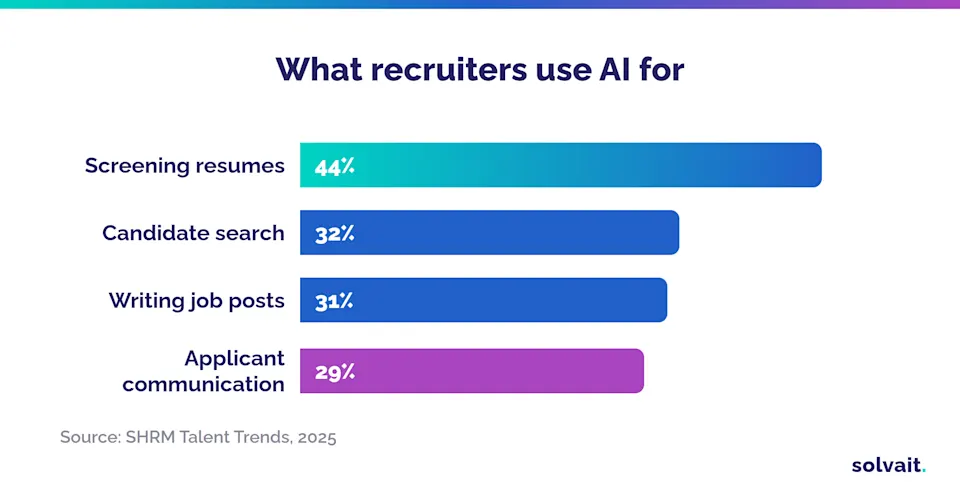
The same logic we walked through for one CV becomes far more valuable across hundreds. Application volume has climbed sharply: per Greenhouse data reported by Axios in 2024, the average job posting drew about 228 applications, up 45% in a single year. At the same time, more than half of organizations run teams where each recruiter manages around 20 open requisitions, per SHRM's 2025 recruiting benchmarking report.So many teams turned to AI. SHRM's 2025 Talent Trends report finds that 43% of organizations now use AI in HR, and recruiting is the function that uses it most. Among recruiting teams that use it, screening resumes is the single most common use.
Where this matters in the Saudi market
In Saudi Arabia, the decision isn't only about speed. It's about compliance too. The Nitaqat programme entered a new three year cycle that raised Saudization rates and tied them to contracts documented on the Qiwa platform, aiming to localize more than 340,000 private sector jobs by 2028, per the Ministry of Human Resources and Social Development. Hiring the right person the first time is part of managing that obligation, not just an operational nicety.
How Solvait Attract does it
Solvait Attract is Solvait's AI powered recruitment solution. It reads CVs, gives each one a match score against the job description, and ranks a shortlist. It works in both Arabic and English, so it handles local CVs the way it should.What sets it apart in the hiring decision:
A transparent match score: No black box number. You see why a candidate ranked where they did, so you can defend the choice to a hiring manager.
Must-have versus nice to have: You define what's non negotiable, so a core fit candidate isn't buried under someone with more secondary skills.
Ranking, not elimination: The tool lifts the closest CVs to the top, and the call stays yours. The AI helps; the human decides.
Solvait is the agentic HR company. Founded in Riyadh in 2010, it serves 300+ clients across Saudi Arabia and the GCC with six products, led by its flagship, AIHR, alongside Attract, Wise, HR Assistant, Everything's App and Solvait HCM, the core HR and payroll product. Solvait runs at 99.9% uptime, goes live in 30 days and holds ISO 27001:2022 certification. Try the idea yourself first: the free CV Match Analyzer gives you the match score and the gap in seconds, with no signup and no data captured. To check formatting readability, use the ATS CV Checker. And if you want to fix what pushes good candidates out before screening, read our guide on the formatting mistakes that make ATS reject a good CV.When you're ready to see how Solvait Attract ranks hundreds of CVs for your team, book a demo.
Frequently asked questions
How do I know the ATS score of my resume?
Use a match tool or an ATS CV check: you paste your CV and the job text, and you get a match percentage plus a breakdown of what was met and what was missing. Solvait's CV Match Analyzer returns the result in seconds, free. The number is a guide. What matters most is seeing which requirements were missing so you can fix them.
What is the difference between an ATS check and a CV to job match score?
An ATS check confirms your CV's formatting is machine-readable, meaning the system can extract your data. A match score measures how well your CV's content lines up with a specific job's requirements. The first is about format, the second is about substance, and both matter.
Is a 60% match score good enough to interview?
It depends on which 6 of 10 requirements were met. If the must haves are covered and the gap is in secondary, learnable skills, the candidate is worth an interview. If the gap is in a core competency for the role, the same number isn't enough. Review the breakdown, not the number alone.
Will an ATS auto reject my CV if the score is low?
Usually not. The idea that systems auto reject 75% of CVs is a myth with no study behind it. The score is used to rank CVs, not eliminate them, and a recruiter still reviews and decides. But a low score means your CV may sit near the bottom of the list, so improving it raises the odds it gets seen.
How do I raise my CV to job match score?
Read the job description closely and surface the skills it actually asks for, using the same words. State relevant experience clearly and near the top, and cut unrelated filler. Then run a match check before you apply to confirm the core requirements show up and read correctly.
References
SHRM: 2025 Talent Trends: AI in HR, 2025 (AI adoption in HR and recruiting)
SHRM: 2025 Recruiting Benchmarking Report, 2025 (time to fill and requisitions per recruiter)
Jobscan: Fortune 500 companies using an ATS, 2025 (ATS prevalence)
ResumeGo: How much time recruiters spend on a resume, 2024 (screening time per CV)
Greenhouse via Axios: How the job application black box works, 2024 (rising applications per job)
IT Brief: Study reveals ATS rarely auto-rejects CVs, debunks 75% myth, 2025 (debunking the auto-reject myth)
Saudi MHRSD via Middle East Briefing: Saudi Arabia Nitaqat 2026 update, 2026 (Nitaqat cycle and Qiwa-linked Saudization)
See agentic HR in action
Solvait AI HR and its agents prepare Saudi labor-law work so HR can review it before anything is submitted.
Tags
Related Posts

Applicant Tracking System (ATS): Employer's Guide
An applicant tracking system reads and ranks CVs before a recruiter sees them. Here's how an ATS works from the employer's side .
Oct 21, 2026

ATS and Time to Fill in Saudi Arabia: Where Time Goes
The global time to fill a role is about 44 days, and most of it is lost screening CVs by hand. See how an ATS reads and ranks resumes in minutes.
Oct 5, 2026

Recruitment Agency Portal: Work Without Sharing Your ATS
How to work with external recruitment agencies inside one ATS in Saudi Arabia, using a separate portal, rules before the first submission, and a PDPL-clean frozen record.
Sep 30, 2026