

How Long Should It Take to Fill a Role in Saudi Arabia, and Where Does the Time Go?
The global average time to fill a role is about 44 days, according to SHRM's 2025 benchmarking, and in Saudi Arabia the pressure runs higher as hiring accelerates under Vision 2030. Most of that time is not lost in the interview or the offer. It is lost before either of them, in reading and sorting a pile of CVs by hand, one at a time.
An applicant tracking system (ATS) is software that collects every CV, reads it, and ranks it by how well it matches the job description, so a recruiter reaches the strongest candidates faster. This article breaks down where hiring time actually goes, how long filling a role should take by role type, and how AI cuts screening from hours to minutes. It ends with a simple way to check your own CV against an ATS for free.
Key takeaways
The global average time to fill is about 44 days (SHRM 2025), and the real bottleneck sits before the interview, not after it.
The biggest time sink is manual screening. Illustrative example: 200 CVs at 3 minutes each is 10 hours before the first interview.
A healthy time to fill depends on the role: 10 to 20 days for entry level, up to 70 days for critical leadership.
An ATS reads every CV, gives each one a match score, and ranks them, so your team's hours shift from sorting to interviewing.
The decision stays human. The AI flags and ranks, and the recruiter chooses.
Where does hiring time actually go, before any ATS sees it?
Ask a hiring team which stage is slowest, and you will usually hear "the interviews" or "offer approvals." The reality is different. Both of those take time, but the larger bottleneck happens well before them, the moment two hundred CVs land in one inbox and wait for one person to read them.
Take a simple illustrative example. One role attracts 200 CVs. Each CV needs about 3 minutes for a quick read. That alone is 10 hours of focused work before the first interview starts. If the recruiter is filling more than one role at once, the number multiplies and screening creeps across the rest of the week.
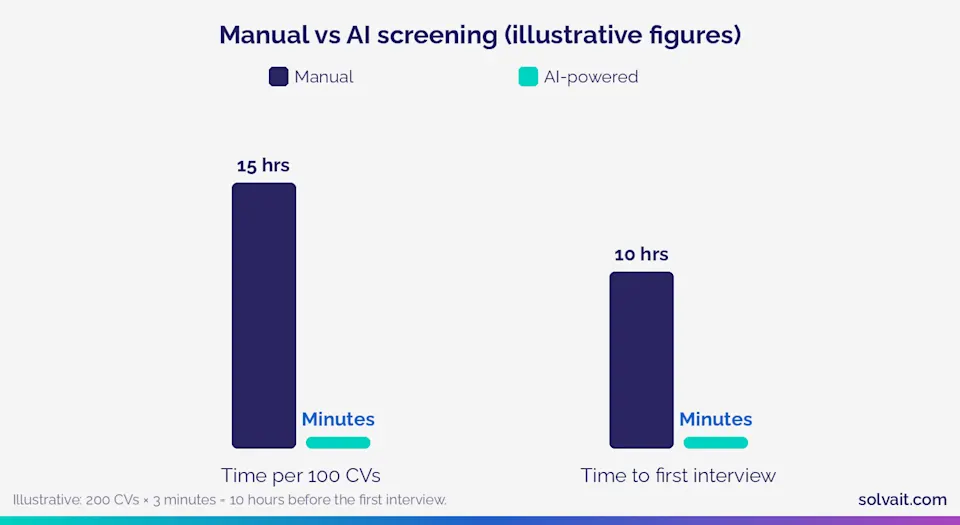
Here is where the days go across the funnel:
Sourcing: Posting the role and collecting applicants. Relatively quick.
Screening: Reading each CV and comparing candidates. This is where the hours pile up.
Coordination: Scheduling interviews and trading messages. Time lost in back and forth.
Interviews: A stage worth the time, because it is real human judgment.
Offer and approvals: Signatures and sign offs, often with more layers in larger companies.
Notice that screening and coordination swallow a large share of time before the first interview, and those are exactly the parts you can shorten without giving up decision quality.
The pressure is sharper in the Saudi market. The labor market is expanding fast under Vision 2030: women's participation in the workforce rose from 17% in 2017 to 36.3% in the first quarter of 2025, according to the Ministry of Human Resources and Social Development, and more than 2.4 million Saudis joined the private sector since 2020. More hiring activity means a bigger CV pile per role, and a longer screening load if it stays manual.
What makes it worse is that most of that time goes to CVs that were never a fit. A large part of the pile arrives because a vague job description attracts applicants you are not looking for. A clearer description brings fewer, closer CVs. That is where saving starts, before any tool. Try the free job description generator and write a role description with Saudi context in under a minute, with no sign up and no data captured.
The takeaway for this stage is simple. Before you try to speed up interviews, look at your screening hours. That is where the time goes first, and where the fix begins.
How long should it take to fill a role in Saudi Arabia?
Before fixing on a "healthy" number, separate two metrics that people often blur together:
Time to fill: Starts when a requisition is approved and ends when the candidate accepts the offer. It measures how long the seat stays empty.
Time to hire: Starts when a candidate enters your pipeline and ends when they accept. It measures how efficiently your team handles a ready candidate.
The metric that matters most for planning is the first, because it tells you how many days the work stays short staffed, and every empty day carries a productivity cost.
What is the benchmark? The global average is close to 44 days per SHRM's 2025 report, a figure that blends every role together, so it is a poor yardstick for yours specifically. The Saudi market usually adds layers that stretch the timeline: longer approval cycles, Saudization requirements, and strong competition for talent, especially as Saudi labor-force participation surpassed 52% for the first time under Vision 2030. Better to compare against ranges by role than against a single number.
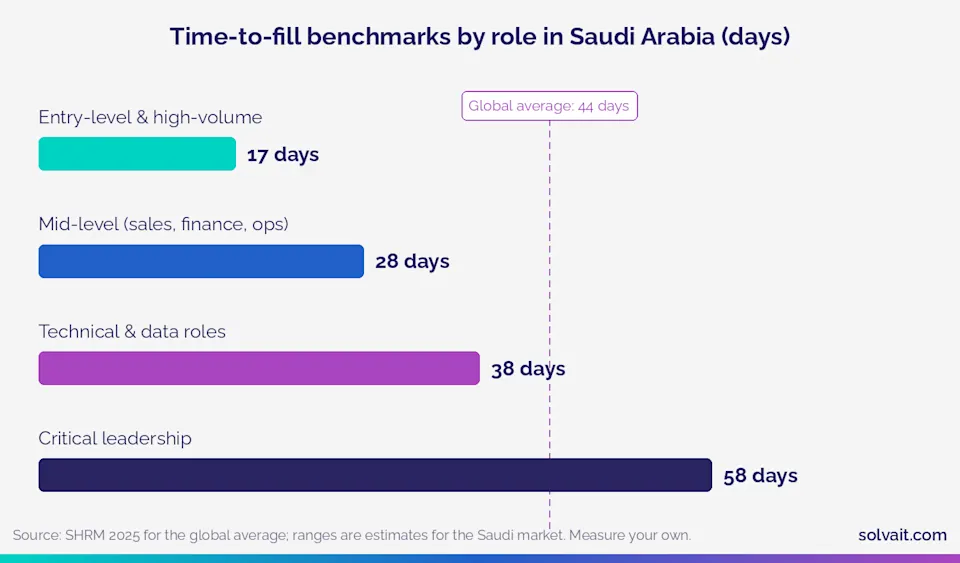
Role | Time to fill range | What usually stretches it |
Entry level and high volume | 10 to 20 days | Slow screening at peak application times |
Mid level (sales, finance, ops) | 20 to 35 days | Layers of approvals |
Technical and data roles | 30 to 45 days | Scarce skills and multiple assessment rounds |
Critical leadership | 45 to 70 days | A short candidate list and a high stakes call |
The ranges above are estimates for the Saudi market, with the global benchmark sitting at 44 days per SHRM. Treat them as a starting point, not a verdict.
How do you measure your real number? The steps are simple:
Record the approval date of each requisition and the offer acceptance date.
Subtract the two dates for each role to get the number of days.
Average by role family, not across the whole company.
Track the trend quarter over quarter, not a single number once.
Do not settle for one company wide average, because it hides the spread. Sales roles might fill in 25 days while technical roles stretch to 70, and the tidy average in the middle misleads everyone. The healthy shape is a number inside your role's range that improves over time. All of this is part of building an hr system saudi arabia that measures what actually happens instead of guessing.
That raises a practical question: if 44 days is the average, and a big part of it is lost in screening, what happens if you shorten screening alone?
How does AI cut CV screening from 10 hours to minutes?
This is the part that changes the math. Instead of a recruiter reading 200 CVs one by one, an ATS reads all of them, parses them, and gives each CV a match score against the job description. The result is a ranked list, with the strongest matches on top and a clear note of what each candidate is missing.
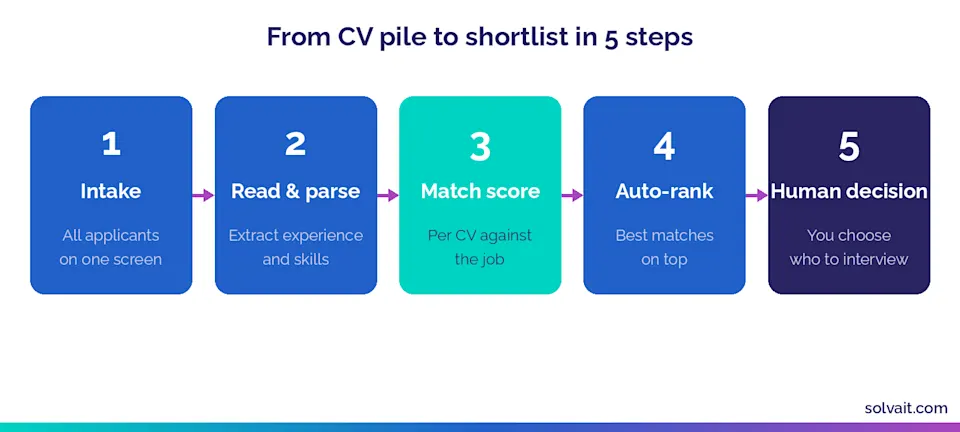
The process runs in five simple steps:
Intake: Every applicant in one screen instead of a scattered inbox.
Read and parse: Pulling experience, skills, and credentials from each CV.
Match score: A clear number per CV against the role's requirements.
Auto rank: The best fits surface first, and the gaps show next to each name.
Human decision: The recruiter reviews the shortlist and picks who to interview.
What does the match score mean in practice? It is the share of the role's requirements a CV meets. A 60% match means 6 of 10 requirements are there, and what matters is which 6 and which 4 are missing. So the number guides you rather than deciding for you: a candidate who needs a short training course may deserve the interview more than one who scores higher on paper.
The difference between the two methods is not only speed, it is consistency. Manual reading varies between reviewers, and even between the first CV and the last CV of the same day. An ATS applies the same standard to everyone.
Criterion | Manual screening | ATS screening |
Time per 100 CVs | Long hours | Minutes |
Scoring consistency | Varies by reviewer | One standard for all |
Match score | Subjective, in your head | A clear number per CV |
Spotting gaps | Easy to miss | Shown for every candidate |
Final decision | Human | Human, with the AI flagging and ranking |
The numbers back this shift. LinkedIn's Future of Recruiting 2025 report found that professionals using generative AI save about 20% of their work week, roughly a full day every week that returns to interviews and decisions instead of sorting.
The AI has limits worth stating plainly, though. In the same survey, 58% of candidates believe AI cannot fairly assess soft skills and cultural fit. So the rule holds: the tool flags and ranks, the human decides. Automated screening shortens the path to a shortlist, and then your judgment takes over in the interview.
If you are a job seeker: how do you get your CV through?
This is not only an employer's concern. Many candidates now ask how their CVs get past screening systems. An ATS friendly resume needs a few simple things:
A clean layout: clear headings, single columns, and no images or complex tables.
Readable text, not a scanned picture.
Keywords drawn from the job posting itself.
Standard section names like "Experience," "Education," and "Skills."
The fastest way is to run a free ATS CV check and see your ATS compatibility score and what is missing before you send it. If you want to match your resume against a specific role, the CV match analyzer tool gives you the score and the gaps in seconds.
Where does Solvait Attract fit?
Once you have seen where the time goes and how it is cut, the tool's place is clear. Solvait Attract is Solvait's AI recruitment system. It collects CVs, reads and parses them, gives each one a match score, then ranks them and shows strengths and gaps, in Arabic and English. It also writes the job description and manages candidate messages at each stage by email and WhatsApp.
One point on positioning: Attract is AI assisted, not agentic. It does not make the hiring decision for you. It prepares the shortlist, and the decision stays with the recruiter. Solvait clients report around 50% time savings, within a single platform trusted by 260+ organizations across Saudi Arabia and the GCC, live in 30 days.
To see how this maps to your own roles and timelines, book a demo and we will walk through an example from your hiring.
FAQ:
How do I know if my resume is ATS friendly?
An ATS friendly resume keeps formatting simple: clear headings, readable text rather than images, and keywords that match the job description. The fastest check is to run it through a free ATS CV checker, which shows your compatibility score and what is missing before you send it. Solvait's tool gives you the result with no sign up.
What is an ATS and how does it screen CVs?
An applicant tracking system (ATS) is software that gathers all applicants in one place, reads each CV, gives it a match score against the job description, and ranks them from the strongest fit to the weakest. Its goal is to get recruiters to the best candidates quickly, while the final decision stays human.
How long should it take to fill a role in Saudi Arabia?
It varies by role. Entry level roles usually fill in 10 to 20 days, mid-level in 20 to 35, technical in 30 to 45, and leadership in 45 to 70 days. The global average is about 44 days (SHRM 2025). The best practice is to measure your own number per role family rather than relying on a single average.
Does AI make the hiring decision instead of the recruiter?
No. In a responsible setup, the AI reads, ranks, and surfaces gaps, but the decision stays human, especially for soft skills and cultural fit, which many candidates doubt a tool can judge fairly. Attract prepares the shortlist, and you choose who to interview.
How can I check my resume against an ATS for free?
Use Solvait's ATS CV checker. Upload your resume and you get an ATS compatibility score, along with the gaps, in seconds, with no sign up and no data captured. To match your CV against a specific role, use Solvait's CV match analyzer tool.
References
SHRM: 2025 Recruiting Benchmarking Report, 2025 (average time to fill close to 44 days).
LinkedIn: The Future of Recruiting 2025 (AI saves ~20% of the workweek, alongside rising demand for human skills such as relationship-building).
Ministry of Human Resources and Social Development: Progress in the Saudi Labor Market, 2025 (labor-market growth and workforce participation under Vision 2030).
World Bank: A Decade of Progress: Saudi Arabia's Labor Market Transformation, 2026 (Saudi private-sector employment reached 52.8%).
Solvait: Why Solvait, 2026 (Solvait first-party figures: 260+ clients, 50% time savings, live in 30 days).
Ready to see Solvait in action?
Book a personalized demo and see how Solvait's AI-powered HR platform can transform the way your team works.
Tags
Related Posts

Recruitment Agency Portal: Work Without Sharing Your ATS
How to work with external recruitment agencies inside one ATS in Saudi Arabia, using a separate portal, rules before the first submission, and a PDPL-clean frozen record.
Sep 30, 2026

Recruiter Burnout in Saudi Arabia: The AI Fix
Recruiter burnout in Saudi Arabia comes from three busywork drains: screening, chasing candidates, and bilingual writing. Here are how AI removes each.
Sep 23, 2026

Why Candidates Ghost After the Interview (And the AI Fix)
Saudi candidates ghost after the first interview because of silence and slow replies, not lost interest. Here are the numbers and the AI fix that works.
Sep 7, 2026