

How to Write a Job Description That Doesn't Filter Out Great Candidates
The great candidate you're looking for has probably already seen your job ad. Then closed it. Not because your salary is low, but because the job description never told them clearly what they'd do or why they'd fit. A job description is the first filter in hiring. It's also the most wasteful one when it's written in a hurry.
A job description is a document that sets out the title, responsibilities, and core requirements of a role. Its job is to pull in the right people and screen out the wrong ones. When it's vague or stuffed with needless requirements, it does the opposite. It pushes away the strongest applicants and attracts people who don't fit.
This guide covers three things: why job descriptions filter out great candidates, how to write one that attracts the right person, and how your description feeds the applicant tracking system (ATS) before any CV reaches your eyes.
Key takeaways
The job description is your first hiring filter, and writing it quickly screens out great candidates before they ever apply.
Long requirement lists and biased wording shrink your qualified applicant pool. Research shows most people apply without meeting every requirement.
A strong description separates must haves from nice to haves, uses neutral language, and names the local context (in Saudi Arabia, Nitaqat and the Qiwa platform).
Your job description feeds the ATS. A precise description plus fair CV screening stops good people from being filtered out twice.
Tools like a job description generator and CV screening in Solvait Attract speed up writing and raise shortlist quality.
Why do job descriptions filter out great candidates?
The reason is rarely a weak market. The reason is that the description was written in five minutes, copied from an old ad, and filled with phrases that mean nothing specific.
Three mistakes repeat more than any others:
Vague responsibilities. "Manage related projects" says nothing. A serious candidate can't tell whether the role fits their experience, so they move on. The person who does apply is often the least selective, not the most capable.
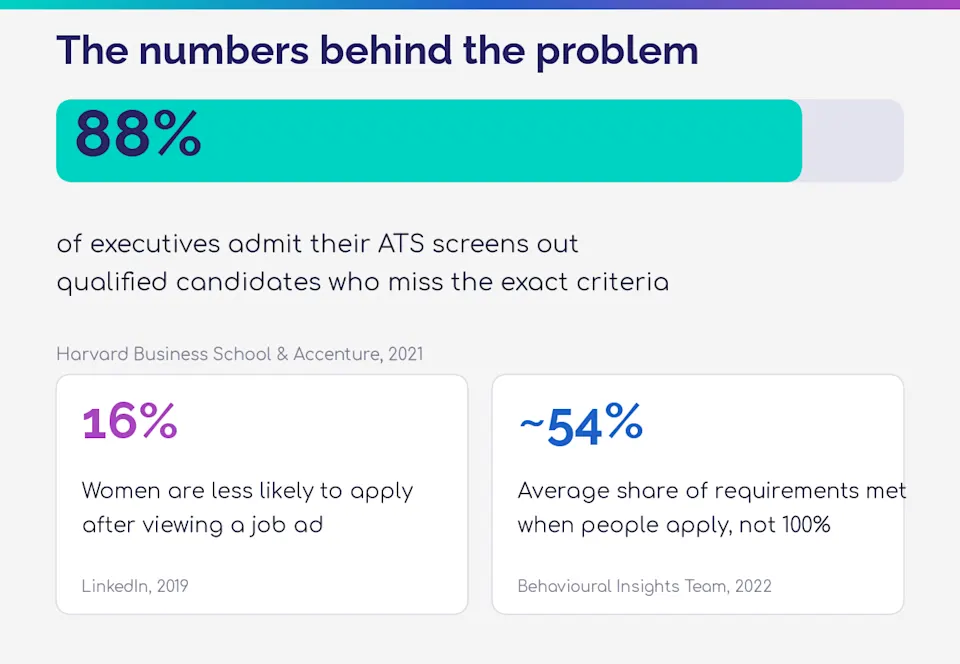
A long requirements list. Every extra requirement screens out someone who would have excelled. This isn't a guess. LinkedIn's 2019 Gender Insights Report found women are 16% less likely than men to apply to a job after viewing it, and apply to about a fifth fewer jobs. When the Behavioural Insights Team tested this behaviour in 2022, people applied when they met roughly half the requirements, not all of them. Excess requirements turn away the qualified first.
Biased or buzzword heavy language. The landmark study by Gaucher, Friesen, and Kay, published in the Journal of Personality and Social Psychology (APA) in 2011, showed that masculine coded wording in an ad makes women less likely to apply, without their being aware of why. Buzzwords like "rockstar" and "ninja" repel quiet, productive talent.
The outcome is the same in all three cases. You get a pile of CVs that don't fit, and you miss the person you were actually looking for.
The five most common job description mistakes
An unfamiliar title no one searches for ("growth hero" instead of "marketing specialist").
Mixing responsibilities with wishes, with no priority order.
Demanding excessive years of experience for a role that can be learned.
No salary or range, so the candidate assumes the worst.
Ignoring the local context: in Saudi Arabia, that means Saudization, Nitaqat, and the Qiwa platform.
What makes a job description attract the right candidate?
A good description isn't a wish list. It's a clear contract: this is what you'll do, this is what we actually need, and this is what you'll get.
Start with outcomes, not tasks. Instead of "responsible for reports," write "you'll build a monthly report that tracks hiring metrics and cuts review hours." An outcome attracts the person who knows how to deliver it.
Separate must haves from nice to haves. A must have is a requirement that can't be learned quickly. A nice to have is a bonus. That split alone brings back candidates who would otherwise have walked away.
The table below sums up the difference:
Element | Weak description (filters talent out) | Strong description (attracts the right people) |
|---|---|---|
Responsibilities | "Manage related tasks" | "You'll build the quarterly hiring plan and track the Saudization ratio" |
Requirements | 15 items, 7 "preferred" scattered among them | 5 clear must haves, 3 nice to haves listed separately |
Language | "Dynamic, rockstar, passionate" | Neutral language that describes the work, not a personality |
Salary | Not mentioned | A clear range, or a note that it's competitive |
Context | Generic, no identity | Names Nitaqat, Qiwa, and the work location in Saudi Arabia |
Then control the length. Five to seven must have requirements cover most roles. Every extra one has to earn its place.
A quick checklist before you publish
Can the reader tell within 30 seconds what they'll do and whether they fit?
Is every "must-have" something that can't be learned in the first few months?
Is the language free of buzzwords and biased terms?
Did you name the local context and the salary or its range?
Is the job title what the candidate actually searches for?
How does your job description affect ATS and CV screening?
An applicant tracking system (ATS) is the software that receives CVs and ranks them before a human sees them. Candidates know this. That's why so many now look for an ATS-friendly CV, download ATS CV templates, and run an applicant tracking system checker before they apply.
Here's the double problem. If your job description is vague, the keywords it carries are vague too. So the candidate writes their CV around the wrong terms, and the system screens them out despite their fit. Then automated filtering doubles the mistake.
And the scale is real. In the "Hidden Workers: Untapped Talent" study from Harvard Business School and Accenture in 2021, 88% of executives admitted their own applicant tracking systems screen out qualified candidates simply because they don't match the exact criteria.
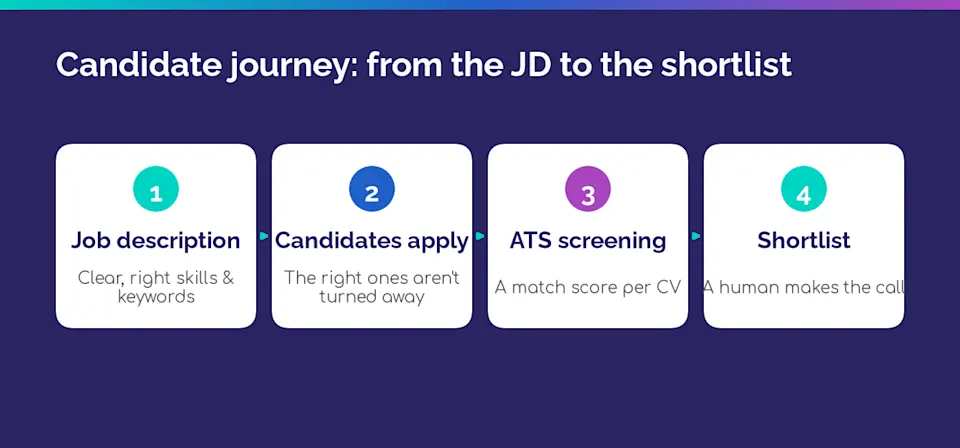
The fix isn't to drop automated screening. It's to improve both ends of it:
A precise description that carries the right skills and keywords.
Fair screening that measures real fit (ats cv and matching cv) and gives each CV a clear score.
A human decision at the end, not a silent automated rejection.In that order, a great candidate isn't filtered out twice: once by a vague description, and again by blind screening.
How Solvait Attract helps
A good job description and fair CV screening are two sides of one process. Solvait Attract covers both.
On the writing side, the job description generator helps you produce a clear description with local context in a minute: responsibilities framed as outcomes, ordered requirements, and neutral language. You start from a good draft instead of a blank page.
On the screening side, Attract reads every CV against the same criteria, calculates a clear match score (what many people search for as what is cv score), ranks candidates by fit, and shows strengths and gaps. The final call stays with you.
Let's be honest here: the tool doesn't replace your knowledge of the role. If you don't know who you want, no AI will write a description that knows it for you. But it turns your knowledge into a clearer description and faster screening.
Let's be fair about the comparison. A free template or a generic generator may be enough for an occasional hire. When you're comparing options and searching for Attract group alternatives while hiring regularly and screening at volume, Attract earns its place: it joins description writing and CV screening in one flow, in Arabic and English, built for the Saudi market.
Try it yourself: start with the free job description generator and write a description for one role today.
Next step: book a demo to see how Attract shortens hiring from the job ad to the offer.
Frequently asked questions
How do I write a professional job description?
Start with the expected outcomes, not a task list. Separate the must-have requirements (five to seven) from nice to haves, use neutral language without buzzwords, and name the local context and the salary or its range. Finish with a quick check: can the reader grasp the role in 30 seconds?
How many requirements should a job description have?
Five to seven must-haves cover most roles. Every extra requirement screens out qualified people, and research shows most applicants apply when they meet only about half the criteria. Put extras under a separate "nice to have" heading instead of mixing them into the must haves.
What is a CV score?
A CV score is a number that shows how closely a CV matches a specific role, based on skills, experience, and requirements in the job description. Screening tools calculate it to rank candidates. A higher score means a closer fit, but a human should always review the shortlist before any decision.
How do I make a CV ATS-compatible?
Use clear job titles, match your skills to the job description's wording, and avoid complex tables or images the system can't read. An ATS CV checker flags gaps before you apply. Remember that genuine fit with the role matters more than stuffing in keywords.
Can AI write a job description?
Yes, it can produce a clear draft quickly, like Solvait's job description generator. But it builds on what you know about the role. Your job is to define the real outcomes and requirements. The tool's job is to turn them into an ordered, neutral description in a minute.
References
LinkedIn: Gender Insights Report 2019, 2019 (supports the 16% figure and the lower application rate).
Harvard Business School & Accenture: Hidden Workers: Untapped Talent, 2021 (supports the 88% figure on ATS screening out qualified candidates).
Gaucher, Friesen & Kay, Journal of Personality and Social Psychology (APA): Evidence That Gendered Wording in Job Advertisements Exists and Sustains Gender Inequality, 2011 (supports the effect of biased language).
Behavioural Insights Team: Gender differences in response to requirements in job adverts, 2022 (supports that people apply without meeting every requirement).
Ministry of Human Resources and Social Development: Qiwa platform, 2026 (Saudi regulatory context: Nitaqat and Saudization).
See agentic HR in action
Solvait AI HR and its agents prepare Saudi labor-law work so HR can review it before anything is submitted.
Tags
Related Posts

Applicant Tracking System (ATS): Employer's Guide
An applicant tracking system reads and ranks CVs before a recruiter sees them. Here's how an ATS works from the employer's side .
Oct 21, 2026

ATS and Time to Fill in Saudi Arabia: Where Time Goes
The global time to fill a role is about 44 days, and most of it is lost screening CVs by hand. See how an ATS reads and ranks resumes in minutes.
Oct 5, 2026

Recruitment Agency Portal: Work Without Sharing Your ATS
How to work with external recruitment agencies inside one ATS in Saudi Arabia, using a separate portal, rules before the first submission, and a PDPL-clean frozen record.
Sep 30, 2026