
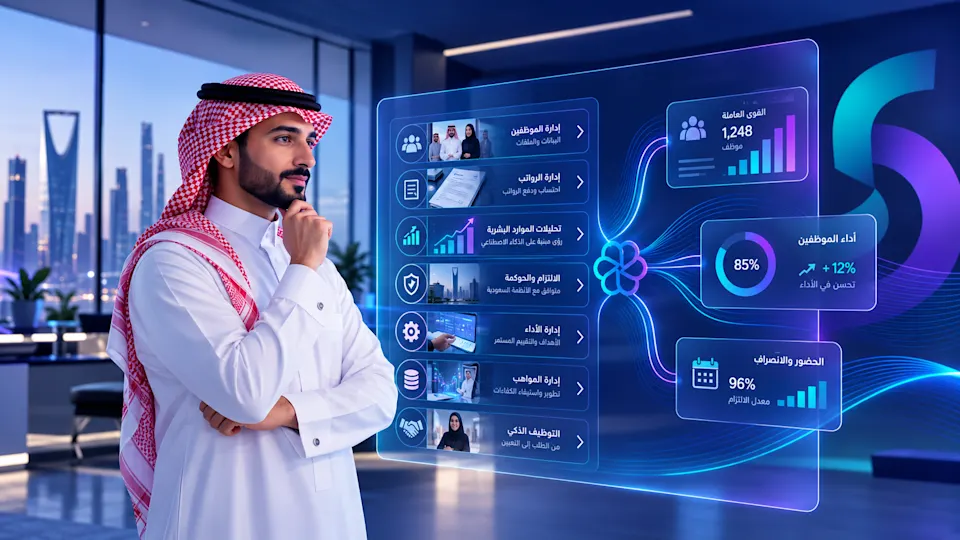
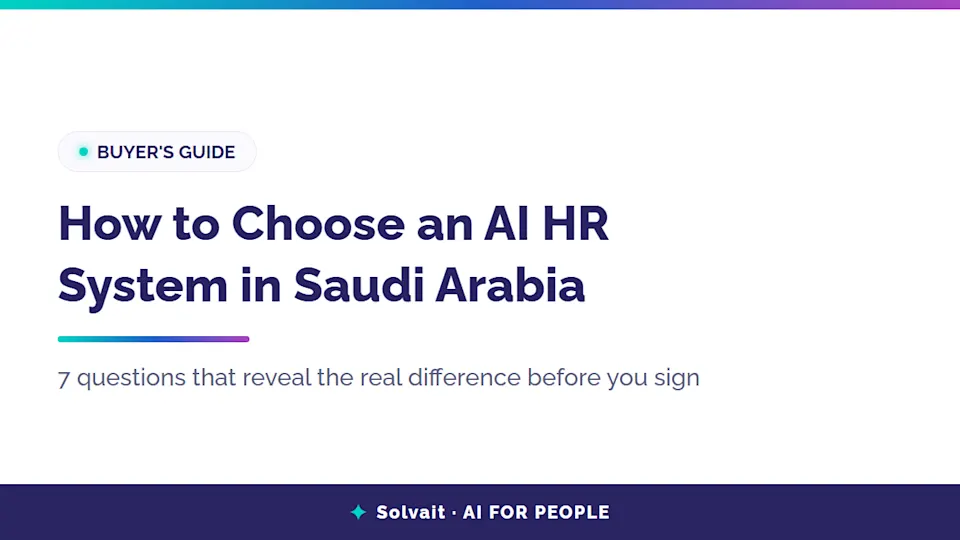
How to Choose an AI HR System in Saudi Arabia: A Buyer's Checklist
What do you actually ask before choosing an AI HR platform?
The demos look alike. The promises sound alike. But a handful of questions, asked at the right moment, reveal which systems are different underneath.
An AI HR system is a platform that runs the full employee lifecycle (hiring, payroll, compliance, self service) with artificial intelligence layered on top to do real work under human oversight. The problem is that every vendor now says "we have AI." The word gets stuck on almost anything. This guide gives you a practical buyer's checklist: seven questions that expose what's real, and five red flags that warn you before you sign.
Key takeaways
The promises are similar; the difference is in the detail : Most systems claim AI. Few actually execute a task instead of just answering in words.
The first and most important question:is this a chatbot that replies, or an AI agent that executes while your team keeps the decision?
Ask for proof of automatic Saudi compliance coverage:GOSI, Qiwa, Mudad, Nitaqat, and the Wage Protection System (WPS).
Ask about the platform, setup time, and security:a serious HR system is built on an enterprise foundation, goes live fast, and holds real certifications like ISO 27001.
In Saudi Arabia, Solvait offers an agentic AI HR platform built on Microsoft Dynamics 365, serving 260+ clients across Saudi Arabia and the Gulf.
Why has choosing an HR system become harder?
Because everyone moved to AI at the same time.
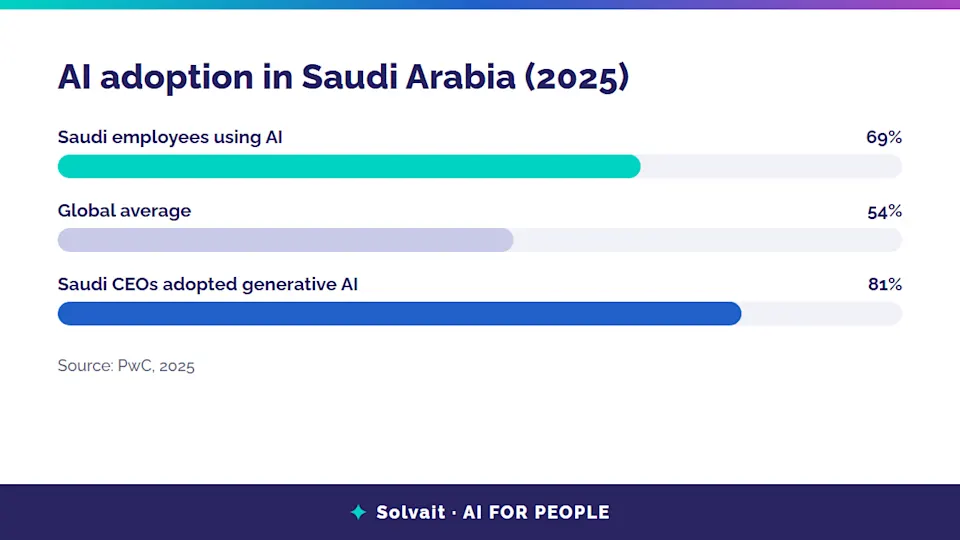
Buyers in Saudi Arabia aren't hesitant about technology anymore. In PwC's 2025 Middle East Workforce Hopes and Fears Survey, 69% of Saudi employees used AI tools at work in the past year, against 54% globally. At the leadership level, PwC's CEO Survey reports that 81% of Saudi CEOs adopted generative AI during the year, and about two thirds credit it with improving profitability.
Demand is high. And the market got just as crowded.
That's the problem. It's now hard to tell a system that truly executes from one that bolted a chat window onto old software. And the decision is expensive. An HR system stays with you for years. It touches every salary, every employee, and every possible fine. So the checklist below is built on questions, not features. Features look alike. Answers don't.
Question one: a chatbot that replies, or an agent that executes?
This one question sorts half the market.
Keep it simple. Three different things all get called "AI":
Type | What it does | Example |
|---|---|---|
Chatbot | Answers questions in words. Doesn't execute. | "What's my leave balance?" and it replies with a number. |
Automation (RPA) | Runs fixed, pre-programmed steps. Breaks when something changes. | Moves data from one file to another on a rigid rule. |
Agentic AI | Understands the goal, plans the steps, executes the task, then shows the result for a human decision. | Reviews a payroll run, flags an unexpected gap, and alerts you before pay goes out. |
The difference isn't cosmetic. In June 2025, Gartner warned about "agent washing": vendors relabeling old chatbots or automation tools and selling them as "agents." Gartner also predicted that more than 40% of agentic AI projects will be canceled by the end of 2027, driven by cost, unclear value, or weak controls.
How do you verify it in the demo? Ask the vendor to show one complete task. Not a slide. The system executing step by step, then handing the decision back to you. A real agent does the work. A chatbot talks about it.
A note on language: "agentic" is widely misused. At Solvait, the "agentic" label applies to the AI HR platform only, not to the other products, which are AI assisted but not agentic.
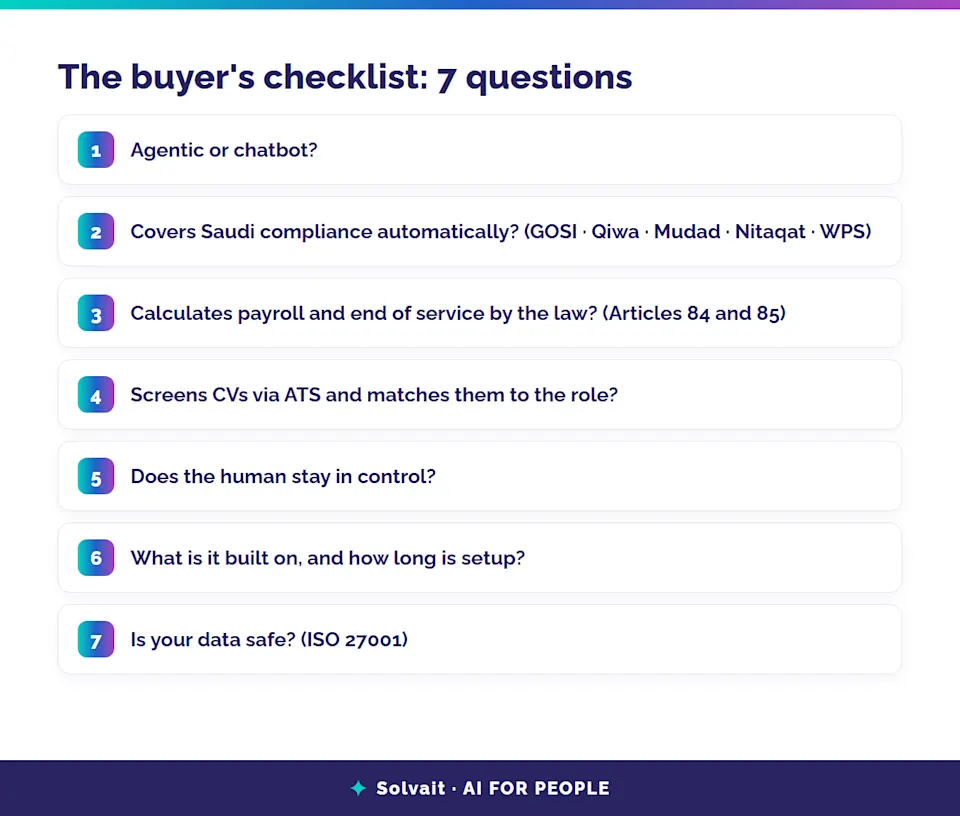
The buyer's checklist: 7 questions before you sign
Print this and take it to every demo. Each question exposes a common gap.
1) Agentic or chatbot? Show me a task the system executes end to end, and where the human decision enters. (See the section above.)
2) Does it cover Saudi compliance automatically? Ask by name: GOSI, Qiwa, Mudad, Nitaqat, and the Wage Protection System (WPS). Then ask it to show how it tracks Iqama expiries, contract ends, and probation periods before they turn into fines. Coverage on paper is not coverage in practice. For a deeper read, see our piece on GOSI compliance without a dedicated specialist.
3) Does it calculate payroll and end of service by the labor law? End of service pay differs sharply between an employer-ended contract (Article 84) and a resignation (Article 85). A system that doesn't distinguish them gives you wrong numbers. Test it yourself with the free end of service calculator, and read the difference in our Article 84 vs 85 post. For monthly payroll, confirm the system builds a valid WPS file the first time.
4) Does it screen CVs through ATS and match them to the role? If hiring is part of your need, ask: does the system read a CV through ATS, score it against the job description, and rank candidates? You can try the same logic with the free ATS CV checker and CV match analyzer. No signup, no data captured.
5) Does the human stay in control? This is a red line. The best systems let the AI flag and alert, then your team decides. Example: AI salary audit compares expected to actual before posting, and halts the run on a suspicious gap. It flags. You decide. If a vendor says it "auto-fixes" without human review, take a step back.
6) What's it built on, and how long is setup? The foundation matters. A system built on a known enterprise platform (like Microsoft Dynamics 365) integrates and scales more easily than a closed one. And ask for a realistic go-live time: weeks or months?
7) Is your data safe? Employee and payroll data are among the most sensitive you hold. Ask for real information security certifications, such as ISO 27001, and ask where the data lives and who can access it.
Red flags: 5 mistakes you pay for after the purchase
The questions above reveal the good. These flags reveal the risk early.
A system that calculates end of service with one rule.
If it doesn't split Article 84 from Article 85, you'll pay differences or lose employee trust.
Payroll reviewed by hand in Excel.
Manual error is costly. In EY's 2022 survey, one in five payroll runs contained an error, and the average cost to fix a single error was around $291. A good system flags the gap before pay goes out, not after.
Great CVs rejected before a human reads them.
If the hiring system doesn't check CV formatting through ATS, you lose strong candidates over formatting, not competence.
Compliance tracked by hand across scattered portals.
Checking GOSI, Qiwa, Mudad, and Nitaqat manually every month is a recipe for fines. Ask for automatic tracking with early alerts.
No security certifications, and no clarity on where data lives.
If the vendor dodges the security question, that is your answer.
Notice the common thread: every red flag maps back to a question in the checklist. The list isn't a theory exercise. It's financial protection.
Where does AI in HR actually stand today?
The shift is real, but gradual. In November 2025, Gartner predicted that 50% of current HR tasks will be automated or managed by AI agents by 2030. And McKinsey's analysis of generative AI in HR puts talent management at about 20% of the function's AI value potential, organizational planning at 15%, and learning and development at 12%.
The message for a buyer: don't believe anyone who says AI runs everything today. And at the same time, a system with no AI that executes is already behind the market.
How the checklist maps to Solvait
Now that you've worked through the questions, here is where Solvait sits on them, plainly.
Solvait is an agentic AI HR platform built on Microsoft Dynamics 365. It runs the full employee lifecycle and adds agents that do real work under your team's oversight:
Employee Concierge agent (Khidmat): answers employees and executes their requests over WhatsApp in Arabic. Live now.
Operations agent (Tashghil): handles repetitive operational tasks. Live now.
Payroll agent (Rawatib): drafts the WPS compliant payroll run for HR review. Live now.
Compliance agent (Mutaba'aa): tracks GOSI, Qiwa, Mudad, and Nitaqat deadlines. Rolling out.
The principle holds across every agent: the AI does the work, and your team makes the call.
On the rest of the checklist: Saudi compliance is built into the platform, security is certified with ISO 27001:2022 and a Microsoft partnership, and go live happens within 30 days. As for proof, Solvait serves more than 260 clients across Saudi Arabia and the Gulf, with 99.9% uptime and up to 50% time savings.
You can try our free tools from the HR tools hub before any commitment, or see the full platform on the AI HR page.
Try before you decide: Book a demo with Solvait and we'll walk the buyer's checklist question by question, on your own data.
Frequently asked questions
What's the difference between a regular HR system and an agentic AI one?
A regular system stores data and does what you tell it, manually. An agentic AI system understands the goal, plans the steps, and executes the full task under human oversight. The practical difference: the first waits for your commands, while the second flags, alerts, and prepares the decision for you, like catching a payroll gap before pay goes out.
How do I eliminate manual Excel errors in our payroll review?
Use a system that runs an AI salary audit before posting: it compares expected to actual pay, flags the differences, and halts the run on any suspicious number until a human reviews it. Detection moves from after payday to before it. The final decision stays with your team, not the system.
What's the difference between Article 84 and Article 85 in end of service pay?
Article 84 governs end of service pay when the employer ends the contract. Article 85 governs it when the employee resigns, and the entitlement is often lower depending on years of service. The gap can be large for the same salary and tenure, so calculate your case with a reliable tool and check the law text to confirm.
Does the system track Saudi compliance (GOSI, Mudad, Qiwa, Nitaqat) automatically?
Some do. Ask the vendor to show automatic tracking with early alerts for GOSI, Mudad, Qiwa, Nitaqat, and WPS deadlines, instead of manual checks across each portal. Real coverage shows up as an alert before the deadline, not as a line on a feature list.
How long does it take to implement a new HR system in Saudi Arabia?
It depends on company size and data quality, but modern systems built on enterprise platforms go live in weeks, not months. Solvait, for example, cites a 30 day go live. Always ask for a documented, realistic timeline rather than a general promise.
References
PwC:Middle East Workforce Hopes and Fears Survey 2025, 2025 (69% of Saudi employees used AI at work vs 54% globally).
PwC:28th Annual CEO Survey: Saudi Arabia findings, 2025 (81% of Saudi CEOs adopted generative AI).
Gartner:Over 40% of Agentic AI Projects Will Be Canceled by End of 2027, June 2025 ("agent washing" warning and cancellation rate).
Gartner:Top Trends Shaping HR Priorities in 2026, November 2025 (50% of HR tasks managed by AI agents by 2030).
McKinsey : Four ways to start using generative AI in HR(distribution of gen-AI value across HR sub-functions).
EY:Payroll errors average $291 each, impacting the economy, 2022 (one in five payroll runs contains an error, about $291 to fix).
Ready to see Solvait in action?
Book a personalized demo and see how Solvait's AI-powered HR platform can transform the way your team works.
Tags
Related Posts
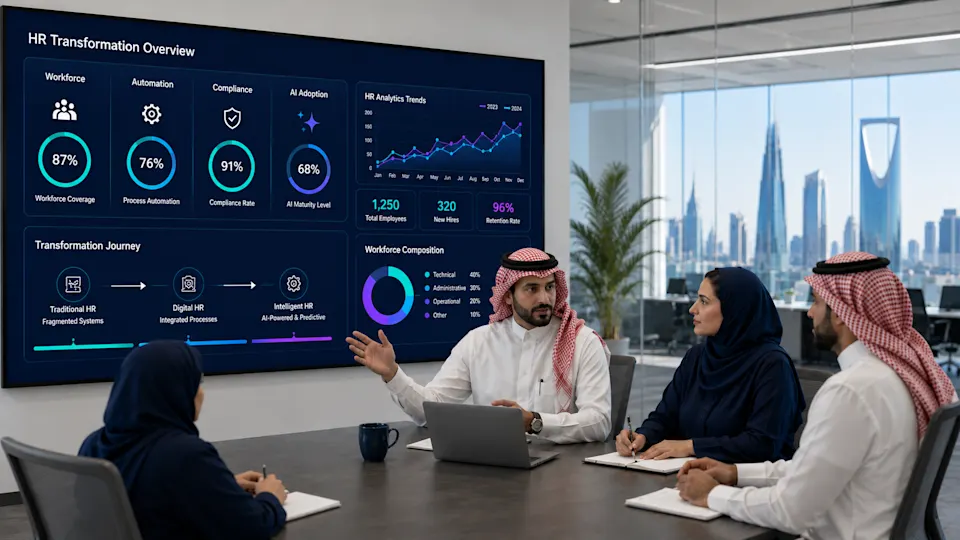
Vision 2030 Is Forcing Saudi CHROs to Rebuild HR
Why Saudi CHROs are rebuilding their entire HR stack for Vision 2030: automation, compliance, and agentic AI, with the numbers that explain it.
Aug 23, 2026
Future of HR in the GCC: 5 Predictions for 2027
Five practical predictions for the future of HR in the GCC by 2027, backed by Gartner, PwC , and what agentic AI means for Saudi and Gulf teams.
Aug 11, 2026
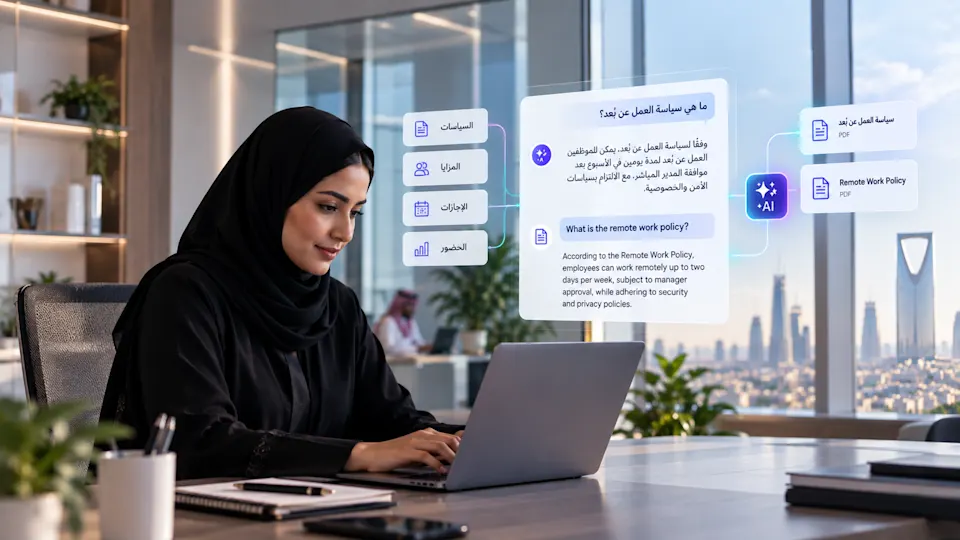
Build a Bilingual Arabic English HR Knowledge Base
A step by step guide to building an Arabic English HR knowledge base employees actually use, powered by agentic AI. Built for Saudi HR teams.
Sep 10, 2026