
Agentic AI in HR: When AI Stops Answering and Starts Acting
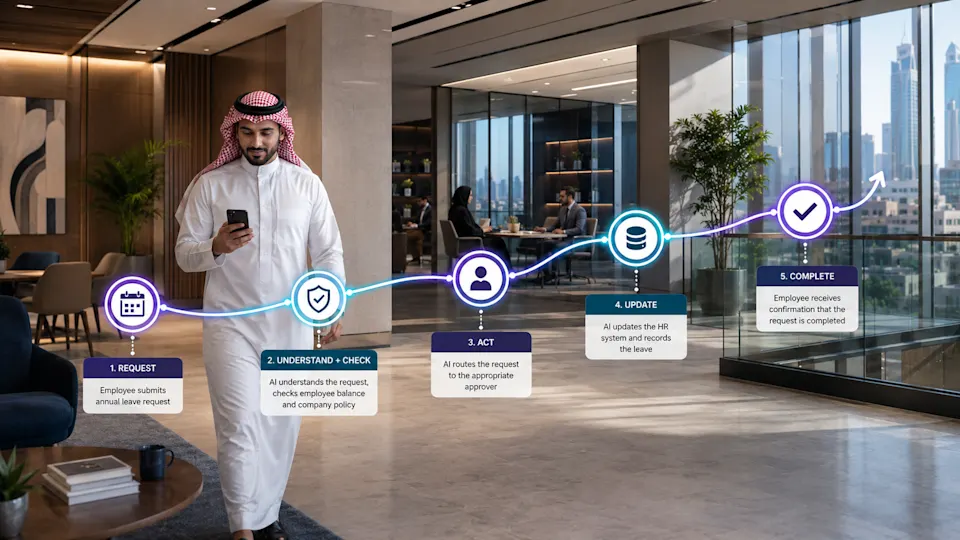
Agentic AI in HR is a system that doesn't just answer employee questions, it completes the whole request on their behalf under human oversight: it takes the leave request, checks the balance, files it and pre fills the type, then routes it for approval. The core difference between it and an ordinary chatbot fits in one line: a chatbot answers, an agent acts. That distinction is what separates a tool that saves you a question from a tool that saves you the work.
Most of what's marketed today as "AI in HR" stops at answering. You ask about your leave balance, it shows you the number. You ask about the allowance policy, it quotes you the clause. Useful, but it leaves the entire execution on your plate: open the system, find the form, fill it, submit it, chase the approval. The agent flips that. It's the one that opens, fills, submits, and follows up.
What's the difference between a chatbot and an agent?
The difference isn't in how smart the reply is. It's in what happens after it. A chatbot's job ends when it shows the answer. An agent's job starts there.
Take a real moment from an ordinary workday. An employee in Riyadh needs three days off next week and types the request in Arabic at eleven at night. A chatbot tells them their balance and suggests they log in to submit the request. An agent checks the balance, creates the request, pre-fills the leave type and dates, then routes it to the employee's manager for approval. Nobody on the HR team touched anything, and the employee never opened the system at all.
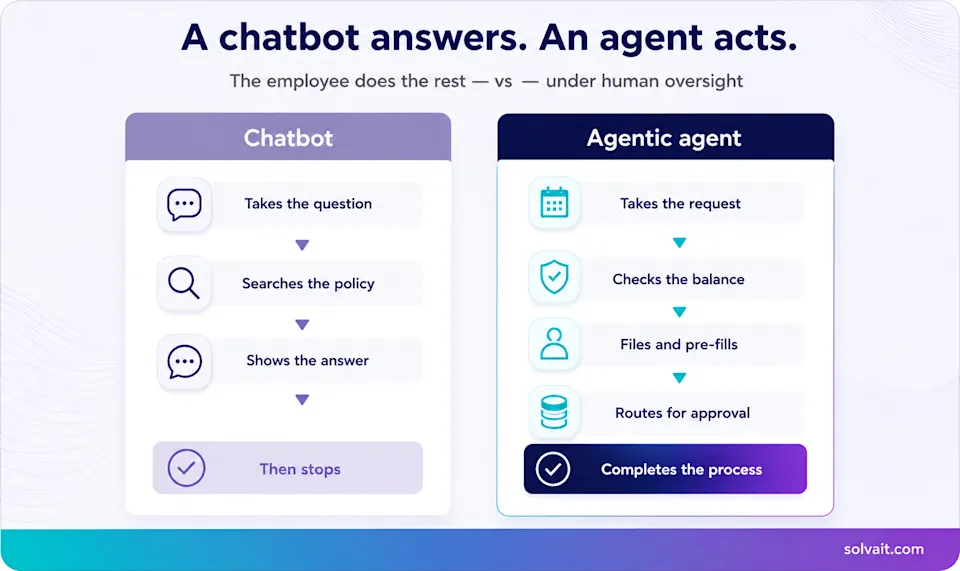
Here's the point that gets missed. Gartner draws the line precisely: until recently, language models generated text and summarized documents, but they couldn't take action on their own initiative. They acted on your prompt. Agentic AI changes that by planning and acting to complete a goal. That shift, from "responds to your command" to "executes your goal," is the whole story.
Why does this matter now, not in five years?
Because the market is moving from experiment to real deployment fast, and the gap between those who act now and those who wait is widening.
The numbers tell it plainly. Gartner expects 40% of enterprise applications to embed task-specific AI agents by the end of 2026, up from less than 5% in 2025. On value, McKinsey estimates AI agents could add between 2.6 and 4.4 trillion dollars annually across business use cases. This isn't a coming wave. It's happening now.
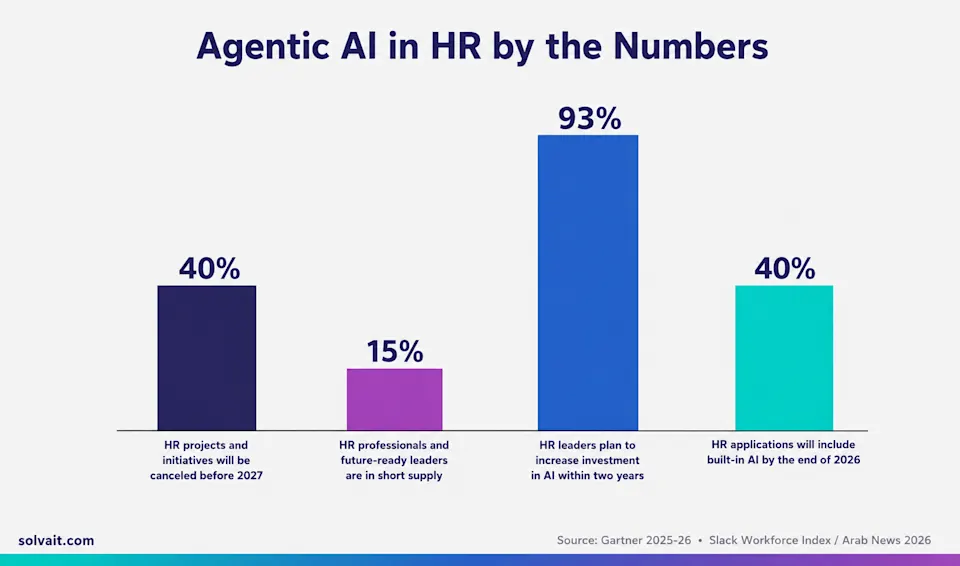
In Saudi Arabia, the momentum is sharper. The Kingdom ranked fourth globally in corporate AI adoption in the IMD 2026 competitiveness report and declared 2026 the Year of Artificial Intelligence. According to the Slack Workforce Index reported by Arab News, 93% of tech leaders intend to introduce autonomous agents within two years, and 40% already have. More telling still, SDAIA has defined six core capabilities for agentic systems: perception, reasoning, learning, action, collaboration, and memory. Action there isn't a footnote. It's a pillar.
But an honest caveat is due. The enthusiasm is running ahead of the readiness. Gartner found that just 15% of IT application leaders are genuinely considering deploying fully autonomous agents, and it warns that more than 40% of agent projects may be scrapped before 2027 on runaway costs and unclear value. The lesson isn't to hesitate. It's to build on the right foundation, with human oversight throughout.
Where does the agent sit on the maturity ladder?
The agent isn't the starting line. It's the top of a four-rung ladder, and jumping to the top without climbing the rungs below is why most projects fail.
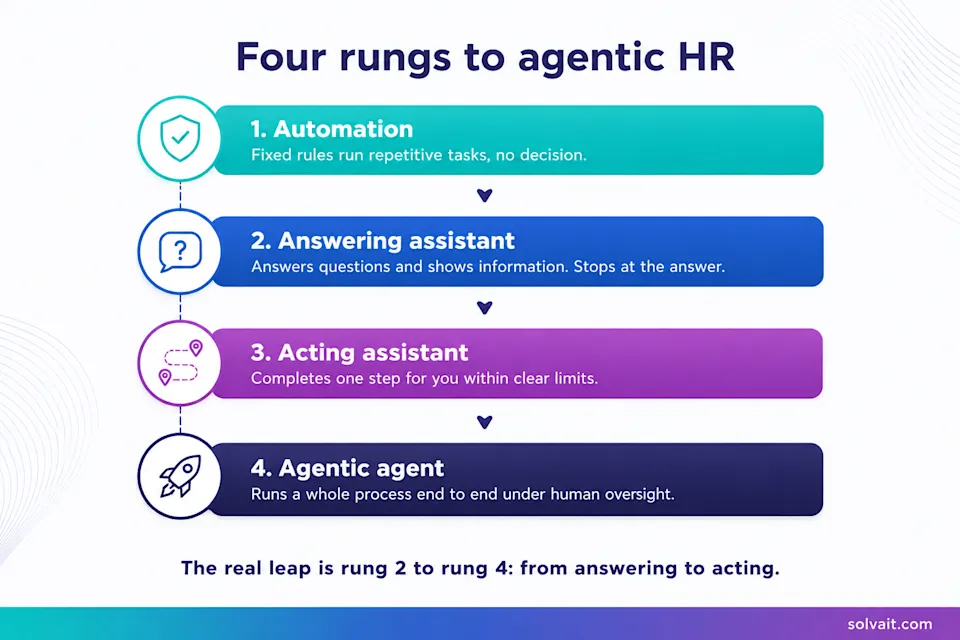
Rung one, automation: fixed rules run repetitive tasks with no decision, like an Iqama-expiry reminder. Rung two, the answering assistant: it answers questions and shows information, then stops at the answer. Rung three, the acting assistant: it completes a single step for you within clear limits. Rung four, the agent: it runs a whole process end to end under human oversight.
The real leap is from rung two to rung four: from answering to acting. Most competitors in the market stop at rung two and call it "AI." That's technically true, but it leaves the hard part, the execution, on the employee.
The practical comparison: answers vs. acts
Situation | Chatbot (answers) | Agent (acts) |
Leave request | Shows your balance, suggests logging in | Creates, pre-fills, and routes it for approval |
Salary question | Quotes the policy clause | Pulls your payslip and explains the lines |
Update details | Tells you where to find it in the system | Updates the field and logs it in the audit trail |
Who actually does it? | The employee | The agent, under human oversight |
When is its job done? | When the answer is shown | When the action is complete |
Look at that last row. A chatbot ends where the employee's real work begins. An agent carries the work to the end. That's the difference you won't see in the demo but you'll feel in every request.
What about control? Does the agent act unchecked?
No. A good agent is built to work within explicit limits under human oversight, and that isn't a constraint, it's a condition of success.
Gartner's 2026 report on agentic AI notes the emergence of whole new categories around governance, security, and cost control, reflecting rising enterprise concern about accountability. In practice, that means three things: an audit trail that logs every action, checkpoints where a human approves sensitive decisions, and clear limits on what the agent is allowed to do. The agent runs the repetitive routine; the human steers and decides at the turns.
That balance is the heart of the "AI for People" philosophy: AI serves the person rather than replacing them. The employee is freed for what needs human judgment, and the agent takes on what doesn't.
Where Solvait fits
Inside the Solvait app, this agentic logic shows up through Solvait ChatBot, the intelligent assistant that executes employee actions rather than merely answering them: leave requests, excuses, payslips, and policy questions, in Arabic and English, around the clock. The employee writes the request in natural language and the agent handles the rest through to approval, with a full audit trail and human oversight on every sensitive decision.
This is part of a wider system built on Microsoft Dynamics 365, from WPS and GOSI compliant payroll to performance and talent. The agent isn't a bolt-on feature. It's an execution layer on top of a complete HR system.
And if you want to see how an agent would run on your own organization's data, book a demo with Solvait.
FAQ
What is agentic AI in HR?
Agentic AI in HR is a system that completes HR actions on the employee's behalf under human oversight, rather than just answering questions. Instead of telling you your leave balance, it creates the request, pre-fills it, and routes it for approval. Its essence is the move from AI that answers to AI that acts.
What is the difference between an HR chatbot and an agent?
A chatbot's job ends when it shows the answer as text, leaving execution to the employee. An agent starts there: it checks, files the request, pre-fills it, and routes it for approval. The first saves you a question, the second saves you an entire piece of work.
Does an agent make decisions without human oversight?
No. A good agent works within explicit limits, with an audit trail logging every action and checkpoints where a human approves sensitive decisions. It runs the repetitive routine while judgment at the important turns stays with the human.
Is the Saudi market ready for agentic AI?
Yes, to a high degree. The Kingdom ranked fourth globally in corporate AI adoption in IMD 2026, declared 2026 the Year of Artificial Intelligence, and through SDAIA defined six capabilities for agentic systems, action among them. The regulatory and institutional momentum clearly favors adoption.
Where should an organization start on the path to agents?
At the foundation, not the top. Begin with automating repetitive tasks, then the answering assistant, then the acting assistant, up to the full agent. Organizations that jump straight to agents on top of immature processes usually fail, which is why Gartner expects more than 40% of agent projects to be scrapped before 2027.
References
Gartner: 40% of Enterprise Apps Will Feature Task-Specific AI Agents by 2026, 2025 (40% by end of 2026, up from under 5%).
Gartner: Just 15% of IT Application Leaders Are Deploying Fully Autonomous AI Agents, 2025 (readiness gap; 40%+ of projects expected scrapped before 2027).
McKinsey & Company: The economic potential of AI agents, 2025 (2.6 to 4.4 trillion dollars annually).
Arab News (Slack Workforce Index): Saudi Arabia's AI imperative: seizing the agentic enterprise, 2026 (93% intend to deploy agents within two years, 40% already have).
SDAIA via Saudi AI ecosystem analysis: Six capabilities for agentic systems, 2025 (perception, reasoning, learning, action, collaboration, memory).
SPA: SDAIA and the Kingdom's IMD 2026 ranking, 2026 (fourth globally in corporate AI adoption).
Ready to see Solvait in action?
Book a personalized demo and see how Solvait's AI-powered HR platform can transform the way your team works.
Tags
Related Posts

From Free Tool to Full Agentic HR: 3 Case Studies
How three Saudi companies moved from a free HR tool to full agentic HR. A practical story about the gap between AI adoption and real value.
Aug 10, 2026

AI in HR: How It Actually Works in the Saudi Market
How AI in HR moves from automation to AI agents in Saudi Arabia, by the numbers, plus where the free digital business card fits into the wider shift.
Aug 17, 2026

How Agentic AI Eliminates HR Team Burdens
How agentic AI is reshaping HR team size in Saudi Arabia and the GCC. What agents take over, what humans keep, and the ROI behind a leaner HR team.
Aug 2, 2026