
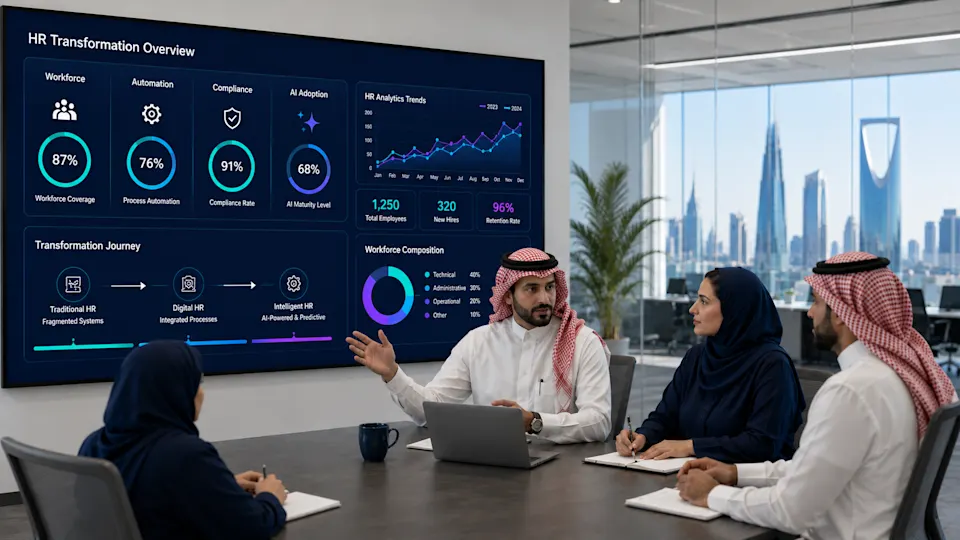
Why Vision 2030 Is Forcing Saudi CHROs to Rebuild Their HR Stack
Saudi CHROs are rebuilding their HR systems from the ground up because a stack designed for the pre Vision 2030 era can no longer keep pace with the speed of Saudization, digitization, and growth the Kingdom now demands. Human capital management is no longer a place to store employee records and run payroll. It has become the operating layer that decides whether a company can execute its strategy at all. Teams still running on scattered tools and manual spreadsheets pay for it in slow decisions, compliance fines, and good people who leave quietly.
This post lays out three forces driving the rebuild: the pressure Vision 2030 puts on the HR function itself, the shift of Saudi compliance into a daily task that punishes any error, and the move of AI from a helper into an agent that does the work. Then we get to what it means for your team.
Why does Vision 2030 press on the HR function specifically?
Vision 2030 changed the nature of work in Saudi Arabia before it changed the tools. The digital economy has reached roughly SAR 495 billion, about 15% of GDP, and women's participation in the tech sector rose from 7% in 2018 to 35% today, the highest rate in the region, according to Saudi Arabia's Ministry of Communications and Information Technology (2025). That growth means teams that scale fast, new roles created constantly, and Saudization targets that shift every year. The function that once managed a hundred employees on a spreadsheet now manages thousands across multiple entities.
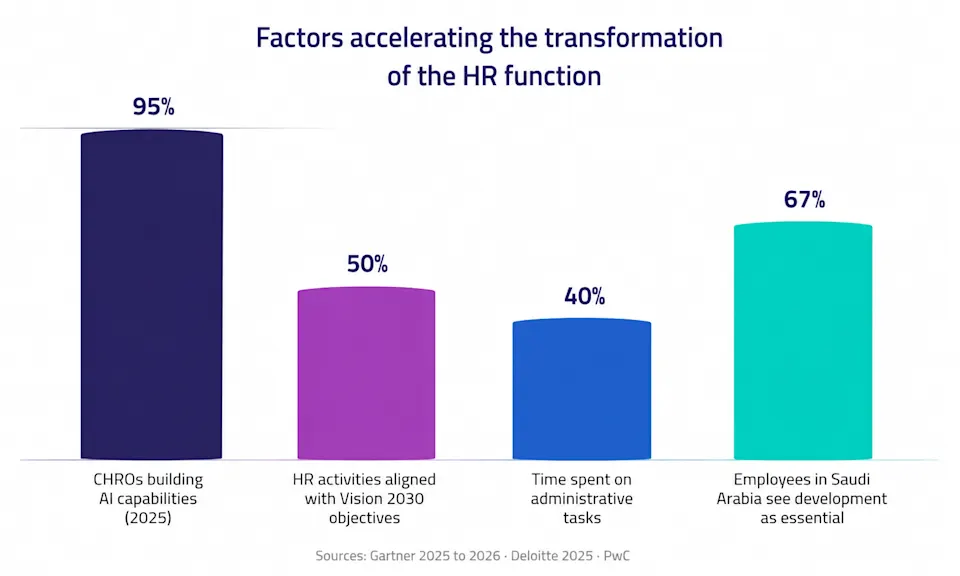
The trouble is that most HR teams haven't caught up. Deloitte's 2025 Global Human Capital Trends report, drawing on a survey of nearly 10,000 business and HR leaders, found managers spend close to 40% of their time on administrative tasks and immediate problem-solving. That time isn't going into building capability or planning. It goes into the same repetitive transactions, every single day.
On the employee side, 67% of workers in Saudi Arabia say upskilling is essential to doing their job well over the next five years, per PwC's Hopes and Fears Middle East survey. The workforce is ready to change. The systems serving it are not. That gap is where the pressure starts: an ambitious strategy sitting on top of an old operating layer.
How did Saudi compliance become a daily task that punishes error?
Compliance in Saudi Arabia stopped being a monthly event. It's a continuous cycle watched by interconnected government systems. Wage protection through Mudad, Saudization through Nitaqat and Qiwa, and contributions through GOSI all run on strict deadlines and direct integration. One error in a Wage Protection System file can lower a firm's compliance rating and freeze its services in Qiwa.
A team tracking this by hand lives in constant risk. A number in the wrong field, a missing bank account, a contract that never got updated, any one of them turns into a fine or a freeze. This is the line between managing compliance and being managed by it.
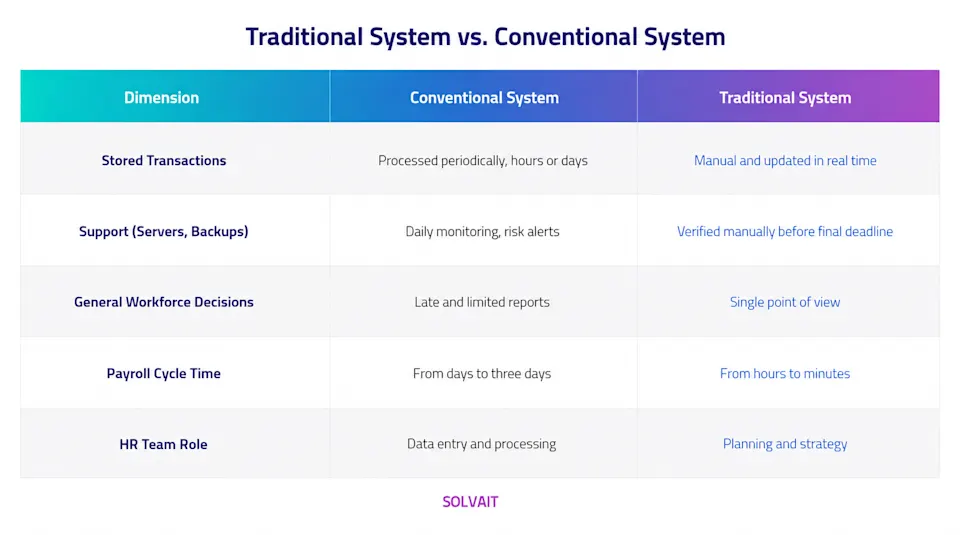
A modern stack flips the equation. Instead of the team chasing deadlines, the system validates every file before its due date, catches conflicts, and corrects common errors on its own. Compliance becomes a result of the design, not a race against the clock.
Has AI in HR moved from automation to agent?
Yes, and this is the deepest shift. Agentic HR is an approach to human resources management in which AI agents execute whole processes, from answering employees to validating payroll, under human oversight. What separates it from ordinary automation is that it doesn't wait for a command at every step. It completes the task end to end and presents the result for review.
The numbers show the scale of the shift. Gartner reports that AI adoption among CHROs reached 95% by the end of 2025, and that 50% of current HR activities will be AI automated or performed by AI agents by 2030. Gartner also expects 15% of day-to-day work decisions to be made autonomously through agentic AI by 2028, up from virtually none in 2024.
But adoption alone isn't the win. Gartner notes that nearly three-quarters of HR leaders report only moderate or minimal returns from their AI investments. The cause isn't the technology. It's the missing foundation that makes it work: unified data, local compliance rules, and clear human oversight. Buy an AI tool and bolt it onto a fragmented stack, and you get faster chaos, not better outcomes. That's exactly why the rebuild is happening. Adding AI isn't enough. The stack has to be built around it.
What does this mean for your team?
Companies rebuilding their stack aren't chasing a trend. The math changed. A team of eight people spending their day on repetitive transactions can become a smaller team that makes decisions, plus an agent carrying the operational load. Same payroll, a completely different impact.
This is where Solvait Wise comes in: an intelligence layer that runs on top of your existing system, reads workforce data, surfaces structural gaps, links goals to execution, and turns insight into an action plan. And if what you need first is a compliant HR and payroll platform aligned with Nitaqat, WPS, and GOSI, Solvait HCM is built on Microsoft Dynamics 365 and ready for the Saudi market. The two work together: one thinks, the other runs.
The human core doesn't change. Decisions that require judgment, context, and a read of the relationships stay with your team. What changes is that your team spends its time on those decisions, not on data entry.
To see it on your own organization's data, book a demo with Solvait.
FAQ
What is human capital management (HCM)?
Human capital management is a full approach to managing employees that brings recruitment, payroll, performance, and development into one system instead of separate tools. It treats people as a strategic asset whose impact on company performance is measured, not just records to store. In Saudi Arabia it also connects to compliance systems like Nitaqat and the Wage Protection System.
Why are Saudi companies rebuilding HR systems now?
Because Vision 2030 accelerated the growth of teams, roles, and Saudization at a pace manual tools can't handle. The digital economy has hit 15% of GDP, and compliance is now a daily, interconnected cycle across Mudad, Qiwa, and GOSI. Legacy systems produce slow decisions and compliance risk.
What's the difference between HR automation and agentic AI?
Automation runs a specific step on a specific trigger, like sending a notification when someone requests leave. Agentic AI completes the whole process end to end under human oversight, like reviewing a payroll file, validating it, correcting its errors, and filing it. The first waits for instructions. The second executes the goal.
Does AI in HR replace employees?
No. Per Gartner, AI automates repetitive tasks while decisions that require human judgment and context stay with the team. The clearest effect is that the team is freed to focus on planning and strategy instead of data entry, so its role changes rather than its headcount.
References
Saudi Ministry of Communications and Information Technology: Saudi Arabia's Digital Economy: A New Era of Tech Growth, 2025 (digital economy size and women's participation in tech).
Deloitte: 2025 Global Human Capital Trends, 2025 (share of managers' time on administrative tasks).
PwC Middle East: The Hopes and Fears of Employees Across Saudi Arabia, 2024 (share of workers who see upskilling as essential).
Gartner: The Future of AI in HR: Reinventing the Operating Model, 2026 (95% adoption and 50% of activities automated by 2030).
Gartner: Gartner Finds 38% of HR Leaders Piloting Generative AI, 2024 (generative AI adoption trend).
Ready to see Solvait in action?
Book a personalized demo and see how Solvait's AI-powered HR platform can transform the way your team works.
Tags
Related Posts
How to Choose an AI HR System in Saudi Arabia
A buyer's checklist of 7 questions that expose the real difference between AI HR systems in Saudi Arabia, before you sign the contract.
Oct 8, 2026
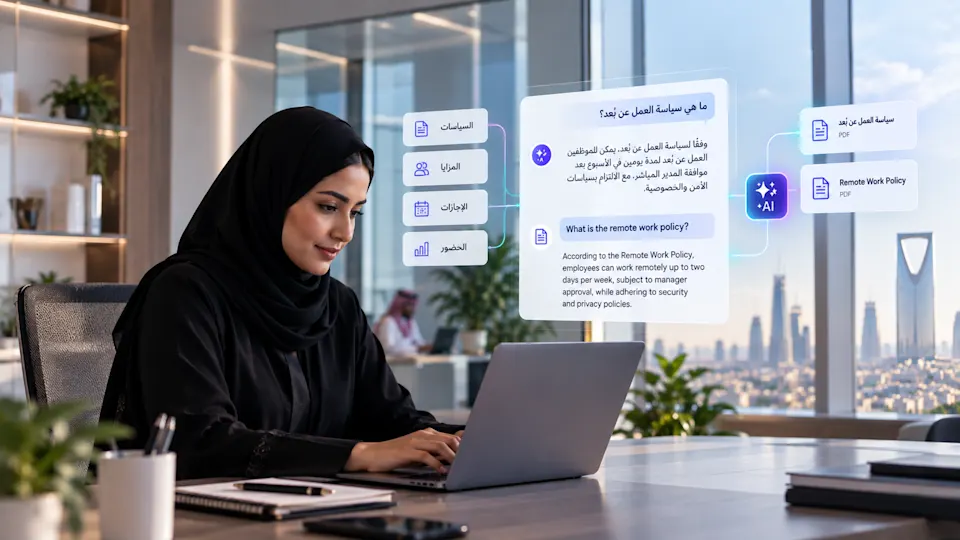
Build a Bilingual Arabic English HR Knowledge Base
A step by step guide to building an Arabic English HR knowledge base employees actually use, powered by agentic AI. Built for Saudi HR teams.
Sep 10, 2026
Future of HR in the GCC: 5 Predictions for 2027
Five practical predictions for the future of HR in the GCC by 2027, backed by Gartner, PwC , and what agentic AI means for Saudi and Gulf teams.
Aug 11, 2026