

Inside Mutaba'aa: The Compliance Agent Watching Your Saudi Deadline
Mutaba'aa is a compliance agent inside Solvait Agentic AI HR that watches your company's statutory deadlines across GOSI, Qiwa, Mudad and the Wage Protection System (WPS), and flags each one before it is missed, with your team making the final call. Put simply: instead of you chasing the deadlines, the agent chases them and puts each one in front of you before it becomes a violation.
The problem it solves is small to describe and expensive to ignore. HR compliance in Saudi Arabia is no longer a once-a-year event. It is a stream of overlapping monthly deadlines across several government platforms, and every missed one carries a direct regulatory cost. The Ministry of Human Resources now ties Qiwa contract documentation to your Saudization status itself, and a late salary in Mudad shows up as a logged violation on your record. The agent does not remove these deadlines. It turns them from one person's memory load into a monitoring system that runs around the clock.
Accuracy note: Mutaba'aa is currently rolling out on the Solvait platform. The core job, watching deadlines and alerting early, is available, and the deeper compliance checks are being added in stages. The final decision always stays with your team: the agent watches and prepares, you approve.
Key takeaways
Agentic AI for HR means agents that do real steps (monitor, cross-check, prepare an action) under human oversight, not a chatbot that only answers questions.
Saudi compliance deadlines sit across at least four authorities: GOSI, Qiwa, Mudad and WPS, and Nitaqat/Saudization, each with its own penalty for being late.
The fine for failing to document a contract electronically on Qiwa is SAR 1,000 per worker, and it multiplies by headcount (ministerial decision, 2026).
Mutaba'aa watches Iqama renewals, contract expirations and GOSI registrations, and alerts before a filing becomes overdue.
The real difference from a calendar reminder: the agent connects data across systems and prepares the next step, instead of firing an empty alert.
Why Saudi HR compliance deadlines break teams (and where agentic AI for HR fits)
Because the deadlines do not come from one place. An HR team at a mid size company tracks at least four government platforms by hand, each with its own cycle and its own penalties. The person responsible only has to be busy for a week, and a deadline slips. The result is not a friendly note. It is a logged violation.
Here is the full picture in one table:
Authority | What gets tracked | The risk if you are late |
|---|---|---|
GOSI (social insurance) | Contributor registration, wage edits, monthly contribution | SANED at 1.5% (0.75% each side), and a stepped pension rate for Saudis who joined from 3 July 2024 that rises every year |
Qiwa | Employment contract documentation, work permits, establishment services | SAR 1,000 fine per undocumented contract, plus a direct hit to your Saudization status and government services |
Mudad and WPS | Monthly payroll file upload and matching | Unreasonable or late wages appear as a violation, with alerts when a deduction exceeds 50% of pay or a basic wage goes unrecorded for over 90 days |
Nitaqat / Saudization | Localization rate and establishment band | A lower band restricts your ability to issue and renew work permits and visas |
The official record shows the burden rising, not easing. The Ministry of Human Resources and Social Development has tied Qiwa contract documentation to Saudization itself, so undocumented contracts affect access to labor and immigration services, per a 2026 analysis by EY. In Mudad, late or unreasonable wages now surface in the establishment's violations record, with automated alerts on large deductions, as Gulf News reported in 2025.
And this sits on top of the ordinary daily load. In a 2024 study of 250 managers by Payroll Integrations, HR managers averaged about 12 hours a week on payroll and benefits admin, roughly a quarter of the work week, and 27% spent 20 hours or more. Every hour spent chasing a date is an hour not spent on people.
Here is the part everyone gets wrong. The problem is not that the team does not know the rules. They know them well. The problem is that manual tracking does not scale. Ten employees fit in a spreadsheet. Six hundred, across four platforms, do not.
What does Mutaba'aa actually do?
It does four things, in order, around the clock. This is what "agentic" means: real work steps, not just answers.
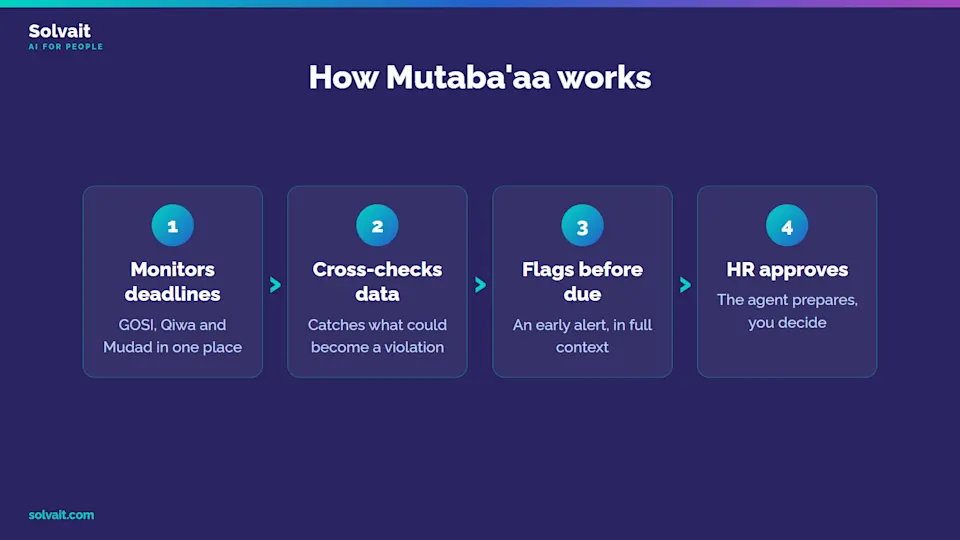
It monitors statutory deadlines across connected systems: Iqama renewals, Qiwa contract expirations, GOSI registrations, and the Mudad payroll filing window. One source of truth instead of four screens.
It cross checks data before the deadline and surfaces what could turn into a violation: a contract about to expire with no renewal, a basic wage not recorded, or a missing contributor in the GOSI file.
It flags before the action is overdue, not after. The alert arrives early and in full context: which company, which employee, which deadline, and what step is needed.
It prepares the next step and puts it in front of your team to approve: The agent does not act on its own for sensitive matters. It watches and prepares; the decision is yours. That is Solvait's stated model: the AI does the work, your team makes the calls.
This is where the agents work together. As payroll day approaches, the Rawatib (Payroll) agent drafts the monthly payroll for HR to review before release, while Mutaba'aa confirms the GOSI and WPS deadlines are in order before close. That is how AI can check payroll readiness before you close the run: not by guessing, but by matching data against the deadlines and rules, then showing you what needs attention.Because the agent is rolling out, it is fair to be clear about the limits. What is live today is deadline monitoring and early alerts across connected systems, and the deeper compliance checks are added in stages. The agent reduces human error. It is not a replacement for a compliance owner who understands your company's context.
How is agentic AI different from reminders and checklists?
The difference is who does the work. A reminder pings you, then leaves you to do it. A checklist waits for you to fill it in. An agentic system monitors, cross checks and prepares, then asks you to approve a step that is already done.
Criterion | Manual reminder / calendar | Checklist or basic HR system | Agentic compliance agent |
|---|---|---|---|
Monitors around the clock | No | Partly | Yes |
Connects data across systems | No | No | Yes |
Alerts before the deadline, in context | Sometimes | Generic alert | Yes, with detail |
Prepares the next step | No | No | Yes, for approval |
Final decision is human | Yes | Yes | Yes |
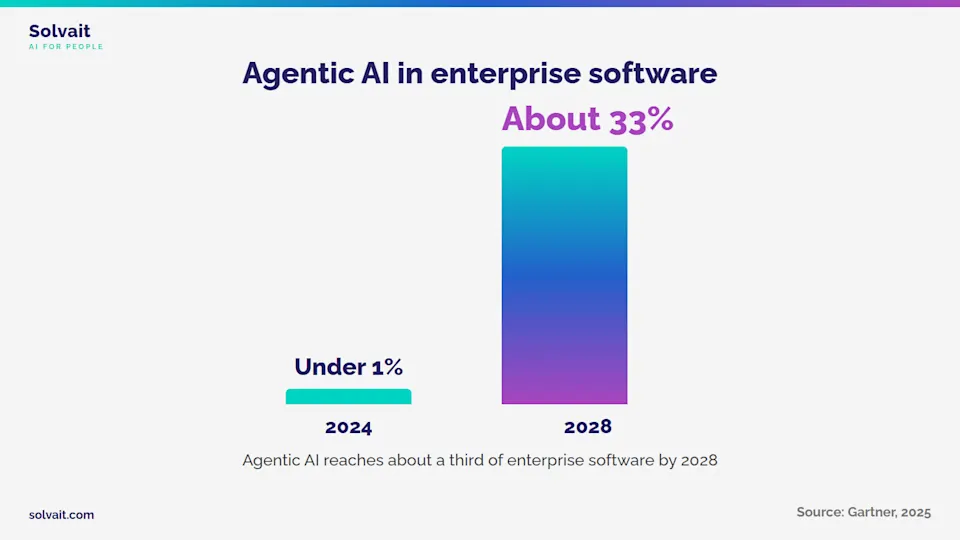
To be fair, regional HR platforms like Jisr and ZenHR already offer compliance calendars and deadline alerts, and for many smaller teams that is enough. What an agentic agent adds is that it does not stop at the alert: it connects data across systems and prepares the step for approval. Pick what fits your team's size and the complexity of your obligations, not what looks shiniest in a demo.This shift is bigger than Solvait. Gartner expects agentic AI to be built into about 33% of enterprise software by 2028, up from under 1% in 2024, and at least 15% of day-to-day work decisions to be made autonomously through these agents.
But the picture is not all upside, and it is only honest to say so. Gartner also warns that more than 40% of agentic AI projects may be cancelled by the end of 2027, on cost, weak risk governance, and vendors rebranding old tools as "agentic." The lesson is clear. An agent earns trust when it works inside human oversight and a defined scope, not when it is left to decide alone. That is exactly Solvait's model.
Solvait and the HR agents
Solvait AI HR is the HR platform built on Microsoft Dynamics 365. It runs the full HR lifecycle and adds four AI agents that work under your team's oversight:
Khidmat (Concierge): answers employees and handles requests over WhatsApp in Arabic. Meet it on the HR Assistant page.
Tashghil (Operations): routes approvals and day to day workflows.
Rawatib (Payroll): drafts the monthly payroll for your team to review before release.
Mutaba'aa (Compliance): watches compliance deadlines and alerts before they pass (rolling out).
At Solvait, "agentic AI" applies to this platform alone, not to the other products. The trust rests on Solvait's own verified numbers: more than 260 enterprise clients in Saudi Arabia and the Gulf, 99.9% uptime, a 30 day go live, with ISO 27001:2022 and a Microsoft Certified Partnership.
If you want to see GOSI, Qiwa and Mudad deadlines gathered into one view, start with the Solvait AI HR page. And for payroll teams that want to check wages before filing, try Solvait's free salary calculator, no sign up needed.
Want to see compliance turn from a deadline chase into a system that watches itself? Book a demo and let our team show you Mutaba'aa on your own company's data.
FAQ
Does Mutaba'aa submit filings for me automatically?
Not for sensitive matters. The agent monitors deadlines, cross-checks data, and prepares the next step, then puts it in front of your team to approve before anything happens. That is Solvait's model: the AI does the work, your team makes the calls. The agent is also rolling out, with capabilities added in stages.
Which systems does the compliance agent watch?
It watches statutory deadlines across connected systems: Iqama renewals, Qiwa contract expirations, GOSI registrations, and the Mudad and WPS payroll filing window. The goal is to gather them into one source of truth instead of four separate screens.
How is it different from a calendar reminder or a basic HR system?
A reminder pings you, then leaves you to work. An agentic agent connects data across systems, catches what could become a violation, and prepares the action ready for approval. The difference is that it does the work steps, not just send an empty alert.
How can AI check payroll readiness before I close the run?
By matching data against the deadlines and rules before approval: the Rawatib agent drafts the run for your team to review, while Mutaba'aa confirms the GOSI and WPS deadlines are in order. Whatever needs attention is shown to you, and the final approval stays a human decision.
References
Gartner: Gartner Predicts Over 40% of Agentic AI Projects Will Be Canceled by End of 2027, 2025 (33% by 2028, 15% of decisions, and the cancellation warning).
EY: Saudi Arabia tightens Qiwa contract rules and ties Saudization to documented Saudi employees, 2026 (Qiwa documentation tied to Saudization and services).
Gulf News: Saudi Arabia flags unreasonable wages and delayed payments as payroll violations, 2025 (Mudad violations and deduction alerts).
Gulf News: Saudi Arabia tightens employment contract rules with new digital verification system, 2026 (SAR 1,000 per undocumented contract).
GOSI: General Organization for Social Insurance, 2025 (contribution rates and social insurance changes).
Payroll Integrations: State of Payroll and Benefits, 2024 (about 12 hours a week on payroll and benefits).
Ready to see Solvait in action?
Book a personalized demo and see how Solvait's AI-powered HR platform can transform the way your team works.
Tags
Related Posts

GOSI Automation Saudi Arabia: Calculate, File & Audit
Calculate, submit and audit GOSI contributions in Saudi Arabia accurately, without a dedicated compliance specialist, using agentic payroll automation.
Aug 24, 2026

AI Payroll Error Detection: Catch Gaps Before You Post
How AI payroll error detection flags pay discrepancies before posting by comparing expected vs found and holding the wrong line.
Oct 11, 2026
How to Choose an AI HR System in Saudi Arabia
A buyer's checklist of 7 questions that expose the real difference between AI HR systems in Saudi Arabia, before you sign the contract.
Oct 8, 2026