

Expected vs Found: AI Payroll Error Detection Before You Post
Payroll error detection with AI means the system compares every salary in a pay run against the amount expected for that employee, before posting. It flags any unusual gap, holds the suspect line, and routes it to your team to decide. The idea is simple. Instead of finding the error after the pay lands in someone's account, the system catches it while the run is still a draft. The logic is the same for every row: "what should this person be paid?" against "what is the system actually showing?". When the two numbers diverge beyond an allowed threshold, an alert is raised and the line is held. No auto fix, no blind payout. The AI flags, and the call stays with whoever holds the authority on your payroll team.
Key takeaways
Modern payroll software doesn't just calculate, it checks the result: expected vs found, for every employee, before posting.
Most payroll errors are caught after payout, where clawing money back is hard and correction time piles up.
AI payroll error detection flags the gap and holds the wrong line, but it does not auto-fix.
In Saudi Arabia, a wrong line held before posting protects the WPS file and keeps you compliant with Mudad and GOSI.
The governing rule: the AI flags, your team decides.
Why do payroll errors slip past manual review?
Because manual review doesn't scale with headcount. Checking three salaries is easy. Checking eight hundred every month, line by line, in the tight window before payday, is a different job entirely.
The numbers back up the feeling. An EY study found that one in five pay runs at the average company contains at least one error over the course of a year, and that fixing a single error costs roughly $291 on average (US market data, cited here for illustration, not as a Saudi figure). What matters more than the amount is the timing. The error is usually found late, after the money has already reached the employee's account.
That's where the real problem starts. Recovering an overpayment from an employee after it's been paid is far harder than stopping it before posting. It turns into an awkward conversation, reversing entries, and amending files that were already filed with the authorities. A spreadsheet never warns you about the gap, because it doesn't know the "expected" figure in the first place. It only shows what was typed into it.
The error itself is usually mundane: an allowance added twice, a bonus booked to the wrong field, a contract that ended and wasn't updated, an absence day that wasn't deducted. Small mistakes, but they hit a number the employee sees in their account immediately.
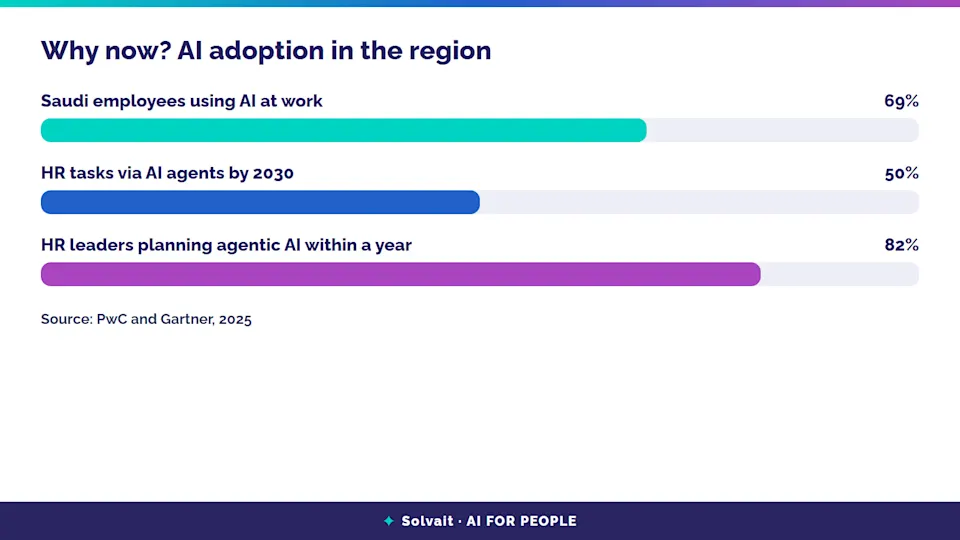
The context is shifting fast. Per PwC's Middle East Workforce survey for 2025, 69% of employees in Saudi Arabia use AI tools at work, against 54% globally. Gartner expects half of HR tasks to run through AI agents by 2030. The tools are here. The practical question is now where to point them first. Payroll is an excellent candidate, because it's repetitive, measurable, and any error in it is costly and visible.
How does AI validate payroll before posting?
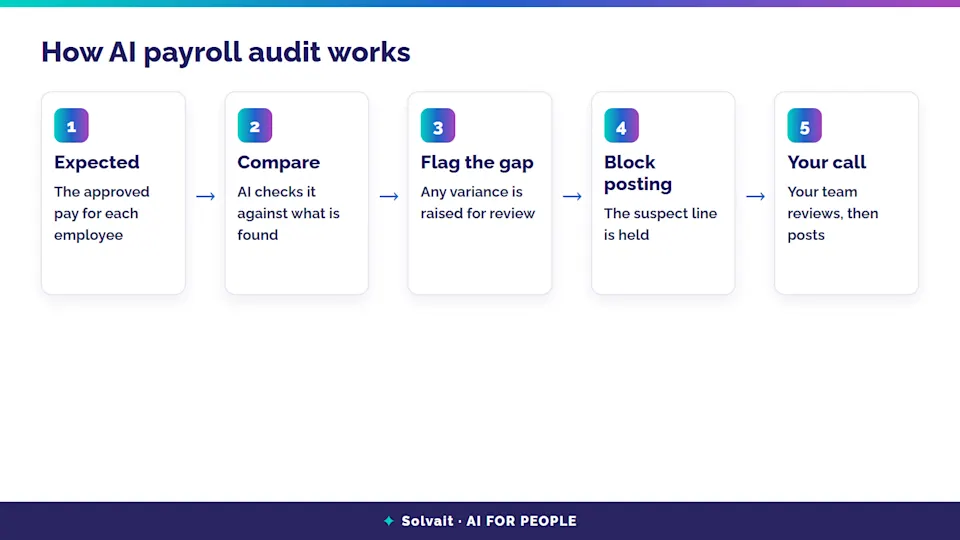
Through one principle: expected vs found. Every employee has an "expected" pay built from their contract, data, and history. When the run is prepared, the system computes the actual "found" amount, subtracts the two, and measures the variance. If the gap crosses a reasonable threshold, an alert is raised and the line's status changes to "posting blocked".
The output isn't just pass or fail. It's a gap with a number and a likely reason. That distinguishes a justified increase (an approved promotion or bonus) from a suspicious one (a data entry error). The human reviewer sees the full context and decides in seconds, instead of combing the whole list.
A worked example on three employees (illustrative numbers):
Employee | Expected | Found | Variance | Status |
Employee A | SAR 12,000 | SAR 9,500 | -2,500 | Posting blocked, review |
Employee B | SAR 8,000 | SAR 8,000 | 0 | Match |
Employee C | SAR 15,500 | SAR 15,500 | 0 | Match |
Two matching rows pass quietly. Only the first line is held. Your team isn't reviewing eight hundred rows, just the ones the system flagged. That's the shift: from checking everything with tired eyes, to reviewing only what deserves it.
The key point is that the system reads the numbers, it doesn't write them. No correction happens behind your back. The line stays held until a person touches it.
Why does the final call stay with your team?
Because a payout is a responsibility, not just a process. And this is where a genuine agent parts ways with marketing noise.
Gartner has warned that more than 40% of agentic AI projects will be canceled by the end of 2027, many of them "old tools repackaged" as agentic, without real autonomy or governance. The lesson is clear. The agent you can trust in payroll isn't the one that "fixes" numbers on its own. It's the one that flags precisely, explains why, then leaves the decision to the person with authority.
In payroll specifically, forcing an automatic decision is a double risk. It might hold a correct salary and delay someone's rightful pay, or wave through an error it mistook for correct. So the rule we build on is simple: the AI flags, you decide. Approval stays a human signature, and a clear trail records who reviewed and who approved.
Manual review | AI payroll audit | |
Coverage | A sample of rows | Every row, every cycle |
When errors surface | Often after payout | Before posting |
Basis | Spreadsheets and memory | Expected vs found |
On a variance | Can slip through | Holds the line and alerts |
Who decides | Human | Human (AI only flags) |
For Saudi compliance, this governance isn't a luxury. A wrong line held before posting means a cleaner WPS (Wage Protection System) file, a more accurate payment through Mudad, and GOSI contributions calculated on correct figures. Amending those files after they're submitted is costly and messy, so preventing the error up front is cheaper and calmer.
What's the most common mistake with AI in payroll?
The most common mistake we hear about "AI in payroll" is imagining a system that changes the numbers on its own. That isn't auditing, it's a gamble. Good auditing does three things and stops: it flags the gap, gives you a likely reason, and holds the line until you decide. The edit stays a human action with clear authority.
The difference isn't semantic. A system that "auto fixes" moves responsibility into a black box nobody reviews, which is exactly what makes so many projects fail. A system that "flags and holds" keeps your team in the driver's seat. You get machine speed with human judgment.
How does Solvait's payroll software handle this?
Solvait Agentic AI HR is built on Microsoft Dynamics 365 and runs the full payroll cycle, WPS, GOSI, and Saudi compliance ready. Inside it sits the payroll agent Rawatib, which prepares and audits the run. It compares expected against found for every employee and surfaces pay gaps before posting, with a clear status on each line. Anything held doesn't pay out until your team reviews and approves it.
Solvait backs this with its own numbers: 260+ enterprise clients across Saudi Arabia and the Gulf, 99.9% uptime, around 50% operational time savings, a 30 day go live, and ISO 27001:2022 certification. These aren't generic promises, they're real operating figures.
Before you replace your whole payroll platform, try a small step. Use Solvait's free salary calculator to estimate ranges and compare them against what you actually pay (no sign up, no data collection). For more on market pricing, see the Saudi salary benchmark guide.
Want to see payroll audit on your own data? Book a demo with Solvait and we'll show you how a wrong line gets held before it reaches anyone's account.
Frequently asked questions
How do I use AI to validate payouts before payroll?
Turn on an audit that compares each salary to its expected amount before posting. The system computes the gap between expected and found, raises an alert on any line that crosses the threshold, and holds its posting until your team reviews it. The AI only flags, and approval stays a human decision.
How can we eliminate manual spreadsheet errors in our salary review process?
By moving from sampling a spreadsheet to an automated audit that checks every row in every cycle. Instead of relying on memory and time, the system compares expected against found and holds whatever is off, narrowing the review to the lines you actually need to see.
How do agentic payments improve accuracy and reduce manual errors?
An agent checks each line against its expected value and holds anomalies before money moves, so errors are caught before payout rather than after. It flags and explains, but doesn't pay or correct on its own. That pairs machine-speed checking with a human approval step, which cuts both missed errors and blind payouts.
What's the difference between payroll calculation and payroll audit?
Calculation produces the number. Audit verifies it. Payroll software computes earnings and deductions, then an AI audit layer checks that the result is sensible against the expected figure before it lands in the employee's account.
Does this support Saudi compliance?
Yes. Holding a wrong line before posting protects the accuracy of the WPS (Wage Protection System) file, payment through Mudad, and GOSI contributions. Correcting those files after submission is harder and costlier than preventing the error up front.
References
EY: Payroll errors and their cost, 2023 (one in five pay runs contains an error; about $291 to fix one error; US context, illustrative).
Gartner: Agentic AI in HR: Strategic Foundations for CHROs, 2025 (half of HR tasks via AI agents by 2030).
Gartner: Over 40% of agentic AI projects will be canceled by 2027, 2025 (human governance and avoiding "agent washing").
PwC: Middle East Workforce Hopes and Fears Survey 2025, 2025 (69% of Saudi employees use AI vs 54% globally).
Solvait:Solvait Agentic AI HR, 2026 (Rawatib payroll agent; operating figures: 260+ clients, 99.9% uptime, 50% time savings, 30-day go-live, ISO 27001:2022).
Ready to see Solvait in action?
Book a personalized demo and see how Solvait's AI-powered HR platform can transform the way your team works.
Tags
Related Posts

GOSI Automation Saudi Arabia: Calculate, File & Audit
Calculate, submit and audit GOSI contributions in Saudi Arabia accurately, without a dedicated compliance specialist, using agentic payroll automation.
Aug 24, 2026

GOSI Mistakes in Saudi Arabia
How small GOSI mistakes snowball into large fines in Saudi Arabia, and how to catch them before they become violations.
Jul 1, 2026

Saudi Labour Law Automation: 9 Clauses to Enforce
Nine Saudi labour law clauses your HR system should enforce automatically after the 2025 reforms, from probation caps to WPS files.
Aug 30, 2026