
Benchmark Any Saudi Salary in 30 Seconds (Free Tool)
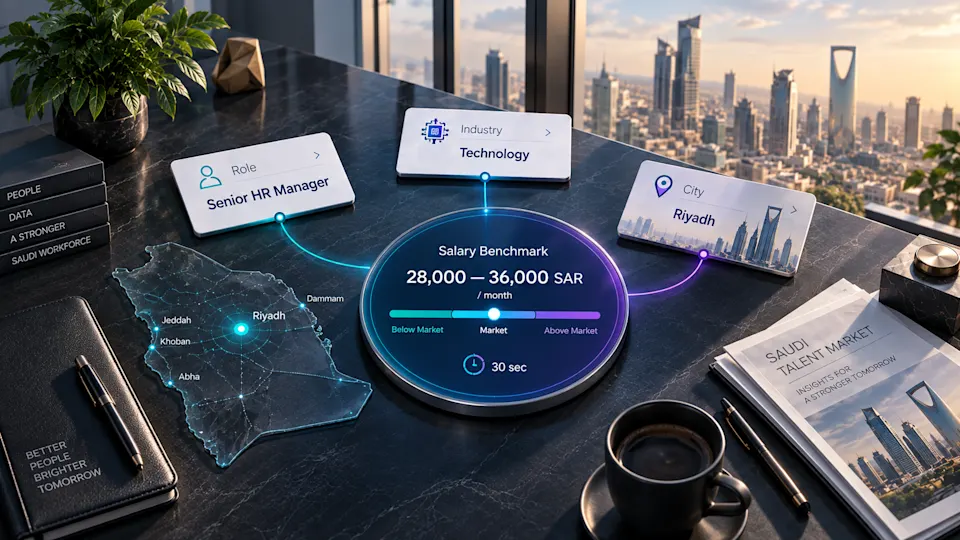
Salary benchmarking is the practice of comparing a specific role's pay against the market range for that same role, so you get a low, median, and high to guide hiring or raises. Solvait's free salary calculator gives you that range for the Saudi market in under 30 seconds: enter the role, sector, and city, and you get a number you can defend to finance and to the candidate. Try it now at the salary calculator.
The idea is simple, but skipping it is expensive. Most pay decisions in Saudi companies still rest on an old spreadsheet, a figure a manager heard from a peer at another firm, or a guess. In a market where pay moves fast, a guess means you either overpay and strain the budget, or underpay and lose the candidate after the first interview.
Why is pricing a salary accurately harder in 2026?
The Saudi market is moving. The average monthly wage across four sectors sits at about SAR 10,238 according to the General Authority for Statistics (GASTAT), with the average for Saudi nationals around SAR 10,016. That single number hides wide gaps between sectors and cities, and that's exactly where you go wrong when you lean on a broad average instead of a precise range.
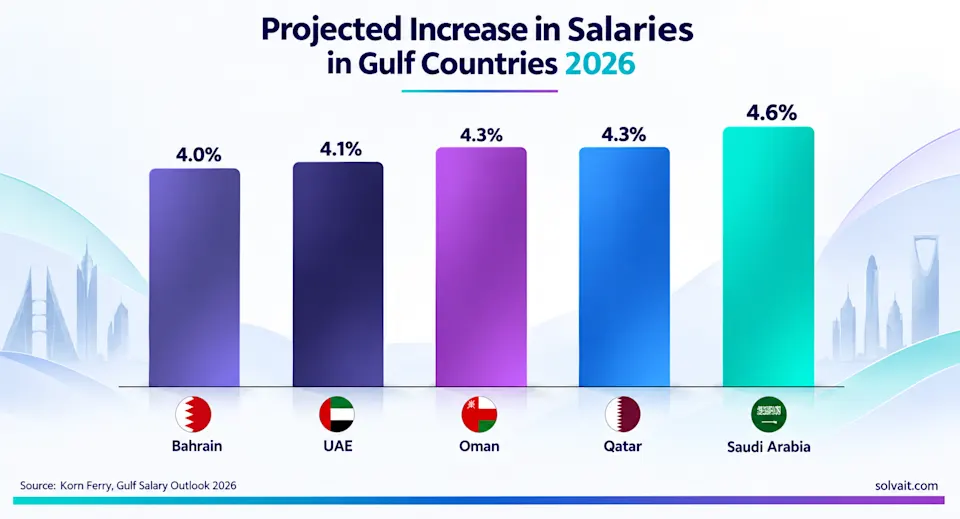
Upward pressure on pay is steady. Korn Ferry projects Saudi Arabia will lead the GCC on average salary increases in 2026 at 4.6%, ahead of Qatar and Oman at 4.3%. A raise of that size across a full payroll base means last year's range no longer holds this year.
Behind those figures is a crowded labour market. Saudi unemployment fell to 6.3% in Q1 2025, the lowest level on record, hitting the Vision 2030 target roughly six years early. Competition for Saudi talent has sharpened, and an accurate salary has become a negotiating card rather than a nicety.
How do you benchmark a Saudi salary in 30 seconds?
A good benchmark isn't one number. It's a range built on the actual factors that move pay. Solvait's tool runs through four steps:
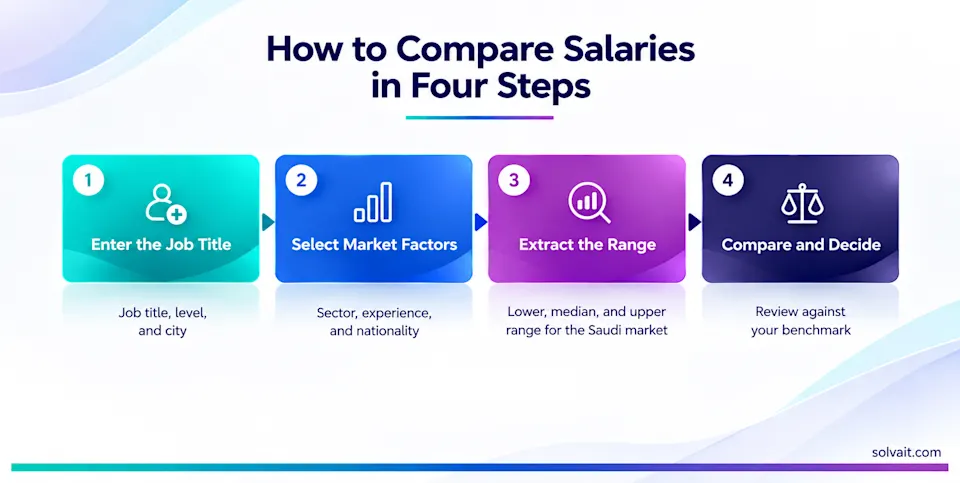
Enter the role:Job title, level, and city. A software developer in Riyadh isn't priced like one in Dammam, and the tool accounts for that.
Set market factors: Sector, years of experience, and nationality where it affects the package.
Pull the range: You get a low, median, and high for the Saudi market, not a bare figure.
Compare and decide: Put your offer or an employee's current pay next to the range, and you see where you stand at once.
The practical difference between this and guessing shows up when you sit across from the finance director. A number built on a current market range survives that conversation. A number pulled from last year's sheet doesn't.
When do you actually need to benchmark pay?
Three situations repeat in every Saudi HR team, and in each one the missing range costs you:
When building a job offer, the range stops you from losing a candidate with a lowball, or from padding the budget with an offer that's higher than it needed to be. During a performance and merit increase cycle, it gives you a fair basis to explain why one employee got a bigger raise than another. And when reviewing your pay structure, it shows where a department is paying below market before the gap turns into resignations.
Here's a number worth pausing on. Mercer's research shows employees who perceive their pay as fair are 85% more engaged and 60% more committed to the organization. Fair pay isn't felt from nowhere. It comes from your ability to benchmark against the market and then explain the basis. That's why benchmarking has become part of retention, not just a hiring tool.
Benchmark vs. guesswork
The gap isn't only accuracy. It's speed and whether you can defend the decision:
Criterion | Guessing or old sheet | Live benchmark |
Reflects the 2026 market | No | Yes |
Adjusts for city and sector | No | Yes |
Ready before the offer goes out | No | Yes |
Defensible to finance | No | Yes |
Time to a number | Days | 30 seconds |
General free tools like LinkedIn Salary or Glassdoor are useful for a quick look, but they blend markets and countries and rarely reflect Saudi pay by city and sector. A tool built on the local market gets you closer to the number you'll actually sign off on.
Where guesswork stops: even the tool has limits
I won't oversell it. Any salary calculator gives you a guide range, not a final price. A candidate with a rare skill can clear the top of the range on merit, and the full package (allowances, insurance, end of service benefits, growth prospects) feeds the final call. The tool gives you the right starting point and the case for finance. The final judgment stays a human decision rooted in context.
Where does Solvait fit?
The salary calculator is a free tool in Solvait's set built for HR teams across Saudi Arabia and the Gulf. It gives you the market range fast, with no heavy sign up.
When you move from benchmarking one salary to running payroll for hundreds of employees, that's where Solvait HCM, built on Microsoft Dynamics 365, comes in: payroll that is WPS and GOSI compliant, employee self service, and pay data linked to appraisal and performance. The range you pull from the calculator becomes part of one loop: from pricing, to paying, to reviewing.
Try it now: benchmark any Saudi salary for free at the salary calculator.
Next step: to see how payroll and performance run in one platform built for Saudi compliance, book a demo.
FAQ
What is salary benchmarking?
Salary benchmarking is the process of comparing a specific role's pay against the market range for that same role, giving you a low, median, and high. HR teams use it to set job offers, guide merit increases, and review pay structures so they stay competitive against the market without blowing the budget.
What is the average salary in Saudi Arabia?
According to GASTAT, the average monthly wage across four sectors is about SAR 10,238, and the average for Saudi nationals is around SAR 10,016. That average hides wide gaps between sectors, cities, and levels, so it's better to benchmark the specific role than to rely on the broad number.
How much will salaries rise in Saudi Arabia in 2026?
Korn Ferry projects Saudi Arabia will lead the GCC with an average salary increase of 4.6% in 2026, followed by Qatar and Oman at 4.3%. These are projections, not guarantees, and they vary by sector, role, and company performance.
Is Solvait's salary calculator free?
Yes. The salary calculator is a free tool aimed at HR teams in Saudi Arabia and the Gulf. It returns the market range for a role by sector and city in seconds, which makes it useful for a quick check before you build an offer or review pay.
Is a benchmark enough on its own to set an offer?
No. A benchmark gives you a guide range and a basis for discussion, but the final decision weighs the candidate's rare skills, the full package of allowances and benefits, and growth prospects. The tool is a starting point. The final call is a human decision rooted in context.
References
General Authority for Statistics (GASTAT): Saudi Workers Monthly Average Wage in Four Sectors (supports SAR 10,238 and SAR 10,016 averages)
Korn Ferry: GCC/UAE Salary Forecast 2026, via Gulf Business, 2025 (supports the 4.6% Saudi increase)
GASTAT / Ministry of Human Resources, via Arab News & Qoyod: Payroll Trends in Saudi Arabia, 2025 (supports 6.3% Saudi unemployment and the Vision 2030 target)
Mercer: 2025 Global Pay Transparency Report, 2026 (supports 85% more engaged and 60% more committed on perceived fair pay)
Ready to see Solvait in action?
Book a personalized demo and see how Solvait's AI-powered HR platform can transform the way your team works.
Tags
Related Posts

Build a Bilingual Arabic English HR Knowledge Base
A step by step guide to building an Arabic English HR knowledge base employees actually use, powered by agentic AI. Built for Saudi HR teams.
Sep 10, 2026
Holding Company Workforce Intelligence in Saudi Arabia
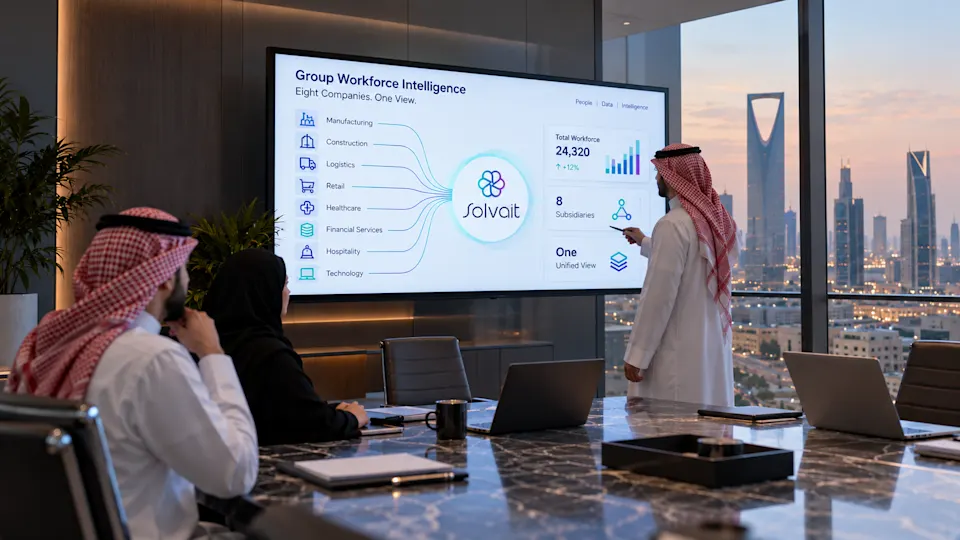
How a Saudi holding company unifies eight subsidiaries into one workforce intelligence view. A practical four layer guide for multi entity groups.
Sep 9, 2026
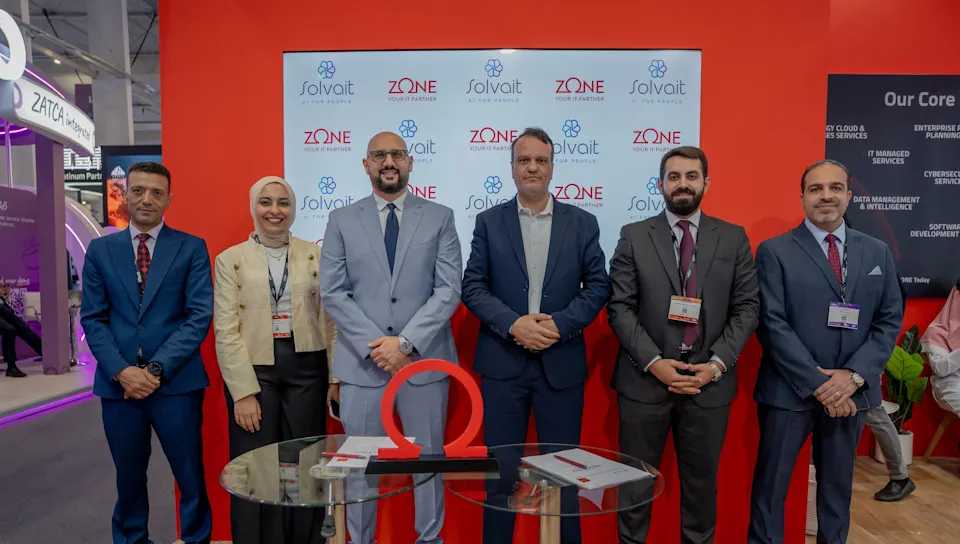
Solvait and ZONE Partner to Expand AI Solutions
Solvait and ZONE sign a strategic partnership uniting an AI native HR platform with proven digital transformation delivery for Saudi enterprises .
Sep 8, 2026