
Saudi Payroll Calculator
Calculate employee salaries accurately with social insurance contributions, allowances, and deductions in compliance with Saudi Arabia's laws and regulations.
Employee Information & Salary Details
Enter employee information and salary details
* Required fields

Free Tool: Calculate Any Saudi Salary in 30 Seconds (No Signup, No Data Capture)
A free Saudi salary calculator is a browser tool that converts a gross salary into net pay by applying the correct GOSI contribution, the SAR 45,000 contribution ceiling, and end of service accrual under Saudi Labor Law. Solvait's version does this in under 30 seconds. You type in a figure, pick Saudi or expat, and read the result. No account, no email, nothing stored. Use the tool.
That is the whole pitch, and the rest of this page explains why a calculator that sounds trivial is actually doing work that trips up real payroll teams every month. Saudi Arabia has no personal income tax, so people assume the math is easy. It isn't. The hard part isn't tax. It's GOSI rates that changed in July 2025, a contribution base that excludes some allowances but not others, a wage cap most spreadsheets ignore, and an end of service formula with two different accrual tiers. Get one of those wrong and you either underpay an employee or overstate a liability on your books.
Why calculating a Saudi salary is not as simple as it looks
Here is the part most people miss: in Saudi Arabia, gross does not equal net for Saudi nationals, even though there's no income tax. The deduction is GOSI, the General Organization for Social Insurance, and the rate is now a moving target.
As of July 2025, a new social insurance scheme applies to Saudi employees who had no GOSI subscription before July 3, 2024. For those new entrants, the pension contribution rose from 9% to 9.5% for both employee and employer, and it climbs 0.5% every year until it reaches 11% in 2028, according to the General Organization for Social Insurance reform summarized by Mercans. Existing subscribers stay on the older rates. So two Saudis sitting at adjacent desks, same salary, same employer, can have different deductions purely because of when they first registered with GOSI. A spreadsheet built in 2023 has no idea this happened.
Then there's the base. GOSI is not calculated on the full salary. It applies to basic wage plus housing allowance only, and only on the portion between SAR 1,500 and a ceiling of SAR 45,000 per month, as RemotePass documents in its KSA calculation guide. Transport allowance, phone, and most other line items sit outside the base. People routinely include them by mistake, which inflates the deduction and quietly shortchanges the employee.
Expats are a different rule entirely. They contribute nothing. The employer pays 2% for occupational hazard cover, capped at the same SAR 45,000, and that's it. No pension, no unemployment cover. So the same gross figure produces a completely different net depending on one field: nationality.
And none of that touches the most error prone calculation of all, which is end of service.
Salary element | Counts toward GOSI base? | Counts toward end of service? |
Basic wage | Yes | Yes |
Housing allowance | Yes | Yes (fixed allowance) |
Transport allowance | No | Yes if fixed in contract |
Performance bonus | No | No |
GOSI ceiling | SAR 45,000/month | No ceiling |
Notice the basic wage and housing rows behave one way for GOSI and another for end of service. That single distinction is responsible for a large share of final settlement disputes. It is also exactly the kind of thing a calculator gets right every time and a tired human at month end does not.
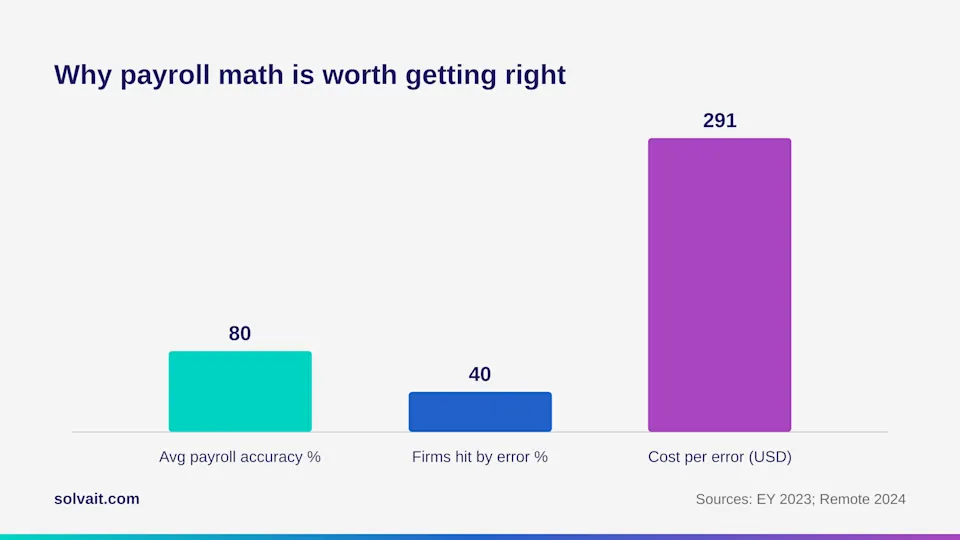
The cost of getting it wrong is not hypothetical. EY's payroll research found the average company runs at about 80% payroll accuracy and makes roughly 15 corrections per pay period, with each error costing around USD 291 in combined direct and indirect cost, as reported by HR Dive. Separately, Remote's 2024 global payroll study found that 40% of employees had hit a payroll error in the past year. Most of those start as a small math slip on a single payslip.
Who needs a Saudi salary calculator
Short answer: more people than you'd think, and not just payroll clerks.
HR teams use it during offer negotiations. A candidate asks "what will I actually take home?" and the recruiter needs a credible number on the spot, not "let me check with finance and call you back." For a Saudi hire, the recruiter also has to keep one eye on the SAR 4,000 Nitaqat threshold, because a Saudi paid below that doesn't count toward the company's Saudization quota, as Commoner Law explains. A fast calculator turns a stalled conversation into a closed offer.
Finance and payroll use it to sanity check the system before the WPS file goes out. When your payroll software produces a net figure that looks off, a quick independent calculation tells you in seconds whether to trust it or dig in. It's a second opinion that costs nothing.
Recruiters and EOR providers use it to quote total cost of employment. The contract salary is only the start. Layer on the employer's GOSI share, end of service accrual, and the SAR 45,000 cap logic, and the real monthly cost of a hire is meaningfully higher than the headline number. Quoting the headline number and surprising the client later is how deals go sideways.
Employees use it most of all, and this is where the no signup, no data capture promise earns its keep. An employee checking whether their employer deducted GOSI correctly does not want to hand their salary to a website that emails them for the next six months. They want an answer and an exit. A worker can also verify their own status directly on the GOSI portal using their Iqama number, but a calculator is faster for a quick what if.
There's a reason the privacy angle matters here specifically. Salary is sensitive. A lot of "free" calculators online are lead magnets that capture your email, your number, and sometimes your actual pay figure before they show you anything. A tool that stores nothing is not just polite. For salary data, it's the right default.
How Solvait's free salary calculator helps in under 30 seconds
You open it. You enter a gross monthly salary. You select Saudi national or expat. You read the breakdown. That's the entire interaction, and it's deliberate.
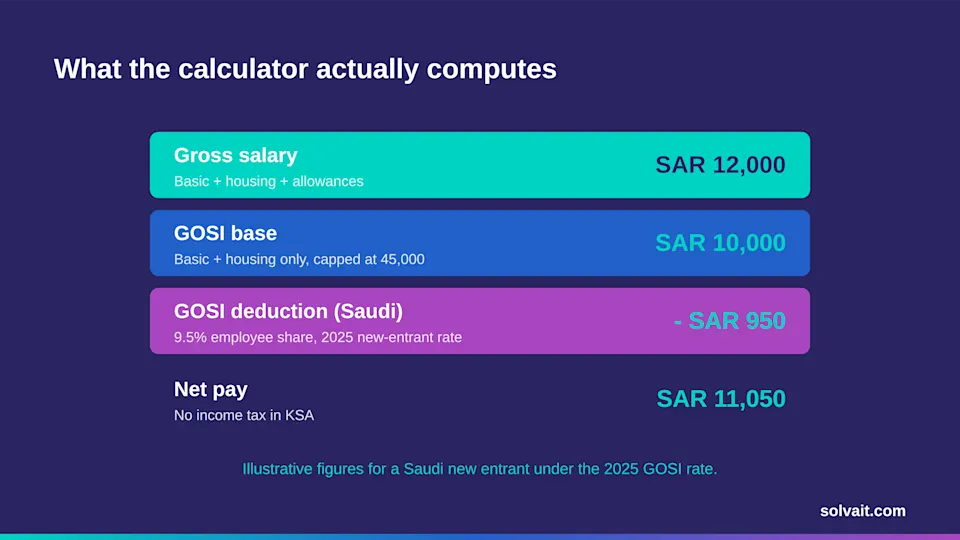
Under the hood it applies the current 2025 GOSI rate for the category you pick, calculates the contribution on the correct base of basic plus housing, respects the SAR 45,000 ceiling, and shows you net pay. Because there's no income tax in Saudi Arabia, for an expat the net usually equals the gross, and the tool says so plainly instead of inventing a deduction that doesn't exist. For a Saudi, it shows the employee GOSI share coming out and the employer share sitting alongside, so finance sees the true cost, not just the take home.
It also handles end of service, the calculation people dread. The Saudi Labor Law formula under Article 84 is a half month's wage for each of the first five years and a full month's wage for every year after that, based on the last wage, as set out in the EOSB guidance from Middle East Briefing. Resignation changes everything: under Article 85, someone resigning between two and five years gets one third, between five and ten years gets two thirds, and only at ten years or more gets the full amount. Most manual attempts forget the resignation tiers and overpay. The calculator doesn't.
Here's the honest limitation, because every tool has one. A 30 second calculator gives you a clean estimate on the standard cases. It will not model a messy real world settlement with unpaid leave balances, mid year salary changes, commission structures, and an Article 80 dismissal all at once. For that you need a payroll engine that holds the full employee record. What the calculator does is catch the 90% of questions that don't need that machinery, and flag when you're in the 10% that does.
Task | Manual spreadsheet | Free calculator |
Apply the correct 2025 GOSI rate | Easy to get wrong | Built in |
Respect the SAR 45,000 GOSI cap | Often missed | Automatic |
End of service in seconds | Slow, error prone | Instant |
Saudi vs expat logic | Manual lookup | One toggle |
Data stored | Depends on the file | None |
When a quick estimate turns into "we need to run this for 600 people every month, with WPS files, GOSI filings, and Qiwa contracts in sync," that's the point where a calculator hands off to a real system. Solvait HCM, built on Microsoft Dynamics 365, runs payroll with WPS and GOSI handling for the whole workforce, not one employee at a time. The calculator answers the question; the platform runs the operation. If you've outgrown the spreadsheet, book a demo.
Frequently asked questions
Is the Saudi salary calculator really free, with no signup?
Yes. Solvait's salary calculator runs in your browser, requires no account or email, and stores none of the figures you enter. You type in a salary, get the GOSI and net pay breakdown, and close the tab. Nothing is saved or sent anywhere, which matters because salary is sensitive personal data.
How is net salary calculated in Saudi Arabia?
Saudi Arabia has no personal income tax, so for expatriates net pay usually equals gross pay. For Saudi nationals, GOSI is deducted from basic wage plus housing allowance, at 9.5% for new entrants under the 2025 scheme, capped at a base of SAR 45,000 per month.
applies the correct rate automatically.
What is the GOSI contribution rate in 2025?
For Saudi new entrants with no GOSI history before July 3, 2024, the employee pension contribution is 9.5% as of July 2025, rising 0.5% yearly to 11% by 2028. Existing subscribers remain on earlier rates. Expats contribute nothing; the employer pays 2% for occupational hazard cover.
How do I calculate end of service in Saudi Arabia?
Under Article 84, you get a half month's wage for each of the first five years of service and a full month's wage for each year after that, based on your last wage. If you resign, Article 85 reduces it: one third for two to five years, two thirds for five to ten years, and the full amount only at ten years or more.
Does the calculator work for both Saudis and expats?
Yes. A single toggle switches the logic. For Saudis it applies GOSI on basic plus housing and shows the employee deduction and employer share. For expats it shows that there's no employee GOSI deduction, since expat contributions are employer paid and limited to occupational hazard cover.
References
EY via HR Dive: Employers make 15 corrections per pay period on average, 2023 (backs 80% payroll accuracy, 15 corrections, USD 291 per error)
Middle East Briefing: End of Service Benefits Under Saudi Arabia Labor Law, 2024 (backs the Article 84 accrual formula)
Commoner Law: Minimum Wage, Saudi Arabia, 2026 (backs the SAR 4,000 Nitaqat threshold)
Ready to see Solvait in action?
Book a personalized demo and see how Solvait's AI-powered HR platform can transform the way your team works.
Tags
Related Posts

Saudi Labour Law Automation: 9 Clauses to Enforce
Nine Saudi labour law clauses your HR system should enforce automatically after the 2025 reforms, from probation caps to WPS files.
Aug 30, 2026

AI Employee Data Validation: A Pre-Payroll Readiness Scan
Solvait's AI Employee Data Validation scans employee data before payroll . Built into Solvait HCM.
Sep 15, 2026

Benchmark Any Saudi Salary in 30 Seconds (Free Tool)
Solvait's free salary calculator gives you the Saudi market range by role, sector and city in 30 seconds. Benchmark any offer before you hire or raise pay.
Sep 13, 2026