
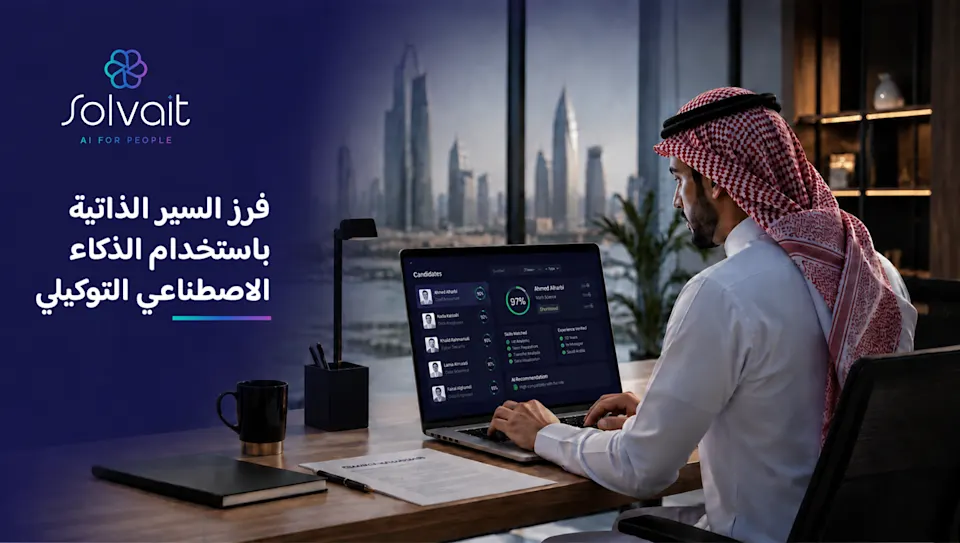
Screen 50 CVs in 30 Seconds, Without Losing the Right Hire
AI CV screening is an approach to candidate review in which an Agentic AI reads dozens of CVs at once, extracts the fields that matter, matches each one to the job description, then surfaces a score plus strengths and gaps per candidate. The decision on who gets interviewed stays with the human recruiter. The idea is simple. The agent handles the heavy, repetitive work, and the recruiter is freed for the judgment only a person can make.
This post answers three questions every recruiter in Saudi Arabia is asking: why does the traditional method fail? How does technology cut hours of work down to seconds? And the one that matters most: how do you make sure the right candidate doesn't slip away while you speed things up?
Why does traditional CV screening fail?
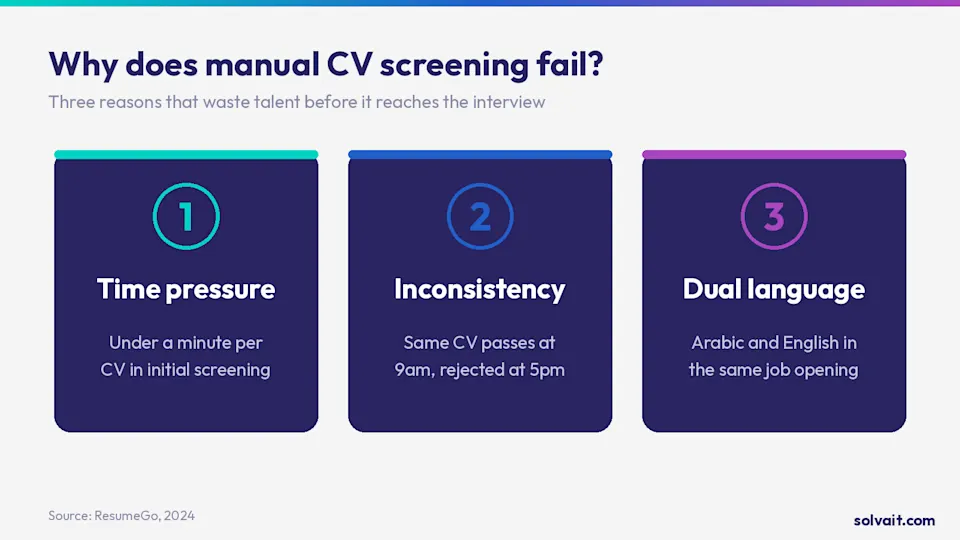
Ask any recruiter about their day and you'll hear a version of the same answer: busy, but not sure what got done. The problem isn't that people are inefficient. It's that the process itself is built to fail. Manual screening breaks down for three connected reasons, and all three show up sharply in the Saudi market.
The first reason is time. ResumeGo's 2024 survey found that 81% of recruiters spend under a minute on a CV during initial screening. When applications arrive by the hundreds for a single role, a recruiter has time for nothing more than a glance, and that's where the details separating a good candidate from an exceptional one get lost.
The second reason is inconsistency. A human decision at the end of a long day isn't the same as one at the start. The same CV might pass in the morning and get rejected in the afternoon, because the standard in someone's head doesn't hold steady. There's no single ruler applied to everyone, so subjectivity creeps into a process that's supposed to be fair.
The third reason is specific to Saudi Arabia: dual language. Applications come in Arabic and English at once for the same role, Saudization targets are live, and hiring speed has become a competitive edge. A recruiter who can't read CVs in both languages with equal fluency will screen half the applicants through a different lens than the other half.
The expensive result is that manual screening doesn't just slow hiring down. It wastes talent along the way. Every CV read in under a minute is a potential candidate who never got a fair look.
How does AI cut hours of work down to seconds?
The difference between "adding an AI feature" and Agentic AI is that the latter does the work, not just suggests it. And the effect on time isn't cosmetic. Zivaro's analysis estimates that automating screening cuts recruiter time per hire from 40 to 51 hours down to roughly 12 to 16 hours, a saving of 60% to 70%.
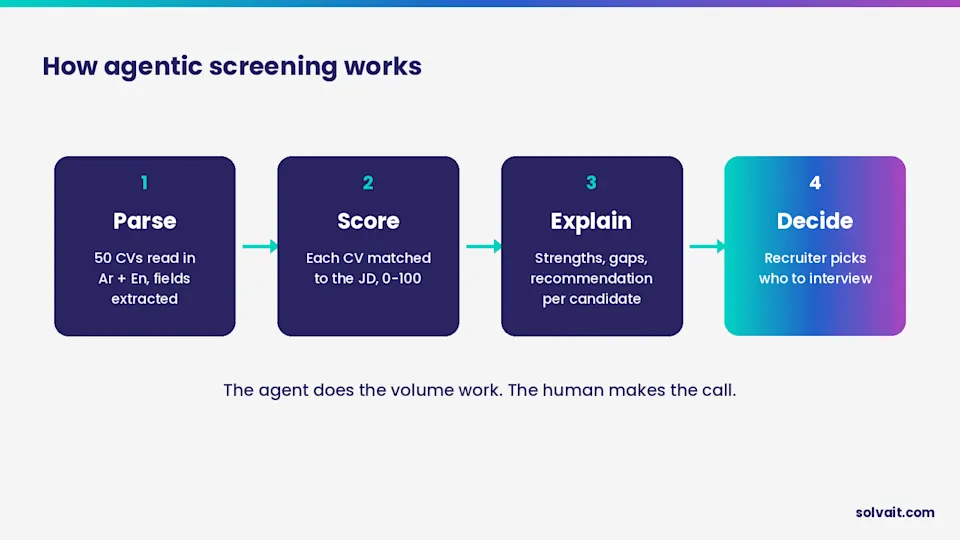
How does that happen in practice? Inside Solvait Attract, a CV moves through four clear stages that complete in seconds.
First, parse: The Agentic AI reads dozens of CVs in Arabic and English and pulls out structured fields: experience, skills, qualifications. This capability is documented in the product .
Second, score: Each CV is matched to the job description and given a 0 to 100 rating.with one explicit principle: AI supports, humans decide.
Third, explain: The tool doesn't stop at an abstract number. It shows why. Where does the candidate stand out? Where's the gap? What's the recommendation?
Fourth, decide: The recruiter reviews the ranked, explained list and picks who to interview. The Agentic AI hires no one. It only prepares the ground.
At one of our customers, two recruiters now produce what used to take a team of six. Nobody was replaced. The work was redistributed: the agent took on sourcing, screening, and scoring in Arabic and English, and the two recruiters moved to interviews and decisions. That's what cutting hours to seconds really means. Not erasing the work, but freeing it for what deserves attention.
How do you avoid losing the right candidate during fast screening?
This is where every HR leader's real worry sits: speed is great, but what if the system filters out an excellent candidate by mistake? Missing the right person, what's called a false negative, is more dangerous than wasting time, because it's a silent loss that shows up in no report.
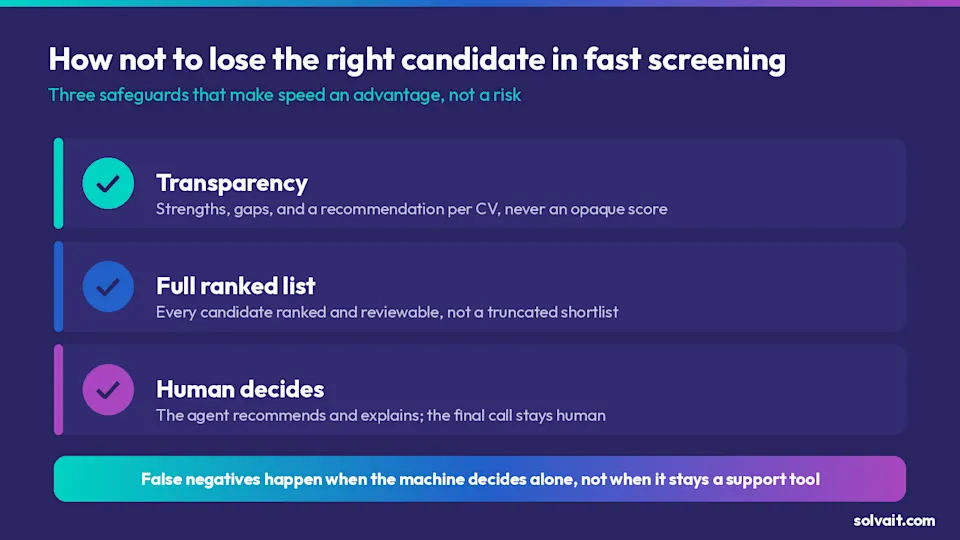
The answer is that fast screening doesn't mean blind screening. Three safeguards protect the right candidate inside Solvait Attract.
The first safeguard is transparency instead of a black box. The system doesn't just say "pass" or "reject." It shows the strengths, gaps, and recommendation for each CV. When the recruiter can see why each candidate was ranked where they were, they can review and step in, so nobody disappears behind an opaque score.
The second safeguard is a full ranked list, not a truncated shortlist. TheAgentic AI doesn't delete lower fit candidates from view. It ranks them. The recruiter can still scroll down and review whoever landed near the bottom, because someone who looks weak on paper may carry experience the job description never captured.
The third safeguard, and the most important: the human always decides. The Agentic AI recommends and explains, but it doesn't hire and it doesn't issue a final rejection. The final call stays human, and that's what makes speed safe. False negatives happen when a decision is left to the machine alone. When the machine stays in a support role and the person stays in the judgment role, speed becomes an advantage, not a risk.
And to be fair: AI won't fix a bad job description. If the brief is vague or asks for contradictory qualifications, match quality will be only as good as the input. The tool speeds up screening and protects talent. It doesn't substitute for being clear about what you're actually looking for.
The difference at a glance
Here's the difference between the two approaches, including the part that matters most to you: not missing strong candidates.
Item | Manual screening | Agentic AI screening |
Time for 50 CVs | 2 to 4 hours | Under 1 minute |
Arabic and English | Reader dependent | Both, natively |
Scoring consistency | Varies by mood | Same rubric every time |
Strengths and gaps | Rarely written down | Listed per candidate |
Missing the right candidate | A silent risk under time pressure | Full ranked list, explained for review |
Who decides | Recruiter | Recruiter |
Look at the last two rows. The decision didn't change, and the right candidate's odds went up, not down.
Where Solvait fits
Inside Solvait Attract, agentic screening isn't an isolated feature. It's part of an end to end acquisition flow: from generating the job description, to sourcing candidates, to analysis and scoring in Arabic and English. Because the platform is built on Microsoft Dynamics 365, candidate data lives in one system instead of scattering across disconnected tools.
Adoption is accelerating, regionally and globally. McKinsey found that roughly 76% of U.S. organizations were using AI regularly in HR by 2025. The question is no longer "should we adopt?" but "how do we adopt in a way that keeps the human at the point of decision?"
If you want to see Agentic AI screening run on a real job description from your own environment, book a demo.
FAQ
Why does manual CV screening fail?
For three reasons: time pressure that pushes recruiters to read a CV in under a minute, human scoring that drifts between the start and end of the day, and the difficulty of screening Arabic and English CVs with equal fluency. The result is wasted talent and slower hiring.
How does A gentic AI shorten screening time?
The Agentic AI reads dozens of CVs in under a minute across four stages: parse, score from 0 to 100, explain, then present a ranked list to the recruiter. Zivaro estimates a 60% to 70% reduction in time per hire.
Will I lose a good candidate with fast screening?
No, as long as the safeguards hold: transparent strengths and gaps for every CV, a full ranked list instead of a truncated one, and a final human decision every time. False negatives happen when the machine decides alone, not when it stays a support tool.
Does agentic screening work on Arabic CVs?
Yes. Solvait Attract reads, analyzes, and scores CVs in both Arabic and English. That matters for the Saudi market, where applications for a single role often arrive in both languages.
References
LinkedIn — The Future of Recruiting 2025, 2025 (AI adoption frees recruiters for strategic work)
Ready to see Solvait in action?
Book a personalized demo and see how Solvait's AI-powered HR platform can transform the way your team works.
Tags
Related Posts
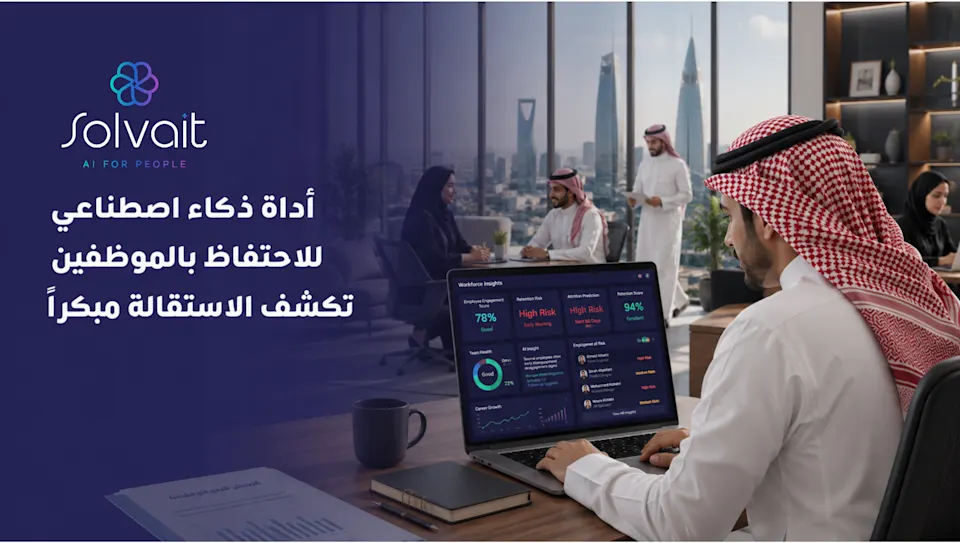
Employee Retention AI Tool
How an employee retention AI tool flags flight risk before the notice, and how GCC HR teams turn those signals into a retention strategy that works.
Jun 21, 2026
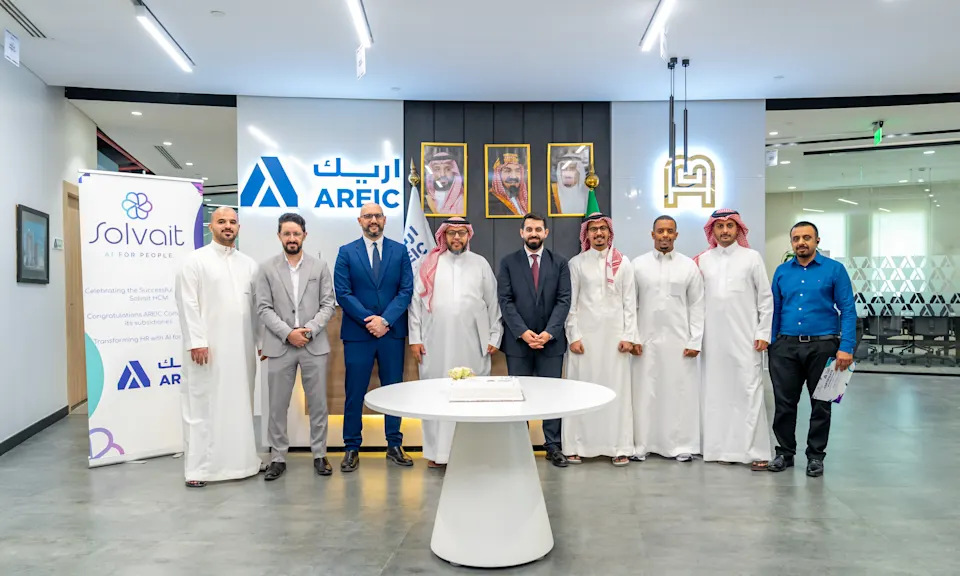
Solvait HCM Goes Live Across Almutlaq Group
Solvait HCM is now live at Almutlaq Real Estate (AREIC), Qantara Development, and Almutlaq Furniture. How one group unified HR on a single platform.
Jun 28, 2026
What Drives Employee Turnover in Saudi Arabia?
discover the factors that prompt high performing talent to consider leaving, and find out how predictive AI can identify the risk of departure early on.
Jun 17, 2026