

The Saudi Labour Law Clauses Your HR System Should Enforce Automatically
Your HR system should enforce Saudi labour law the way your accounting system enforces a balance sheet: as a rule that cannot be broken, not a reminder someone might read. After the February 2025 reforms, at least nine clauses now have a hard deadline, a numeric limit, or a mandatory filing attached, and every one of them can be coded into the system so the breach never happens. That is what this post lays out, clause by clause, with the exact number your platform should check.
Automated labour law compliance means the HR system holds each rule as logic and acts on it: it blocks an action that would break a clause, files what the law requires on time, and keeps an audit trail an inspector can read. The reform that makes this urgent is real. On 18 February 2025, the largest overhaul of the Saudi Labour Law since 2015 came into force, revising probation, contracts, working hours, leave, and termination all at once, per the Ministry of Human Resources and Social Development.
Why manual compliance quietly costs so much
Most Saudi HR teams still enforce the law with a spreadsheet, a shared calendar, and a good memory. That works until the month it doesn't. A probation date slips past 180 days. A WPS file misses the tenth. A resignation sits unanswered for 31 days and is now legally accepted whether you meant it or not.
The price of those slips is not abstract. Payroll errors alone run to 2 to 5 percent of total annual payroll costs, according to a KPMG survey. Under the Wage Protection System, a late or missing salary carries a fine of SAR 3,000 per worker per month, and repeated violations suspend your ability to issue visas and renew Iqamas through Qiwa and Mudad. Gartner estimated in 2025 that organizations without a consolidated payroll approach spend 50,000 to 75,000 US dollars a year on reactive compliance remediation, before any fine is counted.
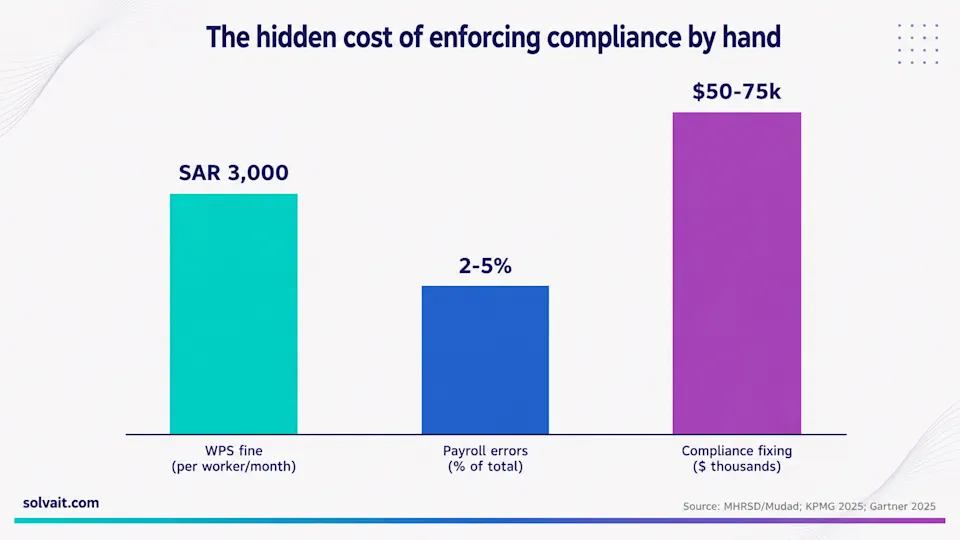
Read that middle number again. Two to five percent of payroll is not a rounding error for a 500-person company. It is a line item nobody budgeted for, spent entirely on fixing things a rule could have prevented.
Which Saudi labour law clauses can a system enforce automatically?
Not every part of the law is machine-enforceable. Judgment calls stay human. But a surprising share of the 2025 reforms reduce to a number, a date, or a required filing, and those are exactly what software is good at holding. Here are the nine that matter most for a Saudi employer.
1. The 180 day probation cap
The reforms let both parties agree to a single probation period of up to 180 days at the outset, replacing the old 90 day plus extension arrangement. Either side may terminate during it. The enforcement rule is simple: the system stores the probation start date and the agreed length, and it blocks any attempt to extend past 180 days or to run a second probation for the same employee in the same role. An extension request on day 181 should fail, not generate a warning.
2. Qiwa contract registration before the job starts
All employment contracts must be digital and registered through Qiwa, and the Arabic text prevails in any dispute. A system that enforces this refuses to activate an employee record until the Qiwa contract exists and its wage clause matches what payroll will pay. That single check closes the gap the Ministry now cross references automatically.
3. WPS file submitted before payday, every month
Salaries must reach workers within the first ten days of the following month, and the WPS file goes to Mudad at least one business day before payday. The system should generate and validate that file on a fixed schedule, flag any employee whose Qiwa contract wage, GOSI registered wage, and actual transfer don't match, and submit early rather than on the deadline. The 2025 enforcement update adds automatic alerts at 10 and 15 days of delay and an inspection at 20, so the margin for a manual miss has narrowed to nothing.
4. End of service benefit accrued monthly
End of service gratuity is a formula, half a month's wage for each of the first five years and a full month for each year after. The mistake is treating it as a number you calculate at exit. A system should accrue it every month against each employee, so the liability on your books is always current and the final settlement is a lookup, not a scramble.
5. The 30 day resignation response window
The reforms define resignation formally and give the employer 30 days to respond. Silence past day 30 counts as acceptance. This is pure automation territory: the clock starts when the resignation is logged, the system escalates before the deadline, and it records the response so acceptance is never accidental.
6. Working hours and the Ramadan reduction
The standard week is 48 hours, reduced to 36 for Muslim employees during Ramadan, with overtime calculated on top. A system enforces this by capping schedulable hours per week, switching the Ramadan limit automatically by the Hijri calendar, and computing overtime rather than leaving it to a manager's arithmetic.
7. Leave entitlements that update themselves
Annual leave is 21 days, rising to 30 after five years of service. Maternity leave is now 12 weeks with six required after childbirth, fathers get three days of paternity leave, and there are three days of bereavement leave. Each of these is a balance the system should track and top up on the right anniversary or event, not a figure an HR officer looks up in a policy document.
8. The non discrimination duty in the hiring flow
The amendments add a firm duty to avoid discrimination by gender, age, nationality, disability, or marital status. No system decides fairness for you. But it can strip protected fields from screening views, log who saw what, and keep the audit trail that shows a decision followed process. That record is your defence if a complaint reaches a labour court.
9. Saudization band awareness at the point of hire
Nitaqat status governs whether you can sponsor a visa, renew an Iqama, or bid for a government contract, and WPS performance now feeds that band directly. A system that tracks your Saudi-to-non-Saudi ratio in real time can warn you before a single hire drops you into a lower colour band, instead of letting you discover it when a visa request is refused.
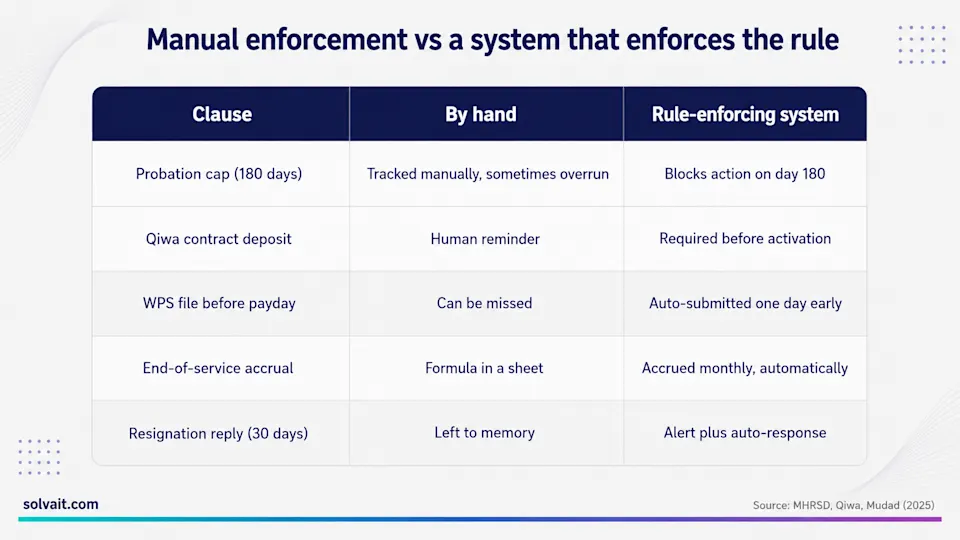
Notice the pattern across all nine. Manual enforcement depends on a person remembering at the right moment. Rule enforcement depends on nothing.
How a system actually enforces a clause
There is no magic here. Enforcing a labour clause automatically comes down to four layers, and any serious HCM platform should give you all four for each rule.
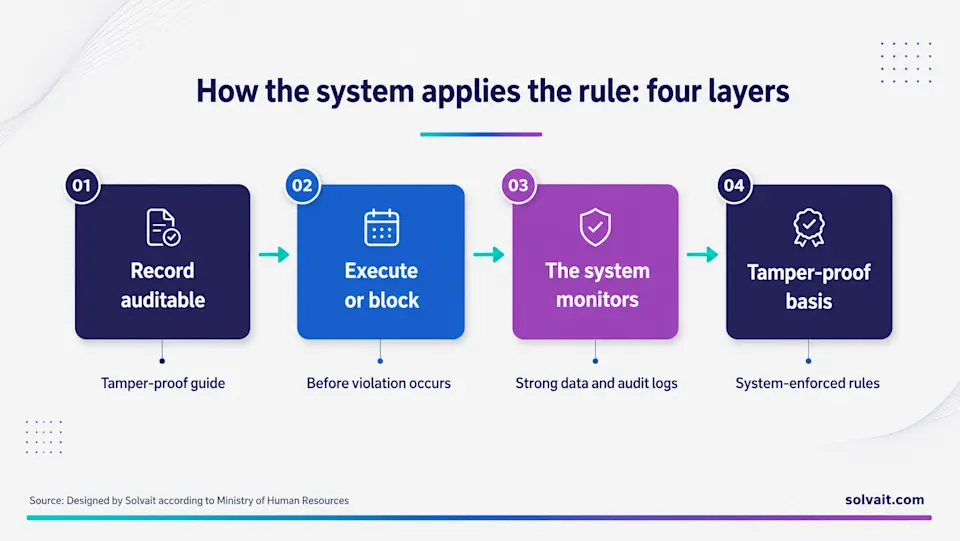
First, the rule is encoded as logic: 180 days, the tenth of the month, 48 hours. Second, the system watches the live data it needs, pulling from Qiwa, Mudad, and GOSI rather than from a form someone filled in. Third, it acts before the breach, blocking the action or filing the document while there is still time. Fourth, it writes an audit trail, so when an inspector asks, the evidence is already there. The honest limit: the encoding is only as current as whoever maintains it. When the executive regulations shift, someone has to update the rules, which is an argument for a platform that ships those updates, not one you patch yourself.
Where Solvait fits
Solvait HCM, built on Microsoft Dynamics 365, is designed for exactly this: it holds Saudi labour rules as enforced logic, generates WPS files for Mudad, accrues end of service monthly, and keeps the Qiwa and GOSI data in sync so the cross-checks pass on the first submission. If you want to see how a specific clause would behave in your own setup, the Solvait HCM platform page walks through the compliance layer, and the free salary and end-of-service calculators let you sanity check a number in a minute with no signup and no data captured.
The reforms are not a one time project. They are the new baseline, and the executive regulations will keep moving. A system that enforces the rules absorbs those changes quietly. A spreadsheet makes them your problem, every February. Book a demo and bring your hardest clause.
FAQ
What changed in Saudi labour law in 2025?
The February 2025 amendments were the largest reform since 2015. They set probation at up to 180 days, made employment contracts digital through Qiwa, gave employers 30 days to answer a resignation, extended maternity leave to 12 weeks, added paternity and bereavement leave, and tightened non discrimination and Saudization duties.
What is the WPS fine for a late salary in Saudi Arabia?
Under the Wage Protection System, a late or missing salary carries a fine of about SAR 3,000 per worker per month. Repeated violations suspend government services on Qiwa and Mudad, block new work permits, and can lower your Nitaqat band, which restricts visa sponsorship.
Can an HR system enforce Saudi labour law automatically?
Yes, for any clause that reduces to a number, a date, or a required filing. A system can block a probation extension past 180 days, submit the WPS file before payday, accrue end of service monthly, and alert on a resignation before the 30-day window closes. Judgment-based questions still need a human.
How is end-of-service calculated under Saudi labour law?
End of service gratuity is half a month's wage for each of the first five years of service and a full month's wage for each year beyond five, based on the final wage. A system should accrue this monthly so the liability is always current rather than calculated only at exit.
Is a probation period still 90 days in Saudi Arabia?
No. Since February 2025, both parties can agree to a single probation of up to 180 days at the start, replacing the previous 90 days plus a separate extension. Either party may terminate during probation, and an employee cannot be placed on probation twice for the same role with the same employer.
References
Ministry of Human Resources and Social Development (MHRSD): Labour Law and 2025 amendments overview, 2025 (backs the reform scope, probation, resignation, leave).
Morgan Lewis: Key Amendments to the KSA Labour Law Announced, 2024 (backs probation and termination changes).
King & Spalding: Amendments to the Saudi Labor Law, 2024 (backs effective date and 180-day probation).
Gartner: Global payroll compliance remediation estimate, 2025 (backs the 50,000 to 75,000 USD remediation figure).
Mudad / MHRSD: Wage Protection System compliance rules, 2025 (backs WPS deadlines, SAR 3,000 fine, alerts and inspection timeline).
Qiwa: Employment contract registration, 2025 (backs mandatory digital contracts and Arabic-prevails rule).
Ready to see Solvait in action?
Book a personalized demo and see how Solvait's AI-powered HR platform can transform the way your team works.
Tags
Related Posts

Free Saudi Salary Calculator
Free Saudi salary calculator. Work out gross, GOSI, end of service, and net pay in 30 seconds.
Jun 20, 2026

AI Employee Data Validation: A Pre-Payroll Readiness Scan
Solvait's AI Employee Data Validation scans employee data before payroll . Built into Solvait HCM.
Sep 15, 2026

Benchmark Any Saudi Salary in 30 Seconds (Free Tool)
Solvait's free salary calculator gives you the Saudi market range by role, sector and city in 30 seconds. Benchmark any offer before you hire or raise pay.
Sep 13, 2026