

GOSI Automation in Saudi Arabia: Calculate, Submit and Audit Contributions Without a Compliance Specialist
You can run GOSI contributions end to end without hiring a compliance specialist, provided you build the process around three tight steps: calculate on the correct wage, reconcile the figures across Qiwa, Mudad and GOSI before you file, then keep an audit trail for every transfer. A system that automates those three steps turns what used to eat two days of monthly work into a half-hour review, and it cuts the errors that trigger corrections and fines.
The problem was never GOSI's complexity on its own. It's that most small teams treat it as a standalone manual chore, when in 2026 it's one link in a digital chain that ties Qiwa, Mudad, GOSI and your bank together. A single mismatched number across those systems either stops payroll or logs a violation. So the real question for an HR or finance lead isn't "do we hire a GOSI specialist?" It's "how do we design the process so it runs itself?"
This article answers that in three parts: calculating the contribution correctly, submitting and approving it through the Wage Protection System, and auditing it before an inspector ever asks.
How are GOSI contributions calculated in Saudi Arabia in 2026?
GOSI is calculated on the contributory wage, which is basic salary plus housing allowance only, capped at SAR 45,000 per month. Other allowances such as transport, phone and commission don't count toward it.
The part everyone gets wrong is the rate. Since the New Social Insurance Law was issued under Royal Decree No. (M/273), the Kingdom runs two parallel systems, and the correct rate depends on when the Saudi employee was first registered with GOSI.
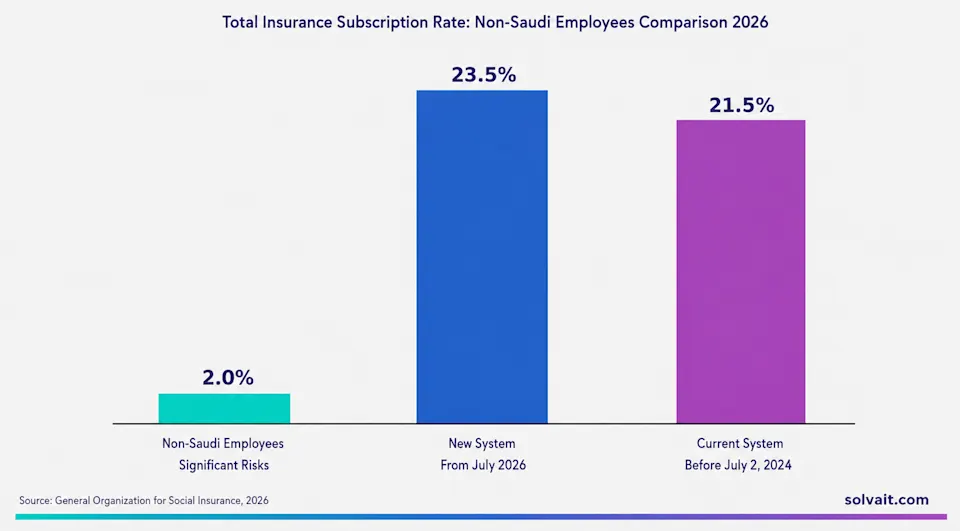
Employee category | Employee share | Employer share | Total |
Saudi, existing system (registered before 3 Jul 2024) | 9.75% | 11.75% | 21.5% |
Saudi, new system (registered after 3 Jul 2024, from Jul 2026) | 10.75% | 12.75% | 23.5% |
Non Saudi (occupational hazards only) | 0% | 2% | 2% |
The new system raises the rate by 0.5% on each side every year through 2028. A non Saudi employee is covered for occupational hazards only, with no pension and no SANED unemployment contribution. That distinction alone means calculating Saudis and non-Saudis at the same rate, a common manual slip, over deducts or under deducts every month.
Take a Saudi employee on SAR 15,000 total: SAR 9,000 basic and SAR 3,000 housing. The contributory wage is SAR 12,000, and the contribution is calculated on that, not on the SAR 15,000. Calculate on the gross and you overpay every month. Forget the housing allowance and you underpay and fall into violation. A system that reads salary components automatically and applies the rate by employee category kills this class of error at the root.
Want to test the numbers on your own salaries before committing to anything? The Solvait salary calculator works out net pay and GOSI contribution in seconds, free and with no signup.
How do you submit the wage file through Mudad and the Wage Protection System without a violation?
Getting the calculation right is half the equation. The other half is the correct amount arriving on time, documented in the Wage Protection System through the Mudad platform.
Mudad is the official Wage Protection System platform, operated under the Ministry of Human Resources and Social Development in partnership with the Saudi Central Bank. Every private-sector establishment, however small, must register and file a monthly wage file. There are no exemptions by headcount.
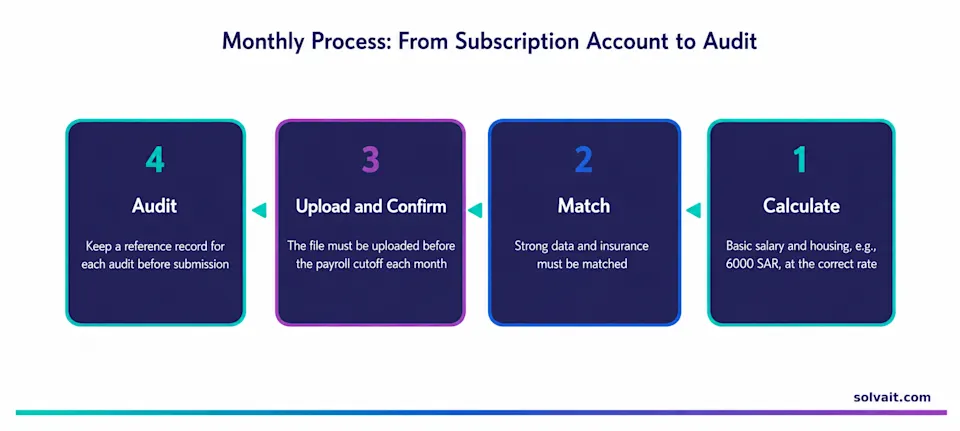
The steps as they actually run:
Build the wage file in the standardised format and upload it to the Mudad platform.
Read the warning messages the platform surfaces before you approve. This is where mismatches between Qiwa, Mudad and GOSI show up.
Approve the file and issue transfer instructions through an approved Saudi bank account.
The bank validates the data before transmitting it to the Ministry, and the compliance certificate is issued automatically once the file matches the contract terms.
What usually lands an establishment in violation isn't an intent to delay. It's a data mismatch. A salary recorded in a Qiwa contract that differs from the amount filed in Mudad or reported to GOSI gets flagged automatically. In 2026 the system detects these discrepancies in near real time and links straight to Ministry inspections.
The penalties are automated and expensive. Late or short salary payments expose the establishment to fines of up to SAR 3,000 per employee per month, plus suspended Qiwa services and frozen visa issuance on repeat violations. Late GOSI contributions themselves carry a monthly late payment penalty. Multiply those figures across a few hundred employees and the cost of the manual error dwarfs the cost of the system that prevents it.
How do you audit payroll and GOSI before the inspector arrives?
An audit isn't a once a year scramble you put off until someone knocks. It's the natural byproduct of a well designed process. If every transfer has a reference trail linking the calculation to the filing to the bank transfer, an audit is just reading a record that already exists.
The trouble is that manual processing rarely leaves a clean trail. If you calculated the contribution in a spreadsheet, uploaded the file from a browser, and issued the transfer from a bank portal, you've got three steps in three places with nothing connecting them. Asked to prove that March salaries were paid in full, on time, and matched GOSI, you start hunting through folders and email.
This is where a system that documents each step diverges from a scattered process. An EY study found that roughly one in five payroll runs contains errors, and that the average cost of fixing a single error runs about $291 in direct and indirect costs. The most expensive errors involved entering an employee into the system late and visa-status updates. Those aren't theoretical numbers. They're correction hours and legal exposure that recur every month with every undocumented run.
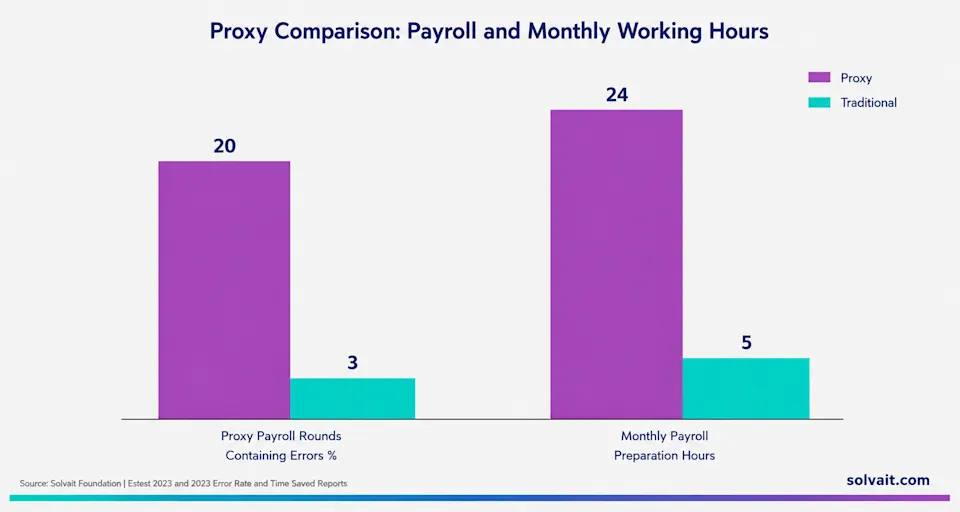
A system that builds the audit trail during the run, not after it, flips the equation. Every calculation, every filing, every transfer, every Mudad warning is recorded and linked. At inspection you open one file instead of assembling scattered evidence.
Where does agentic AI fit into this loop?
Traditional automation executes a fixed rule: "apply rate X to wage Y." That's fine when nothing changes. But the Saudi payroll environment changes constantly: GOSI rates rise annually through 2028, Wage Protection System rules get updated, Nitaqat requirements shift. A fixed rule becomes wrong at the first update.
Agentic HR is an approach to human resources management in which AI agents independently execute HR processes, from CV screening to payroll checks, under human oversight. Applied to GOSI and payroll, that means an agent that reads salary components, identifies each employee's category and system, applies the correct rate, reconciles figures across systems, files the wage file ahead of the deadline, and raises a flag on any mismatch before it becomes a violation. The final decision stays with a person; the repetitive work disappears.
That's where Solvait HCM comes in, the human capital management platform built on Microsoft Dynamics 365. It calculates contributions on the contributory wage at the correct cap, automatically separates existing-system from new system employees and Saudis from non Saudis, produces the Mudad ready wage file, and keeps an audit trail for every transfer. The team reviews and approves rather than recalculating from scratch each month.
Let's be fair about the limits. No system fixes bad source data. If the Qiwa contract itself carries the wrong salary, any automation will faithfully carry the error forward. Automation prevents calculation, timing and reconciliation errors, but it doesn't replace a human review of the base data at setup. Anyone promising that AI "removes the need for review entirely" is overselling it.
When does the system actually earn its cost?
Not every establishment needs a full platform. An employer with five staff might get by with a disciplined manual upload. But the equation flips quickly as you grow.
Factor | Manual processing | Agentic processing |
Rate calculation by employee category | Manual, error-prone | Automatic by system and nationality |
Qiwa, Mudad and GOSI reconciliation | Visual review | Automatic with mismatch alerts |
Wage file submission | Manual every month | Generated and file-ready |
Audit trail | Scattered across tools | Built during the run |
Handling annual rate changes | Manual update | Applied automatically |
The working rule: the more employees you have, the more they span both systems and both nationalities, and the more legal entities you run, the closer the cost of manual error comes to the cost of the system, then passes it. At that point the question stops being about cost and becomes about risk.
FAQ
What is the GOSI contribution rate in Saudi Arabia for 2026?
For a Saudi employee on the existing system it's 21.5% total (9.75% employee, 11.75% employer). For those registered under the new system it rises to 23.5% from July 2026. For a non Saudi it's 2%, paid by the employer only, for the occupational hazards branch.
What wage is GOSI calculated on?
On the contributory wage, which is basic salary plus housing allowance only, capped at SAR 45,000 per month. Other allowances such as transport and commission don't count toward the calculation.
What is the difference between GOSI and the Wage Protection System?
GOSI is social insurance: pension, occupational hazards and SANED contributions. The Wage Protection System, run through Mudad, monitors that salaries are paid in full and on time. One is an insurance contribution, the other is oversight of wage payment, and their data must match.
What is the penalty for filing the wage file late?
Late or short salary payments expose the establishment to fines of up to SAR 3,000 per employee per month, with suspended Qiwa services and frozen visa issuance on repeat violations, and the right of an employee to transfer sponsorship after three consecutive months of non-payment.
Can you manage GOSI and payroll without a dedicated compliance employee?
Yes, if the process is automated so rates apply by category, systems reconcile, and the audit trail is built during the run. Automation doesn't remove the need for a human review at setup, but it does remove the repetitive manual work.
Next step
If your team spends two days a month calculating GOSI, reconciling systems and filing wage files, the problem isn't the team, it's the process. Book a Solvait demo to see the whole loop run with a half hour review instead of two days.
References
General Organization for Social Insurance (GOSI): Contribution rates and the Social Insurance Law, 2026 (rates and contributory wage)
Ministry of Human Resources and Social Development: Wage Protection System, 2026 (filing requirements)
Deloitte Middle East: Update on Wage Protection System file uploading period, 2025 (30-day uploading window)
Ernst & Young (EY): Payroll errors average $291 each, 2022 (error rate and cost of correction)
Ready to see Solvait in action?
Book a personalized demo and see how Solvait's AI-powered HR platform can transform the way your team works.
Tags
Related Posts

AI Employee Data Validation: A Pre-Payroll Readiness Scan
Solvait's AI Employee Data Validation scans employee data before payroll . Built into Solvait HCM.
Sep 15, 2026

Saudi Labour Law Automation: 9 Clauses to Enforce
Nine Saudi labour law clauses your HR system should enforce automatically after the 2025 reforms, from probation caps to WPS files.
Aug 30, 2026

Free Saudi Salary Calculator
Free Saudi salary calculator. Work out gross, GOSI, end of service, and net pay in 30 seconds.
Jun 20, 2026