

The Real Cost of Manual HR in a Saudi Enterprise
A 500 person Saudi enterprise running HR on spreadsheets and manual approvals loses well over SAR 400,000 a year before a single compliance fine is counted. That figure comes from three ordinary sources: the labour cost of every manual data entry, the cost of fixing payroll errors that manual processes let through, and the strategic work an overloaded HR team never gets to.
Most CHROs and CFOs never see this number because it never appears as a line item. It hides inside salaries you already pay, penalties you write off as one offs, and projects that quietly slip a quarter. This post puts the number in front of you, shows where it comes from, and separates the cost you can recover from the cost you can't.
Why is manual HR so expensive when nobody budgeted for it?
The cost is invisible because it's distributed. No invoice arrives for "manual HR." Instead, an HR coordinator spends nineteen minutes recording one government form, a payroll officer re-keys attendance data into a second system, and a manager chases three approvals by email. Each task is small. Multiplied across a 500 person workforce and 52 weeks, they add up to a full salary or two spent on work no customer or employee ever sees.
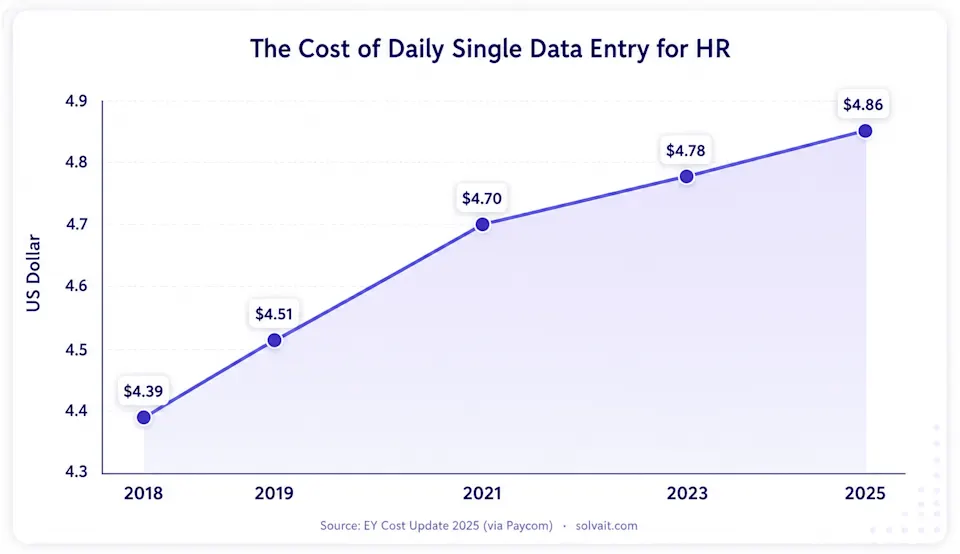
EY has been measuring this since 2018, and the trend goes one direction. The cost of a single manual HR data entry reached $4.86 per instance in 2025, up from an average of $4.78 in 2023 and $4.39 in 2018. Inflation and rising labour costs push it up every survey cycle.
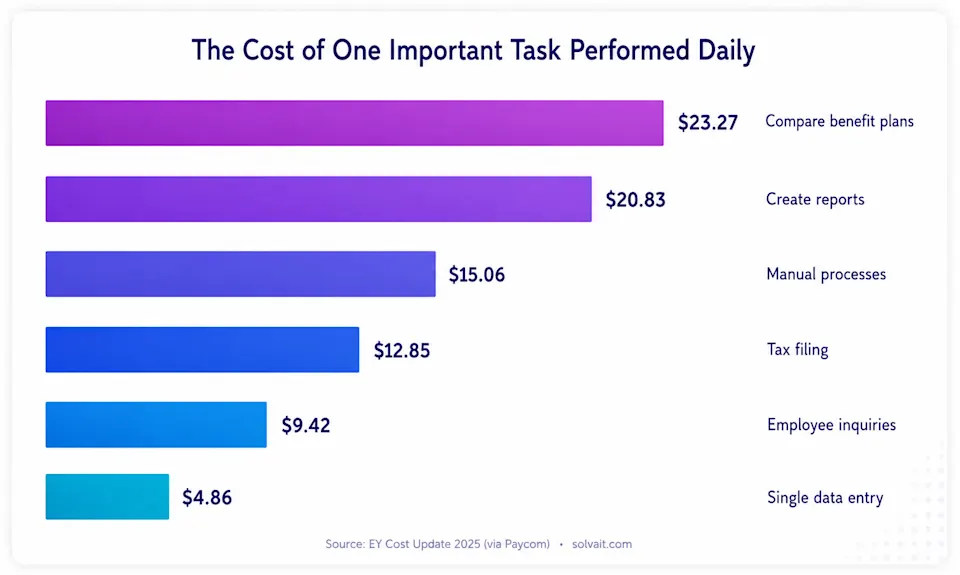
The per entry figure is only the floor. EY's task level data shows how fast the number climbs once a process has more than one step. Searching for employee information costs $11.75, recording a tax form costs $12.85, and reviewing and approving shift swaps costs $15.06. Creating a payroll run manually costs $20.83 per instance, and simply gathering the information to compare two benefit plans runs $23.27.
Now do the arithmetic for a mid sized enterprise. In markets without self service HR, a single HR manager handling manual onboarding, time management, data updates, and compliance documentation across a normal week accumulates over $500 in direct administrative labour before a single error or penalty enters the picture. Run that across a full HR team and 52 weeks, and the annual figure consistently surprises leadership when it is finally calculated.
What do payroll errors actually cost a Saudi enterprise?
This is the layer most cost models miss, and it's the one that hurts. Manual data movement produces errors, and errors in payroll are expensive to catch and expensive to explain.
The benchmark numbers are stark. Each payroll error costs an average of $291 to correct, with roughly 20% of pay runs containing errors. Correction is not a quick fix either. The median payroll error takes three to five hours of payroll staff time to resolve, and complex errors involving retroactive pay or recalculations run six to twelve hours. For a 1,000 employee organisation, the errors that slip through a manual process can add up to hundreds of thousands of riyals a year in pure rework.
In Saudi Arabia, the error doesn't stop at internal rework. A wrong or late figure flows straight into the Wage Protection System, into GOSI contributions, and into your Saudization reporting. A miscalculated end of service benefit becomes a dispute. A late WPS file becomes a compliance flag. The financial exposure of a manual process is the correction cost plus the regulatory cost, and in the Kingdom the second number is rarely small.
Here is the honest trade off, and it matters: automation does not make errors impossible. It moves error catching upstream, before the payroll run closes, which is where a mistake is cheap to fix. Errors caught in the same pay period cost far less than those discovered at year end. That single shift, from fixing errors after the fact to preventing them before submission, is where most of the recoverable money sits.
Where does the money actually go?
Manual HR cost lives in four layers, and only the first one is visible in a budget.
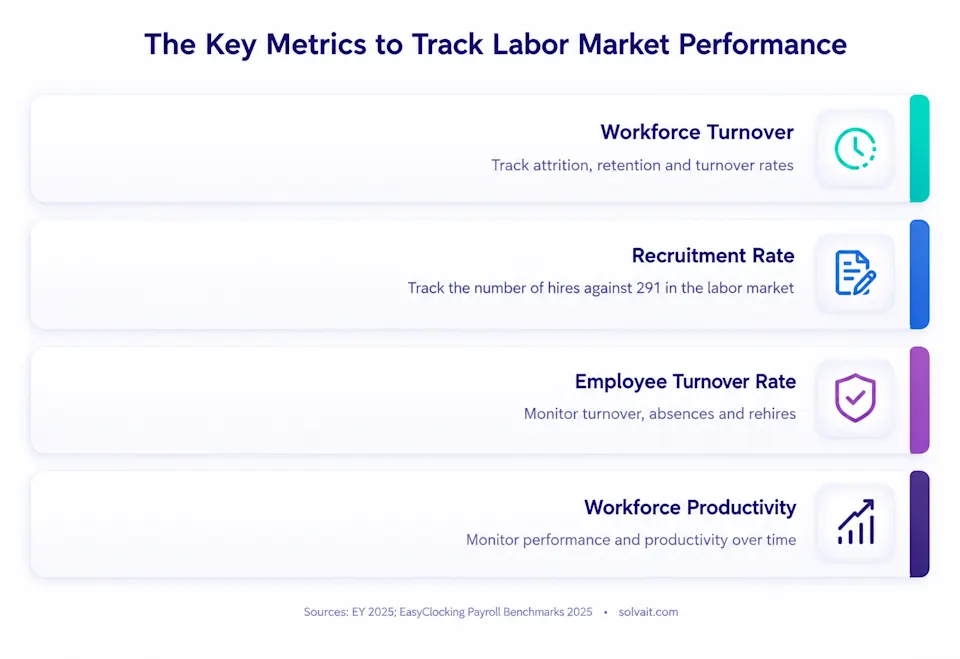
The layer nobody prices is the last one. When your HR team spends more than half its week on administration, the strategic work simply doesn't happen. Deloitte research found that HR staff spend up to 57% of their time on administrative tasks. That's more than half a working day, every day, not spent on retention, workforce planning, or hitting your Saudization targets. In a Vision 2030 economy where HR is being asked to move faster and stay audit ready at the same time, that lost half day is the most expensive line of all, even though it never shows up as a cost.
Cost layer | What it looks like | Typical benchmark |
Visible labour | HR hours on data entry, approvals, filings | $4.86 per manual entry, climbing yearly (EY 2025) |
Error correction | Rework on payroll mistakes | ~$291 per error; ~20% of pay runs affected |
Compliance exposure | GOSI, WPS, Nitaqat penalties | Varies; late or wrong filings carry fines |
Deferred strategy | Retention and planning work not done | 57% of HR time lost to admin (Deloitte) |
Manual versus automated: the same enterprise, two cost profiles
The point of automation isn't to remove HR people. It's to move their hours from the first two rows of that table to the last one. A concrete comparison for a 500 employee Saudi enterprise:
Dimension | Manual HR | Automated HR (HCM platform) |
Data entry | Re keyed across systems, ~$4.86 each | Entered once by the employee via self service |
Payroll run | Manual, error rate near 20% of runs | Validated before close; errors caught upstream |
WPS / GOSI filing | Assembled by hand, late-filing risk | Generated from live data, submission ready |
End of service, leave, Nitaqat | Calculated manually, dispute prone | Rule based, calculated automatically |
HR team focus | 57% on admin | Admin compressed; time returns to strategy |
Where errors are caught | At year end, expensive | In the same pay period, cheap |
The recoverable saving is real, but be clear about what it is. You won't zero out HR labour. You will collapse the re keying, cut the error correction bill, and reduce the compliance exposure, and you'll hand your team back the half day Deloitte says they're losing. That's the number worth putting in a business case.
Saudi enterprises are already moving. The Kingdom's HR technology market was valued at USD 332.3 million in 2024 and is projected to reach USD 710.1 million by 2033, growth driven directly by Vision 2030's push to modernise operations and stay compliant with evolving labour rules. The organisations automating now are the ones that calculated the manual number first.
How Solvait removes the four cost layers
This is where a platform earns its place, so let's be specific rather than promotional. Solvait HCM, built on Microsoft Dynamics 365, is designed for exactly the Saudi cost structure described above. Employees enter and update their own data through self service, which removes the re-keying that drives the per entry cost. Payroll is validated against live data before the run closes, so errors are caught in the same period rather than at year end. WPS files and GOSI contributions are generated from that same data, and end of service, leave, and Nitaqat calculations run on rules instead of manual spreadsheets.
The result maps directly to the four layers: less visible labour, fewer errors to correct, lower compliance exposure, and an HR team with its strategic half day back. Before you model your own case, run your salary and cost figures through Solvait's free salary calculator to ground the numbers in your own payroll.
If you want the number for your own enterprise rather than the benchmark, book a demo and we'll map your current manual cost against an automated baseline, layer by layer.
FAQ
What is the real cost of manual HR in a Saudi enterprise?
For a 500 person enterprise, manual HR typically costs well over SAR 400,000 a year in direct administrative labour alone, before compliance fines. The figure combines the labour cost of every manual entry (about $4.86 each, per EY 2025), the rework cost of payroll errors (around $291 per error), and the strategic work an overloaded team never completes.
How much does a single payroll error cost to fix?
A payroll error costs an average of $291 to correct and takes three to five hours of staff time, per EasyClocking's 2025 benchmarks drawing on EY data. Roughly one in five pay runs contains an error. Errors caught in the same pay period cost far less than those found at year end, which is why validation before payroll close matters most.
Does HR automation replace HR staff?
No. Automation removes repetitive data entry and error correction, not people. Deloitte finds HR teams spend up to 57% of their time on admin; automation returns that time to retention, workforce planning, and Saudization strategy. The goal is to shift HR hours from processing to judgment, not to cut headcount.
How does manual HR affect Saudi compliance specifically?
Manual data flows straight into the Wage Protection System, GOSI, and Nitaqat reporting, so a single entry error can trigger a late WPS file, a wrong contribution, or an end of service dispute. The financial exposure is the correction cost plus the regulatory penalty, which is why automated, validated filing lowers risk more than manual double checking.
Is HR automation worth it for a mid sized Saudi company?
For most enterprises above roughly 200 employees, yes, because the recoverable saving (re-keying, error rework, compliance exposure) usually exceeds the platform cost within the first year. The Saudi HR tech market is growing toward USD 710 million by 2033 precisely because these numbers hold up when leadership calculates them.
References
Deloitte, via Xedos, 2026 (supports 57% of administrative time)
IMARC Group: Saudi Arabia HR Tech Market, 2025 (backs the SAR/USD market size and forecast)
Ready to see Solvait in action?
Book a personalized demo and see how Solvait's AI-powered HR platform can transform the way your team works.
Tags
Related Posts

Solvait and Motoon Kick Off HCM Project
Solvait and Motoon Real Estate kick off the Solvait HCM project to build one unified human capital management platform, aligned with Saudi Vision 2030.
Aug 17, 2026

How Agentic AI Eliminates HR Team Burdens
How agentic AI is reshaping HR team size in Saudi Arabia and the GCC. What agents take over, what humans keep, and the ROI behind a leaner HR team.
Aug 2, 2026

HR on Microsoft Dynamics 365: Solvait & ConsultTik
Solvait and ConsultTik partner to bring HR on Microsoft Dynamics 365 together with local implementation expertise across Saudi Arabia, Jordan and Qatar.
Oct 7, 2026