
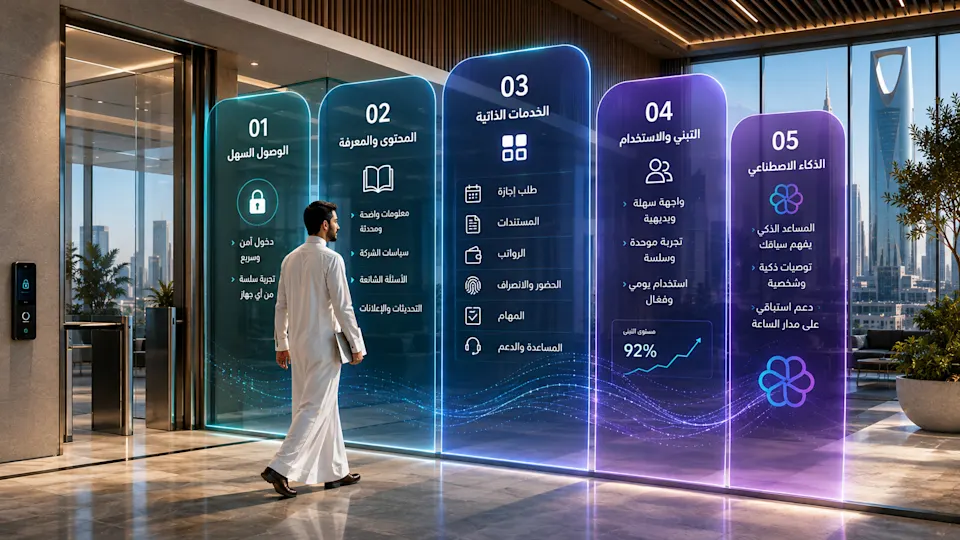
Employee Self Service Portal: Building One Staff Actually Use
An employee self service portal is an interface where staff handle their own HR tasks: updating personal details, requesting leave, downloading payslips, generating salary letters, and asking policy questions, without emailing anyone. An Arabic first portal means the layouts, forms, and error messages were built in Arabic and right to left from the start, not bolted on as a translation layer over an English design.
The problem is rarely buying the portal. Most companies in Saudi Arabia already have one inside their HR system. The problem is that employees don't use it, so they fall back to WhatsApp, email, and the queue outside the HR office. This guide explains why most portals fail on adoption, and how to build one that works in a fully Saudi context.
Show Image
Why is self service now a default expectation, not a nice to have?
Saudi employees already live digitally. Saudi Arabia's General Authority for Statistics found that 99.0% of individuals aged 15 to 74 in Saudi Arabia use the internet in 2025, and the Communications, Space and Technology Commission reported that 95.5% of users access government e-services. Someone who renews an Iqama and books a medical appointment from an app on their phone won't accept emailing HR to change their address.
The same expectation shows up in global HR research. A Gartner study found that 79% of employees prefer self service options for handling HR tasks, and organizations that offer it well see higher engagement alongside lower administrative cost. The trade is straightforward: give people the option, and your HR team stops answering the same six questions every day.
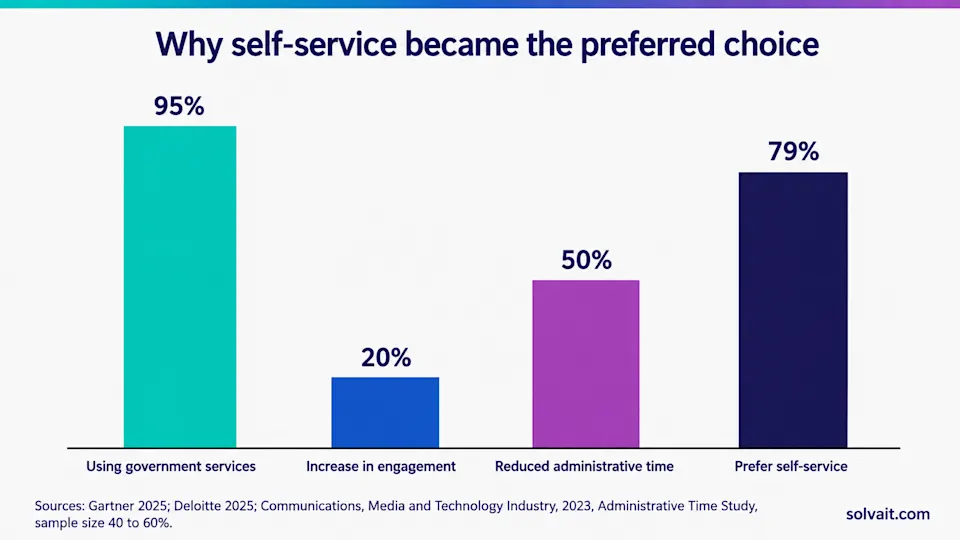
The impact goes past time saved. Deloitte found companies that implemented digital self-service technologies reported a 20% increase in employee engagement. The reason is transparency. When people can see their own leave balance, payslip, and request status, doubt drops and friction drops with it.
But here's the part everyone underestimates. Owning a portal is not the same as staff using it.
Why do most self service portals fail on adoption?
The failure is rarely technical. It's design, language, and trust.
A 2026 survey of 1,000 employees by Applaud and Censuswide, at organizations with 2,000 or more staff, found that 25% of employees complete only 0 to 25% of their HR tasks through self service, while only about 20% can self serve nearly all of their needs. The rest use the portal for the easy things and revert to email or a phone call for anything that feels slightly unusual.
Three causes repeat in the Saudi context specifically.
Language as a translation layer, not a foundation: When the interface is built in English and then translated, RTL problems surface: broken forms, reversed dates, clumsy Arabic error messages. The employee senses the tool wasn't made for them.
Half-finished tasks: Many portals only let you view. You can see your leave balance but not request it, see your payslip but not download it as an official file. Any task that needs HR to step in sends the employee back to square one.
Missing trust: Gartner's HR technology research found that 34% of organizations cite security concerns as the primary barrier to self service adoption. Salary, bank, and address data are sensitive. If the employee doesn't feel access is tightly controlled, they won't trust the portal.
What are the five layers of a portal staff actually use?
A working portal isn't one screen. It's five layers stacked on each other, and each one answers a failure above.
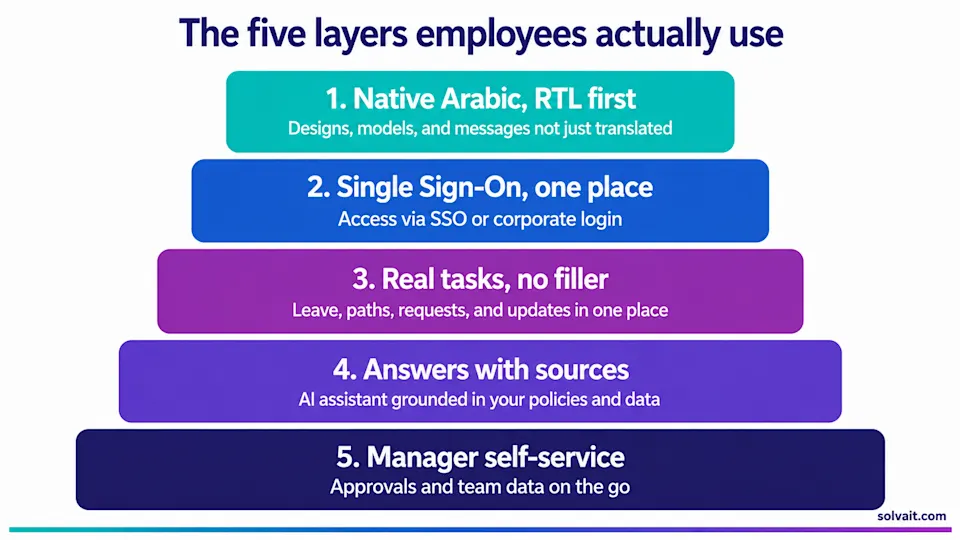
Layer 1: Arabic native, RTL by default: Layouts, forms, menus, and error messages are written in Arabic, right to left, as the original, not a translation. Latin strings and numbers (IBAN, GOSI) stay correctly placed inside the Arabic text. This layer alone is the difference between a tool employees feel is theirs and one they avoid.
Layer 2: One identity, mobile first: Login through Nafath or single sign on, with an interface designed for the phone before the desktop. Saudi employees reach for their phone, not a laptop, and a payslip needs to download from the phone in under a minute.
Layer 3: Real tasks, not just viewing: Leave requests end to end, salary letters generated on demand, payslips downloaded, contact and bank details updated. When employees enter their own data, accuracy improves, because they know their address and account better than any HR coordinator does.
Layer 4: Answers with sources: An AI assistant answers policy questions from the company's own documents and cites the clause it used. That breaks the "send an email and wait" cycle that floods HR teams.
Layer 5: The manager self service loop: Leave approvals, team data, and a dashboard in the same flow. A portal that serves the employee and forgets the manager leaves half the work manual.
This is where agentic AI earns its place. Instead of the assistant only answering, it executes the step. A salary-letter request becomes a finished document. A data update routes itself for approval. No ticket opened.
Manual HR vs an Arabic first portal
The gap is clearest when you put both paths side by side. Same task, two completely different experiences.
Task | Manual HR | Arabic first portal |
Update address | Email HR, wait days | Employee edits, instant |
Get a salary letter | Request, 2 to 3 days | Self generated, minutes |
Leave balance | Ask HR each time | Visible on phone, 24/7 |
Payslip access | HR sends monthly | Downloaded anytime |
Policy question | Wait for a reply | AI answers with source |
Let's be fair about the limits. A portal doesn't fix everything. If your policies are vague or your data is messy, the portal will expose the mess rather than hide it. And adoption needs onboarding and a short training push in the first few weeks, not just a launch. But build the five layers on a clean foundation, and the return comes fast and it's concrete.
Where do market options stand?
Most global HR systems offer strong self service, but they were built English first, so Arabic arrives as a later layer. Local platforms sit closer to the regulatory context, though some lag on automation depth and AI. The right choice balances three things: Arabic and RTL depth, alignment with Saudi systems (GOSI, Wage Protection System, Nitaqat), and AI maturity.
This is where Solvait's PeopleHub comes in, part of the HCM platform built on Microsoft Dynamics 365, with real self service tasks for leave, payroll, and requests. And when an employee needs an answer about a company policy, Solvait's AI assistant handles it, answering from the company's own documents and citing its source, directly connected to PeopleHub's data to execute the request instantly without opening a ticket. If you want to test a practical piece before any decision, try the free salary calculator: it gives you a sense of calculation accuracy in the Saudi context, with no sign up and no data capture.
Ready to see PeopleHub in action? Book a free demo with Solvait and find out how it fits your organization's HR systems.
Frequently asked questions
What's the difference between employee self service and manager self service?
Employee self service lets an individual handle their own tasks: updating details, requesting leave, downloading a payslip. Manager self service adds an administrative layer: approving team requests, viewing balances, tracking indicators. A working portal offers both in one connected flow rather than two disconnected tools.
Does a self-service portal need to integrate with Saudi government systems?
Yes, if you want it genuinely useful. A strong portal integrates with GOSI, the Wage Protection System, and the Qiwa platform, so data reflects automatically without double entry. That integration reduces errors and keeps you compliant with Saudi labour requirements.
How long until employees adopt a self service portal?
When it's part of a modern platform, usage starts within weeks, not months. Real adoption depends on two things: an Arabic native design that makes the tool easy to use, and a short onboarding that shows employees exactly what they can now do themselves.
Is employee data safe in a self-service portal?
Safety rests on role based access. Employees see only their own record, managers see their team's balances but not salaries or bank details, and executive data is restricted. Since security is the top barrier to adoption, access rules should be tight and clearly explained to staff.
References
General Authority for Statistics (GASTAT): ICT Access and Usage by Households and Individuals 2025, 2025 (99% internet use)
Communications, Space & Technology Commission (CST): Internet Saudi Arabia report, 2023 (95.5% e-government use)
Deloitte: 2025 Global Human Capital Trends, 2025 (20% engagement lift)
Applaud & Censuswide: Self-service adoption survey, 2026 (adoption plateau)
Ready to see Solvait in action?
Book a personalized demo and see how Solvait's AI-powered HR platform can transform the way your team works.
Tags
Related Posts
How to Choose an AI HR System in Saudi Arabia
A buyer's checklist of 7 questions that expose the real difference between AI HR systems in Saudi Arabia, before you sign the contract.
Oct 8, 2026

Recruitment Automation in KSA: Hire a Full Batch, Small Team
Hire a large batch of Saudi employees with a small HR team via one record that feeds Qiwa, GOSI, and wage protection automatically.
Aug 31, 2026
End of Service in Saudi Arabia: Article 84 vs 85
How to calculate EOS in Saudi Arabia , the resignation vs termination difference, with a decision table and a worked example for every case.
Sep 27, 2026