

How Do You Hire a Full Batch of Saudi Employees Without a Single Manual Handoff?
You can onboard 50 Saudi employees without a single HR coordinator by wiring every onboarding step to one employee record that feeds Qiwa, GOSI and the Wage Protection System automatically, with a self-service portal the new hire completes themselves. Employee onboarding automation in Saudi Arabia means an AI agent runs the repetitive work, from contract creation to account provisioning, so your team spends its time welcoming people instead of retyping their data.
This isn't a theoretical promise. When a batch of 50 hires signs their offers over two weeks, the manual coordinator faces 50 Qiwa contracts, 50 GOSI registrations, and dozens of emails chasing documents, all before anyone actually starts work. A single mismatch between the salary in Qiwa and Mudad freezes the salary run. A late GOSI registration exposes the company to a fine. The problem isn't the coordinator's competence. It's that the process is built on repeated manual entry.
Why manual onboarding breaks at scale
Onboarding in Saudi Arabia is not one task. It's a chain of linked government obligations. Every hire needs an authenticated contract on Qiwa, a GOSI registration, a Wage Protection System setup through Mudad, and, for expatriates, Iqama steps through Muqeem.
Each employee must be registered with GOSI within 15 days of the hiring date, Saudis by national ID and expatriates by Iqama number, with basic salary and housing allowance entered accurately, per the 2026 GOSI establishment guidance. Miss that window and penalties start.
Then there's data parity. Salary, housing allowance and role classification inside the Qiwa contract must match exactly the figures submitted to Mudad and reported to GOSI. This is where many companies fail. Inconsistencies between Qiwa, Mudad, GOSI and Muqeem can freeze system access and disrupt payroll until someone resolves them by hand.
Multiply that complexity by 50 and a daily task becomes a bottleneck. The coordinator spends the week copying numbers between portals instead of meeting the people they just hired.
What can actually be automated in onboarding
The direct answer: every repetitive, data driven task. A modern system builds one trusted employee record the moment an offer is accepted, and every downstream step cascades from it. The best Saudi HR systems generate compliant WPS files automatically, submit them, confirm delivery, and record audit receipts without manual uploads.
Here's the practical difference between the two paths for a batch of 50 hires:
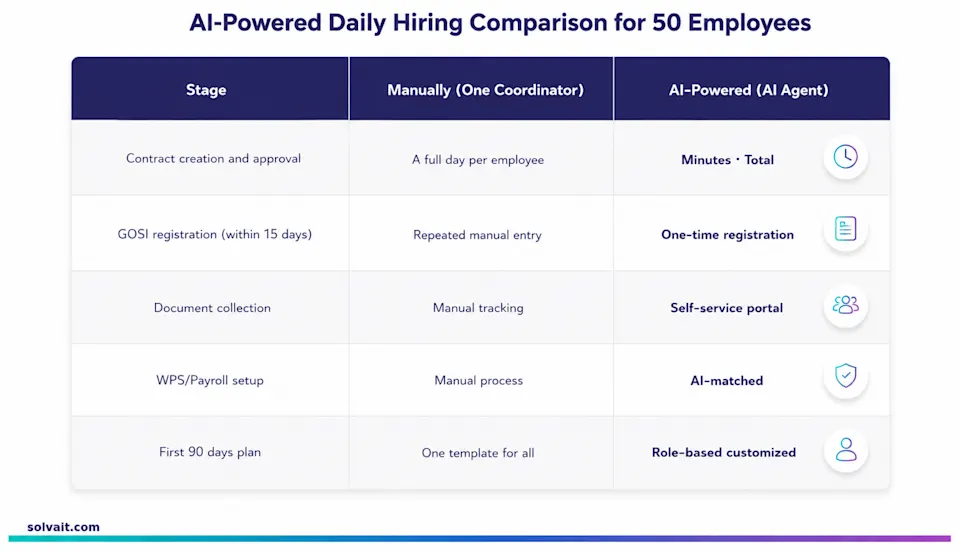
Notice the last column doesn't remove human oversight. The agent executes; a specialist reviews and approves. That's the whole idea behind agentic AI in HR: automate the doing, not the deciding.
The tasks that leave the coordinator's list
Contract creation: the system generates bilingual Qiwa contracts and registers them directly during onboarding, along with later amendments and renewals.
GOSI data entry: registration is derived from the same record, so no retyping and no copy-paste errors.
Document collection: a self service portal where the hire uploads their ID, bank details and certificates before day one.
Account and device provisioning: system access and email requests fire automatically once the file is complete.
What an automated onboarding journey looks like
Four stages. It starts the moment the offer is accepted, not on day one. Practitioners call this pre boarding: everything between offer acceptance and the start date, from sending the contract and finishing compliance paperwork to preparing equipment and staying in touch. Getting it done early cuts first day chaos and signals that your organization is professional and prepared.
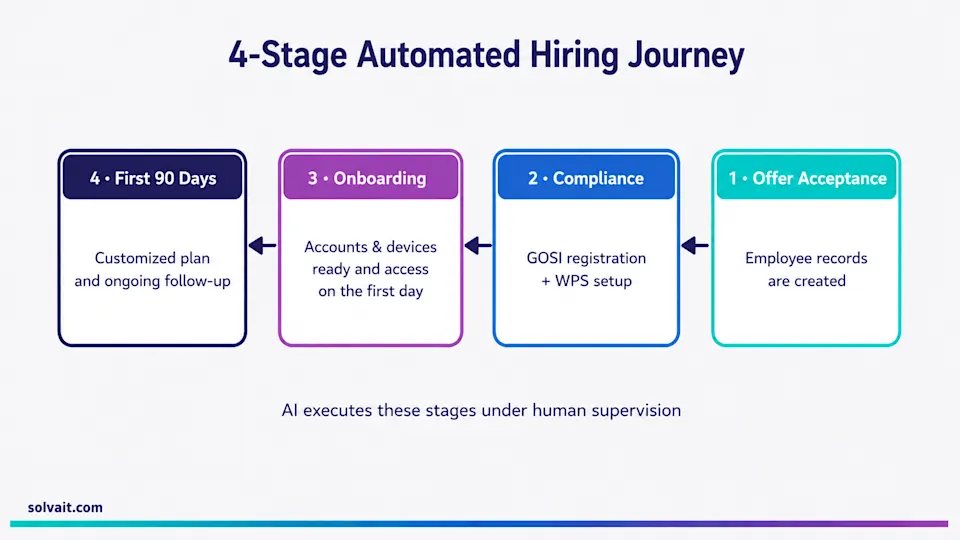
The final stage, the first 90 days, matters most for retention. The data is blunt here. Around 20% of turnover happens in the first 45 days according to SHRM, and employees who go through a great onboarding experience are 69% more likely to stay for three years. Automating the administrative side frees the manager's time for what can't be automated: coaching and the human relationship.
Is automation worth it? The numbers answer
Organizations that invest in structured onboarding report up to 82% higher new hire retention and more than 70% higher productivity, according to Brandon Hall Group research. Companies using AI for onboarding saw a 50% improvement in new hire time to productivity, per Gartner in 2025.
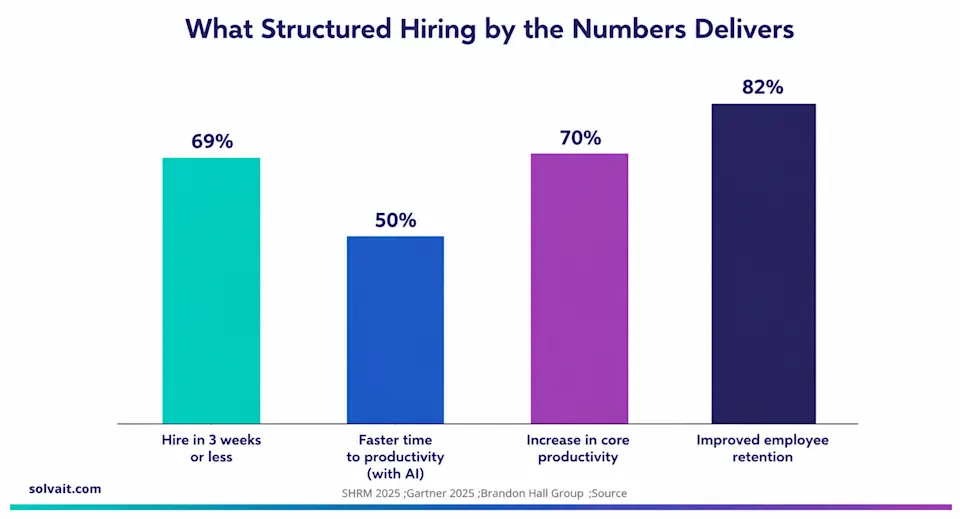
Gartner's October 2025 CHRO survey put harnessing AI to reshape HR at the top of the priority list for 2026. The direction is clear. Automation is moving from a nice to have to an operational necessity.
One honest caveat. Automation won't fix a badly designed onboarding process. If your first 90 days plan is one template for everyone, automating it just gives you the same template faster. The tool accelerates what you build, so build the process first.
Where Solvait fits
Solvait Attract manages talent acquisition up to offer acceptance. From there, Solvait HCM built on Microsoft Dynamics 365 takes over hiring and compliance: Qiwa contracts, GOSI registration, and wage protection setup through Mudad, all from a single employee record. The agentic layer that executes the repetitive tasks under your team's supervision comes from Solvait AI HR, with agents that carry out the work and raise exceptions for human approval. And when you want to turn this cohort's data into insight turnover, skills gaps, performance the analytics layer comes from Solvait Wise. The practical result: a small HR team hires a large batch without turning into a data entry center.
Before you model payroll for the new batch, try Solvait's free salary calculator to estimate cost in seconds.
Want to see this run on your own data? Book a Solvait demo and let our team walk you through a 50 hire onboarding path from accepted offer to day one.
FAQ
How long do you have to register a new employee with GOSI in Saudi Arabia?
Each employee must be registered with GOSI within 15 days of the hiring date, Saudis by national ID and expatriates by Iqama number, with basic salary and housing allowance entered accurately. Missing the window exposes the establishment to penalties, so an automated system links registration to the employee record at offer acceptance to keep you inside the deadline.
Can you onboard a large batch without a big HR team?
Yes. When the process is built on one employee record that feeds Qiwa, GOSI and Mudad automatically, the system runs the repetitive tasks and the small team handles review, approval and welcome. Scale becomes a matter of automated processing, not headcount.
What stays human when onboarding is automated?
The system automates execution: contract creation, data entry, account provisioning and salary-figure matching. Judgment and relationship stay human: approving exceptions, coaching, and integrating the new hire into the team culture across the first 90 days.
Does automation solve data parity across Qiwa, Mudad and GOSI?
Yes, because the data has a single source. When salary and housing allowance come from one employee record, the same figures flow to Qiwa, Mudad and GOSI, preventing the mismatches that can freeze system access and delay payroll.
References
Brandon Hall Group - Onboarding research: structured onboarding → up to 82% higher new-hire retention and 70%+ productivity.
SHRM (Society for Human Resource Management) - New-hire onboarding & early turnover (≈20% of turnover in the first 45 days; strong onboarding lifts 3-year retention). → https://www.shrm.org
Gartner - 2025 research on AI in onboarding (time-to-productivity) and the October 2025 CHRO survey (AI a top 2026 priority). → https://www.gartner.com/en/human-resources
GOSI (General Organization for Social Insurance) - Employee registration within 15 days of hiring (Saudis by National ID, expats by Iqama). → https://www.gosi.gov.sa
Qiwa - Official employment-contract platform (salary, housing allowance, role classification). → https://qiwa.sa
Mudad - Official wage/payroll platform (data parity with Qiwa & GOSI). → https://mudad.com.sa
Ready to see Solvait in action?
Book a personalized demo and see how Solvait's AI-powered HR platform can transform the way your team works.
Tags
Related Posts
How to Choose an AI HR System in Saudi Arabia
A buyer's checklist of 7 questions that expose the real difference between AI HR systems in Saudi Arabia, before you sign the contract.
Oct 8, 2026
Future of HR in the GCC: 5 Predictions for 2027
Five practical predictions for the future of HR in the GCC by 2027, backed by Gartner, PwC , and what agentic AI means for Saudi and Gulf teams.
Aug 11, 2026
AI HR Assistant: The Chatbot Conversation
How an agentic HR assistant answers employee questions in Arabic around the clock, and completes the task instead of just replying.
Aug 9, 2026