

End of Service in Saudi Arabia: How Article 84 and Article 85 Decide Resignation vs Termination Payouts
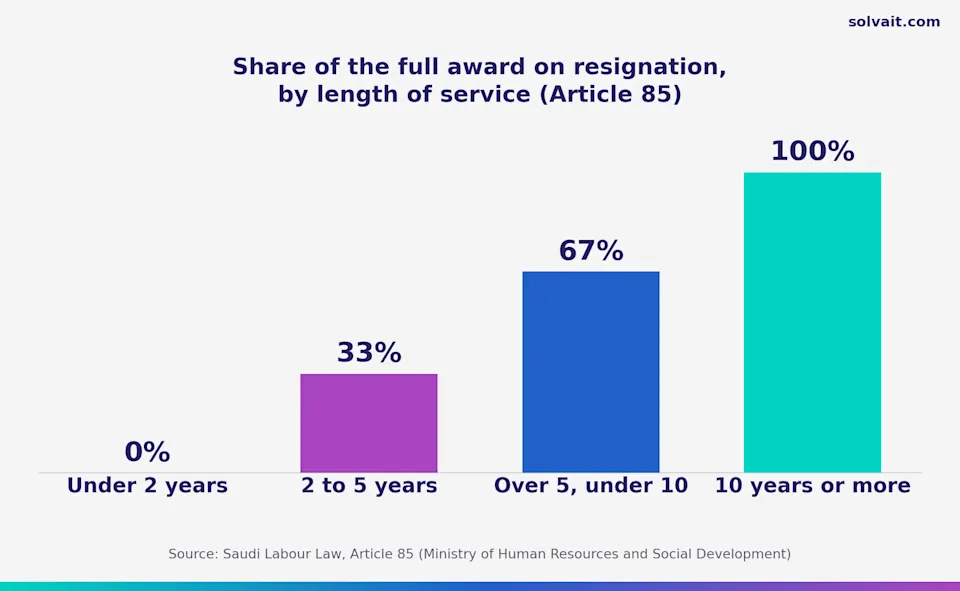
Whether the employee resigned or was let go changes the end of service award completely, sometimes by tens of thousands of riyals. The rule in one line: Article 84 builds the full award, and Article 85 cuts that award on resignation only, according to length of service. End of service in Saudi Arabia is a payment the employer owes the worker when the employment relationship ends, calculated on the last wage and the years of service. On employer termination it is paid in full. On resignation it is paid at a share that depends on tenure: nothing under two years, one third from two to five, two thirds for more than five and under ten, and the full award at ten years or more. A few exceptions pay the full award even after a resignation: force majeure, a woman leaving within six months of marriage or three months of childbirth, and leaving because the employer broke its obligations. This guide walks through the calculation step by step, with a decision table and a worked example for each case.
Key takeaways
Article 84 sets the full award: half a month's wage for each of the first five years, then one full month for each following year, on the last wage, with partial years prorated.
On employer termination the end of service award is paid in full. The reduction in Article 85 applies to resignation only.
Article 85 resignation tiers: under two years nothing, two to five years one third, more than five and under ten two thirds, ten years or more the full award.
Articles 87 and 81 pay the full award despite a resignation in set cases: force majeure, a woman leaving within six months of marriage or three months of childbirth, and leaving because of the employer's breach.
The 2025 amendments did not change how the award is calculated. They changed how resignation itself works. In force since 19 February 2025.
How do Articles 84 and 85 decide the end of service award?
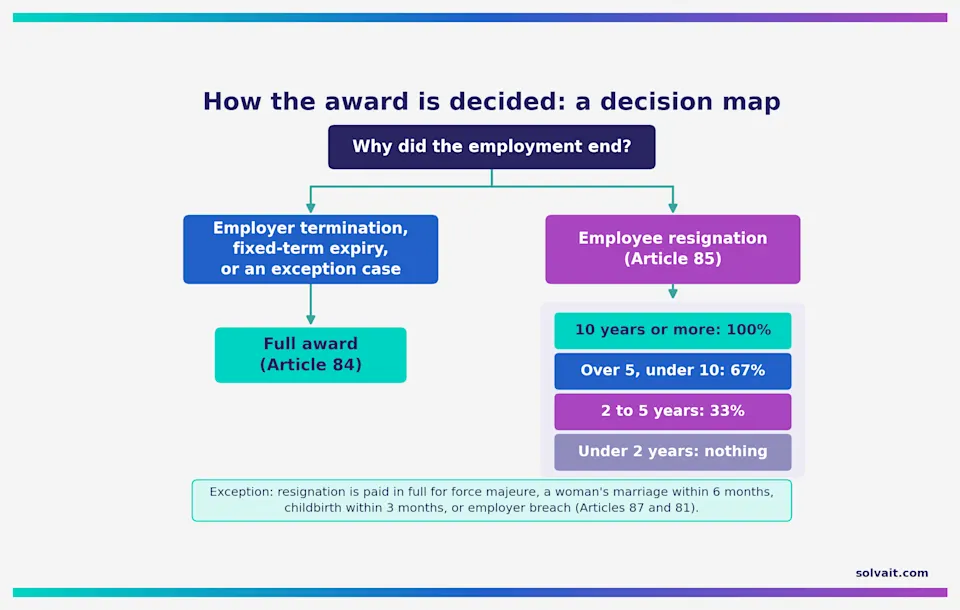
The base is simple. The errors come from confusing two articles that do two different jobs. Article 84 builds the full award. Article 85 decides how much of that award a worker keeps when the worker is the one who resigned.
Article 84 sets the full award like this: half a month's wage for each of the first five years of service, and one full month's wage for each year after that. It is calculated on the last wage, not on basic salary alone, meaning basic pay plus the fixed allowances set for the worker, most often housing and transport. And the worker earns the award for partial years in proportion to the time actually served.
The working formula for the full award:
Full award = [ (0.5 × years within the first five) + (1 × years beyond five) ] × last monthly wage
Article 85 then multiplies that award by a share that depends on why the person left and how long they served. If the employer ended the contract, or a fixed term contract reached its natural end date, the share is 100%. If the worker resigned, the reduced shares apply.
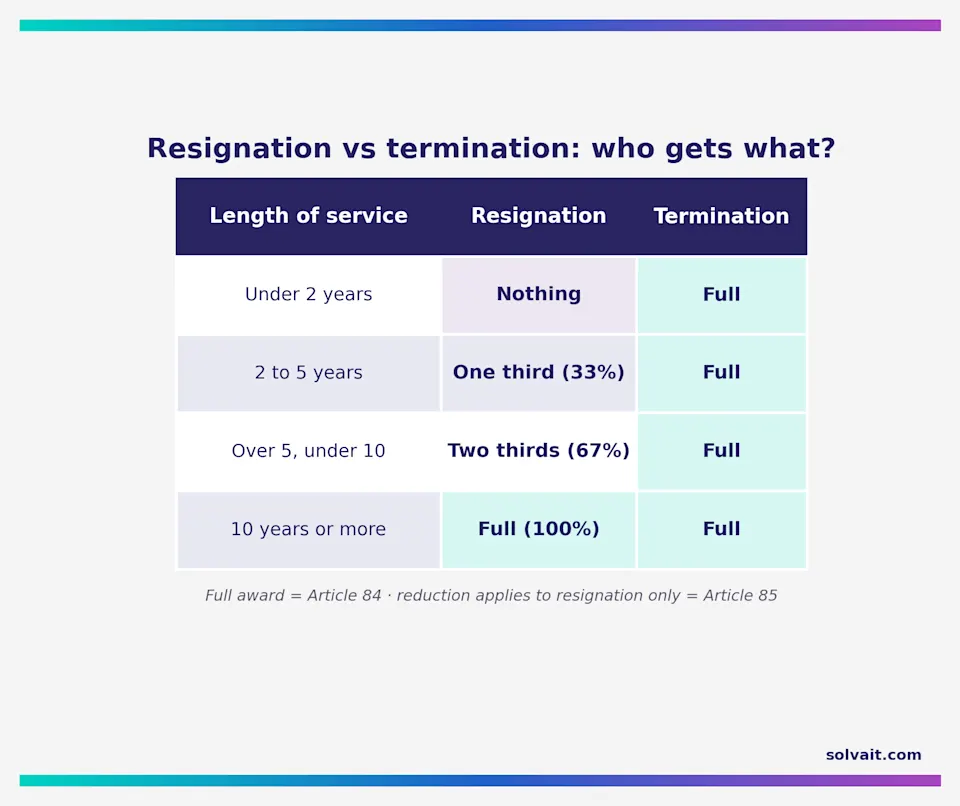
The decision table: who gets what?
Length of service | Resignation (Article 85) | Employer termination (Article 84) |
Under 2 years | Nothing | Full award |
2 to 5 years | One third (33%) | Full award |
More than 5, under 10 | Two thirds (67%) | Full award |
10 years or more | Full (100%) | Full award |
A rule worth keeping: one day past five years of service moves a resigning worker from one third to two thirds. One day past ten years moves them to the full award. Tenure here is not a detail. It sets the number.
A worked example for every case
Take the full calculation first, then apply the resignation shares to it.
An employee whose employer ended the contract after 8 years, on a last monthly wage of SAR 12,000. Because the employer ended it, Article 84 applies in full:
First five years: 5 × 0.5 × 12,000 = SAR 30,000
The next three years: 3 × 1 × 12,000 = SAR 36,000
Total: SAR 66,000
Now the same Article 84 logic, but with a resignation under Article 85:
Case | Full award (Article 84) | Article 85 share | Actually owed |
Resigns after 1.5 years, last wage SAR 10,000 | 7,500 | Nothing | SAR 0 |
Resigns after 4 years, last wage SAR 10,000 | 20,000 | One third | SAR 6,667 |
Resigns after 8 years, last wage SAR 12,000 | 66,000 | Two thirds | SAR 44,000 |
Resigns after 12 years, last wage SAR 15,000 | 142,500 | Full | SAR 142,500 |
Employer terminates after 8 years, SAR 12,000 | 66,000 | Full | SAR 66,000 |
Look at the third row against the last one. Same tenure, same wage, yet the resigning worker gets SAR 44,000 and the terminated worker gets SAR 66,000. The SAR 22,000 gap comes down to one word in the exit letter.
When the full award is paid despite a resignation
Articles 87 and 81 give the worker the full award even after a resignation, in four cases:
Force majeure: leaving for a reason beyond the worker's control pays the full award (Article 87).
A woman's marriage: if a female worker ends her contract within six months of her marriage, she is owed the full award (Article 87).
Childbirth: if she ends her contract within three months of giving birth, she is owed the full award (Article 87).
Employer breach: a worker may leave without notice and keep full rights when the employer fails its core obligations (Article 81).
In these cases the reduced Article 85 shares do not apply. The full Article 84 award is paid.
Which five ways do HR teams miscalculate end of service?
The numbers show why this deserves precision. Saudi courts received more than 133,432 labour cases in 2024, with rulings up 21% year on year, according to the Ministry of Justice. Friendly settlement resolves 77% of disputes before they reach court, per the Ministry of Human Resources and Social Development, yet a wrong final settlement remains one of the most common triggers for a dispute at exit. These five errors are the usual suspects.
Mistake | What happens | Legal risk |
Applying the Article 85 reduction to a termination | The award is cut when the full amount is owed | A claim for the difference, back-pay ordered, and the amount ranks as a first rate privileged debt |
Calculating on basic salary instead of the full last wage | Every settlement comes out below what is owed | A systematic shortfall that repeats with every leaver and scales with headcount |
Ignoring the proportional calculation of partial years | Extra months of service are dropped | The error labour offices see most, and an easy one to dispute |
Ignoring the Article 87 and 81 exceptions | The reduction is applied where the full award is due | A shortfall that falls harder on women, with reputational cost |
Treating a fixed term expiry as a resignation | A full award due at natural expiry is cut | A shortfall in the settlement and a claim for the difference |
The first is the dangerous one because it looks reasonable. The Article 85 reduction was built for resignation alone. Apply it to a worker the employer let go and you have simply paid them less than half of what they are owed in some cases, and that is an easy gap to prove at the labour office.
The second is quieter but wider. The law uses the last wage, not basic pay on its own. The wage that counts is usually basic plus the fixed, recurring allowances set for the worker, most often housing and transport. Calculate on basic alone and the error shows up not in one settlement but in every settlement, which is what turns a single slip into a pattern.
What did the 2025 amendments change for resignation and end of service?
Here is where most of this year's confusion sits. The labour law amendments in force since 19 February 2025 did not touch how the award is calculated. The structure of Articles 84 and 85 is the same, the shares are the same, the exceptions are the same. What changed is the resignation mechanism itself.
Area | Before | After 19 February 2025 |
The award formula (Articles 84 and 85) | As is | Unchanged |
Definition of resignation | Not expressly defined in the law | Formally defined, must be a written request |
Employer silence | Unregulated | Resignation deemed accepted after 30 days with no response |
Deferring acceptance | Unregulated | Employer may defer up to 60 days by a written, reasoned decision taken within the first 30 days |
Withdrawing a resignation | Unclear | Allowed within 7 days if not yet accepted |
Employee notice on an indefinite contract | 60 days | 30 days |
Why does this touch the end of service number? Because the award is calculated to the actual last day of service, and that day now depends on the acceptance date or the expiry of the statutory windows. A worker who submits a resignation the employer never answers ends service after 30 days, and those days feed the partial year calculation. Skip them and you are back to the third mistake in the previous section.
What does an HR team update in practice?
A written, dated resignation form with a clear acknowledgment of receipt.
A 30 day response clock, plus a documented process for any deferral decision, written and reasoned.
An offboarding checklist that ties the acceptance date to the last day of service date the award is built on.
A review of settlement timing: the employer settles wages and dues within one week when the relationship ends, and within two weeks when the worker is the one ending it.
How does Solvait help you calculate end of service accurately?
The rule behind this calculation is clear. Applying it by hand across hundreds of workers, each with a different wage, allowance set and tenure, is where the error lives. That is where automation earns its place.
Teams run this calculation in one of three ways, and the honest answer to which is right depends on scale, not on preference:
Approach | Works well when | Breaks down when |
A manual spreadsheet or a free calculator | Headcount is small, contracts are uniform, exits are rare | Volume grows, allowance structures vary, or resignation versus termination has to be judged case by case |
A global HRIS not localised for Saudi | You mainly need general HR records and payroll | It applies a generic gratuity formula that misses the Article 85 tiers and the Article 87 and 81 exceptions |
A Saudi-localised system such as Solvait | Compliance and audit-defensible numbers matter at scale | Rarely, since this is the case it is built for |
For a five person firm with identical contracts, a spreadsheet and the free calculator may be all you ever need, and we would rather you use those than pay for what you will not use. The case for a system starts when volume and variation turn the manual call into the weak link.
The Solvait Agentic AI HR platform is built on Microsoft Dynamics 365 and runs the full HR lifecycle with Saudi compliance built in, including Labour Law and end of service under Articles 84 and 85. It calculates on the last wage, prorates partial years automatically, and distinguishes resignation from termination instead of relying on a manual call that can go wrong. The result is a figure you can defend in front of an auditor or a labour office, not one you hope is right. Solvait runs this approach for more than 260 enterprise clients, with close to 50% time savings.
Before any settlement, check the number yourself with Solvait's free end of service calculator. It applies Articles 84 and 85 and breaks the amount out line by line, with no signup and no data captured. For fully worked examples, see our guide on calculating end of service with worked examples.
To see this calculation run automatically inside your real settlements, book a demo with Solvait.
Frequently asked questions
How is end of service calculated in Saudi Arabia?
Under Article 84: half a month's wage for each of the first five years of service, and one full month for each year after that, on the last wage including fixed allowances, with partial years prorated. A worker who serves five years is owed the equivalent of 2.5 months of their last wage on termination.
What is the difference between resignation and termination for end of service?
On employer termination the award is paid in full under Article 84. Resignation is subject to the Article 85 reduction: nothing under two years, one third from two to five, two thirds for more than five and under ten, and the full award at ten years or more.
Can a resigning worker still get the full end of service award?
Yes. The full award is paid despite a resignation in the Article 87 and 81 cases: force majeure, a female worker leaving within six months of marriage or three months of childbirth, and leaving because the employer breached its obligations. It is also paid in full to anyone who completed ten years.
Did the 2025 amendments change the end-of-service calculation?
No. The calculation structure in Articles 84 and 85 is unchanged. The amendments in force since 19 February 2025 organised the resignation mechanism: a written definition, deemed acceptance after 30 days of employer silence, and the right to defer acceptance up to 60 days by a written decision.
Which wage is the award calculated on?
The last wage, meaning basic pay plus the fixed allowances set for the worker, most often housing and transport. Variable items such as commission and overtime usually sit outside the base unless the contract says otherwise.
References
Ministry of Human Resources and Social Development: End-of-Service Award Regulation, supports the Article 84 formula, Article 85 shares, and Article 87 exceptions.
Saudi Labour Law, Royal Decree No. M/51: full text, supports Articles 84 and 87 and the settlement timing.
King & Spalding: Amendments to the Saudi Labor Law, 2024, supports the resignation changes and the 19 February 2025 effective date.
Ministry of Justice, via Gulf News: Over 133,000 labour cases in 2024, supports the labour-case volume.
EY: payroll error survey, 2022, supports the cost of manual calculation errors.
Ready to see Solvait in action?
Book a personalized demo and see how Solvait's AI-powered HR platform can transform the way your team works.
Tags
Related Posts

Future of HR in the GCC: 5 Predictions for 2027
Five practical predictions for the future of HR in the GCC by 2027, backed by Gartner, PwC , and what agentic AI means for Saudi and Gulf teams.
Aug 11, 2026

Arabic First Employee Self Service Portal Guide
How to build an Arabic first employee self service portal your staff actually use in Saudi Arabia: the 5 layers, adoption benchmarks, and where AI fits.
Sep 1, 2026

Recruitment Automation in KSA: Hire a Full Batch, Small Team
Hire a large batch of Saudi employees with a small HR team via one record that feeds Qiwa, GOSI, and wage protection automatically.
Aug 31, 2026