
End of Service Calculator
Calculate accurate end of service benefits following Saudi Arabia's labor laws and regulations.
Step 1: Employee Information & Salary Details
Enter employee information and salary details
* Required fields

Calculate End of Service for Any Saudi Employee in 60 Seconds, Free
The Solvait End of Service Calculator works out the award for any employee in Saudi Arabia in about a minute, under Articles 84 and 85 of the Labor Law and aligned with Ministry of Human Resources and Social Development (HRSD) rules. No signup. No data captured. You enter the last wage, the length of service, and the reason for leaving, and the award comes back broken out line by line.
We built it for three people: the HR officer preparing a final settlement, the employee checking their own entitlement before they hand in a resignation, and the finance lead who needs a defensible number for the provision. Below we walk through how the award is actually calculated, because a figure you understand is one you can defend in front of an auditor or a labor office. A figure you copied off a website is not.
The rule in one sentence
Article 84 sets the award at half a month’s wage for each of the first five years of service, and a full month’s wage for every year after that, calculated on the last wage, with any part of a year paid in proportion to the time served.
Two things get missed. The first is the base. The law uses the last wage, not basic salary in isolation. In practice the wage that counts is basic pay plus the fixed, recurring components decided for the worker, which for most Saudi contracts means housing and transport allowances. Variable items like commission or overtime usually sit outside it unless the contract says otherwise, so read the Qiwa contract before you assume. The second miss is partial years. Counting only whole years and dropping the extra months quietly shorts the employee, and it is the error labor offices see most.
A worked example
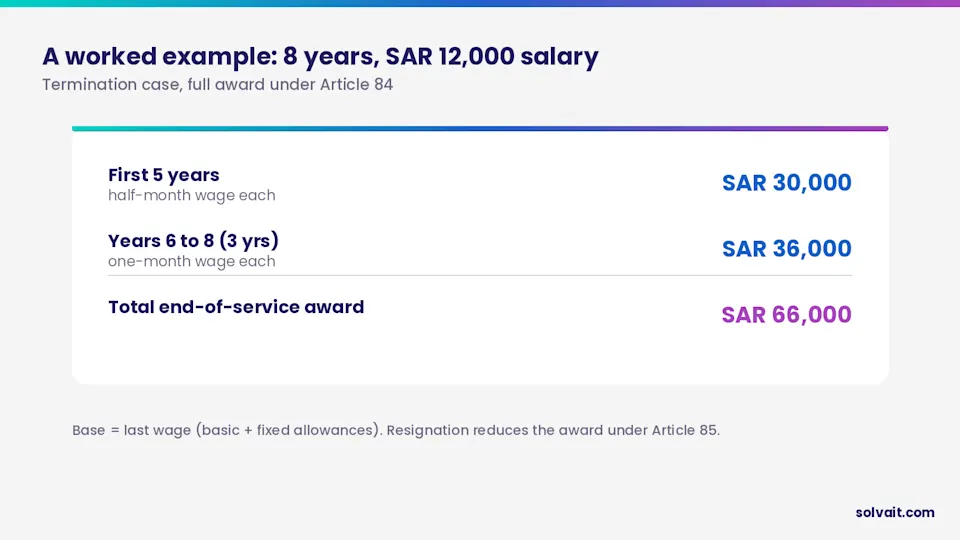
Take an employee who served 8 years at a last wage of SAR 12,000, whose contract was ended by the employer, so the full award applies under Article 84.
First five years: half a month each, so 5 × 0.5 × 12,000 = SAR 30,000. The next three years, the sixth through the eighth: a full month each, so 3 × 12,000 = SAR 36,000. Total: SAR 66,000.
That is the termination case. Change one fact, the reason for leaving, and the number can move by tens of thousands of riyals.
Resignation changes the equation
Article 85 governs resignation, and it scales the award to length of service. Under 2 years: nothing. Two to five years: one third of the full award. Five to ten years: two thirds. Ten years or more: the full award. Employer termination sits on the other side of the line. It pays the full award regardless of how long the person served, unless the dismissal falls under one of the Article 80 grounds that forfeit the right, such as proven serious misconduct.
One case cuts across both rules. A female employee who resigns because of marriage or childbirth, within the window the law defines, keeps her full entitlement rather than the reduced resignation tier. The tool asks the reason for leaving precisely because these branches change the result.
Here is the same employee across the exit types.
Exit type | Service | Award (of full) |
Resignation | Under 2 years | Nothing |
Resignation | 2 to 5 years | One third |
Resignation | 5 to 10 years | Two thirds |
Resignation | 10 years or more | Full award |
Employer termination | Any length (over probation) | Full award, unless Article 80 forfeits it |
This is where most manual errors live: treating a resignation like a termination, or forgetting the reduction tier. Same person, same salary, same years of service, two entirely different figures depending on why the employment ended. The calculator applies the right branch every time.
Do not forget the settlement clock
The award is only half the job. Article 88 sets a deadline for paying it. When the employer ends the contract, all final entitlements are due within one week of the last working day. When the employee resigns, the employer has up to two weeks. Miss the window and the employer is exposed to a claim at the labor office, so the settlement date belongs on the same worksheet as the number.
Why a genuinely free tool
Fair question: why offer this free, with no signup?
Because the value should reach you before any ask does. No data capture, no mandatory registration, no gate. You open the tool, enter the numbers, read the breakdown. Saving the result as a PDF is there if you want it, not a toll you pay to see the answer.
The free tool is not a marketing exception to how we work. It is a small sample of it. The same accuracy runs inside Solvait HCM, built on Microsoft Dynamics 365, where end of service sits within a full final settlement, every line traceable to the rule that produced it, so the figure holds up under review.
Try the tool now
Open the free End of Service Calculator and run the first case on your desk. And if you want to see how Solvait handles the entire final settlement inside one system, book a demo.
FAQ
How is end of service calculated in Saudi Arabia?
Under Article 84, the award is half a month’s wage for each of the first five years of service and a full month’s wage for each year after, calculated on the last wage (basic pay plus fixed allowances such as housing and transport), with any part of a year paid proportionally.
Does the award differ between resignation and termination?
Yes. On employer termination the employee receives the full award regardless of length of service, unless Article 80 applies. On resignation it is reduced under Article 85: nothing under two years, one third from two to five years, two thirds from five to ten, and the full award at ten years or more.
Which salary components go into the calculation?
The base is the last wage: basic salary plus the fixed, recurring allowances decided for the worker, typically housing and transport. Variable items such as commission and overtime are usually excluded unless the contract states otherwise, so check the Qiwa contract.
When must the final settlement be paid?
Under Article 88, when the employer ends the contract the entitlements are due within one week of the last working day. When the employee resigns, the employer has up to two weeks.
Is the Solvait calculator really free?
Yes. It is fully free, with no signup and no mandatory data capture. You enter the numbers and read the result immediately. Saving it as a PDF is optional.
References
Saudi Labor Law - Articles 84-85 (end-of-service award & resignation reductions) and Article 88 (final settlement deadlines). Ministry of Human Resources and Social Development (HRSD).
Wage components and employment-contract guidance — Qiwa (official labor platform).
Ready to see Solvait in action?
Book a personalized demo and see how Solvait's AI-powered HR platform can transform the way your team works.
Tags
Related Posts

Benchmark Any Saudi Salary in 30 Seconds (Free Tool)
Solvait's free salary calculator gives you the Saudi market range by role, sector and city in 30 seconds. Benchmark any offer before you hire or raise pay.
Sep 13, 2026

Saudi Labour Law Automation: 9 Clauses to Enforce
Nine Saudi labour law clauses your HR system should enforce automatically after the 2025 reforms, from probation caps to WPS files.
Aug 30, 2026

Free HR Tools in Saudi Arabia: 6 Tools From Solvait
Six free HR tools from Solvait for Saudi teams:salary,end of service,job descriptions, appraisal goals,CV match,and business cards.No data captured.
Jul 16, 2026