

What Is End of Service Benefit (EOSB)?
An end of service benefit is a sum the employer must pay an employee when the work relationship ends, calculated on the last wage and total years of service under Articles 84 and 85 of the Saudi Labor Law. The core rule is simple: half a month's wage for each of the first five years, then a full month for each year after that, with partial years counted in proportion to time actually served. The final figure, though, changes completely depending on why the contract ended. An employee whose contract is terminated by the employer receives the full benefit. An employee who resigns may receive a third, two thirds, or nothing, depending on how long they served.
That single distinction causes most of the errors. One owner applies the resignation rate to an employee who was actually terminated, underpays, and walks straight into a labor dispute. Another forgets to prorate partial years and quietly strips the employee of their final months. This guide takes you through it step by step: which wage goes into the calculation, how service time is counted, how the formula works, and how everything shifts between termination and resignation, with examples in real numbers.
Which wage goes into the calculation?
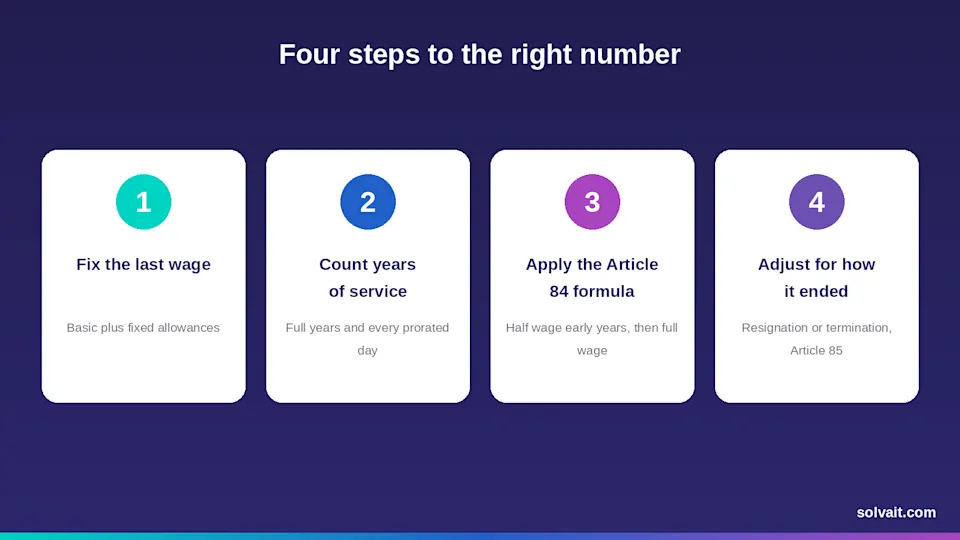
Here is the point many owners miss. The benefit is not calculated on basic salary alone. The law sets it on the “last wage,” and wage here means basic pay plus the fixed allowances an employee receives regularly, such as housing and transport allowances when they are a steady part of pay.
Variable allowances are a different matter. Sales commissions, overtime pay, and discretionary performance bonuses usually fall outside the calculation base because they are not fixed. This is where the first mistake happens. A company that calculates only on basic pay shortchanges the employee. A company that calculates on everything paid in the final month, including a one off commission, inflates the figure without basis. The practical rule: start with basic pay, add the recurring fixed allowances, and leave the variable part out.
And “last” is deliberate. The benefit is built on the final wage before separation, not an average across the years of service. So if an employee got a raise or promotion a month before leaving, the benefit rests on the new, higher wage.
How service time is counted, in full years and partial days
Service starts on the first actual working day and ends on the last day in the role, and it includes statutory leave periods. The part that gets dropped is the fraction. The law guarantees the employee a benefit for portions of a year in proportion to time actually served, so someone who worked four years and eight months is owed for those eight months too, not just the four full years.
Ignoring the fraction is a common error because it looks like a harmless simplification. It isn't. Picture an employee on a final wage of SAR 8,000 who served nine years and six months. Counting only “whole years” denies them a full half year of accrual, a gap worth thousands of riyals. The official tools, such as the end of service calculator on the Qiwa platform, prorate this to the day. That is the standard any manual calculation is measured against.
The core Article 84 of the Saudi Labor Law formula: a worked example
Article 84 is explicit: half a month's wage for each of the first five years of service, and a full month for each year after that. Apply it to an employee whose contract is terminated, last wage SAR 10,000, with exactly 8 years of service.
First, the opening five years: 5 years × half a month = 2.5 months of wage. Then the next three years: 3 years × a full month = 3 months of wage. Total: 5.5 months of wage. Multiply by the last wage: 5.5 × 10,000 = SAR 55,000.
If the same person had served 8 years and 4 months, we add the partial accrual. Four months is a third of a year, and in the “full month per year” stage that is roughly a third of a month's wage, about SAR 3,333 more, bringing the figure near SAR 58,333. Note this example assumes termination by the employer, meaning full entitlement. If the exit were a resignation, the picture changes, which is what we turn to now.
Resignation changes everything: the Article 85 of the Saudi Labor Law rules
This is the most dangerous misunderstanding in the whole topic. Article 84 sets how the total benefit is calculated. Article 85 sets how much of it the employee actually receives on resignation. The gap between the two is what separates a correct calculation from one that lands you in the labor court.
On resignation, entitlement depends on length of service. An employee with under two years receives nothing. From two years up to five years, they receive one third of the benefit. Over five years up to ten, they receive two thirds. At ten years or more, they receive the full benefit, exactly as if they had been terminated.
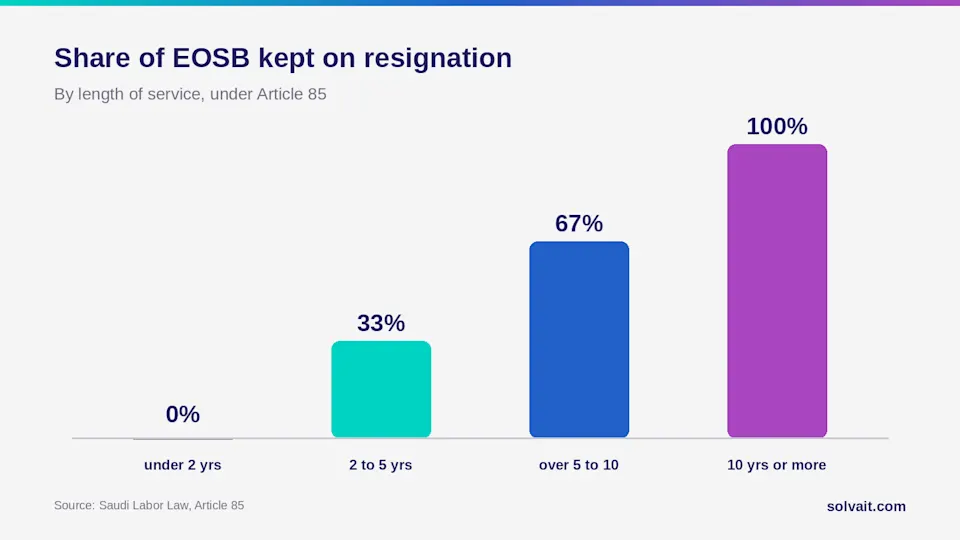
Back to our SAR 55,000 employee (8 years, wage 10,000). Had they resigned instead of being terminated, their tenure falls in the “over five up to ten” band, so they keep two thirds: 55,000 × 2/3 = about SAR 36,667. The difference between the two outcomes is SAR 18,333, for the same person on the same wage. That is exactly why identifying the reason for separation is the most important step before any arithmetic.
There are important exceptions. The law treats some resignations as full entitlement, such as a female employee leaving because of marriage or childbirth within the period the law specifies, or leaving because of a force majeure event beyond the employee's control. In these cases the employee receives the full benefit regardless of length of service.
The entitlement table: who gets how much?
Case | Length of service | Share owed |
|---|---|---|
Termination by employer | any duration (2 years or more) | full (100%) |
Resignation | under 2 years | nothing |
Resignation | 2 to under 5 years | one third (33%) |
Resignation | 5 to under 10 years | two thirds (67%) |
Resignation | 10 years or more | full (100%) |
Resignation for marriage or childbirth | within the statutory period | full (100%) |
Keep that top row in mind. Many disputes start when an exit is misclassified: what was a termination gets logged as a resignation, the amount drops, and the disagreement begins.
The costliest mistakes in EOSB calculation
After hundreds of settlements, the same errors keep surfacing. The first is mixing the termination formula with the resignation formula, the costliest of all because it flips the result on its head. The second is counting only whole years and dropping the fraction, which loses the employee the final months they earned. The third is building the calculation on basic salary alone when fixed allowances are part of the wage.
Then comes the mistake of delay. The financial calculation isn't the only bottleneck. The clearance process itself drags: confirming the return of company property, settling outstanding loans, reviewing the balance of unused leave. That manual chain between HR and Finance is the leading reason final dues arrive late, and the delay itself can create added obligations for the company.
The numbers explain why this deserves precision. An Ernst & Young study in 2022 found that one in five payrolls run the traditional way contains an error, and fixing a single error costs an organization about $291 on average. Deloitte reported that 30% of companies cite manual data entry as the most time-consuming part of payroll processing. End of service calculation is the peak of that complexity, because it folds wage, tenure, and reason for separation into one operation that leaves no room for a slip.
Where an HR system makes a real difference
Everything above can be worked out by hand on paper. The question isn't whether you can. It's how often you'll get it wrong, and what each error will cost. This is where an HR system earns its place, not by “doing the math for you” but by removing the sources of error at the root.
Element | Manual | HR system |
|---|---|---|
Prorating every worked day | often skipped | automatic |
Resignation vs termination | common mix up | built in |
Last-wage update | manual entry | from the record |
Time to settle | days | minutes |
Cost of an error | disputes, claims | documented payout |
Solvait HCM, built on Microsoft Dynamics 365, applies the text of Articles 84, 85, and 87 of the Saudi Labor Law to the employee's actual data: it prorates to the day, distinguishes resignation from termination automatically, and bases the calculation on the last wage recorded in the employee's profile, fixed allowances included. More importantly, it ties the end of service benefit to the clearance workflow and the payroll cycle, so the settlement never stalls between departments. The result is one correct, documented, auditable figure instead of a manual estimate exposed to error and dispute.
If you run payroll for a full team and want every end of service calculation right the first time, request a demo from Solvait and see the calculation turn from a monthly burden into something done in minutes.
Key Questions You May Have :
Is the end of service benefit calculated on basic salary or full wage?
It is calculated on the last wage, which is basic salary plus recurring fixed allowances such as housing and transport. Variable allowances like commissions, overtime, and discretionary bonuses usually fall outside the calculation because they are not fixed.
How much is the end of service benefit after 10 years of service?
For the first five years, half a month's wage per year, so 2.5 months. For the next five years, a full month per year, so 5 months. Total: 7.5 months of wage. On a last wage of SAR 10,000 that is SAR 75,000 on termination, and the full amount on resignation too, since ten years are complete.
What does an employee get if they resign before two years?
They are not entitled to an end of service benefit for their service period if they resign before completing two full years, unless the contract states otherwise. Other dues remain, such as compensation for unused annual leave and any outstanding wages.
What is the difference between end of service benefit and end of service dues?
The end of service benefit is the amount calculated from tenure and wage under Article 84. End of service dues are broader: they add to that benefit the value of unused leave, any unpaid wages, and any other allowances or amounts owed at exit.
Does the benefit differ between Saudi and non Saudi employees?
No. The calculation rules in Article 84 and the resignation rules in Article 85 apply equally to Saudi and non Saudi workers covered by the Labor Law. Specific categories with their own regulations, such as domestic workers, are excluded.
References
Ministry of Human Resources and Social Development: Saudi Labor Law, Articles 84 and 85, 2024 (statutory basis for the formula and resignation rules)
Qiwa Platform: End of Service Benefit Calculator, 2025 (standard for prorating to the day)
Ernst & Young: EY survey: Payroll errors average $291 each, 2022 (payroll error rate and cost to correct)
Deloitte: Global Payroll Benchmarking Survey, 2024 (manual data entry as the most time-consuming step)
Ministry of Human Resources and Social Development: Progress in the Saudi Labor Market, 2025 (77% of disputes settled before litigation; wages of over 8.5 million employees protected)
Tags
Related Posts

Solvait HCM Goes Live Across Almutlaq Group
Solvait HCM is now live at Almutlaq Real Estate (AREIC), Qantara Development, and Almutlaq Furniture. How one group unified HR on a single platform.
Jun 28, 2026

Sorting CVs using Agentic AI
How Agentic AI cuts hours of work to seconds, and how to make sure you don't lose the right candidate during fast screening in Saudi Arabia?
Jun 24, 2026

Employee Retention AI Tool
How an employee retention AI tool flags flight risk before the notice, and how GCC HR teams turn those signals into a retention strategy that works.
Jun 21, 2026