

The Problem Isn't How Many Recruiters You Have. It's the Process.
When hiring slows down, the instinctive fix is to add another recruiter to the team. But that doesn't touch the root cause. If your process burns two days per candidate just scheduling an interview over email, hiring a third recruiter simply means three people wasting two days instead of two.
The data backs up that diagnosis. According to SHRM's 2025 benchmarking, more than half of organizations run about 20 open requisitions per recruiter, and the screening and interview stages each take 8 to 9 days on average. And note: those aren't days of actual work on the candidate. They're days the task spends waiting its turn in a crowded queue. Adding headcount shortens the wait a little, but it never reaches the real culprit: the repetitive manual tasks that eat an expert's time on work that doesn't need their expertise.
A human expert doesn't create value by screening 300 resumes or trading seven emails to lock a meeting time. Their value is in assessing the candidate, persuading the rare talent, and reading between the lines in an interview. Every hour spent on mechanical work is an hour stolen from the work they're actually paid for.
Here's where almost everyone gets it wrong. Speed doesn't come from pushing the team to work faster. It comes from removing the work the team shouldn't be doing at all. Strip out the mechanical tasks, and the same recruiter's output doubles without adding a single hour to their day.
And the real cost of slowness is bigger than what shows up in a time report. According to LinkedIn's 2024 Talent Trends report, 62% of candidates walked away from a hiring process because it took too long. So a slow process doesn't just cost you days. It costs you the best candidates, the ones who accepted a faster offer from a competitor.
Where the Time Actually Goes in Hiring Saudi Talent
Let's break the journey down stage by stage. Once you map the real time spent on each step, the bottleneck becomes obvious, and it becomes just as obvious that the problem isn't the number of people.
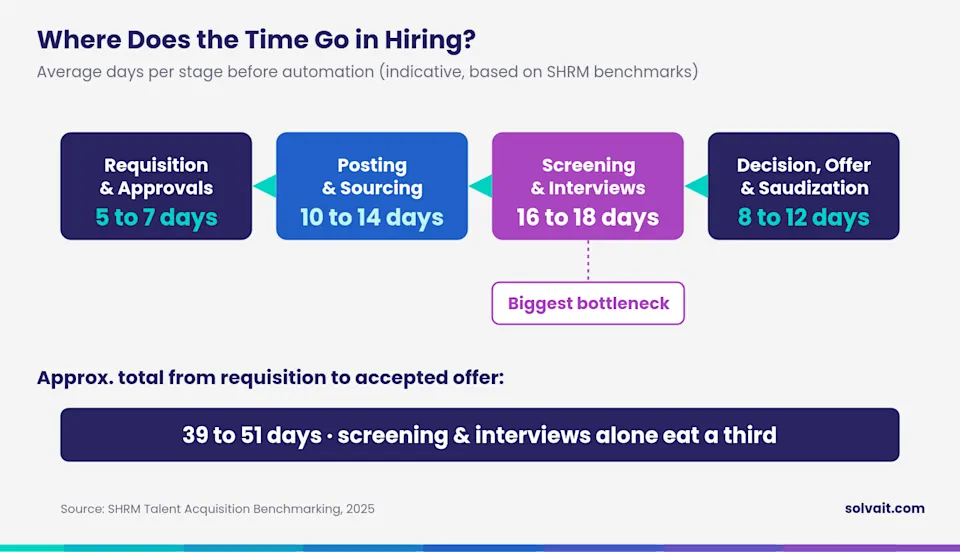
Stage One: Opening the Requisition and Approvals (5 to 7 days)
Before a single ad goes live, the requisition moves through a chain of approvals. The department head, then HR, then sometimes budget. Each signature waits its turn in a busy inbox. These are days when no one is working on the candidate , the paperwork is just waiting. In the Saudi market there's an extra layer: checking the hire's impact on the Saudization band before approval, especially in sectors that recently raised their quotas like engineering, accounting, and pharmacy.
Stage Two: Posting and Sourcing (10 to 14 days)
Sourcing candidates swallows close to a third of a recruiter's workweek, by industry benchmarks. Writing the job description, posting across several platforms, manually searching databases, drafting outreach messages one by one. Most of that time goes to searching and messaging, not to assessment.
Stage Three: Screening and Interviews (16 to 18 days)
This is the single biggest chokepoint in the whole journey. Manually screening hundreds of resumes takes minutes per CV, and once you multiply that by the number of applicants, it turns into days. Then comes scheduling: an endless back and forth to find an hour that suits the candidate and the interview panel at the same time. One stage that combines two mechanical jobs, screening and scheduling, and neither one needs human expertise in the first place.
Stage Four: Decision, Offer, and Compliance (8 to 12 days)
After the interview comes collecting the evaluations, waiting on the panel's decision, preparing the offer, and a final check of Saudization and band requirements before release. In Saudi companies this stage stretches the more systems you have to verify by hand: Qiwa, Mudad, GOSI, and Nitaqat band classification.
The rough total from opening the requisition to offer acceptance runs between 39 and 51 days. Notice that the stages eating the most time, screening, scheduling, and approvals, are precisely the mechanical stages that require no human judgment. And that's exactly what makes the problem solvable without hiring anyone.
Hold onto this breakdown, because it tells you precisely where automation should go, and where the human should stay in charge.
How to Cut the Time Threefold by Fixing the Process, Not Growing the Team
Automation doesn't replace the recruiter. It redistributes their time. The idea is simple: let the machine handle what's repetitive and measurable, and let the human handle what needs judgment and relationship. When that happens, the three longest stages shrink to a fraction of their former length.
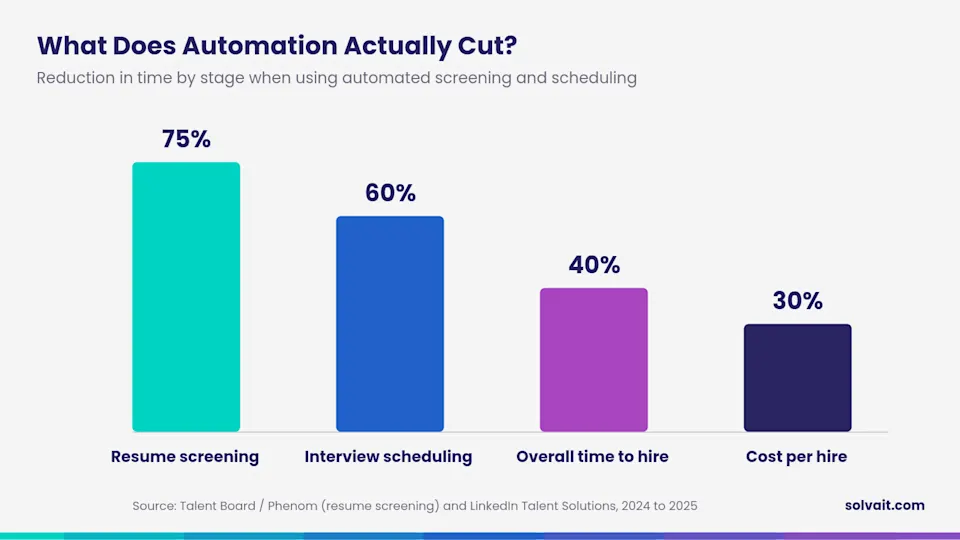
These numbers aren't marketing promises. A study by Talent Board and Phenom found that AI powered screening tools cut resume review time by up to 75%. And organizations using intelligent recruiting tools report a 30% to 50% acceleration in time to hire, according to market data aggregated from LinkedIn and others for 2024 to 2025. Notice that most of the impact concentrates at the front of the funnel: screening, sourcing, and scheduling, the very stages we diagnosed as the biggest bottleneck.
Here's where the manual process differs from the automated one at each stage:
Stage | Manual | With AI and Automation |
Screening 200 resumes | Hours to days | Minutes, ranked by match |
Scheduling interviews | Email back and forth | Self booking link and calendar sync |
Candidate communication | Intermittent and irregular | Automatic and continuous at every stage |
Saudization and band compliance | Manual tracking on files | Real time monitoring of ratios |
The recruiter's role | Data entry and coordination | Assessment, decision, relationship building |
Here's an important point: automation won't fix a bad job description, and it won't sell a candidate on a difficult boss or an uncompetitive salary. What it does is remove the dead time between steps. The speed you gain is time that used to be lost in waiting and data entry, not time that was spent on real thinking. That's why speed doesn't conflict with quality here. The speed comes from structure, not from rushing.
Where Solvait Comes Into the Picture
Once it's clear the fix is in the process and not the headcount, the practical question becomes: which tool takes over the mechanical stages and leaves the decision to the human? This is where Solvait's Attract comes in, the talent acquisition solution within the Solvait ecosystem built on Microsoft Dynamics 365.
The link to the stages we diagnosed is direct. Automated screening ranks applicants by how well they match the job description instead of manual review. Self scheduling kills the message ping pong. Automatic communication keeps the candidate engaged so you don't lose them to a faster competitor. And on the Saudi side, the ecosystem integrates with Saudization requirements so band monitoring stays live instead of being tracked by hand on spreadsheets. The result is that the recruiter goes back to their real job: assessing talent and winning it over, not entering data.
If you want to see where the time leaks in your own process, request a demo from Solvait and start from a diagnosis of your current journey.
How Solvait Puts This Into Practice
The four stages above aren't a hypothetical list. They map almost one to one onto features that already exist inside Solvait's Attract, the part of the Solvait ecosystem dedicated to talent acquisition. And that ecosystem matters here, because Attract isn't a standalone tool. It's built on Microsoft Dynamics 365, the same foundation that carries Solvait's core HCM platform. The candidate who gets hired flows into payroll, self service, and performance management without anyone re entering a single field. The agentic AI that screens the CV and the system that produces the Wage Protection file are one and the same system.
Here's how Attract handles each step of the blueprint above.
Writing the job description : Attract generates a job description written in the context of the Saudi market, starting from the title and a few core requirements, so the first step stops being a blank page. The same capability is available as a free job description generator on the Solvait website if you'd like to try it.
Building the pipeline and reading resumes : Attract generates the hiring stages, then analyzes incoming resumes automatically. This is the part that turns a full day of reading into a ranked list in seconds. Resumes are processed in a structured way, so you compare candidates on the same fields instead of comparing them by who wrote the prettiest CV.
Matching, strengths, and gaps : For each candidate, Attract produces a match score with an explicit breakdown of strengths, gaps, and recommendations against the role. This is the difference between "the AI picked this person" and "here's why this person fits, here's where they fall short, and now you decide." The recommendation supports the decision , the hire is yours.
Keeping the workflow in one place : Attract integrates with LinkedIn for sourcing and with Microsoft Teams for interviews, so candidate data, notes, and appointments don't scatter across five windows. For organizations already living inside the Microsoft ecosystem, that single environment integration is usually the deciding factor.
And a word about the rest of the ecosystem, because hiring rarely happens in isolation. Once the person is hired, Solvait's Wise takes over performance, OKRs, and talent development on top of your existing HR system, so the strengths and gaps you spotted during screening turn into a real development plan instead of a forgotten note. Solvait's core HCM platform then carries payroll, GOSI, and WPS readiness, the compliance layer every Saudi hire eventually reaches. The thread running through all of it is the tagline Solvait leads with: AI for People. The agentic AI does the repetitive work, and the human handles the judgment.
Solvait runs these systems with a product and support built for the Gulf market, not translated into it after the fact. And if you want to see the four step path run on your own data, with your own roles and your own band calculations Request a Demo .
Frequently Asked Questions
Do I really need to hire more recruiters to speed up hiring?
In most cases, no. Slow hiring usually comes from the dead time between stages: waiting on approvals, manual screening, and the back and forth of scheduling. These are mechanical tasks that don't need an expert. Automating them doubles the current team's output without growing it, because the problem is in the process, not the number of hands.
Where does most of the time go in the hiring process?
In the screening and interview stages. According to SHRM's 2025 data, each takes 8 to 9 days on average, roughly a third of the total duration. The reason is that manual screening and email scheduling consume days of waiting rather than actual work on the candidate.
Does automation hurt hiring quality in exchange for speed?
No, when it's applied to the right stages. Automation takes over the repetitive tasks like screening and scheduling, and leaves assessment and the decision to the human. The speed you gain is time that was being wasted on waiting. The evidence: organizations that hire quickly through a structured process record better new hire performance, not worse.
How long does hiring talent in Saudi Arabia usually take?
Most often between three and eight weeks, depending on the seniority of the role, Saudization requirements, and visa procedures. Roles subject to high Nitaqat bands take longer because of compliance verification. Automating screening, scheduling, and Saudization monitoring shortens this duration noticeably.
What's the difference between time to hire and time to fill?
Time to fill is measured from the moment the requisition is officially opened to offer acceptance, and it reflects the efficiency of the entire pipeline. Time to hire starts when the candidate enters the process. The global average time to fill is about 44 days according to SHRM, and it's the broadest indicator for measuring how fast the system moves.
References
SHRM: 2025 Talent Acquisition / Recruiting Benchmarking 2025 (average time to fill 44 days; screening and interviews 8 to 9 days; about 20 requisitions per recruiter)
LinkedIn Talent Solutions: Global Talent Trends / Reducing time to hire 2024 to 2025 (62% of candidates withdrew due to a long process)
MHRSD Saudi Arabia: Nitaqat / Saudization Requirements 2025 to 2026 (Saudization bands and their impact on the hiring journey)
Ready to see Solvait in action?
Book a personalized demo and see how Solvait's AI-powered HR platform can transform the way your team works.
Tags
Related Posts
How to Stay in the Nitaqat Green with the Help of Agentic AI ?
How your organization can maintain its Nitaqat Green status utilizing continuous monitoring and proactive Agentic AI.
Jun 16, 2026

Solvait's Free Resume Match Analyzer
Select the right candidates for jobs quickly and with high accuracy using Solvait’s CV matching analyzer tool.
Jun 2, 2026
A free tool for creating performance reviews that writes the full evaluation in seconds.
A free AI powered tool from Solvait writes complete performance reviews quickly, accurately, and at no cost.
Jun 1, 2026