

How to Write a Professional Job Description That Attracts the Right Candidate
A professional job description is a document that states the title, responsibilities, requirements, and what the company offers the candidate, and it serves as the first point of contact between the organization and the job seeker. You write one in nine steps: start with a clear title, write a short role summary, list the core responsibilities, separate must have requirements from preferred ones, explain what the candidate gains, spell out the expected outcomes, format the text so it can be scanned, then review before publishing. Clarity here is not a formality: more than half of job seekers say the quality of a job description influences whether they apply, and a vague description pulls in unqualified applications that drain your team's time.
In a competitive market like Saudi Arabia, where the fight for talent is sharper and candidate expectations are clearer, the job posting is no longer an internal document. The candidate forms a first impression of the role and the company from reading the ad, and their experience with you starts there. This guide covers why the job description matters, what its essential elements are, and how to avoid the mistakes that cost you a good candidate.
Why job description quality makes a real difference
Start with one number that captures the problem. 72% of hiring managers say they write clear job descriptions, while only 36% of candidates agree, according to G2 data. That gap between what you think is clear and what the candidate finds clear is the source of most unqualified applications.
Clarity affects five things directly: the quality of applicants, the speed of filling the role, the HR team's time, the candidate experience, and the company's image in the job market. When an applicant understands the role from the start, the odds of a post-hire mismatch drop, and the chances they stay longer rise.
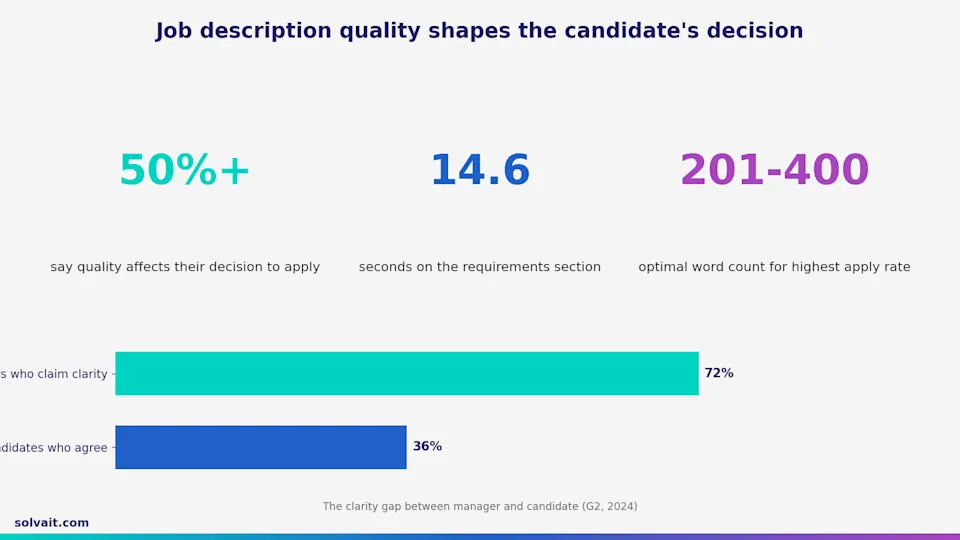
Length matters too, and in a measurable way. Appcast analyzed more than 379 million clicks on job ads and found that descriptions between 201 and 400 words earn the highest apply rate, which drops once the ad passes 401 words. And the candidate does not read every word: they spend an average of 14.6 seconds on the requirements section, per an InsightGlobal analysis. You are writing for a reader who scans, not one who studies every line.
The essential elements of a job description
A professional description answers the candidate's questions before they ask them. Nine elements cover that:
Job title : known and understood in the market, not a vague internal label.
Department or function : where the role sits in the structure.
Location and work type : on site, remote, or hybrid, and full time or part time.
A clear role summary : a paragraph explaining the purpose of the role and why it matters.
Core responsibilities : the actual daily or weekly tasks.
Must have requirements : the necessary qualifications and experience only.
Preferred skills : what counts as a plus, not a condition.
What the company offers : development, work environment, growth path.
How to apply : a clear step the candidate takes.
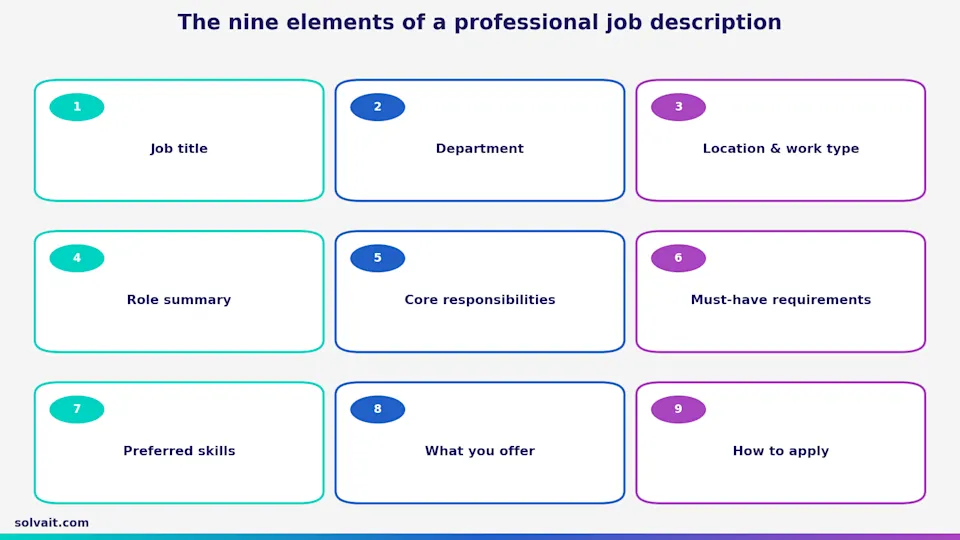
It also helps to name the team the person will work with or who they report to. These details give the candidate a clearer picture before applying and raise the quality of the applicant pool.
Common mistakes that cost you the right candidate
Seven mistakes show up again and again in job descriptions, and all of them are fixable:
Vague, generic wording : phrases like "carry out required tasks" say nothing about the actual work, so the candidate cannot understand the role.
Overloaded requirements : a long list of conditions makes the job look unrealistic and keeps good candidates from applying. Separate must have from preferred.
Ignoring company culture : the candidate wants to know the work environment, not only the tasks.
Unclear titles : a vague title does not surface well in search results or on job boards.
Copying templates without editing : a template is a useful start, but a problem if you do not adapt it to your role and market.
Focusing on the company, ignoring the candidate : the candidate wants to know what they gain, not just your requirements. Highlight learning and growth.
Complex language and internal jargon : unfamiliar acronyms confuse the candidate. The simpler the language, the clearer the message.
What these mistakes share is that they are about clarity, not technical content. A poor description is rarely wrong on the facts; it is vague in the wording.
Nine steps to write a professional job description
Start with a clear title : use a title known in the market, and avoid internal ones.
Write a short role summary : a paragraph on the purpose of the job. Example: "We are looking for an HR specialist to support recruitment, manage employee data, and improve the employee experience."
List the core responsibilities : write the actual tasks clearly, and keep the list short and organized.
Spell out the must have requirements : state only the necessary qualifications and experience, such as years of experience, technical skills, and language.
Add preferred skills : a separate section for what counts as a plus.
Explain what the company offers : a professional environment, development, flexibility, a clear growth path.
Focus on expected outcomes : instead of "manage marketing campaigns", write "contribute to increasing qualified leads". This shows the candidate the impact of the role.
Use a scannable format : clear headings, ordered bullets, short paragraphs. The candidate scans for what matters.
Review before publishing : confirm the description is clear, organized, and fit for the role, and review it internally per company policy.
Vague description versus clear description
The difference between a description that attracts the right candidate and one that wastes your time shows up in the details:
Element | Vague description | Clear description |
Title | Internal or unfamiliar | Known in the market and searchable |
Responsibilities | "Carry out required tasks" | Specific, measurable daily tasks |
Requirements | Long list with no priority | Must have and preferred separated |
Candidate view | About the company only | What the candidate gains is clear |
Length | Too long or too short | 201 to 400 words, easy to scan |
Outcome | Unqualified applications | Candidates closer to the role's needs |
How to speed up writing without losing quality
HR teams often need to prepare several ads in a short window, and keeping a consistent quality across them is a real challenge. This is where automation helps: it gives you an organized starting point instead of a blank page, and holds a consistent style across every ad.
Solvait's free job description generator produces a structured draft in minutes using AI. You enter the title, department, location, and work type, and it drafts a description covering the summary, responsibilities, requirements, and skills, in Arabic and English, which you then review and edit to fit your company.
From the job description to smart recruitment
Writing a professional description is the first step in the hiring journey. After you publish, you need to manage candidates, track applications, and organize interviews. The clearer the description, the higher the quality of incoming applications, and the more efficient the screening and evaluation stages become.
This is where Solvait Attract fits in, a platform that helps HR teams manage the hiring journey from posting the role to receiving applications, screening candidates, and following the evaluation stages. The journey starts with a clear job description and extends into a more organized hiring process. In the Saudi market, speed matters, but reaching the right candidate at the right time is the harder challenge, and a clear job description improves the quality of shortlists from the start.
To see how Solvait manages the full hiring journey on your data, book a demo.
Frequently asked questions
What is a job description?
A job description is a document that states the job title, responsibilities, requirements, and required skills, plus what the company offers the candidate. It serves as the first point of contact between the organization and the job seeker, and is later used as a reference in hiring, training, performance reviews, and career development.
How do I write a professional job description?
Start with a clear title, then a short role summary, then the core responsibilities, separate must have from preferred requirements, explain what the candidate gains, spell out expected outcomes, use a scannable format, then review before publishing. Keep the length between 201 and 400 words for the highest apply rate.
What are the essential elements of a job description?
Nine elements: job title, department, location and work type, role summary, core responsibilities, must have requirements, preferred skills, what the company offers, and how to apply. Naming the team and the reporting line gives the candidate a clearer picture.
What is the right length for a job description?
Descriptions between 201 and 400 words earn the highest apply rate, per Appcast's analysis of more than 379 million clicks, while the rate drops past 401 words. The candidate scans quickly, so clarity and brevity matter more than long detail.
How do AI tools help write a job description?
AI tools give you a structured draft in minutes instead of starting from a blank page, and keep a consistent style across every ad. You enter the basic information, the tool drafts the summary, responsibilities, and requirements, then you review and edit before publishing.
References
G2 — Recruiting Statistics, 2024 (job description clarity gap: 72% of managers versus 36% of candidates)
InsightGlobal — Job Description Statistics, 2025 (over half of seekers influenced by description quality, 14.6 seconds on requirements section)
LinkedIn Talent Solutions — Job Descriptions Best Practices, 2024 (effect of language style on apply rate)
Ready to see Solvait in action?
Book a personalized demo and see how Solvait's AI-powered HR platform can transform the way your team works.
Tags
Related Posts

Solvait's Free Resume Match Analyzer
Select the right candidates for jobs quickly and with high accuracy using Solvait’s CV matching analyzer tool.
Jun 2, 2026
A free tool for creating performance reviews that writes the full evaluation in seconds.
A free AI powered tool from Solvait writes complete performance reviews quickly, accurately, and at no cost.
Jun 1, 2026

How can you recruit talent faster and more accurately?
Where does time actually get wasted in the process of recruiting Saudi talent, and how can time be shortened by reforming the process itself?
Jun 15, 2026