

What Happens to Your Business When HR Still Runs on Spreadsheets
A spreadsheet doesn't scale. When your company was five people, one Excel file covered everything: payroll, leave, employee records. Now that you're a hundred people, that same file is the source of your errors, not your solutions. Manual HR problems don't announce themselves with an alarm bell. They leak in quietly: a payroll error found after payday, a GOSI deadline that passes with no reminder, a report that takes two days because the data lives in ten files.
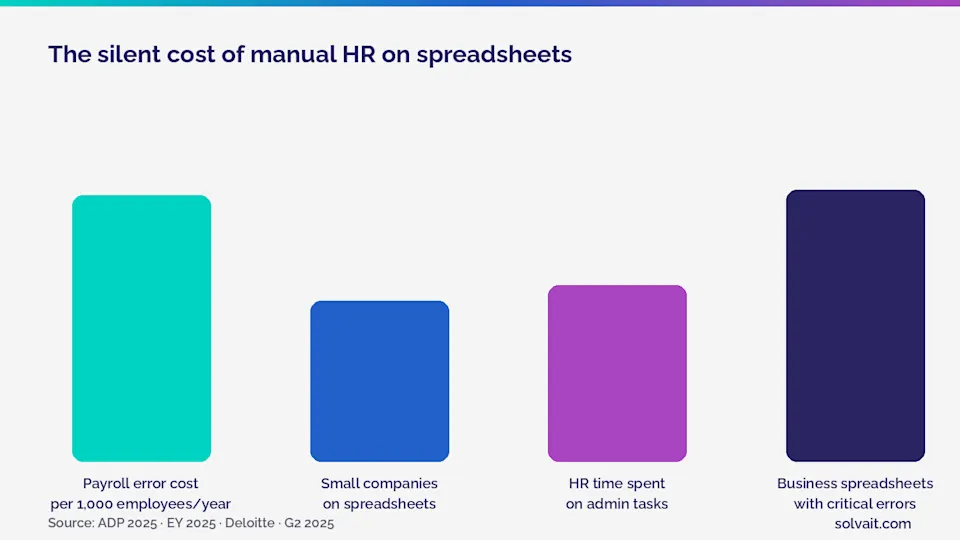
The numbers show the scale. A recent study found that 94% of business spreadsheets contain critical errors. Deloitte research points to HR teams spending 57% of their time on administrative tasks. That's time and talent going into data entry and chasing signatures instead of building a team.
The quiet cost that never shows up in the budget
Payroll breaks first. EY found that a manual, non automated process can carry an error rate near 20%, and that fixing a single error costs $291 on average. For a 1,000 employee company, correcting payroll errors can run close to $922,000 a year. And 51% of small businesses still run payroll on spreadsheets, per 2025 data.
But money isn't the most dangerous part. Trust is worth more. Research shows nearly half of employees start looking for a new job after just two payroll mistakes. When an employee doubts they'll be paid accurately and on time, their bond with the company erodes before they even think about resigning.
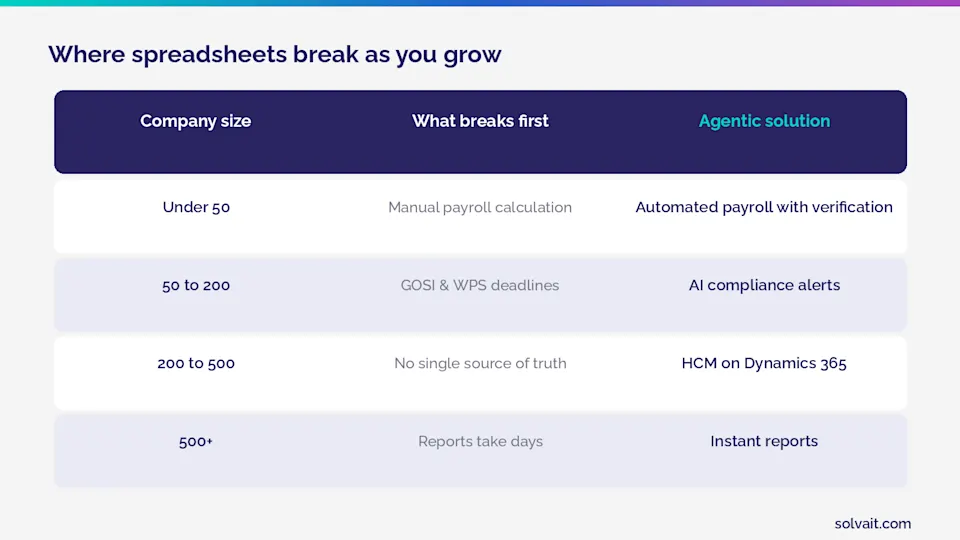
Where spreadsheets break as you grow
The problem isn't Excel itself. It's forcing it to carry what it was never designed for. And at each stage of growth, something different breaks. Under 50 people, manual payroll math breaks first. Between 50 and 200, GOSI and Wage Protection deadlines start slipping through the cracks. Between 200 and 500, you discover there's no single source of truth, because every department keeps its own version. Above 500, a simple report becomes a days long project.
In the Saudi market, regulations add another layer of risk. Wage Protection, GOSI, Nitaqat, Qiwa, Mudad: all deadlines and obligations that don't forgive error. A manual spreadsheet relies on someone remembering the deadline. A system remembers for you.
From the spreadsheet to the agent
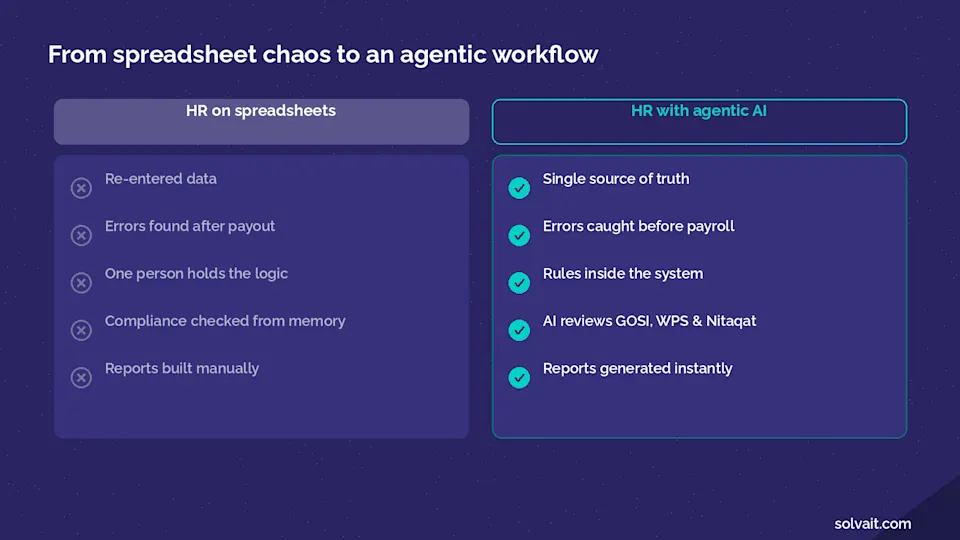
The alternative isn't just "newer software," it's a shift in how HR works. In the manual model, data is re-typed across files, errors are found too late, and all the logic sits in one person's head; if they're out, everything stops. In the agentic model, there's a single source of truth, errors are flagged before payroll runs, the rules live in the system, and the AI agent checks GOSI, Wage Protection, and Nitaqat compliance automatically.
An honest admission: moving off spreadsheets isn't free or instant. It takes data migration, training, and some patience in the first few weeks. But the real cost isn't in the move, it's in staying. Every extra month on spreadsheets is a month of errors found late and time wasted.
How Solvait HCM helps
Solvait HCM is a full HR system built on Microsoft Dynamics 365, designed to be the single source of truth that spreadsheets can't give you. In practice, it brings employees, payroll, and self service into one place, ready for Wage Protection and GOSI. The related feature in our Feature Bank is pre payroll employee profile validation , which flags missing data, from an absent bank account to an incomplete contract, before it turns into a payroll error.
The expected payoff is plain. Instead of finding the error after payday, the system catches it before. Instead of a report taking two days, it's generated on demand. Want to see what moving off Excel looks like on your team's data? Book a demo.
FAQ
What are the risks of running HR on spreadsheets?
The main ones are payroll errors (near 20% in manual processes), missed compliance deadlines like GOSI and Wage Protection, no single source of truth, and time lost on admin tasks that could be automated. These errors are usually found after it's too late.
When should a company move from Excel to an HR system?
When team size or compliance complexity starts to outgrow what spreadsheets can hold. The signs often appear past 50 employees: forgotten deadlines, duplicated data, slow reports. Moving early is cheaper than fixing accumulated errors later.
Does AI actually reduce payroll errors?
Yes. An automated system flags missing data and anomalies before payroll runs and uses unified data instead of scattered files. EY research indicates that payroll automation measurably reduces errors and the cost of correcting them.
How much do manual payroll errors cost?
Per EY, fixing a single error costs about $291 on average, and correcting errors for a 1,000-employee company can approach $922,000 a year, before counting the erosion of employee trust and the compliance risk.
References
• ADP / academic research: Payroll Errors and HR Systems, 2025 (supports 94% of spreadsheets with critical errors).
• G2: Payroll Statistics 2025, 2025 (supports 51% small firms on spreadsheets).
Ready to see Solvait in action?
Book a personalized demo and see how Solvait's AI-powered HR platform can transform the way your team works.
Tags
Related Posts

Inside Tashghil: The Operations Agent for HR Automation
Tashghil, Solvait's operations agent, runs leave, advance automatically within guardrails, while your team keeps the call. Here's how.
Sep 22, 2026

GOSI Automation Saudi Arabia: Calculate, File & Audit
Calculate, submit and audit GOSI contributions in Saudi Arabia accurately, without a dedicated compliance specialist, using agentic payroll automation.
Aug 24, 2026

Vision 2030 Is Forcing Saudi CHROs to Rebuild HR
Why Saudi CHROs are rebuilding their entire HR stack for Vision 2030: automation, compliance, and agentic AI, with the numbers that explain it.
Aug 23, 2026