

Why Your Job Ads Attract the Wrong Candidates?
The wrong candidate didn't find you by accident. Your job ad invited them. When a job description is vague, copied, or stuffed with inflated requirements, it filters the wrong people in and the right people out. You end up with an inbox full of CVs that don't fit the role, and strong candidates who read two lines and closed the tab. The good news: this is a writing problem, not a market problem. And you can fix it before the role ever goes live.
A job description is the first real interaction between your company and a candidate. Before the interview, before the offer, there's a paragraph of text that decides who applies and who backs out. That makes its quality the first screening decision in your entire hiring process, not a cosmetic detail.
Candidates judge your role by the description, not your logo
Ask any capable candidate why they skipped a job, and they rarely say "the salary." Most will tell you they couldn't work out what they'd actually do in the role. The data backs this up. According to Indeed's research, 52% of job seekers say the quality of a job description is very or extremely influential in their decision to apply. More telling: 63% of candidates didn't apply to a role because they didn't understand the specific skills or tools required. You aren't losing those people at the interview. You're losing them at the third paragraph of the ad.
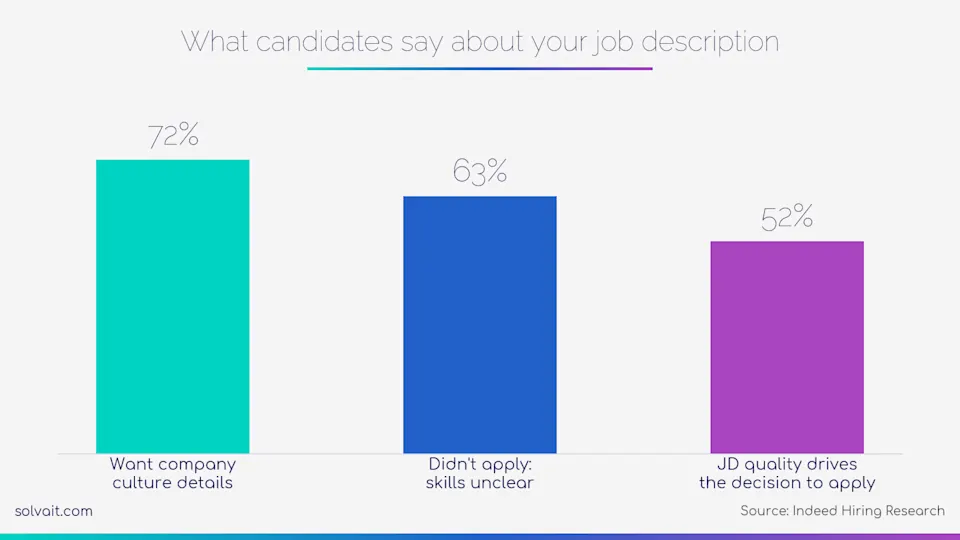
There's a layer many teams miss too. 72% of candidates want to see company culture details inside the job description itself. When the ad says nothing about the team or how the work actually happens, the candidate fills the gap with assumptions, usually not in your favour. A well written description doesn't just describe the job. It sells it to the right person and gently sends the wrong one away.
Length is part of the problem as well. LinkedIn's analysis of millions of postings found that job ads around 300 words earn the highest application rate per view. Endless task lists don't read as thorough. They read as an undefined role where nobody in the company quite knows what they want.
The four mistakes that pull in the wrong person
Most weak descriptions make the same errors. Here are the four that cost the most in the Saudi market.
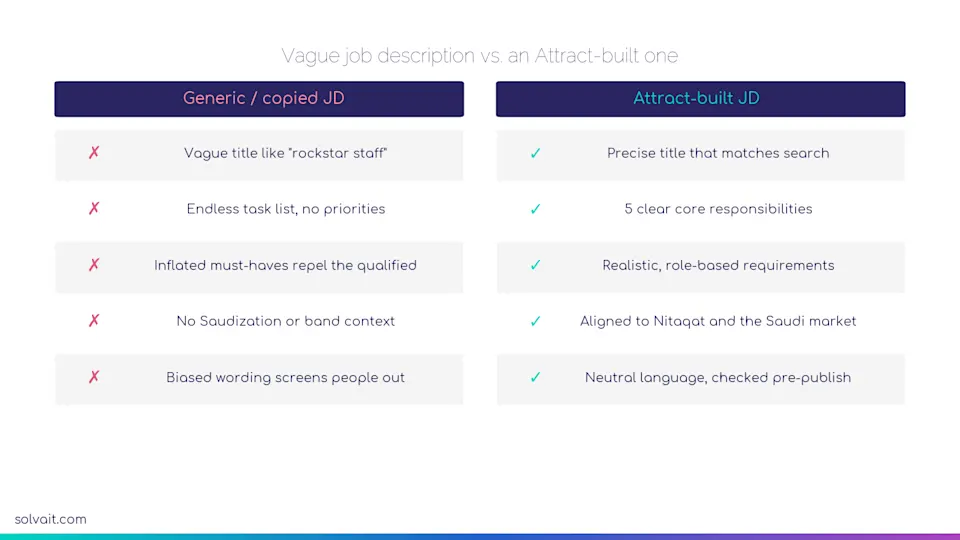
The vague title : "Rockstar staff" or "sales ninja" doesn't match what a job seeker types into a search box. Candidates search for "HR specialist" or "field sales representative," and if the clear title isn't there, they never reach your ad. The precise title is the first ranking factor on any hiring platform.
A task list with no priorities : List fifteen bullets with equal weight and the candidate can't tell what the role is really about. A good description surfaces five core responsibilities and leaves the secondary detail for the interview.
Inflated requirements : Demanding ten years of experience and four certifications for a mid level role repels the genuinely qualified and keeps the applicants who don't read the criteria carefully. In a market where Saudi unemployment sits at record lows, every extra requirement shrinks the talent pool available to you.
Biased language : Certain words and phrasings quietly screen out whole groups of applicants, undermining both Saudization goals and team diversity. This one is hard to catch by eye, because it's baked into writing habits.
The Saudi context raises the cost of getting it wrong
In Saudi Arabia, a weak job description doesn't cost you one candidate. It costs you in a market that's already tight. Overall unemployment fell to 2.8% in Q1 2025 according to the General Authority for Statistics, the lowest on record. Even so, 46% of HR professionals in the Kingdom say finding qualified talent has become harder, not easier. The paradox makes sense: roles are plentiful and skilled people are wanted everywhere at once.
The problem runs deeper than headcount. One report finds that 64% of private sector organisations rank "lack of skilled applicants" as their top recruitment challenge, and the Kingdom could face a shortfall of 663,000 skilled workers by 2030. When every capable candidate is wanted by five companies, your job ad isn't only competing on appeal. It's competing on clarity. A vague description loses that race before it starts.
Then there's the Saudization load. You're not looking for any candidate. You're looking for the right one who serves your Nitaqat requirements and team quality at the same time. A description that ignores this context invites a random flood and leaves your TA team manually sorting what should have been sorted at the writing stage.
And the cost of a bad hire isn't theoretical. SHRM estimates that replacing an employee costs between 50% and 200% of their annual salary, while the U.S. Department of Labor puts the cost of a bad hire at least 30% of first year earnings. A large share of that starts with the job-description paragraph that pulled in the wrong person.
How AI fixes the description before you publish
This is where the job shifts from "write a better description" to "let the system stop you publishing a weak one." Attract, Solvait's AI powered applicant tracking system, works on the job description at the point of creation, not after the damage is done.
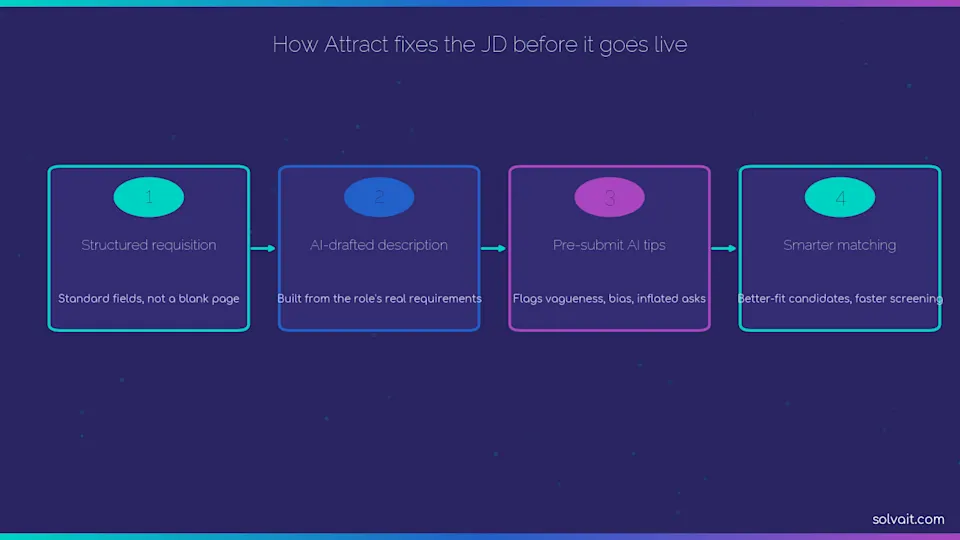
Attract starts from a structured requisition instead of a blank page: standard fields that make sure every role is described the same way . The system then generates a professional description built from the role's requirements, turning the manager from a blank page writer into a reviewer of a ready draft. The part that matters most: Attract gives AI tips before the requisition is submitted , flagging vagueness, inflated requirements, or wording that could screen people out, while editing is still quick and easy.
The core idea is that AI here is an assistant, not a judge. The final call stays with the recruiter. But instead of discovering the mistake two weeks into a stream of mismatched CVs, you see it and fix it the moment you write it. Once the sharper description goes out, the whole pipeline improves: smarter candidate matching, faster screening, and a clearer stage view.
If you want to test the idea before any commitment, Solvait's free Job Description Generator gives you a professional, Saudi context description in under a minute, with no signup and no data captured. It's the easiest way to see the gap between a generic description and one built to attract the right candidate.
A sharper job description alone won't build your whole recruiting function, but it stops the biggest leak at the top. Fix the start, and everything after it gets easier. To see how Attract works inside your own hiring process, from requisition to onboarding, book a demo.
FAQ
What makes a good job description?
A good job description states the precise title, five core responsibilities, realistic role requirements, and a glimpse of team culture, in neutral language. It stays close to 300 words and answers the candidate's first question: what will I actually do in this job?
Why do my job ads attract unqualified candidates?
Usually because of a vague title, a task list with no priorities, or inflated requirements that repel the qualified. A vague description filters the wrong people in. Naming the title and core responsibilities precisely rebalances who applies.
How does AI help write a job description?
AI generates a draft from the role's requirements, suggests improvements, and flags vagueness, inflated requirements, and biased wording before you publish. A human makes the final call, but the system stops the most expensive mistakes from going live.
What is the ideal job description length?
LinkedIn data suggests descriptions around 300 words earn the highest application rate per view. Candidates prefer clear, scannable descriptions, and long task lists give the impression of an undefined role.
References
Indeed: What Job Seekers Want in a Job Description, 2023 (supports the 52%, 63%, and 72% figures)
LinkedIn Talent Solutions: Stats That Will Change the Way You Write Job Posts (supports the 300-word and 61% salary figures)
General Authority for Statistics (GASTAT): Labour Market, Q1 2025 (supports the 2.8% unemployment figure)
SHRM: The Cost of a Bad Hire, 2025 (supports the 50% to 200% range)
U.S. Department of Labor (via HBK): The Hidden Costs of Bad Hiring, 2026 (supports the 30% of first-year earnings figure)
Ready to see Solvait in action?
Book a personalized demo and see how Solvait's AI-powered HR platform can transform the way your team works.
Tags
Related Posts

AI Recruitment in Saudi Arabia
How does Agentic AI speed up hiring in Saudi Arabia? CV screening, one skills based match score, and a decision that stays with your team. Meet Solvait Attract.
Jun 8, 2026

Solvait’s Free Job Description Generator
Free AI tool to generate a professional, Saudi context job description in 60 seconds. No signup, no data captured. Try the JD generator today.
Jul 7, 2026

End of Service in Saudi Arabia: Article 84 vs 85
How to calculate EOS in Saudi Arabia , the resignation vs termination difference, with a decision table and a worked example for every case.
Sep 27, 2026