

How to Build a Saudi Talent Pipeline Before You Desperately Need One
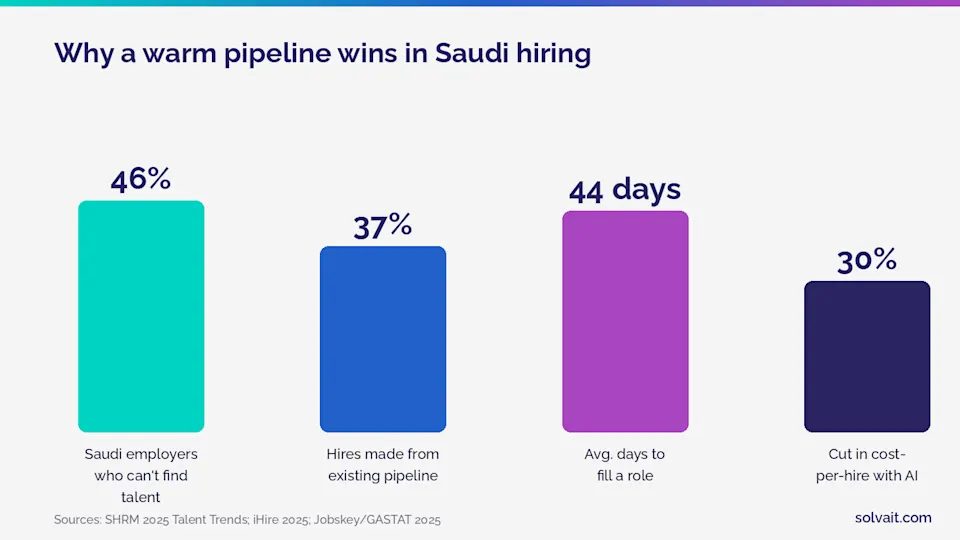
A talent pipeline is a pool of pre qualified candidates you've already identified, contacted, and built a relationship with before a role opens, so they can move into your hiring process the moment a matching seat appears. The idea is simple: build the relationship before you need it, not after. The gap between a team that runs a live pipeline and one that starts from zero on every req shows up in a single number. Average time to fill hit 44 days in 2025 (SHRM), and pipeline hires skip the sourcing and initial outreach phases entirely.
In the Saudi market, this isn't a luxury. Overall unemployment fell to a record 2.8% in Q1 2025 (GASTAT), and yet 46% of HR professionals in the Kingdom say finding qualified talent has become harder, not easier. When everyone around you is hiring at the same speed, the team with a ready list wins.
Why pipelines matter more in Saudi Arabia right now
The Saudi economy is hiring at a pace the Kingdom hasn't seen before. The Public Investment Fund alone created roughly 400,000 jobs over five years and plans millions more. But demand outruns supply in the skills that matter. Estimates tied to GASTAT data point to a projected shortfall of 663,000 skilled workers by 2030, with unrealized revenue reaching $206 billion.
That plays out concretely on the ground. Specialist roles stay open weeks longer than planned, and fresh graduate salaries in the private sector jumped 30% in a single year for some specializations. Small and mid sized firms carry the heaviest load, because they compete for the same talent the giga projects are chasing.
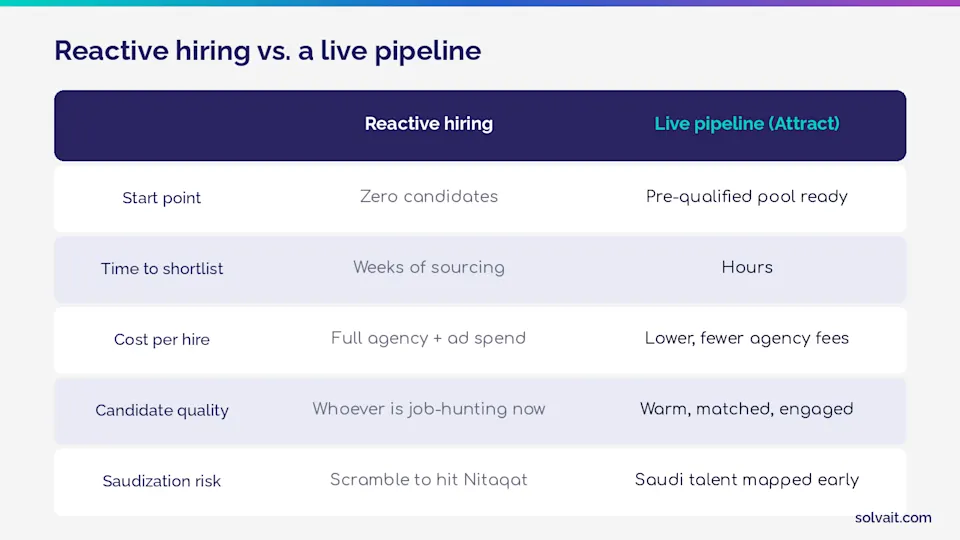
There's a Saudi specific wrinkle here too: Saudization. When you suddenly need to raise your national hire ratio to stay in the Nitaqat green band, having no ready pool of Saudi talent turns a compliance obligation into a last minute scramble. A live pipeline turns that scramble into calm planning.
Before the steps, if your first bottleneck is writing a job ad that pulls the right candidate from the start, try the free Job Description Generator and build your pipeline on a clear brief from day one.
The five steps to build a live pipeline
1. Segment candidates into three tiers :
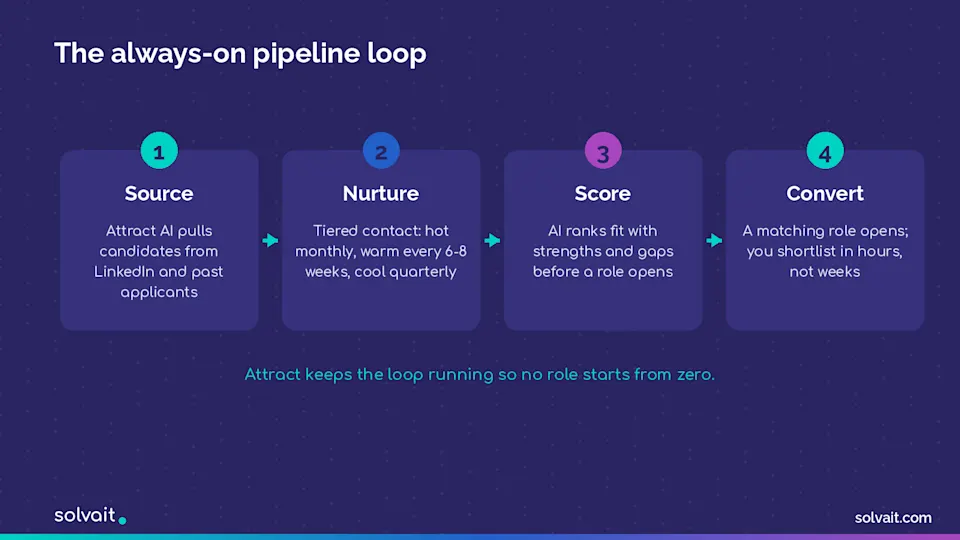
Not every name on your list is equal. Split them into hot (people you've interviewed, trusted referrals, final stage applicants), warm (engaged but not far along), and cool (potential sources you haven't contacted yet). This split sets the cadence for each tier and stops you from burning everyone out with the same message.
2. Source before the role opens :
The most common mistake is starting the search the moment a req gets approved. Flip the order. Map the roles you'll need in the next six to twelve months and start sourcing now. An AI powered applicant tracking system like Attract pulls candidates from LinkedIn and from your own past applicants, so the list builds while your team works on something else.
3. Set a steady nurture rhythm :
Lists go cold fast. A candidate who hasn't heard from you in months simply forgets your company. Tier your contact: hot monthly, warm every six to eight weeks, cool quarterly at most. The risk of going quiet is higher than the risk of over communicating. SHRM notes that part of the recruiting struggle comes from companies under communicating, not over communicating.
4. Score fit early with AI :
Instead of waiting for a role to open before you assess who you have, let AI rank candidates by fit and surface each one's strengths and gaps. When the req does open, the shortlist is already there. AI supports the decision here, it doesn't replace it. The final call stays with your TA team.
5. Convert the pipeline into hires :
When a matching role opens, you go from a ready shortlist to interviews in hours, not weeks. The data backs the move: iHire's 2025 report (529 employers) found 36.9% of hires came from an existing pipeline, and another 42.3% came from internal promotion or hiring. Nearly four in ten hires never started from a fresh job posting at all.
What everyone gets wrong: treating the pipeline as an archive
The thing that kills a pipeline isn't a shortage of names, it's letting them go cold. Recruiters get busy, candidates stop hearing from you, and the carefully sourced list turns into a graveyard of stale profiles. A pipeline isn't a file you open when you need it. It's a relationship you feed. This is exactly where agentic AI earns its place: instead of leaving contact to a busy recruiter's memory, the AI agent handles the regular follow up, flags the candidate who's due for a touchpoint, and suggests the next step.
One honest limit: a pipeline won't fix a weak hiring reputation. If your candidate experience is poor or your responses are slow, no tool saves you. A pipeline multiplies the impact of a good hiring process. It can't repair a broken one.
How Solvait Attract helps
Attract is an AI powered applicant tracking system built on Microsoft Dynamics 365, designed to keep this loop running without constant manual oversight. In practice, it maps the features in our Feature Bank to the pipeline steps: automated recruitment stage generation and LinkedIn integration to pull candidates straight into your list , with a dashboard that shows every candidate's path and stage.
The expected payoff is plain. Instead of starting each role from zero, you start from a warm, ranked list, which cuts your shortlisting time and lowers your reliance on recruitment agencies. And because Saudization planning starts early, you avoid the last minute race against Nitaqat.
Want to see what a live pipeline looks like inside Attract on your own data?
Book a demo and we'll show you how reactive hiring turns into calm planning.
FAQ
What's the difference between a talent pipeline and a job posting?
A job posting attracts whoever happens to be job hunting at that moment. A talent pipeline is a pool of pre qualified candidates you've built a relationship with before you need them, so you move them into interviews the instant a matching role opens, without starting the search from scratch.
How long does it take to build an effective pipeline?
A pipeline starts paying off within weeks of consistent outreach, but its real strength shows after a few months, once you have warm candidates in every tier. Consistency is the key. Intermittent contact cools the list faster than most teams expect.
Can a small team manage a talent pipeline?
Yes, with the right automation. A small team can't nurture hundreds of candidates by hand, but an AI-powered applicant tracking system handles the tiered outreach and reminders and pulls candidates in automatically, freeing the team for relationships and decisions.
How does a talent pipeline help with Saudization?
When you map your Saudi talent early and keep them in your pipeline tiers, raising your Nitaqat ratio becomes gradual planning rather than a last minute scramble. You open the role already holding a ready list of Saudi candidates instead of searching in a panic.
References
• SHRM: 2025 Talent Trends, 2025 (supports 44-day time to fill and 69% recruiting difficulty).
• GASTAT / Arab News: Record lows in Saudi unemployment, 2025 (supports 2.8% unemployment and 51.3% participation).
• Public Investment Fund / Vision 2030: Employment reports, 2025 (supports 400,000 jobs figure).
Ready to see Solvait in action?
Book a personalized demo and see how Solvait's AI-powered HR platform can transform the way your team works.
Tags
Related Posts

Solvait’s Free Job Description Generator
Free AI tool to generate a professional, Saudi context job description in 60 seconds. No signup, no data captured. Try the JD generator today.
Jul 7, 2026

AI Recruitment in Saudi Arabia
How does Agentic AI speed up hiring in Saudi Arabia? CV screening, one skills based match score, and a decision that stays with your team. Meet Solvait Attract.
Jun 8, 2026

What Manual HR on Spreadsheets Costs Your Business
Manual HR problems in Saudi Arabia: payroll errors, compliance risk, wasted time. Where spreadsheets break as your company grows, and what replaces them.
Jul 9, 2026