

Are Your Job Roles Actually Designed for the Work? (Most Aren't)
Most job roles in companies were never designed. They accreted. A role starts as a job description, then picks up a task here and a responsibility there with every departure, restructure, or emergency project, until the title says one thing, the real responsibilities say another, and the required competencies match neither. A designed role starts from the work that actually needs doing, then derives its responsibilities and competencies in deliberate order. The difference between the two is the difference between a team that knows who does what and a team that bumps into invisible walls every day.
This article shows how to tell a designed role from an accreted one, and how AI surfaces the mismatches inside a single role, while the final decision stays with a human.
What's the difference between a designed role and an accreted one?
An accreted role grows by accident. Tasks land on it because their owner happened to be available when the need arose, not because they belong there. Over time it becomes a mix of responsibilities inherited from other roles, some the owner has no competency for, and some competencies nobody uses. A designed role is built the other way around: you start from the work that must get done, define the responsibilities that deliver it, then derive the competencies that support those responsibilities. Every element has a reason to exist.
The numbers show the scale of the problem. Gallup reports that the share of employees who clearly know what's expected of them at work fell to a record low of 44% in late 2022 and stayed near it at 45% afterward. That means more than half of employees aren't sure exactly what's expected of them, the direct symptom of roles that accreted rather than got designed.
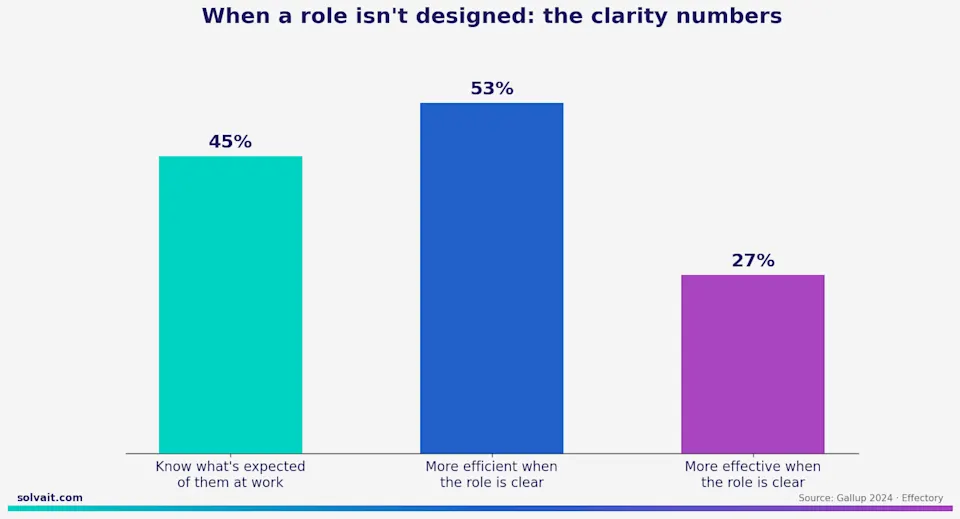
And the effect isn't theoretical. Effectory's research found that employees with clarity in their roles are 53% more efficient and 27% more effective than those living with role ambiguity, an overall performance lift of about 25%. Role clarity isn't an organizational nicety; it's a direct performance lever.
Why do roles accrete in the first place?
Because work changes faster than the job description. The description gets written once at hiring and then forgotten, while daily life keeps loading the role with new tasks. A colleague leaves, and their tasks get spread across whoever remains, without review. A project launches, and its responsibilities get bolted onto the nearest available role. These additions repeat for years, producing a role that no longer resembles its description, and nobody ever sat down to ask: does this role still make sense?
In Saudi Arabia this gets more urgent. With Vision 2030 and Saudization requirements, precise organizational design has become a condition for effective localization, because you can't localize a role whose real boundaries you don't know. A vague role is hard to fill, hard to measure, and hard to build a development path on.
How does Solvait Wise detect role mismatch?
This is where AI plays a specific diagnostic role. It doesn't redesign the role for you. It puts the role's responsibilities on one side and its competencies on the other, and shows where they don't meet: a required responsibility with no competency to support it, or a competency defined in the role that serves no actual responsibility. These are exactly the spots an accreted role hides.
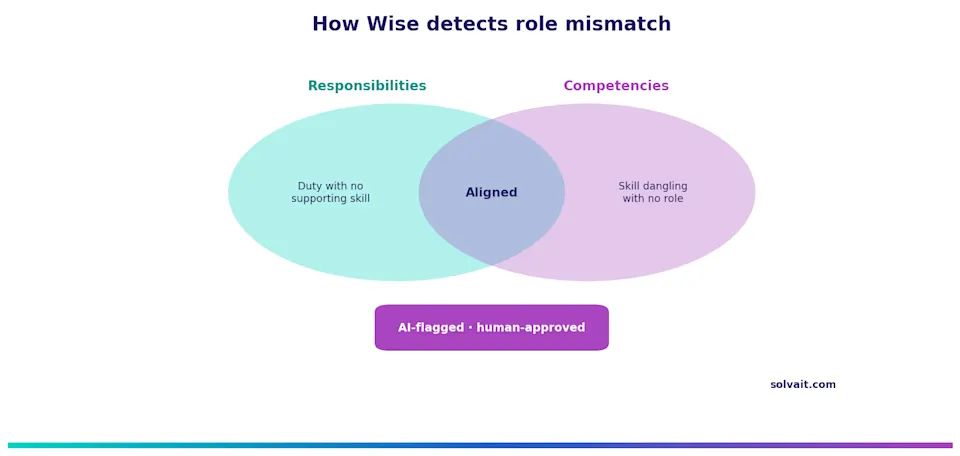
The overlap between responsibilities and competencies is the "designed role"; everything outside it is an AI flag that something is off. But note the label in the diagram: the flag is "AI flagged, human approved." Wise surfaces the gap and suggests the fix, then the decision returns to the org designer or HR leader: approve, adjust, or ignore. AI detects; the human decides.
A designed role vs an accreted one
The practical difference shows when you set the two side by side on clear criteria.
Criterion | Accreted role | Designed role |
Origin | Tasks piled up over time | Intentionally built from the work |
Title vs tasks | Don't match | Match |
Competencies | Don't fit the real tasks | Derived directly from the tasks |
Overlap & gaps | Common, invisible | Surfaced and resolved |
Look at that last row. In an accreted role, overlap between roles and gaps in responsibilities stay hidden until they blow up as a task everyone ignored or a task two people did. A designed role surfaces those spots before they cost you. That is exactly what moves role analysis from a token yearly review to a living operational tool.
Where Solvait Wise fits
Job role intelligence is a native capability inside Solvait Wise, within the organizational design module. Wise analyzes the single role, not the whole chart: it compares its responsibilities against its competencies and highlights the mismatches, clearly marked as "suggested, human approved," so the redesign decision stays yours.
This is a narrower, deeper lens than analyzing the org structure or span of control. Instead of looking at the chart from above, Wise looks inside the role itself. If you want to see how a vague role turns into a designed one with matching responsibilities and competencies, explore Solvait Wise in detail.
Start with one role you suspect accreted without design, set its responsibilities against its competencies, and you'll be surprised what shows up. Role design isn't an organizational luxury; it's the foundation everything else rests on: hiring, performance, and development paths.
Ready to find out which of your roles were designed and which just accreted? Book a Demo with Solvait.
FAQ
What's the difference between org structure analysis and role design analysis?
Org structure analysis looks at the overall chart: who reports to whom, how many direct reports, how the management layers spread. Role design analysis looks inside a single role: do its responsibilities match its required competencies? The first addresses the shape of the organization; the second addresses the build quality of each individual job. They're complementary but different levels.
How does AI detect that a role isn't well designed?
AI compares the responsibilities assigned to the role against the competencies defined for it, looking for two cases: a responsibility with no competency to support it, and a competency that serves no actual responsibility. The presence of these gaps signals a role that accreted without design. AI raises them as a suggestion, and the redesign decision stays with a human.
Does the AI redesign roles by itself?
No. Its role is diagnostic: it surfaces the mismatches and suggests the fix, but approving any change to the role stays an explicit human decision. Every suggestion appears marked as "suggested, human-approved," exactly the agentic HR principle: the system analyzes and suggests, the human decides.
Why does role design matter for Saudization and Vision 2030?
Because effective localization requires roles with clear boundaries. You can't localize a role whose real responsibilities and required competencies you don't know, and you can't measure its holder's performance or build a development path on it. Precise role design makes localization plannable and measurable, and aligns with Vision 2030's goal of building a qualified local workforce.
References
Gallup - The Great Detachment: Why Employees Feel Stuck, 2025 (role clarity at a record low of 44%-45%)
Effectory - HR analytics: role clarity impacts performance (role clarity: 53% more efficient, 27% more effective)
PwC Middle East - How Saudi Arabia's workforce can keep growing beyond Vision 2030, 2025 (organizational design and workforce building under Vision 2030)
Saudi Ministry of Human Resources and Social Development - Skills and Training, 2025 (Saudi workforce development framework)
Ready to see Solvait in action?
Book a personalized demo and see how Solvait's AI-powered HR platform can transform the way your team works.
Tags
Related Posts

Vision 2030 Is Forcing Saudi CHROs to Rebuild HR
Why Saudi CHROs are rebuilding their entire HR stack for Vision 2030: automation, compliance, and agentic AI, with the numbers that explain it.
Aug 23, 2026

Build an Employee Growth Path Without Guesswork | Solvait
A practical guide to building a growth path for every employee in Saudi Arabia: from skill gap analysis to plan, with a clear role for AI.
Aug 19, 2026

Future of HR in the GCC: 5 Predictions for 2027
Five practical predictions for the future of HR in the GCC by 2027, backed by Gartner, PwC , and what agentic AI means for Saudi and Gulf teams.
Aug 11, 2026