

Your HR Team Doesn't Need More People. It Needs an Agent.
Agentic AI is a form of artificial intelligence in which software agents execute complete processes end to end, not single steps, under human oversight with approval authority left with people. The difference from a chatbot is small to describe and large in practice: a chatbot tells an employee how to submit a leave request. An agent submits it, checks the balance, applies company policy, routes it for approval, and updates the record.
For Saudi companies this matters for a specific reason. The problem here isn't a shortage of HR talent. It's that the HR talent you already have spends its day on transactions that require no human judgment. When an HR director asks for another headcount, they're rarely asking for another mind to think about retention or workforce planning. They're asking for another pair of hands to key GOSI data and reconcile a WPS file. That is exactly the share of the work that has become delegable.
The real gap isn't adoption. It's redesign.
The global numbers look contradictory at first. By the end of 2025, AI adoption among HR leaders reached 95%, yet nearly three quarters of those leaders report only moderate or minimal returns on their AI investments, according to Gartner in 2026.
Across all business functions, though, only 23% of organizations have actually scaled agents in at least one function, with another 39% still experimenting, according to McKinsey's State of AI in 2025.
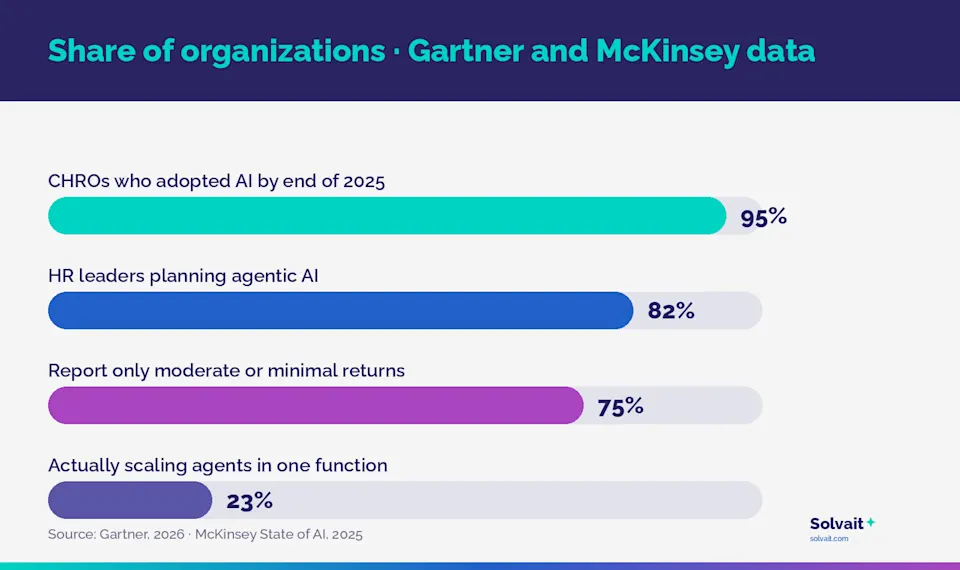
Gartner's diagnosis of that gap is worth sitting with: successful AI transformation depends only 30% on the technology and 70% on redesigning processes, workflows and roles. Put plainly, most companies bought a tool and left the process untouched. An agent running on top of a process designed for a human is just another layer.
The consequence that should interest whoever holds the budget is this. Gartner expects the current HR business partner ratio of one per 423 employees to shift within one to five years to one per 800 to 1,200. That ratio doesn't improve by hiring more partners. It improves when the partner stops processing transactions.
What actually belongs to an agent
Not every HR task qualifies. The ones agents handle well share three traits: a clear rule, clean data, and a verifiable outcome. An Iqama renewal has all three. A promotion decision has none.
In Saudi Arabia, the largest share of these tasks is governed by government systems rather than internal discretion. GOSI has registration rules and deadlines. WPS has a file format and a monthly cycle. Nitaqat has defined ratios by activity and company size. That's an ideal environment for an agent, because correct is defined in advance and wrong is expensive and discovered late.
Take the WPS file. Most teams discover that an employee's IBAN is missing or an Iqama has expired at the moment the system rejects the file, which is after the payroll cycle has already run. An agent inverts the order: it validates records before the cycle opens and surfaces the incomplete ones while they can still be fixed.
Task | Clear rule | Clean data | Verifiable outcome | Fit for an agent |
Pre payroll employee profile validation | Yes | Yes | Yes | Yes |
Iqama renewals and contract expiry tracking | Yes | Yes | Yes | Yes |
Leave approvals against balance and policy | Yes | Yes | Yes | Yes |
Answering repeat employee questions | Yes | Yes | Yes | Yes |
Rating performance and deciding a promotion | No | Partly | No | No, human call |
Resolving a grievance between staff and manager | No | No | No | No, human call |
Those last two rows are deliberate. An agent left to decide matters of judgment creates far more risk than the time it saves. Anyone selling you otherwise is selling you a deferred problem.
Four agents, and one job that stays human
Rather than treating "AI for HR" as one block, it's more useful to split it by the kind of work being handled. Inside Solvait's Agentic HR platform, that layer is divided across four specialized agents.
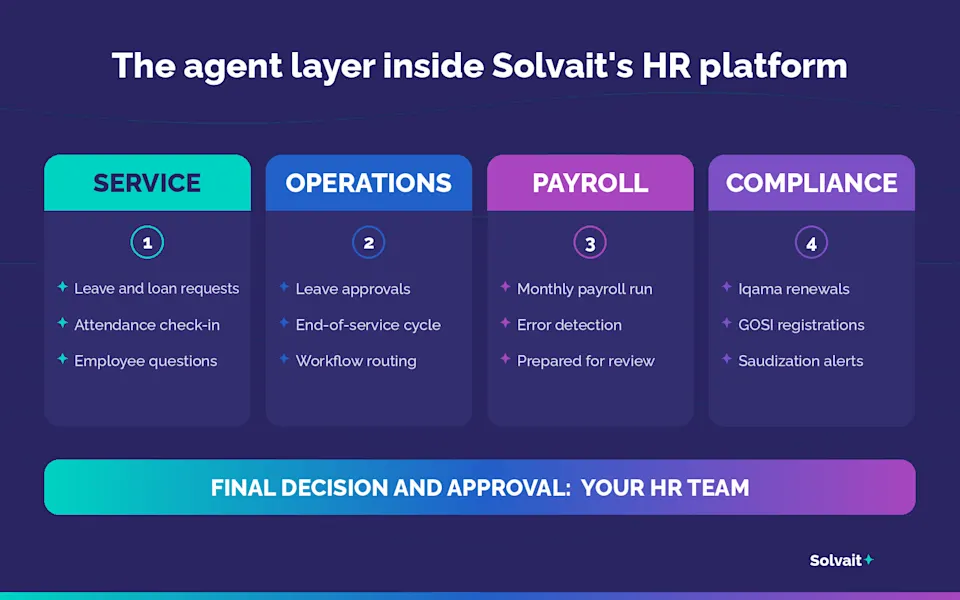
The service agent : receives and executes employee requests over WhatsApp in Arabic: leave, loans, attendance check in, the questions your team answers forty times a month. This is the share of work that consumes the most of your team's day and the least of its expertise.
The operations agent : coordinates workflows across parties, from leave approvals to the end of service cycle. In practice, a manager opens their screen and finds decisions waiting, not half assembled transactions to chase first.
The payroll agent : runs the monthly cycle, detects errors, and prepares the register for your team to review before approval. Note the sequence: prepare, then human review, then human approval. Approval doesn't move.
The compliance agent : watches dates and regulations: Iqama renewals, contract expiries, GOSI registrations, and Saudization alerts before they turn into a violation.
The job that stays entirely human is judgment. Which employee to fight to keep, how to redesign a department that has quietly doubled, when to grant an exception to policy. If you want to see the analytics layer feeding those decisions, that lives in Solvait Wise.
The math a CFO cares about
The practical decision isn't "should we adopt AI." It's "the next budget request: a person or an agent."
Criterion | One more hire | An AI agent |
Time to impact | 60 to 90 days to hire and onboard | 4 to 8 weeks to go live |
Capacity ceiling | Grows one hire at a time | Scales with transaction volume |
Nights and weekends | No coverage | Runs continuously |
Turnover exposure | Knowledge leaves with the person | Rules stay inside the system |
What your team does | Processes transactions | Reviews decisions |
The table isn't arguing that hiring is wrong. It's arguing that hiring is an expensive answer to a transaction volume problem. Another person earns their budget when you need more human judgment, not more data entry.
And to be fair to the other side: deploying agents is neither free nor immediate. Data scattered across spreadsheets and legacy systems needs cleaning before any agent works reliably, and that work is tedious and takes weeks. Companies that skip it get an agent operating confidently on wrong data, which is a worse outcome than not deploying at all.
Why the timing is different in Saudi Arabia
Local conditions make delay costlier than usual. 80% of CEOs in the Kingdom say their organization's culture supports AI adoption, and 94% are confident in domestic economic growth, per PwC's 29th CEO Survey in 2026.
Employees are ahead of the systems they're given. 75% of Middle East employees used AI tools in their roles over the past year, against 69% globally, according to PwC's Middle East Workforce Hopes and Fears Survey in 2025. Someone who uses an AI assistant all day and then fills a paper form to request leave notices the contradiction.
At the economy level, PwC estimates AI's contribution to Saudi GDP at roughly $235.2 billion, or 12.4%, by 2030. A number that size doesn't materialize from pilot tools sitting in isolated departments.
Where to start
Pick one painful, measurable process. Usually that's pre-payroll employee validation, because the pain is monthly, expensive and obvious.
Measure the baseline first : How many hours does validation consume each month? How many incomplete records surface only after a file rejection? Without a before number you can't prove an after.
Clean the data before you deploy : Missing IBAN fields, expired Iqama numbers and undated contracts are what will stall the agent, not the technology.
Deploy narrow : One department or one location, for two or three full cycles.
Keep approval with a human : The agent prepares, proposes and escalates exceptions. A person approves.
Expand on two real numbers : Hours saved and errors avoided. Without both, you won't convince the CFO to widen the scope.
Companies that see real impact redesign the process rather than layering onto it. Which is precisely why only 23% have reached genuine scale.
Where Solvait fits
The Solvait platform is built on Microsoft Dynamics 365, and its agent layer runs across the full employee lifecycle from hire to end of service, with Saudi compliance for GOSI, WPS and Nitaqat built in. It integrates directly with government systems, which removes the double entry that generates most payroll errors in the first place.
More than 260 organizations across the Kingdom and the Gulf run on it today.
If you want to see how the agent layer translates into daily operations inside a full HR system, the Solvait HCM page is the right place to start.
Ready to size the impact on your own team? Book a demo and we'll walk a real payroll cycle through the agent using your organization's numbers, not generic ones.
FAQ
What is agentic AI in HR?
Agentic AI in HR is a form of artificial intelligence in which software agents execute complete HR processes end to end, such as submitting a leave request, checking the balance and routing it for approval. It differs from a chatbot, which only answers, and from traditional automation, which fires a single fixed rule step. Final approval authority stays with the HR team.
Will AI agents replace my HR team?
No. Agents take on rule governed transactions such as payroll data validation and Iqama renewals. Decisions requiring human judgment, including promotions, grievances and structural design, stay with people. Gartner expects half of current HR activities to be AI automated by 2030, with the other half remaining human and AI augmented.
How long does it take to deploy an HR agent in a Saudi company?
Deployment typically runs 4 to 8 weeks for one scoped process, such as pre-payroll validation. The longest part isn't the technology, it's data cleanup: completing IBAN fields, Iqama numbers and contract dates. Companies that skip cleanup get a fast agent and unreliable results.
Are AI Agents compliant with Saudi labor law?
Compliance depends on how the system is designed, not on the agent itself. Platforms built for the Saudi market embed GOSI, WPS and Nitaqat rules inside the workflow and integrate directly with government systems. Ask any vendor to demonstrate live integration with those systems rather than list them on a slide.
What is the difference between HR automation and agentic AI?
Traditional automation performs one step when a fixed condition is met, such as sending an email when a request is filed. An agent reads context, takes multiple steps and handles exceptions: it checks policy, verifies the balance, routes to the right approver, and escalates anomalies to a person instead of stalling the process.
References
Gartner: Build An HR Operating Model That Succeeds In The AI Era, 2026 (95% CHRO adoption, three-quarters reporting moderate returns, the 30/70 split, HRBP ratio shift, 50% automation by 2030)
McKinsey: The State of AI, 2025 (23% scaling, 39% experimenting)
PwC Middle East: CEOs in Saudi Arabia remain confident on growth and AI adoptio, 2026 (80% supportive culture, 94% growth confidence)
PwC Middle East: Workforce Hopes and Fears Survey, 2025 (75% of regional employees used AI tools)
Solvait: AI HR, 2026 (four-agent architecture, 260+ enterprise clients)
Ready to see Solvait in action?
Book a personalized demo and see how Solvait's AI-powered HR platform can transform the way your team works.
Tags
Related Posts
Answer 60% of HR Questions Automatically
How an AI HR assistant answers repetitive employee questions in Arabic and English and frees your team for the work that matters.
Jul 14, 2026

Agentic HR vs Automation vs Chatbots: A Plain Guide
Agentic HR is not automation and not a chatbot. A plain language guide to the difference, the four AI HR agents in Solvait AI HR, and when you need each.
Oct 20, 2026
How to Choose an AI HR System in Saudi Arabia
A buyer's checklist of 7 questions that expose the real difference between AI HR systems in Saudi Arabia, before you sign the contract.
Oct 8, 2026