
Agentic HR vs Automation vs Chatbots: A Plain Language Guide
Agentic HR is an approach to human resources in which AI agents plan and carry out a task across several steps, then hand the result to a person to approve, rather than simply answering a question or repeating a fixed rule. The difference between agentic HR, plain automation, and a chatbot comes down to one question: who acts? A chatbot replies with information. Automation runs a rule you wrote in advance. An agentic AI takes a goal, breaks it into steps, pulls data from more than one system, and prepares the work, while the final call stays with your team.
This distinction matters because the market is now crowded with the words "AI agent". You can buy something labeled an "agent" that is really a chatbot. This guide explains the difference in plain language, shows the four AI HR agents inside Solvait Agentic AI HR and what each one does, and makes clear when you need each type and why a human stays in the loop.
Key takeaways
AI HR agents act across multiple steps and prepare the work; a chatbot only answers, and automation only runs a fixed rule.
The real difference is not "which is smarter". It is who acts and who decides.
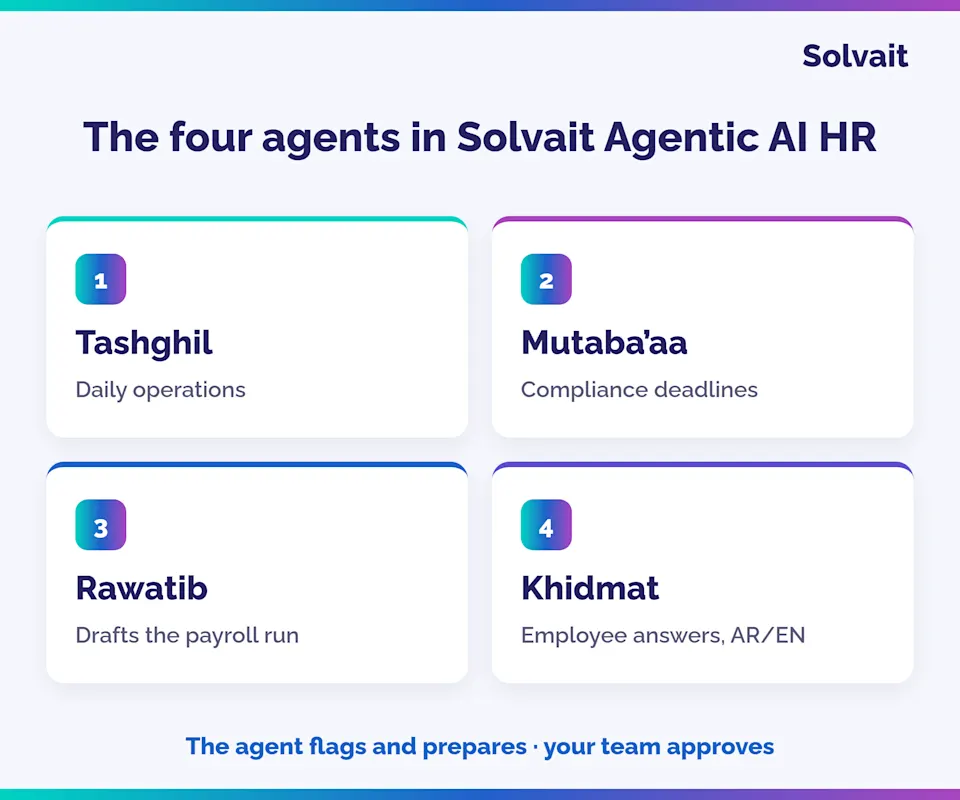
Solvait AI HR runs four agents: Tashghil (daily operations), Mutaba'aa (Saudi compliance deadlines), Rawatib (drafts the payroll run), Khidmat (answers employees in Arabic and English, including on WhatsApp).
An agent flags and prepares. It does not post pay or file with authorities on its own. Your team approves every consequential action.
Gartner expects 15% of day-to-day work decisions to be made autonomously by AI agents by 2028, up from 0% in 2024.
What is the difference between agentic AI, automation, and a chatbot?
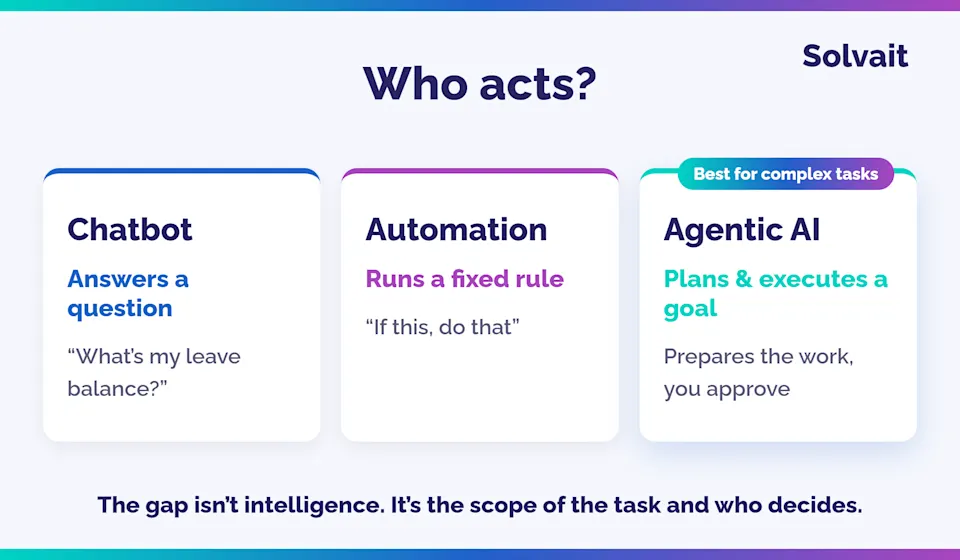
All three are useful, but they solve different problems. The easiest test: ask "what does this thing do when I leave it alone?"
A chatbot understands your question and gives you an answer. Ask it "what is my leave balance?" and it replies with the number or points you to the page. Great for repeat questions, but it stops at the reply. It won't open the request or chase the approval.
Automation runs a fixed rule you wrote: "if X happens, do Y." For example, on the first of every month, send a reminder. Reliable and strong for repetitive steps, but it doesn't handle the exception. Feed it a case you didn't program, and it stops or gets it wrong.
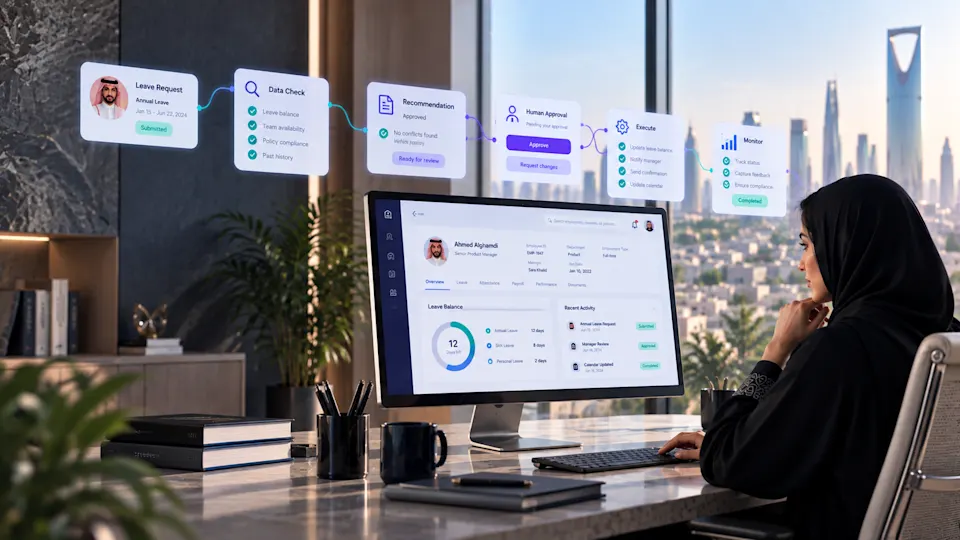
An agentic AI takes a goal, not a single step. It breaks the goal down itself, gathers data from payroll, attendance, and contracts, finds what's missing, and prepares the result. Then it shows you the result to approve. That is the heart of agentic AI: it acts across steps instead of just replying.
Dimension | Chatbot | Automation | Agentic AI |
|---|---|---|---|
What it does | Answers a question | Runs a fixed rule | Plans and executes a multi-step goal |
Source of logic | Scripted replies | "If this, do that" | Works out the steps itself |
Handling exceptions | Hands you to a person | Stops or errors | Adapts and proposes a fix |
Across several systems | No | Usually no | Yes (payroll, attendance, contracts) |
Role of the human | Asks | Writes the rule | Approves the final decision |
HR example | "What is my leave balance?" | Monthly deadline reminder | Preparing the full payroll run for review |
Look at the last row. The gap isn't intelligence. It's the scope of the task and who owns the decision. And for exactly that reason, a good agent is designed to show its work, not hide it.
What are the four AI HR agents in Solvait AI HR?
Solvait AI HR is Solvait's complete HR platform, built on Microsoft Dynamics 365, with four smart agents layered over the HR lifecycle and working under human oversight. Each agent owns one area, and each has a clear limit: it flags and prepares, and the decision stays with your team.
Agent | Area | What it does | What it won't do alone |
|---|---|---|---|
Tashghil | Daily operations | Handles the repetitive work across the employee lifecycle and prepares it | Won't make org decisions for the manager |
Mutaba'aa | Compliance | Watches Qiwa, Mudad, GOSI, Nitaqat and Labour Law deadlines, and prepares the file ahead of time | Won't file with authorities on its own |
Rawatib | Payroll | Drafts the payroll run ready for HR review | Won't post or submit the run on its own |
Khidmat | Employee service | Answers employees in Arabic and English, even on WhatsApp, and routes to a person when needed | Won't decide sensitive requests |
The Mutaba'aa agent shows the value of agency in a Saudi context. GOSI integration, along with Qiwa and Mudad, means many deadlines spread across many files: a contract ending, an Iqama renewal, a probation period, a wage file. The agent watches them daily and prepares what's due before it slips, so compliance shifts from an end-of-month scramble to quiet work all month. (The Mutaba'aa agent is currently rolling out on the platform.)
The Khidmat agent is what an employee sees day to day inside the platform's self service portal, known as PeopleHub. Instead of opening screen after screen, the employee types the question in their own language and gets the answer or the request ready to go.
When do you need each type, and how does a human stay in the loop?
The rule isn't "an agent is always better". The rule is match the tool to the task.
You need a chatbot when the goal is a fast answer to repeat questions: leave balance, a policy link, the payday date.
You need automation when the step is single, clear, repetitive, and exception-free: a recurring reminder, moving data between two fields, an alert when a threshold is crossed.
You need an agent when the task is multi-step, crosses several systems, and needs judgment on exceptions: preparing a payroll run, watching dozens of compliance deadlines, triaging an employee's case across attendance, contract, and pay together.
Here's the part many vendors skip: human in the loop isn't a nicety, it's an operational necessity. Gartner has predicted that more than 40% of agentic AI projects will be canceled before the end of 2027, driven by weak ROI and missing risk controls. The lesson is blunt. An agent that acts with no review and no audit trail becomes a risk, not a tool.
So the right model is "the agent flags, your team decides". The agent prepares the draft and surfaces the gaps; the owner approves or edits. You keep control, and you keep the ability to prove who approved what, and when.
Common mistakes when evaluating "AI" in HR
Confusing answering with acting. If all the product does is reply, it's a chatbot no matter what it's called.
Assuming full automation. A claim that the system "auto-fixes errors" and posts pay with no review is a warning sign, not a feature.
Ignoring local integration. An agent that doesn't understand Qiwa, Mudad, and GOSI won't help you in Saudi Arabia, however clever it is.
Forgetting the audit trail. If you can't prove who approved an action, you have a compliance risk, not a solution.
Numbers to frame the decision
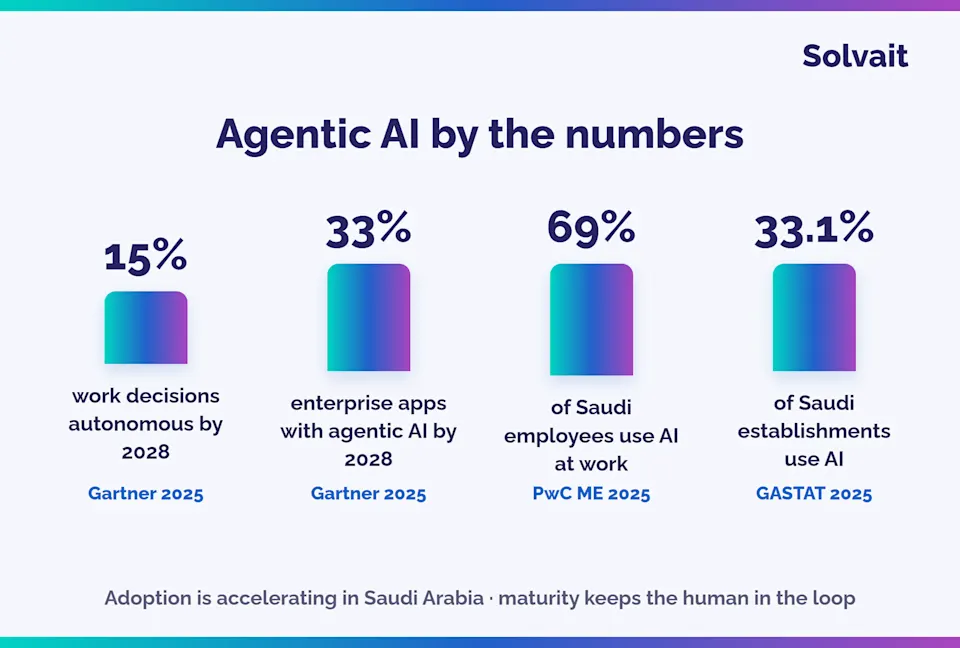
Gartner (2025) predicts 15% of day-to-day work decisions will be made autonomously by AI agents by 2028, up from 0% in 2024.
Gartner (2025) also expects 33% of enterprise software applications to include agentic AI by 2028, up from less than 1% in 2024.
At the same time, Gartner (2025) warned that more than 40% of agentic AI projects will be canceled before the end of 2027, which underlines the need for human oversight.
PwC Middle East (2025) found 69% of employees in Saudi Arabia use AI at work, against 54% globally.
GASTAT (2025) reported that 33.1% of Saudi establishments used AI technologies in 2025, up 20% year on year.
The takeaway: adoption is accelerating, especially in Saudi Arabia, but real maturity comes from choosing the right tool and keeping the decision with a person.
How Solvait puts this difference to work
At Solvait we build this distinction into the product, not the pitch. Solvait AI HR runs the full HR lifecycle (core HR, payroll ready for WPS and GOSI, Saudi compliance, self service) and layers the four agents on top: Tashghil, Mutaba'aa, Rawatib, and Khidmat. The platform line says it plainly: the AI does the work, your team makes the calls.
This isn't a theoretical promise. Solvait serves more than 260 enterprise clients with a 30 day go live, holds ISO 27001:2022, and is built on Microsoft Dynamics 365. Because the agents work under human oversight with an audit trail, you keep what an auditor asks for: who approved, what, and when.
To see the idea in practice, start with the Solvait AI HR page and meet the four agents in detail.And when you reach a serious comparison for your next platform, book a demo and we'll show the agents working on a scenario from your own environment.
FAQ
What is the difference between agentic AI and automation?
Automation runs a fixed rule you wrote in advance, and stops at any exception it wasn't programmed for. Agentic AI takes a goal, breaks it into steps itself, gathers data across several systems, adapts to exceptions, then presents the result for a person to approve. Automation executes; an agent plans and executes under oversight.
Do AI HR agents replace employees?
No. An agent handles repetitive work and prepares drafts and deadlines, but it doesn't post pay, file with authorities, or decide sensitive cases on its own. The decision stays with the HR team. The team's role shifts from data entry to review and judgment, which is what "human in the loop" means.
What is the difference between an agent and a chatbot in HR?
An HR chatbot answers a question and stops at the reply, like "what is my leave balance?" An agent goes further: it opens the request, gathers what's needed from more than one system, and prepares the action ready to approve. The first tells you; the second does the task and then shows it to you.
Do the agents integrate with Qiwa, Mudad, and GOSI?
Yes. The Mutaba'aa agent in Solvait AI HR is designed to watch compliance deadlines across Qiwa, Mudad, GOSI, Nitaqat, and Labour Law, and prepare the file ahead of time. The platform is built on Microsoft Dynamics 365, and its payroll is ready for the Wage Protection System (WPS).
How many agents are in Solvait AI HR?
Four: Tashghil (daily operations), Mutaba'aa (compliance deadlines), Rawatib (drafts the payroll run), and Khidmat (answers employees in Arabic and English on WhatsApp). All work under human oversight, preparing the work while your team approves it.
References
Gartner: Gartner Predicts Over 40% of Agentic AI Projects Will Be Canceled by End of 2027, 2025 (backs the 2028 decisions figure, the enterprise software share, and the cancellation rate).
PwC Middle East: Workforce Hopes and Fears Survey 2025, 2025 (69% of Saudi employees use AI at work vs 54% globally).
General Authority for Statistics (GASTAT): AI technologies use by establishments, 2025, 2025 (33.1% of Saudi establishments used AI, up 20%).
McKinsey & Company: Four ways to start using generative AI in HR, 2023 (only 3% of organizations using generative AI apply it in HR).
Solvait: Solvait AI HR, 2026 (the four agents, Microsoft Dynamics 365 foundation, first-party company figures).
Ready to see Solvait in action?
Book a personalized demo and see how Solvait's AI-powered HR platform can transform the way your team works.
Tags
Related Posts

Vision 2030 Is Rewriting the Saudi HR Stack
Vision 2030 changed Saudi Arabia's labour market and compliance faster than legacy systems can keep up. Why Saudi CHROs have to rethink the HR stack now.
Sep 21, 2026
Agentic AI in HR: What "Self Running HR" Really Means
Agentic AI in HR means AI agents execute HR work under human oversight. Here is what that changes for Saudi HR teams, and what it does not.
Sep 16, 2026
How Agentic AI Eliminates HR Team Burdens
How agentic AI is reshaping HR team size in Saudi Arabia and the GCC. What agents take over, what humans keep, and the ROI behind a leaner HR team.
Aug 2, 2026