

Vision 2030 Is Rewriting the Saudi HR Stack:
Vision 2030 changed Saudi Arabia's labour market and its compliance environment far faster than most HR systems can keep up with. The workforce grew and changed shape, compliance became near real time across connected government platforms, and yet many HR teams still run all of it on scattered spreadsheets, disconnected systems, and manual processes. The stack that was fine five years ago is now a liability, not a tool. Rethinking it isn't something to defer.
This isn't a pitch to buy new software. It's a call for the CHRO, alongside the IT director and the CEO, to look honestly at their stack and ask one question: does it move at the speed of the market, or lag behind it?
What has Vision 2030 actually changed for HR?
In short, almost everything: the volume of work, the shape of the workforce, and the tempo of compliance.
The numbers tell the story. According to the Ministry of Human Resources and Social Development, Saudi women's labour-force participation rose from 17% in 2017 to 36.3% in Q1 2025, the overall participation rate reached 68.2%, Saudi participation climbed to 51.3%, and the Human Resources Development Fund supported 143,000 Saudis into private-sector jobs in a single quarter (HRSD, 2025).
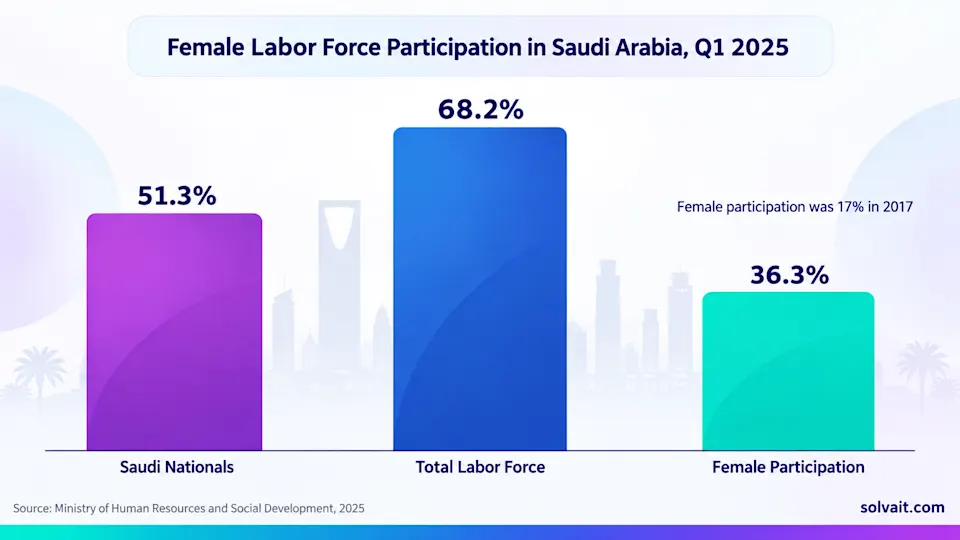
That means a bigger, more varied workforce: more new hires, more contracts, more end of service cases, more daily questions.
Then there's compliance, the part that changed most. Saudization through Nitaqat is no longer an annual policy; it's a band that moves with every hire and departure. Payroll is tied to the Wage Protection System (WPS) through Mudad, and GOSI records and contracts in Qiwa are cross-checked in near real time. A violation doesn't wait for year end; the system catches it as it happens.
A market moving at that speed, at that scale, under that scrutiny, can't be run on tools designed for a slower, smaller world.
Why can't the legacy stack keep up?
Because the legacy stack rests on three assumptions that are no longer true: that the work is small, that compliance is periodic, and that data lives in one place.
The first assumption fell when the numbers grew. What one person and a spreadsheet used to handle now needs a whole team chasing repetitive tasks.
The second fell with real time compliance. You can't review your Nitaqat band or WPS file "at month end" when the government system compares your data daily. The gap gets found before you reach it.
The third fell when systems fragmented. When employee data lives in one system, payroll in another, and attendance in a third, errors become inevitable. EY finds that one in five payrolls contains an error, most of it rooted in inconsistent data (EY, 2022).
The difference is clear when you put the two stacks side by side:
Aspect | Legacy stack | Vision 2030 ready |
Compliance | Periodic manual review | Continuous and native |
Saudization / Nitaqat | Tracked in spreadsheets | Monitored, flagged early |
Payroll and WPS | Manual, error prone | Prepared and validated |
Headcount growth | Breaks the system | Absorbed by the system |
Team focus | Transactions | Decisions and strategy |
Look at the last row. The real cost of the legacy stack isn't just the errors, it's that your team spends its time on transactions instead of decisions.
What does a Vision 2030 ready HR stack look like?
Four layers, each building on the one below it.
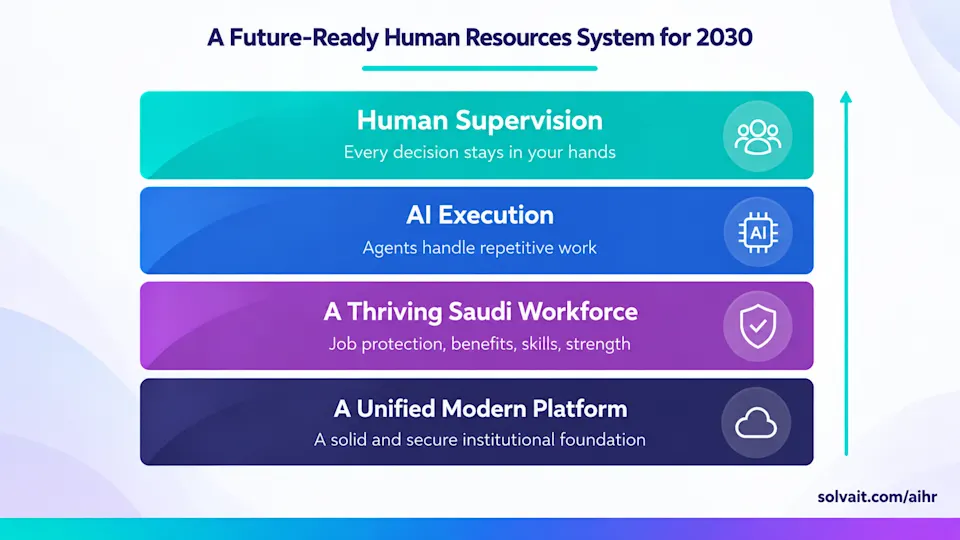
One modern platform: An enterprise foundation that brings employee data, payroll, and attendance into one place, instead of point tools that don't talk to each other.
Native Saudi compliance: WPS, GOSI, Nitaqat, and Qiwa are not bolt ons; they're built into the core, moving at the same tempo as the government platforms themselves.
AI-driven execution: This is where the deeper shift happens. McKinsey estimates that two thirds of HR processes can be automated, and that AI could generate $150 billion to $200 billion in annual value in HR alone (McKinsey, 2026). The direction is clear: Gartner expects 33% of enterprise software to include agentic AI by 2028 (Gartner, 2025).
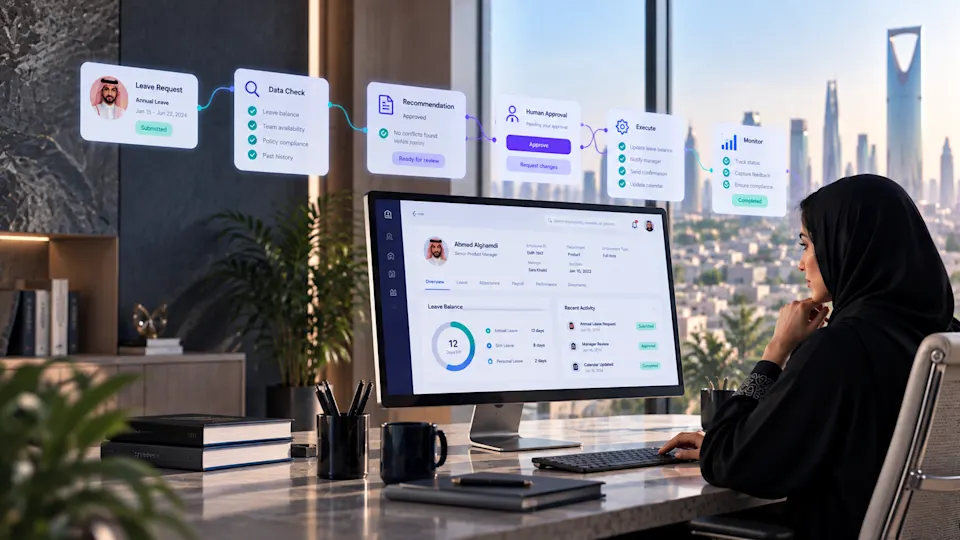
Human oversight: The layer people skip and then pay for. Gartner warns that more than 40% of agentic AI projects will be canceled by 2027 because of weak controls. AI takes the repetitive work, but every consequential decision stays with your team.
This direction isn't imported; it lines up with the Kingdom's own. PwC estimates that AI could add about $135 billion to Saudi Arabia's economy by 2030, or 12.4% of GDP, the largest absolute gain in the region (PwC). And the Saudi Data and AI Authority's adoption framework stresses responsible use and defining human oversight within any adoption (SDAIA).
Let's be fair: re-platforming isn't free or instant, and AI won't fix a broken process, it amplifies it. But the cost of staying on a legacy stack, in a market moving this fast, is far higher.
Where does Solvait fit?
This is where Solvait AI HR comes in. It's built on those same four layers: a foundation on Microsoft Dynamics 365 certified to ISO 27001:2022, native Saudi compliance, AI agents that run the repetitive work, and human oversight that keeps the decision with your team. It runs alongside Solvait HCM, serves more than 260 clients across Saudi Arabia and the GCC, and goes live in 30 days.
The goal isn't a smaller HR team. It's a team that spends its time on what sets companies apart in the Vision 2030 era: the decision, not the transaction.
Frequently asked questions
Why does Vision 2030 force a rethink of the HR stack?
Because it changed three things at once: the size of the workforce (women's participation alone jumped from 17% to 36.3%), the tempo of compliance (Nitaqat and WPS became near real time across connected platforms), and the speed of the market. Scattered, manual systems were built for a slower world.
What makes an HR stack "Vision 2030 ready"?
Four layers: one modern platform, native Saudi compliance built into the core (WPS, GOSI, Nitaqat, Qiwa), AI driven execution for repetitive work, and human oversight that keeps consequential decisions with the team.
Does this mean replacing the HR team with AI?
No. AI takes the repetitive work while your team keeps the decisions. Gartner warns that more than 40% of agentic AI projects fail without controls and human oversight, so governance is part of the design, not an add on.
Who should lead the rethink?
The CHRO, in partnership with the IT director and the CEO. It's no longer a single department's call, because it touches compliance, data, and the platform the company is built on.
Book a demo
Your stack either moves at the speed of Vision 2030 or lags behind it. Book a Solvait demo to see what a Vision 2030 ready HR stack looks like, layer by layer.
References
Ministry of Human Resources and Social Development (HRSD): Progress in the Saudi labor market, 2025 (supports the labour-force participation figures and employment support).
PwC: The potential impact of AI in the Middle East (supports the $135 billion, 12.4% of GDP by 2030).
McKinsey: HR's dual mandate in the AI era, 2026 (supports two-thirds of HR processes automatable and $150 to $200 billion in value).
Gartner: Agentic AI predictions, 2025 (supports 33% of software by 2028 and 40%+ of projects canceled without controls).
Saudi Data and AI Authority (SDAIA): AI Adoption Framework (supports responsible use and defining human oversight).
EY: Cost and risks due to payroll errors, 2022 (supports one in five payrolls with an error).
Ready to see Solvait in action?
Book a personalized demo and see how Solvait's AI-powered HR platform can transform the way your team works.
Tags
Related Posts
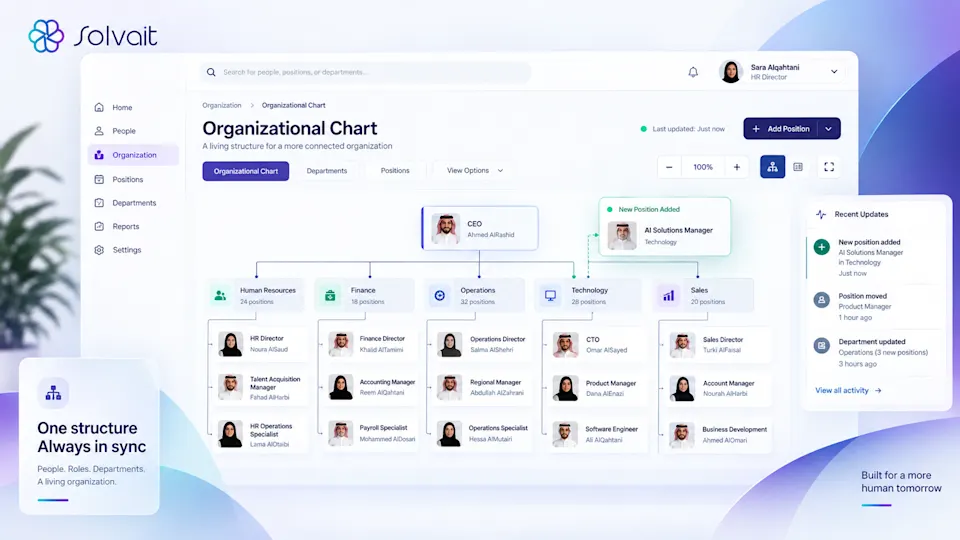
How to Map a Clear Org Structure in Wise's Org Chart
A practical guide to mapping your org structure in Wise's interactive org chart in one living chart that updates on every change.
Sep 20, 2026
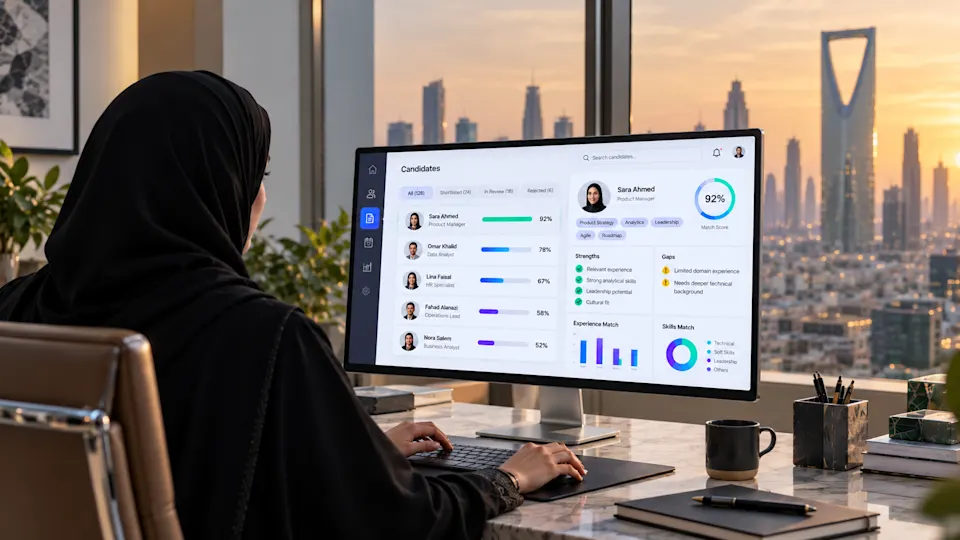
AI CV Screening: How It Ranks Arabic and English CVs
How AI CV screening reads Arabic and English CVs, scores each applicant with strengths and gaps, and what Saudi recruiters should still decide themselves.
Sep 17, 2026
Agentic AI in HR: What "Self Running HR" Really Means
Agentic AI in HR means AI agents execute HR work under human oversight. Here is what that changes for Saudi HR teams, and what it does not.
Sep 16, 2026