
Agentic AI in HR: What "HR That Runs Itself" Actually Means, and What It Doesn't
Agentic AI in HR is an approach where AI agents carry out HR processes on their own, from screening candidates to checking a payroll run, while your team keeps the authority to review and approve. "HR that runs itself" is a fair description of the day to day work moving off your desk. It is a bad description if you read it as HR without people. The agents do the tasks. The judgment stays human.
That distinction matters more this year than last. Vendors are attaching the word "agentic" to anything with a chatbot, and the gap between the pitch and the product is now wide enough to burn a budget on. So before you evaluate a single platform, it helps to know what an agent actually does, where it earns its keep in a Saudi HR function, and the one thing it will not do no matter what the demo suggests.
What makes AI "agentic" instead of just assistive?
An assistant waits for you to ask. An agent watches for a condition and acts on it. That is the whole difference, and it changes how the work feels.
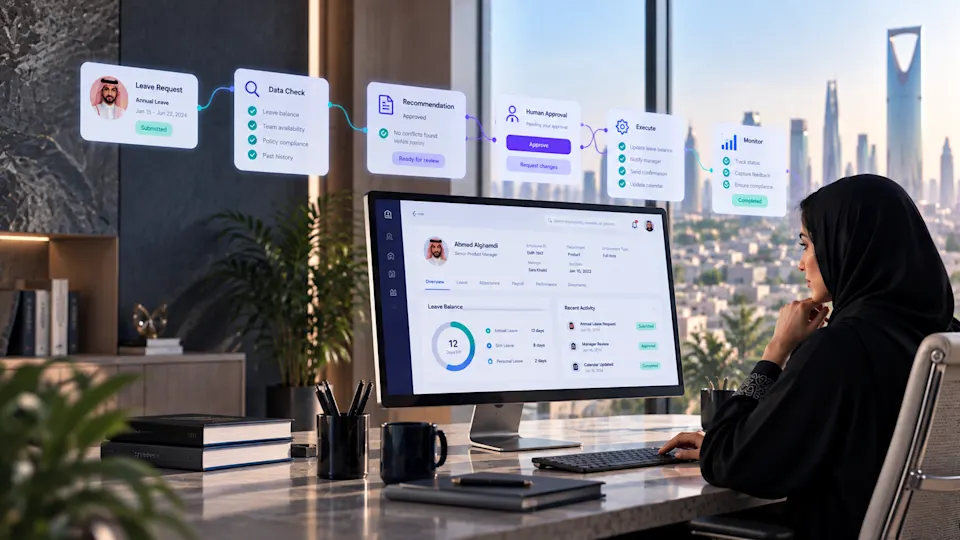
Ask a generative assistant to draft a job description and it drafts one. Useful, but you started it. An agent monitoring your workforce data notices an Iqama expiring in 30 days, drafts the renewal task, assigns it to the right coordinator, and flags the record for you, all before anyone opened a calendar. One responds. The other initiates.
Gartner draws the same line in its own terms: agentic AI can plan, decide, use tools, and complete multi-step tasks with minimal human supervision, where earlier generative tools mostly generated text or summaries. The practical test for any "agentic" claim is simple. Does it wait for a prompt, or does it act on a trigger? If it waits, it is a copilot with good marketing.
Dimension | Assistive AI | Agentic AI |
Role | Suggests and drafts | Executes the task |
Trigger | You ask | Watches, acts on events |
Payroll check | Explains a rule | Flags the variance itself |
Human role | Does the work | Reviews and approves |
Best label | Copilot | Coworker under oversight |
Where does agentic AI actually earn its keep in HR?
The value shows up wherever HR work is repetitive, deadline driven, and error prone. That covers a lot of a Saudi HR team's week.
McKinsey estimates that AI could generate 150 to 200 billion dollars in annual value in HR alone, and that two thirds of HR processes can be partially or fully automated. Those are not future numbers. In its November 2025 study, McKinsey put 57 percent of current work hours within reach of today's technology, with AI agents accounting for the larger share of that.
Compliance is the clearest case in the Kingdom. An agent can track Iqama renewals, contract expiries, GOSI registrations, and Nitaqat band movements, then surface each filing before it is late rather than after a penalty lands. Recruitment is another: parsing and ranking CVs in Arabic and English, moving candidates through stages, and sending stage based updates so nobody goes quiet for a week. Payroll is the third, and the most sensitive. An agent can scan a pay cycle for missing contracts, out of range salaries, and configuration gaps that would otherwise trigger a Wage Protection System rejection, and it can flag every one before you post.
Notice the verb in that last sentence. Flag. Not fix.
What will agentic AI in HR never do on its own?
It will not make the final call on anything that carries legal, financial, or human weight. That is a design choice, not a limitation to be engineered away.
An agent should not auto correct a salary, auto submit a WPS file, or auto approve a termination. It validates, audits, recommends, and routes. A person reviews the recommendation and decides. This is the "human in the loop" model, and in Saudi HR it is not optional: GOSI contributions, end of service settlements under Articles 84 and 85, and Saudization decisions all have consequences that a company, not an algorithm, has to answer for.
There is hard evidence for keeping people in the seat. Deloitte's 2026 enterprise survey found only 21 percent of organizations have a mature governance model for autonomous agents, meaning roughly four in five are scaling autonomy without the guardrails to manage it. Gartner expects more than 40 percent of agentic AI projects to be cancelled by the end of 2027, citing unclear value and inadequate risk controls, and separately predicts that half the companies that cut customer service staff for AI will rehire by 2027.. The lesson is not "avoid agents." It is "deploy them where a human still signs off."
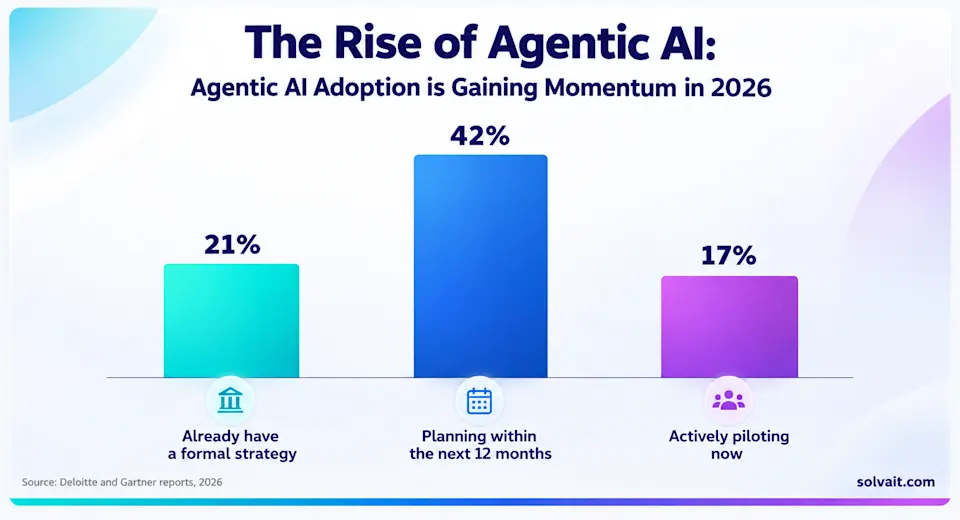
The chart above captures the real state of play. Intent is racing ahead of control. Gartner's 2026 figures show only 17 percent of enterprises have deployed agents while 42 percent more plan to within a year, and Deloitte's 21 percent governance-maturity number sits well below both. The companies that win here are the ones closing that gap deliberately, starting with lower-risk tasks and scaling as trust is earned.
How does an HR agent actually work, step by step?
Strip away the vocabulary and every well built HR agent runs the same loop.
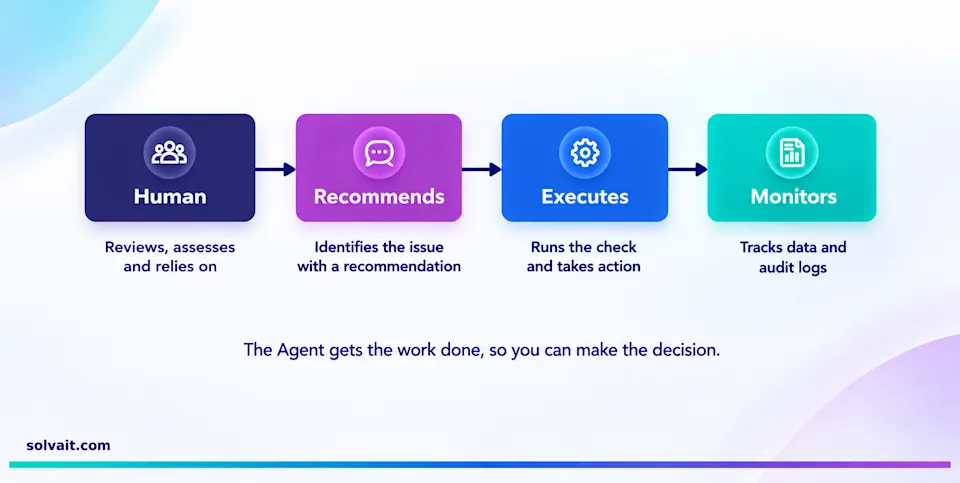
It watches the data, dates, and pay cycles. It acts by running the check or drafting the filing. It flags what it finds with a recommendation attached. Then a person reviews, decides, and approves. The loop repeats, and the agent gets out of your team's way on the busywork without ever taking the decision out of your hands.
This is the model Solvait built its agentic HR platform around. Four named agents handle distinct domains: Tashghil for HR operations, Mutaba'aa for compliance watching, Rawatib for payroll and WPS processing, and Khidmat as the employee concierge on WhatsApp in Arabic and English. Each one does the work; your team makes the call. If you want to see the performance and goals (OKR) side without committing to a full platform, Solvait Wise is the AI performance and OKR layer that sits on top of your existing HR system rather than replacing it.
For Saudi organizations under Vision 2030 pressure to modernize, the appeal is not novelty. It is that the compliance and payroll work most likely to trip a penalty is exactly the work an agent handles well, under a human's final review.
FAQ
What is agentic AI in HR?
Agentic AI in HR is an approach where AI agents independently execute HR processes, from CV screening to pre-payroll checks, under human oversight. Unlike a chatbot that answers when asked, an agent watches for a trigger, acts, and surfaces a recommendation for a person to approve. The work moves off HR's desk; the decision stays with HR.
Is agentic AI the same as ChatGPT or a generative AI assistant?
No. A generative assistant responds to a prompt: you ask, it drafts. An agent initiates: it monitors data or events and takes multi-step action on its own, then routes the result to a human. Gartner frames agentic AI as systems that plan, decide, use tools, and complete tasks with minimal supervision, which assistive tools do not do.
Will agentic AI replace HR jobs in Saudi Arabia?
It replaces tasks, not the function. Agents absorb repetitive compliance, screening, and payroll checking work, while people keep judgment, approvals, and employee relationships. Gartner predicts half the companies that cut customer service staff for AI will rehire by 2027, a sign that stripping out human oversight backfires.
Can an AI agent run payroll by itself?
It should not. In a sound design, the agent audits the pay cycle, flags discrepancies such as missing contracts or out of range salaries, and recommends fixes. A payroll manager reviews and approves before anything posts. Auto correcting salary or auto-submitting a WPS file removes the accountability that Saudi payroll requires.
How do I tell real agentic AI from "agent washing"?
Ask one question: does it wait for a prompt, or act on a trigger? Real agents monitor conditions and initiate multi step work; rebranded chatbots and RPA do not. Gartner named "agent washing" for this reason and estimates only a small fraction of vendors claiming agentic AI actually deliver it.
The takeaway, and your next step
"HR that runs itself" is true for the busywork and false for the decisions, and any vendor who blurs that line is selling you the wrong thing. The agents that will hold up in a Saudi HR function are the ones that watch, act, and flag, then hand the call to a person who is accountable for it.
If you want to see what that looks like across compliance, recruitment, and payroll in your own setup, book a demo with Solvait and we will walk through it with your real workflows.
References
Gartner - Gartner Predicts 40% of Enterprise Apps Will Feature Task-Specific AI Agents by 2026, 2025 (defines agentic capabilities)
Gartner - Over 40% of Agentic AI Projects Will Be Canceled by End of 2027, 2025 (the 40% cancellation figure and its causes; "agent washing")
Gartner - Hype Cycle for Agentic AI, 2026 (17% deployed, 42% planning within a year)
Gartner - Half of Companies That Cut Customer Service Staff Due to AI Will Rehire by 2027, 2026 (rehiring - customer service specifically)
Gartner - Agentic AI Will Autonomously Resolve 80% of Common Customer Service Issues by 2029, 2025 (agentic autonomy trajectory)
Deloitte - State of AI in the Enterprise 2026, 2026 (21% mature agentic governance; survey of 3,235 leaders)
McKinsey & Company - HR's Dual Mandate in the AI Era, 2026 (150-200bn HR value; two-thirds of HR processes automatable)
McKinsey Global Institute - Agents, Robots, and Us: Skill Partnerships in the Age of AI, 2025 (57% of current US work hours automatable with today's technology)
Ready to see Solvait in action?
Book a personalized demo and see how Solvait's AI-powered HR platform can transform the way your team works.
Tags
Related Posts
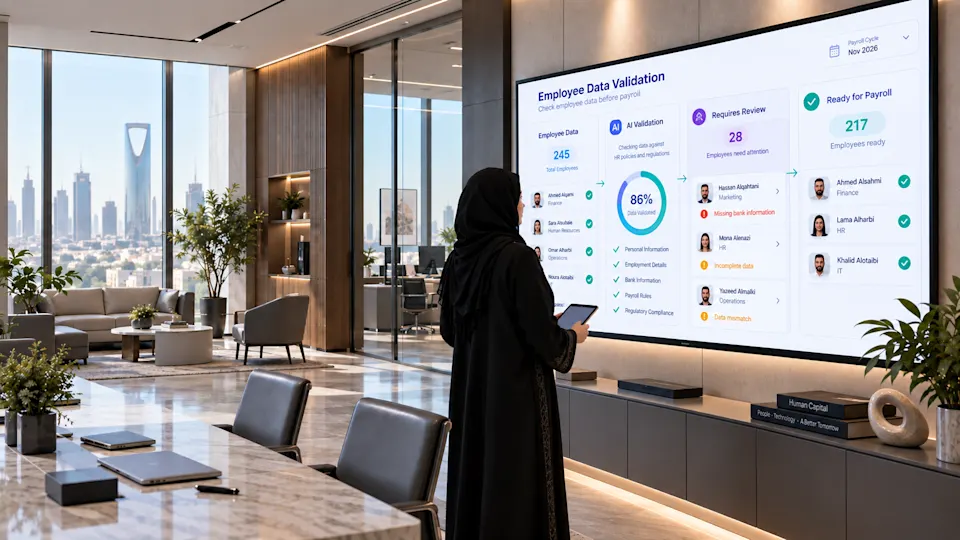
AI Employee Data Validation: A Pre-Payroll Readiness Scan
Solvait's AI Employee Data Validation scans employee data before payroll . Built into Solvait HCM.
Sep 15, 2026
Nestlé Waters KSA Chooses Solvait for HCM: Kick-off
Nestlé Waters Saudi Arabia has chosen Solvait to build its HCM platform on Microsoft Dynamics 365. The implementation project kicks off.
Sep 14, 2026
Benchmark Any Saudi Salary in 30 Seconds (Free Tool)
Solvait's free salary calculator gives you the Saudi market range by role, sector and city in 30 seconds. Benchmark any offer before you hire or raise pay.
Sep 13, 2026