

How to Run a Performance Appraisal Cycle: Stages, Weights and Approvals
The performance appraisal cycle is a sequence of five stages that run in order: set goals, then self assessment, then manager review, then calibration, then approval. Each stage waits for the one before it, exactly like a single production line. And that's the whole problem. The biggest reason a cycle runs late isn't the form or the number of employees. It's one person falling behind in the line.
Same people every year. Same form. Yet the scores come out uneven and the approvals slip by weeks. Most teams run appraisals as a solo task for each manager instead of a production line with an order, weights, and calibration. This guide walks the five stages in sequence, untangles the three terms everyone mixes up, then shows how the final score adds up from weights and why calibration curbs manager bias.
Key takeaways
The performance appraisal cycle is a sequential line of five stages, and any delay in one stage delays the whole cycle.
Performance appraisal measures one person, calibration keeps managers fair to each other, and a 360 review gathers input from everyone around them. Three different things.
The final score adds up from weights: goals versus competencies, self-assessment versus manager review. The weight is set by the role, not the manager's mood.
More than half of any rater's score reflects the rater, not the person being rated. That's why calibration exists.
The formal cycle sets fairness and approval. The real improvement happens in short, frequent conversations between cycles.
The appraisal cycle has five stages: where does it usually stall?
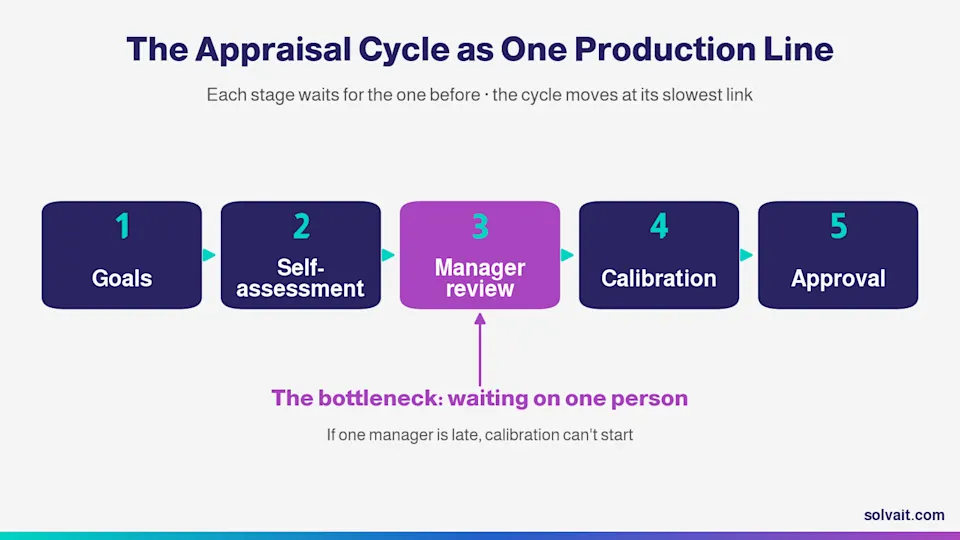
Picture the cycle as a production line. Raw input enters one end, passes through five stations in order, and a signed off score comes out the other. No station can start before the one before it finishes. Here are the five stations.
Stage | Owner | Output | What stalls it |
1. Set goals | Employee + manager | Clear goals with an owner | Vague goals with no measure |
2. Self assessment | Employee | Employee's view of their own year | Employee delays the form |
3. Manager review | Direct manager | A first score per employee | One manager is busy |
4. Calibration | Panel of managers | Consistent, fair scores | No calibration meeting is booked |
5. Approval | Leadership / HR | Final approved score | A late signature |
Look at the last column. Almost every stall is waiting on a person, not a flaw in the form. That person is the bottleneck in the line.
Take an illustrative example from a Saudi team. An annual cycle for 50 employees, split across five managers. If one manager runs two weeks late on the manager review stage, calibration can't even begin, because it needs everyone's scores on the table at once. So the employees of the four managers who finished on time wait on the fifth. The cycle moves at the speed of its slowest link.
This is where the real problem shows. Fewer than one in five HR leaders believe performance management is effective at its core job, and 81% are still changing their systems, according to Gartner. The cause isn't intent. It's that the line stops at the slowest station, and nobody can see where it stopped.
What is the difference between a company review, a performance review and a 360 review?
These are the three terms people mix up most, and the confusion alone causes half the arguments in appraisal season. The difference is simple once you tie each one to its question.
Term | The question it answers | Who takes part | When |
Performance appraisal | How did this employee do against their goals? | The direct manager | End of cycle |
Calibration | Are managers' scores fair and consistent with each other? | A panel of managers | Before approval |
360 review | How do the people around them see them? | Manager + peers + reports | During the cycle or standalone |
Here's the idea that clears it up. Performance appraisal is vertical, from manager to employee. Calibration is horizontal, between managers, to keep things fair. And a 360 review is circular, from everyone around the person. Many teams call all three "the review," so an employee assumes their peers' input will set their raise, when in most systems a 360 is a development tool, not a scoring one.
The phrase "company review" that many people search for usually means calibration or the organization-wide view: the full picture of all scores together. A "performance review," by contrast, is one individual. The first keeps teams fair to each other. The second measures a single person.
How does the score add up from weights, and why does calibration curb manager bias?
The final score isn't a number a manager writes on a feeling. It's the sum of weights that were announced in advance. Two weights matter most.
First, goals versus competencies. Goals are results, what you delivered. Competencies are behavior, how you delivered it: collaboration, quality, reliability. A sales role might be 70% goals and 30% competencies. A customer service role often flips that. The split is set by the nature of the role, not the rater.
Second, self assessment versus manager review. Self assessment gives the employee a voice, but it usually carries less weight. A common illustrative split is 30% self and 70% manager. Announce the weights before the cycle, so nobody is surprised.
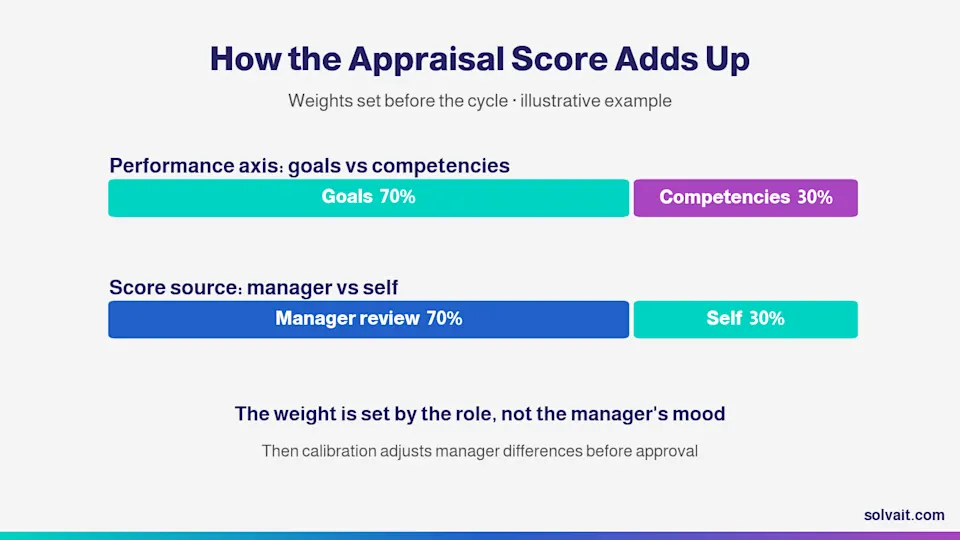
Weights alone aren't enough, though. A deeper problem remains: the manager is human, and humans are unstable raters. Research published in Harvard Business Review found that more than half of any rater's score (about 61% on average) reflects the rater, not the person being rated. This is the idiosyncratic rater effect. A lenient manager lifts everyone, a harsh one lowers everyone, and the employee pays for the luck of the draw on their manager.
This is exactly where calibration comes in. When managers sit together and compare their scores on one scale, the lenient and the strict both surface, and scores get adjusted to be fair across teams. Calibration isn't extra bureaucracy. It's the only mechanism that corrects a bias no amount of training removes.
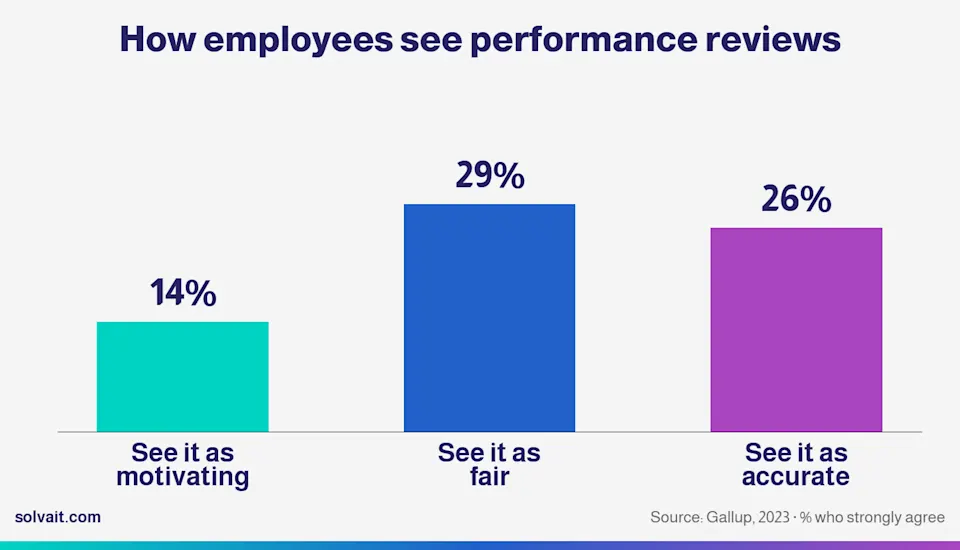
That leads to the timing question. Employees who get weekly rather than annual feedback are about five times more likely to say the feedback they get is meaningful, according to Gallup. Even so, only 14% of employees say their review inspires them to improve, 29% find it fair, and 26% find it accurate. The practical lesson: the formal cycle sets fairness and approval, but the real improvement happens in the short, frequent conversations in between.
What's the most common mistake in appraisal season?
Treating each stage as if it stands alone. A manager finishes their scores, then waits on the rest, then a calibration meeting gets requested that can't find a slot on the calendar, then approvals pile up in the last week. The line exists, but it's invisible, so nobody knows where it stopped. The fix isn't a smarter form. It's seeing the whole line in one place: who's done, who's late, and where the cycle stands right now.
Where Solvait Wise fits in the cycle
Solvait Wise is an AI assisted platform for performance and goals. It isn't agentic, and it doesn't put scores in place of the manager. What it does is bring the five stages into one place: company goals cascade to teams, weights are set in advance, and a single board shows who's done and who's late in real time. The calibration meeting sees every score on one scale, so leniency and strictness get corrected before approval. The decision at every step stays with the manager.
Before you get to the platform, try the goals stage yourself. The free performance appraisal goal generator writes a clean, ready goal in about thirty seconds (a performance review generator), in Arabic and English. No signup, no data captured. Enter the job title, let the AI performance review generator suggest the wording, then edit it as you see fit. Clear goals at the start mean a faster cycle at the end.
Solvait is a Saudi company that has been building HR systems for about fifteen years, and more than 260 organizations across Saudi Arabia and the Gulf rely on it today. If you want to see what the appraisal cycle looks like when it runs as one visible line, book a demo and we'll run it on your data.
FAQ
What is the difference between a company review and a performance review?
A performance review measures one employee against their goals and is written by their direct manager. A "company review" usually means calibration or the organization wide view: comparing all managers' scores together to keep them fair and consistent before approval. One is about an individual, the other about the full picture.
What are the stages of a performance appraisal cycle?
Five sequential stages: set goals, then self-assessment, then manager review, then calibration, then final approval. Each stage waits for the one before it, so a delay in any stage delays the entire cycle.
What is calibration in performance management?
Calibration is a meeting where managers sit together and compare their scores on a single scale. It corrects fairness: a lenient manager lifts everyone, a strict one lowers everyone. Calibration surfaces that gap and adjusts scores before they're approved, so they're fair across teams.
How are appraisal weights split between goals and competencies?
By the nature of the role, and announced before the cycle starts. A results driven role leans toward a higher weight on goals, while a service or behavior driven role raises the weight on competencies. The point is that the weight is an announced decision, not a manager's in the moment judgment.
Should I replace the annual review with continuous feedback?
Don't replace, combine them. The annual cycle sets fairness, approval, and weights, while short, frequent feedback is what actually improves performance. Employees who get weekly feedback are far more engaged than those who wait for one review a year.
References
Gartner: Gartner Says 81% of HR Leaders Are Changing Their Organization's Performance Management System, 2019 (fewer than one in five HR leaders find performance management effective; 81% are changing it).
Harvard Business Review: Reinventing Performance Management, 2015 (idiosyncratic rater effect: about 61% of a score reflects the rater).
Gallup: Give Performance Reviews That Actually Inspire Employees, 2023 (14% find reviews motivating, 29% fair, 26% accurate).
Gallup: More Harm Than Good: The Truth About Performance Reviews, 2019 (weekly versus annual feedback).
Ready to see Solvait in action?
Book a personalized demo and see how Solvait's AI-powered HR platform can transform the way your team works.
Tags
Related Posts

Performance Appraisal Calibration: Why Ratings Differ
Two managers, same work, different scores-how performance appraisal calibration keeps every rating fair and defensible in Saudi Arabia.
Sep 29, 2026
End of Service on Resignation in Saudi: Worked Examples
EOS if you resign in Saudi Arabia, with worked examples. What you get after 4 or 8 years, the Article 85 ladder, the Article 84 base, and exceptions.
Oct 4, 2026
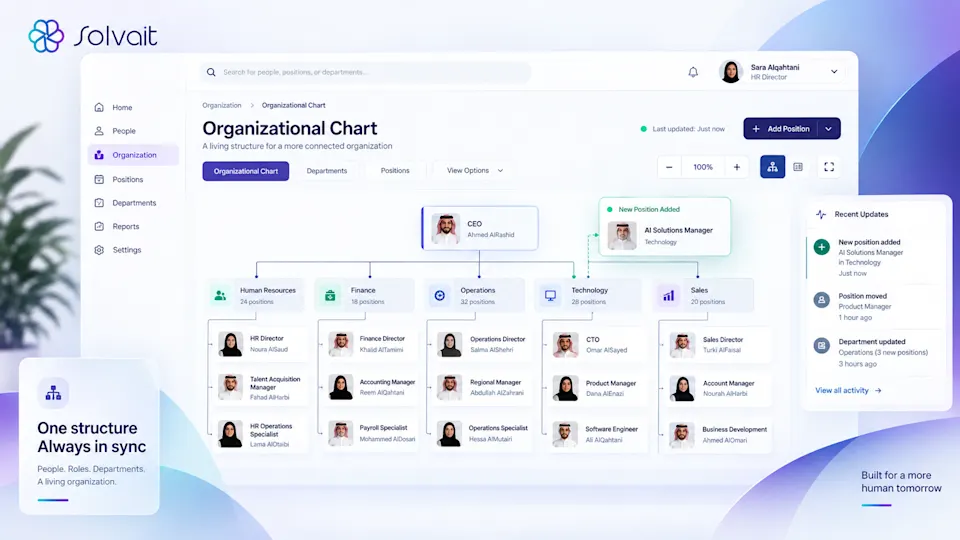
How to Map a Clear Org Structure in Wise's Org Chart
A practical guide to mapping your org structure in Wise's interactive org chart in one living chart that updates on every change.
Sep 20, 2026