

How Much Is My End of Service if I Resign After 4 Years in Saudi Arabia? Worked Examples
If you resign from a private sector job after four years, you get one third of the end of service benefit, not the full amount. The base is half a month's wage per year, then cut to a third because the resignation falls between two and five years. On a total wage of SAR 10,000 that means a base of SAR 20,000 and an actual payout of about SAR 6,667.
End of service on resignation is governed by two articles working together. Article 84 builds the base; Article 85 applies a ratio tied to your years of service. Put plainly: the end of service benefit is a sum the employer pays the worker when the contract ends, calculated on the last wage and length of service, and its payable value on resignation shrinks by a ratio that depends on your service band. This post walks the most common case, resignation, with numbers you can check yourself.
Key takeaways
Resign before two years: no end-of-service benefit at all.
Two up to five years, including exactly five: one third. Over five and under ten: two thirds. Ten years or more: the full benefit.
The base (Article 84) is half a month per year for the first five years, a full month per year after that, on the total wage, not basic salary alone.
One extra month past the five-year line moves you from a third to two thirds, so the payout more than doubles.
Run your own figure in an end of service calculator, then check your contract and total wage before you hand in your notice.
Why this number matters now
Resignation is an everyday event in the Saudi labor market, not an edge case. Employed Saudis in the private sector reached about 4.1 million by Q3 2025 according to the General Authority for Statistics, alongside millions of expatriate workers. By the end of 2024 the Wage Protection System covered the wages of more than 8.5 million employees, per the Ministry of Human Resources and Social Development. Every one of them, on deciding to leave, hits the same question: what am I owed?
The trouble is that most calculators and summaries give a rough figure, and some get the five-year boundary wrong. The gap between a correct answer and a close one can be thousands of riyals. So we start from the text, then turn it into worked examples.
How much end of service do you get if you resign? The Article 85 ladder
Article 85 says a resigning worker gets one third of the benefit after service of no less than two consecutive years and no more than five, two thirds if service exceeds five years but has not reached ten, and the full benefit at ten years or more. That is four bands:
Service at resignation | Share | Outcome |
Under 2 years | Zero | No end of service benefit is paid |
2 up to 5 years (including exactly 5) | One third (about 33%) | Build the base, pay a third of it |
Over 5 and under 10 years | Two thirds (about 67%) | Build the base, pay two thirds of it |
10 years or more | Full benefit (100%) | Paid with no reduction |
Where exactly does the five year line fall?
This is where many people slip. The text reads "no more than five years" for the third, and "exceeds five years" for two thirds. So a worker who completes exactly five years stays in the one-third band, and two thirds begins only above five, even by a single day. For a resigning worker, exactly five years means a third, not two thirds.
And this line is no formality. Look at the money on a total wage of SAR 10,000:
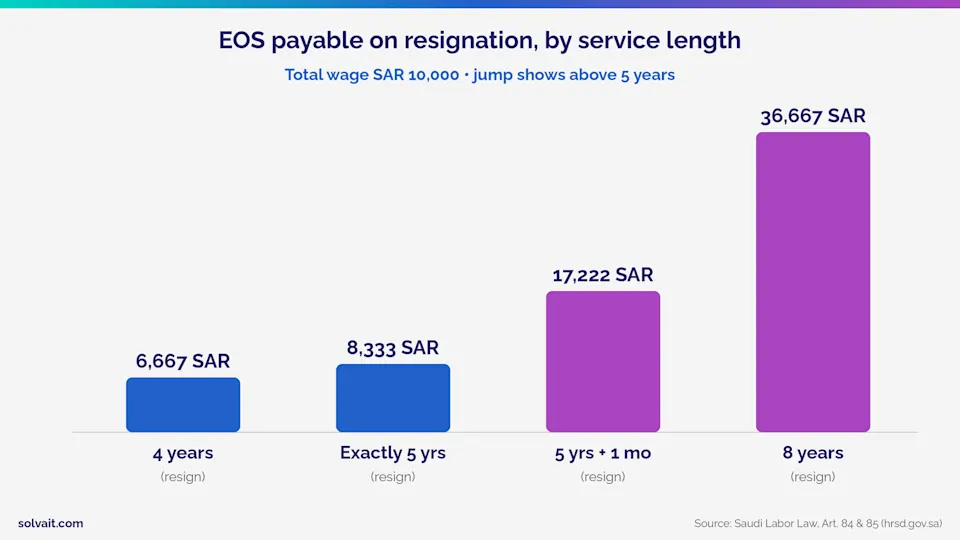
Someone resigning at exactly five years takes about SAR 8,333 (a third of a SAR 25,000 base). Stay one more month and the share becomes two thirds, so the payout jumps to about SAR 17,222. One month roughly doubles the figure. If you are anywhere near five years, that is the number to remember.
How is the base built before the ratio applies? The Article 84 formula
The ratio in Article 85 is applied to a base that Article 84 builds. In principle the base is simple:
Half a month's wage for each of the first five years.
A full month's wage for each year after the first five.
Fractions of a year are paid pro rata: months divided by 12, days divided by 360.
The last wage is the basis for the calculation.
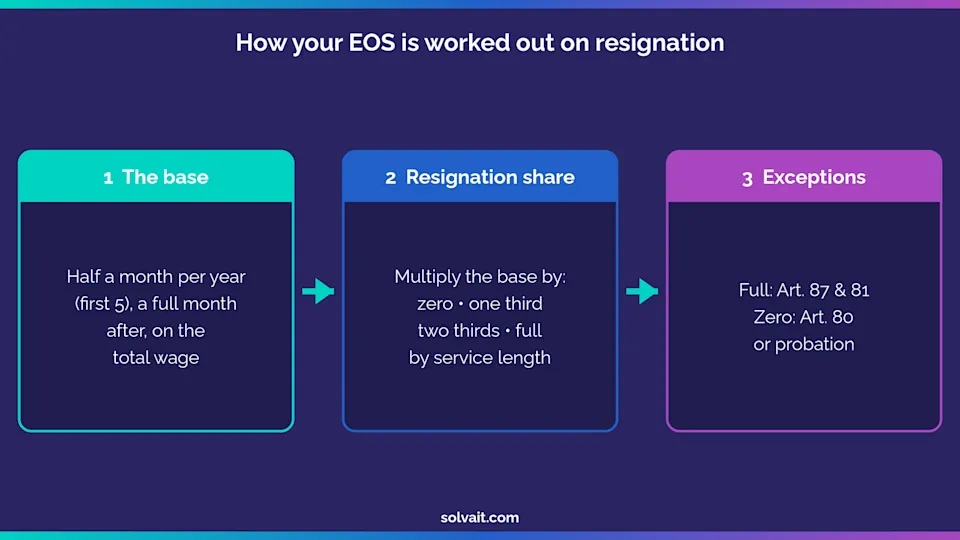
Which wage is it based on? Total, not basic
This is the point that costs employees the most when they miss it. The benefit is calculated on the last actual wage, which under the Article 2 definition includes basic salary plus housing allowance, transport allowance, fixed allowances, commissions, and regular bonuses. Basic salary alone is not the pool. Irregular overtime and one-off discretionary bonuses usually fall outside it, and variable commissions are estimated by an average under the logic of Article 86. There is no upper cap on the benefit, however long the service.
Take a total wage of SAR 10,000 across all of the examples below:
Case | Building the base | Base | Share (resignation) | Payable |
4 years | 0.5 × 10,000 × 4 | 20,000 | One third | SAR 6,667 |
4 years and 6 months | (0.5 × 10,000 × 4) + (0.5 × 10,000 × 6÷12) | 22,500 | One third | SAR 7,500 |
8 years | (0.5 × 10,000 × 5) + (1 × 10,000 × 3) | 55,000 | Two thirds | SAR 36,667 |
Look at that last row. In the three years past the first five, the accrual rate doubles from half a month to a full month, so the base climbs from 25,000 (for the first five) by another 30,000. That is why the payout jumps once service passes five years.
For contrast: if the employer had ended the four year worker's contract for a legitimate reason, the worker would get the full base (SAR 20,000) under Article 84, not a third of it. Resigning versus being let go does not change the base. It changes the ratio applied to it.
When is your benefit not reduced despite resigning? Articles 87 and 81
The Article 85 ladder is not absolute. In some cases a worker takes the full benefit even after ending the contract, and in others the benefit falls away entirely. The table covers both ends:
Case | Legal basis | Effect |
Leaving work due to force majeure beyond the worker's control | Article 87 | Full benefit, regardless of length of service |
A female worker ending the contract within six months of her marriage, or three months of childbirth | Article 87 | Full benefit, regardless of length of service |
A worker leaving because of a material breach by the employer | Article 81 | Keeps full financial entitlements |
Dismissal for one of the grounds of grave misconduct | Article 80 | No benefit |
Ending the contract during probation | Article 54 | No benefit for that period |
Three points keep this table from being misread:
Article 87 governs the amount, not the right to terminate: It opens with "by way of exception to Article 85," meaning it sets the benefit at the full amount in those cases. It does not create a standalone right for the worker to cancel the contract at will. And the exact text is "three months from the date of childbirth," not "during maternity leave."
Dismissal under Article 80 forfeits the benefit, but with conditions: The employer has to prove one of the nine grounds and follow the process, including a written warning and investigation. If the ground is not proven or the process is skipped, the dismissal is unlawful and the worker's entitlements stand.
Probation counts later if the contract continues: No benefit is due if the contract ends during probation, but that time is included in total service once the worker passes probation and stays on.
Check your case with Solvait's end of service gratuity calculator
Every example here can be checked against your own numbers. Enter your total wage, length of service, and reason for leaving in Solvait's end of service gratuity calculator, and it returns the figure under Articles 84 and 85 in under a minute. The tool is free, with no signup and no data captured. If your pay leans on variable commissions, use the salary calculator first to settle the total wage.
At company scale, a slip in one band or in the wage definition multiplies across hundreds of employees and surfaces in settlements and Qiwa claims. That is where Solvait AI HR fits, Solvait's platform on Microsoft Dynamics 365, which runs the end of service calculation under Articles 84 and 85 inside the pay cycle itself, alongside GOSI, Qiwa, Mudad, Nitaqat, and Saudization obligations. The statutory rule is applied automatically; the human stays on the decision. Solvait serves more than 260 enterprises and cuts process time by up to 50%.
To see that on your own data, book a demo.
Then come back to your own case right now: use the tool and work out your benefit before you decide.
FAQ
Is end of service calculated on basic or total salary?
On the last total wage, not basic alone. The pool includes basic salary, housing allowance, transport allowance, fixed allowances, commissions, and regular bonuses, under the "wage" definition in Article 2 of the Labor Law. Irregular overtime and one off bonuses usually fall outside it.
How much end of service does someone get after resigning at four years?
One third of the benefit, because their service is between two and five years. The base is half a month per year, so on a SAR 10,000 total wage the base is SAR 20,000 and the actual payout is a third of it, about SAR 6,667.
Does it change if I resign at exactly five years versus one month later?
Yes, by a wide margin. At exactly five years the share stays one third. Above five, even by a month, it becomes two thirds. On a SAR 10,000 wage the payout rises from about SAR 8,333 to about SAR 17,222 because of that one month.
Does a worker get a benefit if dismissed under Article 80 or during probation?
No. Dismissal for one of the grave-misconduct grounds in Article 80 forfeits the benefit, provided the employer proves the ground and follows the process. No benefit is paid if the contract ends during probation either, though probation counts toward service if the contract continues after it.
When is end of service paid after resignation?
The employer must pay entitlements within a short window of the contract ending under Article 88, and the window depends on the reason for ending. It helps to agree the payment date in writing and document the last wage before leaving to avoid any dispute.
References
Ministry of Human Resources and Social Development - Saudi Labor Law, full text (Articles 54, 80, 81, 84, 85, 87, 88), 2025. (Basis for the bands, the formula, and the exceptions)
Ministry of Human Resources and Social Development - [Executive Regulations of the Labor Law](https://www.hrsd.gov.sa/sites/default/files/2025-02/اللائحة التنفيذية لنظام العمل وملحقاتها.pdf), 2025. (Probation and implementing rules)
General Authority for Statistics - Labor Market Statistics, Q3 2025, 2025. (Private-sector Saudi employment figure)
Ministry of Human Resources and Social Development - Progress in the Saudi Labor Market, 2025. (Wage Protection System covering more than 8.5 million employees)
Ready to see Solvait in action?
Book a personalized demo and see how Solvait's AI-powered HR platform can transform the way your team works.
Tags
Related Posts

AI Employee Data Validation: A Pre-Payroll Readiness Scan
Solvait's AI Employee Data Validation scans employee data before payroll . Built into Solvait HCM.
Sep 15, 2026

Benchmark Any Saudi Salary in 30 Seconds (Free Tool)
Solvait's free salary calculator gives you the Saudi market range by role, sector and city in 30 seconds. Benchmark any offer before you hire or raise pay.
Sep 13, 2026

Saudi Labour Law Automation: 9 Clauses to Enforce
Nine Saudi labour law clauses your HR system should enforce automatically after the 2025 reforms, from probation caps to WPS files.
Aug 30, 2026