

Nitaqat 2026: The Guide Saudi HR Teams Actually Need
Nitaqat Mutawar is the classification system the Ministry of Human Resources and Social Development uses to measure localization in every private establishment, then tie that company's government services to the result. The current phase began in April 2026, runs for three years, and targets more than 340,000 additional private sector jobs for Saudi nationals.
Three changes in this phase can move your band without a single hire or termination. The Yellow tier is gone, and establishments that sat in it moved straight to Red. The values behind the required percentage rose across most sectors, so a company that was High Green last year can be Low Green today at the same headcount. And since 15 April 2026, a Saudi employee counts toward your localization percentage only if their contract is electronically documented on the Qiwa platform (https://www.qiwa.sa).
This guide covers how your percentage is calculated now, where the violation you can't see is hiding, and how to turn band monitoring from an annual review into a weekly operating metric.
How the Nitaqat 2026 green zone is calculated
The figure you see in Qiwa isn't Saudis divided by total headcount. It's the output of a calculation that reads your economic activity and company size, then compares your performance against the target set for your category. Because that target moved in April, the comparison itself changed.
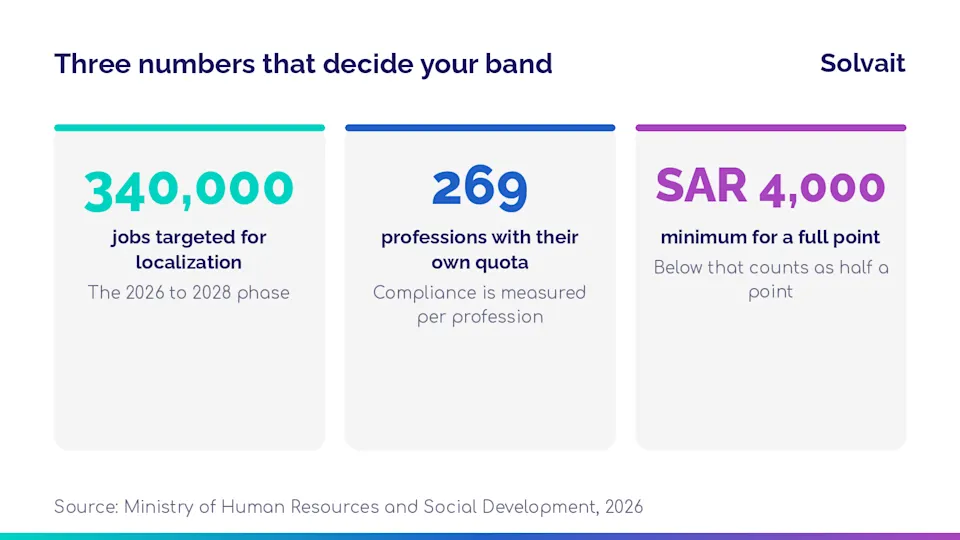
Three conditions decide whether your Saudi employee counts at all:
A documented Qiwa contract : GOSI registration alone is no longer enough. An employee without a digitally signed contract sits on your payroll and stays invisible to the localization calculation.
A monthly wage of at least SAR 4,000 : to count as a full point. Between SAR 3,000 and SAR 4,000, the employee counts as half a point.
A profession aligned with the specific localization decisions : which now cover 269 roles. Some require professional accreditation, such as the Saudi Council of Engineers for covered engineering professions.
The third condition catches even disciplined teams off guard. A company can be Green at establishment level and non compliant inside one department, because a profession decision applies to the department's own headcount rather than the size of the business.
What each band means when you need a government service
The difference between bands never shows up in an HR meeting. It shows up the day you need a visa, a work permit renewal, or eligibility for a government tender.
Band | What you keep | What you lose |
Platinum | Priority visa approvals and transfers | Nothing |
High Green | Full operational flexibility | Margin, with every resignation |
Mid Green | Core services intact | Room to scale hiring quickly |
Low Green | Services still work | One small change can push you to Red |
Red | Nothing | Visas, permit renewals and government tenders, plus expatriate staff can transfer sponsorship without your consent |
Removing the Yellow tier is the detail most teams underrate. Yellow used to be a warning zone that bought you time to correct course. That zone no longer exists. You're Green or you're Red, and the distance between Low Green and Red can be two resignations.
Where the violation you can't see is hiding
Across HR implementations, a sudden band drop almost never traces back to a big decision. It traces back to small operational details that stacked up:
A Saudi employee joined two months ago and never signed their contract digitally in their own Qiwa account. They work, you pay them, and the system doesn't see them.
A promotion changed the job title without updating the profession in the record, so the employee dropped out of the localization decision that used to cover them.
A pay structure keeps base salary under SAR 4,000 and makes up the difference with variable allowances, so the employee counts as half a point.
A sales team grew from two people to four, which triggered the profession decision, and nobody noticed.
None of these is an HR mistake. Each one is operationally reasonable, and the regulatory effect lands somewhere else weeks later.
That's the difference between a system that records data and one that reads it. An AI agent inside a modern HR platform reviews employee files before they turn into a problem: missing contract, wage under the threshold, mismatched profession data, expired document. This is what agentic AI means in a compliance context. Not a dashboard telling you what happened, but a continuous review that flags what's about to.
Four practical steps before month end
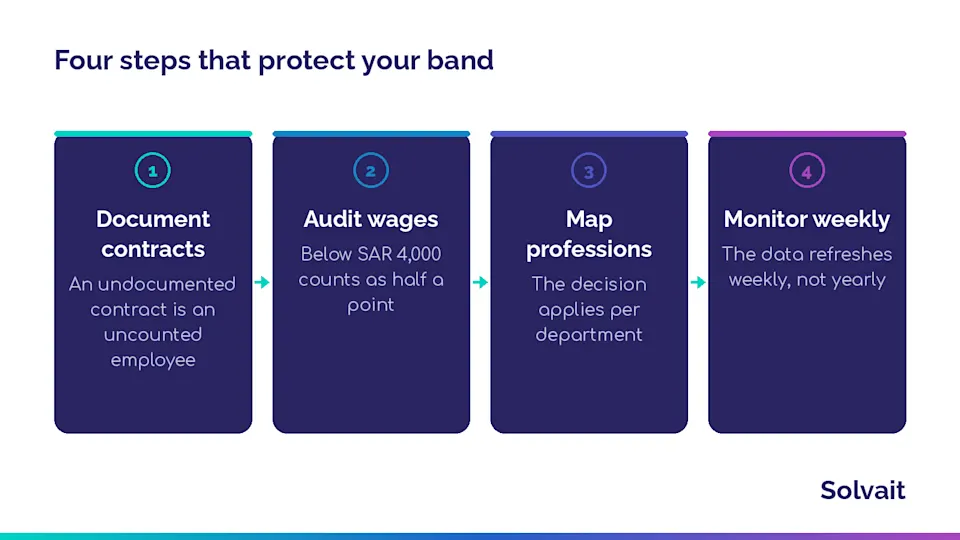
1. Audit the contracts : Pull a list of every Saudi employee and reconcile it against contract status in Qiwa. Start with anyone who joined in the last six months, since new joiners are the group most likely to have an unsigned digital contract.
2. Review the pay structure : Identify every Saudi whose base wage sits under SAR 4,000, and weigh the cost of raising it against the cost of counting them as half a point. Sometimes the raise is cheaper than losing visa access.
3. Map professions : List your departments, the headcount in each covered profession, and your percentage inside that profession specifically. A Green company that fails in one department still fails.
4. Monitor weekly : Nitaqat data refreshes on a rolling basis. It isn't an annual snapshot. Put band review on the weekly HR agenda instead of opening it a week before you need visas.
Where Solvait fits
Solvait HCM runs on Microsoft Dynamics 365 and holds employee, contract and wage data in one record instead of three spreadsheets that quietly disagree. The performance analytics and industry comparison module shows your current percentage against target, broken down by department and profession rather than company level only. The AI employee profile validation module catches the missing contract, the wage under threshold and the expired ID before any of it reaches your classification.
Try the free salary calculator to break any Saudi salary into basic pay, allowances, GOSI deductions and net in seconds. No signup, no data captured.
If you want to see profession level Saudization tracking inside a single system, book a Solvait demo and we'll walk through your establishment's position step by step.
FAQ
When does a Saudi employee count toward the localization percentage?
When their contract is electronically documented on Qiwa, they're registered with GOSI, and their monthly wage is SAR 4,000 or above to count as a full point. Between SAR 3,000 and SAR 4,000 they count as half a point. Missing any condition means an employee who works for you and doesn't appear in your calculation.
Does the Yellow band still exist in 2026?
No. Yellow was eliminated in the current phase, and establishments that were in it moved directly to Red. That removes the warning zone companies used to rely on for time to correct course before services were suspended.
Can my company be Green and non compliant at the same time?
Yes. Establishment level classification and profession specific decisions are calculated separately. The marketing and sales decision, for example, applies to any company with three or more workers in those roles regardless of overall ratio.
How often does the Nitaqat classification update?
Establishment data updates on a rolling basis in Qiwa, and the classification reflects a weighted average over a prior period rather than a single day. In practice, a hire or a resignation shows up within days to weeks, not instantly.
What's the first move if my company is in Red?
Start with the employees you already have who aren't being counted: undocumented contracts, wages under threshold, mismatched profession data. Fixing the calculation is faster and cheaper than hiring, and it can return you to Green without a single new headcount.
References
Ministry of Human Resources and Social Development: New phase of the Nitaqat Mutawar Program , 2026 (340,000 job target and three year duration)
Okaz, reporting MHRSD: Qiwa contract documentation required for localization counting , 2026 (documentation requirement from 15 April 2026)
Middle East Briefing / Dezan Shira: Saudi Arabia's Nitaqat 2026 update: quotas by sector and compliance requirements , 2026 (Yellow removal, SAR 4,000 threshold, 269 professions)
Qiwa platform: Establishment services and Nitaqat indicator , 2026 (band verification and contract data)
General Authority for Statistics: Labour Force Survey, Q1 2026 , 2026 (labour market context)
Ready to see Solvait in action?
Book a personalized demo and see how Solvait's AI-powered HR platform can transform the way your team works.
Tags
Related Posts

Hit Nitaqat Without Losing Quality
How to meet 2026 Saudization quotas and keep hiring quality high, with profession level rates, and a pipeline that survives six months.
Jul 31, 2026

Benchmark Any Saudi Salary in 30 Seconds (Free Tool)
Solvait's free salary calculator gives you the Saudi market range by role, sector and city in 30 seconds. Benchmark any offer before you hire or raise pay.
Sep 13, 2026

Saudi Labour Law Automation: 9 Clauses to Enforce
Nine Saudi labour law clauses your HR system should enforce automatically after the 2025 reforms, from probation caps to WPS files.
Aug 30, 2026