

OKR Coverage %: How to Measure Whether Your Goals Ladder Up to Strategy
OKR coverage is the percentage of your team's goals that actually link to a company objective. You calculate it simply: linked goals divided by total goals, times 100. If a department runs 40 goals and 28 of them tie to a clear company objective, coverage is 70%. The other 12 are real work with no direction. The number answers one uncomfortable question: how much of your team's effort feeds the strategy, and how much is adrift?The myth is that more goals signal more activity. The truth is that a goal with no link to strategy is paid effort with no destination. Measuring coverage is the fastest way to see that gap mid-cycle, not after it.
Key takeaways
• OKR coverage = goals linked to a company objective ÷ total goals × 100. One number for goal alignment.
• An orphan goal links to nothing above it. An unowned goal has no single accountable owner. Both burn time without return.
• In an MIT Sloan Management Review study of 124 organizations, only 28% of the leaders responsible for execution could name three of their company's strategic priorities.
• A healthy coverage range is above 90%. From 60 to 90% is a watch zone. Below 60% means the strategy lives only on paper.
• Solvait Wise links every goal to a company objective with AI, and surfaces orphan goals and unowned goals in one view.
What is OKR coverage, and how do you calculate it?
OKR coverage is a plain metric in performance and goal management: what share of your teams' goals ties to a company objective. In the OKR model, each team goal is meant to "ladder up" to a higher goal until it reaches company strategy. Coverage measures whether that chain exists, or whether goals fly solo.The formula is one line:OKR coverage = (goals linked to a company objective ÷ total goals) × 100
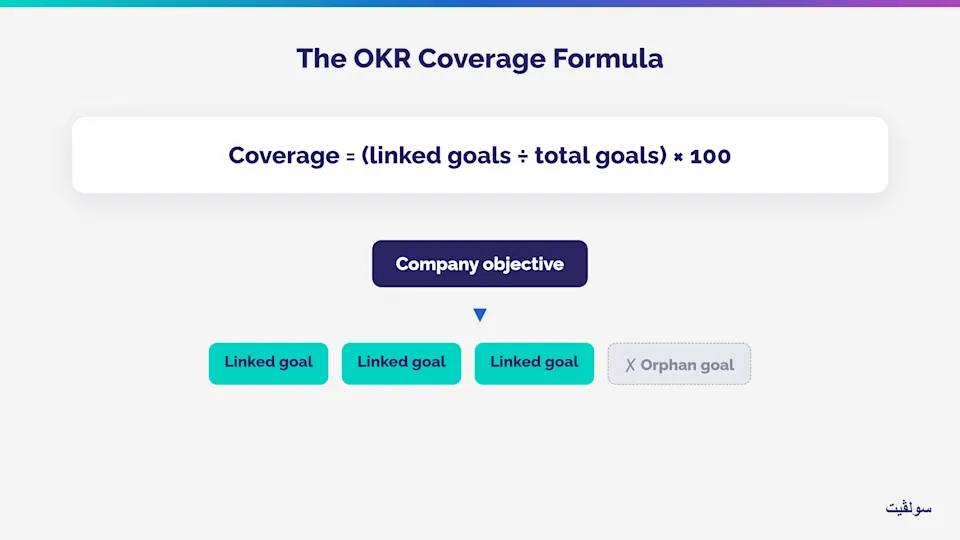
Before you count, agree on two definitions:
Orphan goal: a goal that links to nothing above it. The team works on it, but nobody can say which strategy it serves.
Unowned goal: a goal with no single, named owner. When everyone owns it, nobody does. It slips quietly until the cycle ends.
A quick worked example. An engineering team has 18 goals for the quarter. You review them and find 13 tie to company objectives (faster releases, fewer outages), while 5 are internal goals linked to no stated direction. Coverage is 72%. The number doesn't say those five goals are bad. It says you don't know why you're running them, and that deserves an answer before you spend a whole quarter on it.One thing to keep straight: coverage measures the link, not the quality or the completion. A linked but badly written goal is still a problem. But without the link, even an excellent goal gets lost. Fix the link first, then work on quality.
What does the number mean, and what does an orphan goal cost?
The number alone isn't enough. You need to know which band you're in and what to do there. Here is the decision table:
Coverage | What it means | Next step |
|---|---|---|
Above 90% | Strong alignment. Effort feeds the strategy | Watch quality and weights, not the link |
60 to 90% | Watch zone. Part of the effort is adrift | Review unlinked goals: link them or stop them |
Below 60% | Strategy on paper only | Rebuild the cascade from the company objective down |
Back to the classic example. Forty team goals, 12 with no link to a company objective. That is 30% of your team's effort adrift. If the average goal takes one and a half to two people across the quarter, you're funding a third of your team to work in a direction nobody asked for. That isn't a laziness problem. It's a linking problem.And the gap is more normal than most leaders think. In an MIT Sloan Management Review study of 124 organizations, only 28% of the executives and middle managers responsible for executing strategy could name three of their company's priorities, and one third could not name even one (2018). If the people running execution don't know the priorities, how is an individual goal supposed to link to them?
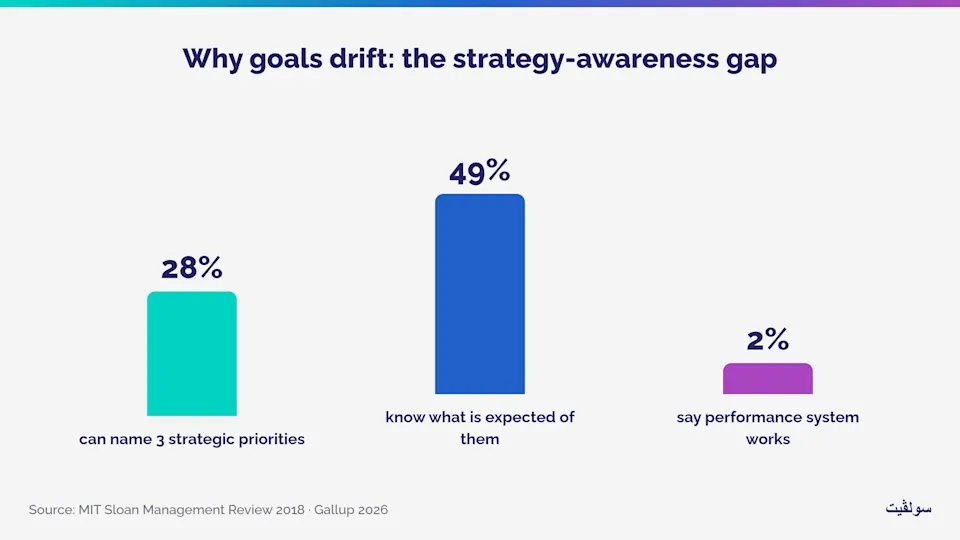
Clarity itself is slipping. Gallup reports that only 49% of employees strongly agree they know what is expected of them at work in 2026, down from 61% in 2015. And employees who see meaning in their work are 5.6 times more engaged than those who don't (Gallup, 2025). The link isn't an admin nicety. It's what tells a person why they're working at all.
The mistake everyone makes: measuring coverage once, at the start of the year. Goals change, priorities shift, and orphan goals multiply quietly through the quarter. Coverage is a live metric, reviewed every cycle, not a field you fill once and forget.
How do you measure and fix coverage at scale?
In a team of ten, you can review goals by hand on a spreadsheet. In a company with five departments and dozens of teams, the manual sheet lies to you. You need the system to draw the cascade for you: from the company objective down to the department, the team, the individual, and to light up where the thread breaks.This is where Solvait Wise comes in, an AI assisted performance and talent platform. Wise links every goal to a higher one, calculates OKR coverage automatically for each team and department, and shows in a single view:
Orphan goals: goals that ladder up to no company objective, ready for review.
Unowned goals: goals with no clear owner, before they stall.
The full cascade: from company strategy down to the individual's goal, in one tree everyone can see.
Wise is AI assisted. It shows you the gap and suggests the link, and the decision stays with you. It is not an autonomous agent that acts on its own. The agentic product at Solvait is called Solvait AI HR, and that is a different platform.For a fast starting point before the full system, Solvait's free appraisal goal generator helps you write clear, measurable goals that are ready to link, with no sign up and no data collection.This idea is not new to Saudi Arabia. Vision 2030 itself was cascaded into strategic objectives delivered through Vision Realization Programs, each with KPIs tied to specific targets. That is exactly goal to strategy alignment, at a national scale. What holds for a nation holds for a company: a strategy that never descends into goals someone owns stays a slogan.
Copy ready checklist: review your coverage in 6 steps
[ ] Write this quarter's three to five company objectives in one place.
[ ] Collect every team goal into a single list.
[ ] Link each team goal to one company objective (or mark it "orphan").
[ ] Calculate: linked goals ÷ total goals × 100.[ ] For each orphan goal: link it to a higher goal, stop it, or defer it.
[ ] Confirm every goal has one named owner, not a committee.
Solvait Wise: from a goal list to a cascade you can see
Most teams don't fail at setting goals. They fail at linking them and keeping the link alive through the cycle. Solvait Wise turns goal alignment from a tiring manual review into a live view: a coverage percentage per department, an alert for every orphan goal, and a clear owner for each one. Performance measurement becomes about direction, not just the count of goals.Because the deeper problem is that performance systems themselves are broken for many, here is a sobering number: only 2% of HR leaders think their performance management system works well (Gallup). The fix isn't more forms. It's a clearer link and simpler measurement.Try the free appraisal goal generator to write link-ready goals today. When you're ready to see your full company cascade and coverage live, book a demo with Solvait.
FAQ
What is OKR coverage?
OKR coverage is the percentage of team goals that link to a company objective. You calculate it by dividing the number of linked goals by total goals, then multiplying by 100. The number measures goal alignment: how much of the effort actually serves the strategy.
What is a healthy OKR coverage range?
Above 90% is strong alignment. From 60 to 90% is a watch zone that needs a review of the unlinked goals. Below 60% means the strategy never descended into real goals, and you need to rebuild the cascade from the company objective down.
What is the difference between an orphan goal and an unowned goal?
An orphan goal links to nothing above it, so you can't tell which strategy it serves. An unowned goal is linked but has no single clear owner. The first is a direction problem, the second is an accountability problem, and both drain team time.
Is Solvait Wise an agentic tool?
No. Solvait Wise is an AI assisted tool that helps with goal alignment and performance measurement, shows you the gap, and leaves the decision to you. The agentic product at Solvait is Solvait AI HR, a different HR platform.
How do I start measuring coverage quickly?
Collect company goals and team goals in one place, link each team goal to a company objective, then calculate the percentage. Use the checklist above as a start, or the free appraisal goal generator to write goals that are ready to link.
References
MIT Sloan Management Review: No One Knows Your Strategy, Not Even Your Top Leaders, 2018 (backs the 28% figure and one-third naming no priority).
Gallup: Employee Engagement Remains Flat as AI Adoption Accelerates, 2026 (backs the 49% vs 61% clarity figure).
Gallup: Purposeful Work Boosts Engagement, but Few Experience It, 2025 (backs the 5.6 times figure).
Gallup: Only 2% of CHROs Think Their Performance Management System Works (backs the 2% figure).
Saudi Vision 2030: Overview and Vision Realization Programs (backs the national goal-to-strategy alignment example).
Ready to see Solvait in action?
Book a personalized demo and see how Solvait's AI-powered HR platform can transform the way your team works.
Tags
Related Posts

How to Run a Performance Appraisal Cycle
A practical guide to the performance appraisal cycle in Saudi Arabia: five sequential stages, how weights add up, and why calibration curbs manager bias.
Oct 6, 2026

Performance Appraisal Calibration: Why Ratings Differ
Two managers, same work, different scores-how performance appraisal calibration keeps every rating fair and defensible in Saudi Arabia.
Sep 29, 2026
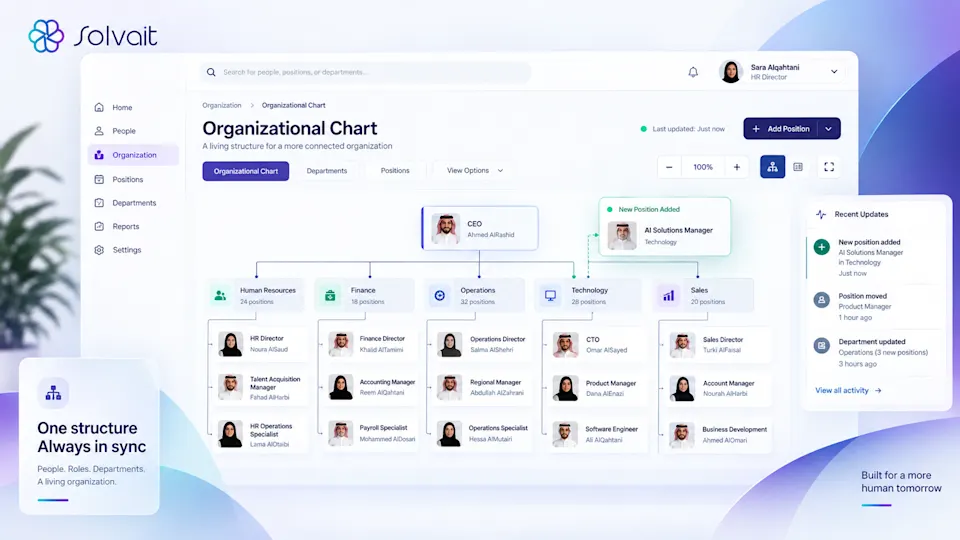
How to Map a Clear Org Structure in Wise's Org Chart
A practical guide to mapping your org structure in Wise's interactive org chart in one living chart that updates on every change.
Sep 20, 2026