

How to Design an Org Structure That Supports Your Saudization Goals
Start with the org chart, not the hiring plan. A high performance structure that supports your Saudization goals comes from designing spans and layers around the work first, then placing Saudi hiring where the band math and the business both need it. Bolt Saudi headcount onto a structure that's already broken, and you get compliance on paper with bottlenecks underneath.
Most Saudization plans skip that first step. They treat Nitaqat as a headcount target: count the Saudis, count the total, hit the ratio for your sector and size. The number moves, the band turns green, and the org chart stays exactly as tangled as it was. Six months later the same managers are overloaded, the same layers slow every decision, and the new Saudi hires land in roles nobody designed. This guide is about doing it the other way around.
Why org design is the lever, not a footnote
Structure is where the value actually sits, and the 2026 data is blunt about it. In Gartner's HR Priorities Survey of 426 CHROs across 23 industries and four regions, evolving the HR operating model had the single highest predicted impact on AI productivity gains, at 29 percent, ahead of AI skills, acceptance, or awareness. The structure moves the needle more than the training does.
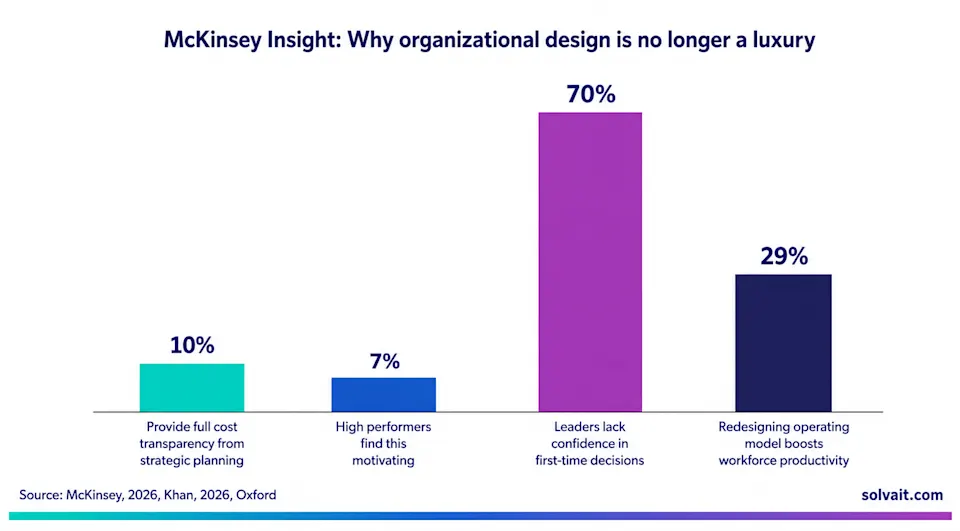
The gap shows up everywhere leaders are honest about it. Deloitte's 2026 Global Human Capital Trends found that 70 percent of leaders say being fast and agile is their main competitive strategy, but only 7 percent believe they lead that adaptation at the pace required. That 63 point gap is a structure problem wearing a strategy costume. And the upside is measurable: KPMG data shows organizations using strategic workforce planning can achieve around 10 percent labor cost savings through better structure and resource allocation.
For a Saudi enterprise, structure carries a second load that companies elsewhere don't feel: the Nitaqat band. Your org design decides how many roles you have, at what level, in which professions. Nitaqat decides how many of those roles must be Saudi, profession by profession. Design the structure without that in view and you're solving the same puzzle twice.
What "high performance structure" actually means
A structure performs when three things line up: managers carry a span they can actually handle, the layers between the CEO and the front line are few enough to keep decisions fast, and the roles that must be Saudi are designed into the org, not squeezed in after.
Take span of control first, because it's the one most companies get wrong quietly. Span of control is the number of employees reporting directly to a single manager. Gallup's 2025 research put the average at 12.1 direct reports per manager, up nearly 50 percent since 2013, as companies stripped out middle management layers. The trap is the average. It looks healthy while one or two managers quietly carry double what they can handle, and those are the managers who burn out and resign.
There's no single right number, which is exactly why a spreadsheet target of "one manager per ten" fails. The right span depends on what the manager actually does.
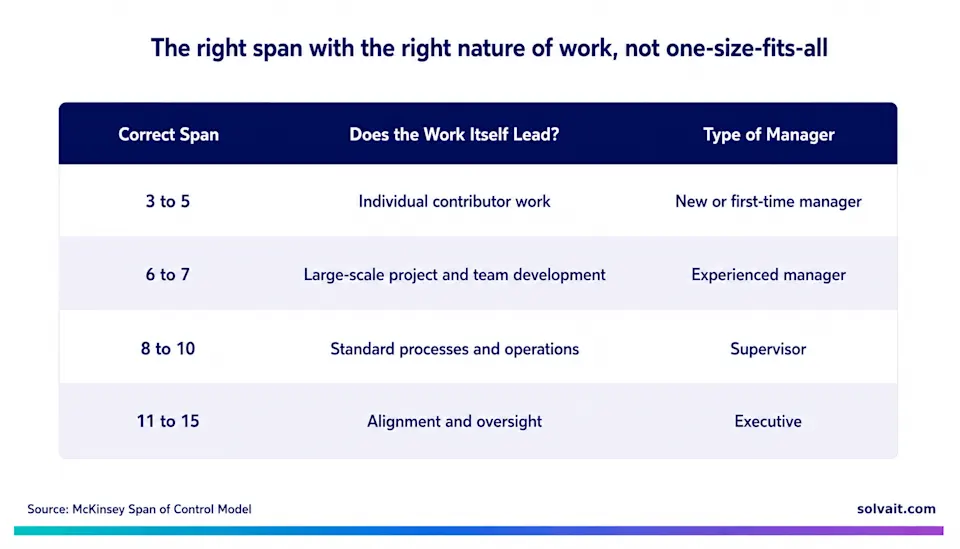
McKinsey's archetype model is the one to anchor on. A player coach who still does heavy individual work can carry 3 to 5 reports; a coach developing a team, 6 to 7; a supervisor over standard processes, 8 to 10; a facilitator whose job is coordination and oversight, 11 to 15. Hand a player coach a facilitator's span and you've designed a resignation. This is the layer of judgment a headcount only Saudization plan never reaches.
How to design the structure and the Saudization plan together
Here's the sequence that keeps the two from fighting each other.
Map the current structure honestly: Every manager, every span, every layer, and the Saudi to expatriate mix in each unit. Most companies have never seen this in one view. They see the departments they touch and hear about bottlenecks only when those bottlenecks explode into a resignation or a missed deadline.
Read the band per profession, not just company wide: This is where 2026 bites. Profession specific Nitaqat quotas now apply across 269 roles, which means a company can pass its headline band assessment and still fail on a single occupation. Marketing and sales sit at a 60 percent Saudization requirement; engineering at 30 percent with a minimum salary condition; and a April 2026 ministerial decision put 69 administrative support professions, including secretarial, translation, and data entry work, at 100 percent Saudization. Your structure has to be read profession by profession against these, because that's how the ministry reads it.
Design roles to the work, then assign the Saudization target to the right level: A 100 percent Saudi administrative function is a design decision about how you build that function, not a scramble to swap names on a chart. The wage floor matters here too: the minimum monthly wage for a Saudi national to count as a full unit toward the quota rose from SAR 3,000 to SAR 4,000. Design roles below that line and they count for half. The structure and the salary bands have to be built together.
Model before you move: Test the redesign against the band you're targeting before you post a single job. This is the step that used to be impossible by hand across hundreds of managers and dozens of professions, and it's the step where analytics earns its place.
The talent pool is finally there to make this work, which wasn't true a few years ago. The private sector now employs roughly 2.2 million Saudi nationals, up from fewer than 1.5 million in 2017, and Saudi unemployment reached about 7 percent by 2025, hitting the Vision 2030 target early. Saudization in 2026 is less a compliance tax and more a hiring market you can actually design for.
What everyone gets wrong
The common mistake is treating Saudization and org design as two separate projects run by two separate people. The compliance lead chases the band; the OD lead redraws the chart; neither sees the other's constraints until they collide. You end up over-hiring in professions where the quota is easy and under designing the functions where it's hard, and the structure absorbs the strain.
The second mistake is flattening for the sake of flattening. Consolidating middle management layers is the trend, but stripping layers without adjusting spans just moves the problem: the remaining managers inherit spans they can't carry, and you trade a slow structure for a burnt out one. Layers and spans are one decision, not two.
Where AI reads the structure for you
This is the part that used to be impossible at scale. A human OD lead can hold maybe one division's spans in their head. Reading every manager's span, classifying the type of work, cross referencing 269 profession quotas, and checking the wage floor across a whole enterprise is not a human speed task. It's an analytics task.
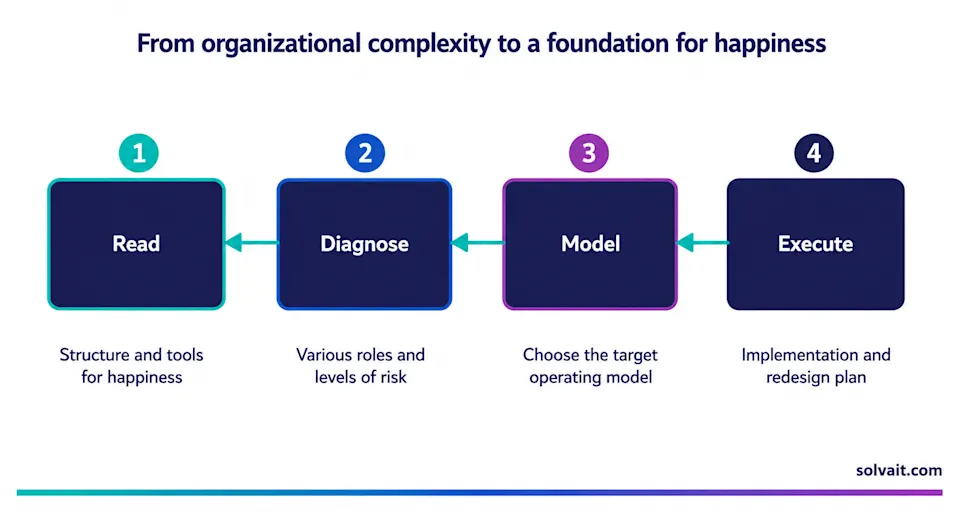
Solvait Wise is built for exactly this layer. It reads your org chart, calculates each manager's span, classifies the work against the archetype model, and flags where a structure is carrying risk, whether that's an overloaded manager, an extra layer, or a unit drifting out of its Nitaqat band. Then it models the redesign against the band you're targeting, so the finding turns into a plan: which roles to add, at what level, in which professions, to hit the target without breaking the spans. Explore Solvait Wise to see how the diagnosis becomes a decision instead of a report on a shelf.
The decision stays yours. Cultural fit, a specific manager's capacity to stretch, the timing of a reorganization: those are human calls. What the analytics does is hand you the full, honest map, so you spend your judgment on the right structure instead of spending it discovering the problem too late.
Ready to design a structure that hits your Saudization goals?
See how Solvait Wise reads your org chart, spots the structural risk, and ties it to your Nitaqat targets. Book a demo with Solvait and we'll walk through it on your own structure.
FAQ
How do you design an org structure that supports Saudization goals?
Design spans and layers around the work first, then map your Nitaqat quotas profession by profession onto that structure. Read the band per occupation, not just company wide, since 269 professions carry their own quotas. Place Saudi roles at the levels where the design needs them and the band requires them, and model the result against your target band before you hire.
What is span of control and why does it matter for org design?
Span of control is the number of employees reporting directly to one manager. It drives decision speed, engagement, cost, and turnover. There's no single ideal number: a manager doing heavy individual work handles 3 to 5 reports, while a coordinator can handle 11 to 15. Matching the span to the type of work matters more than any fixed ratio.
How do profession specific Nitaqat quotas change org design in 2026?
In 2026, Nitaqat quotas apply to 269 individual professions, so a company can pass its overall band and still fail on one occupation. Marketing and sales sit near 60 percent, engineering at 30 percent, and 69 administrative support roles at 100 percent. Structure has to be designed profession by profession, not just at the company level.
Can AI help with organizational structure design?
Yes. AI reads the full org chart, calculates each manager's span, classifies the type of work, and flags overloaded managers, redundant layers, and units drifting out of their Nitaqat band. It then models a redesign against your target band. The final structural decision stays human; the AI supplies the complete, accurate map that a person can't assemble at that scale.
Does a flatter structure automatically improve performance?
No. Removing management layers without adjusting spans just shifts the strain onto the remaining managers, who inherit spans they can't handle. A flatter chart can trade a slow structure for a burnt-out one. Spans and layers are a single design decision, and both have to be set against the type of work each manager does.
References
Gartner: Top Priorities for HR Leaders in 2026, 2025 (backs the 29% AI-productivity impact from HR operating-model redesign, 426 CHROs)
Deloitte: 2026 Global Human Capital Trends, 2026 (backs the 70% agile / 7% keep-pace gap)
Gallup: Span of Control: Optimal Team Size for Managers, 2025 (backs the 12.1 average span and the McKinsey archetype spans)
KPMG, via Alpha Apex Group: Spans and Layers Analysis, 2026 (backs the ~10% labor-cost savings from strategic workforce planning)
Saudi Vision 2030 analysis: Nitaqat wage floor and 269-profession quotas, 2026 (backs the SAR 4,000 full-unit wage condition and profession-specific quotas)
GASTAT, via Vision2030.ai: Saudi unemployment and private-sector employment, 2026 (backs the ~2.2 million private-sector Saudis and ~7% unemployment)
Ready to see Solvait in action?
Book a personalized demo and see how Solvait's AI-powered HR platform can transform the way your team works.
Tags
Related Posts
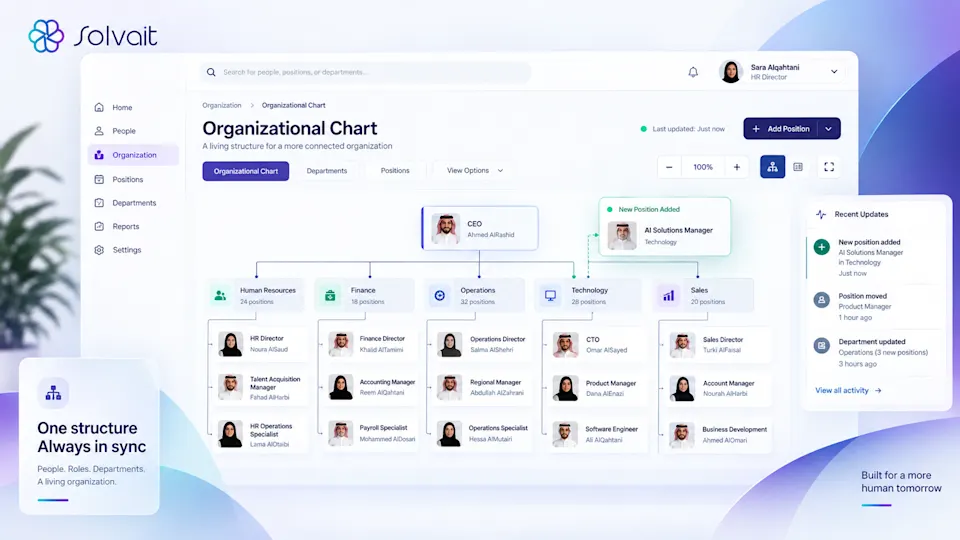
How to Map a Clear Org Structure in Wise's Org Chart
A practical guide to mapping your org structure in Wise's interactive org chart in one living chart that updates on every change.
Sep 20, 2026

How AI Spots Org Bottlenecks Meta
How AI reads your org chart and surfaces the broken span of control before it costs you.
Jul 30, 2026

Nitaqat 2026: The Green Zone Guide for Saudi HR
The 2026 Nitaqat phase raised the ratios, removed the Yellow band, and tied Saudization to Qiwa contracts. A practical guide to protecting your band.
Jul 26, 2026