
Qiwa Contract vs Iqama Expiry: Two Clocks, One Fine
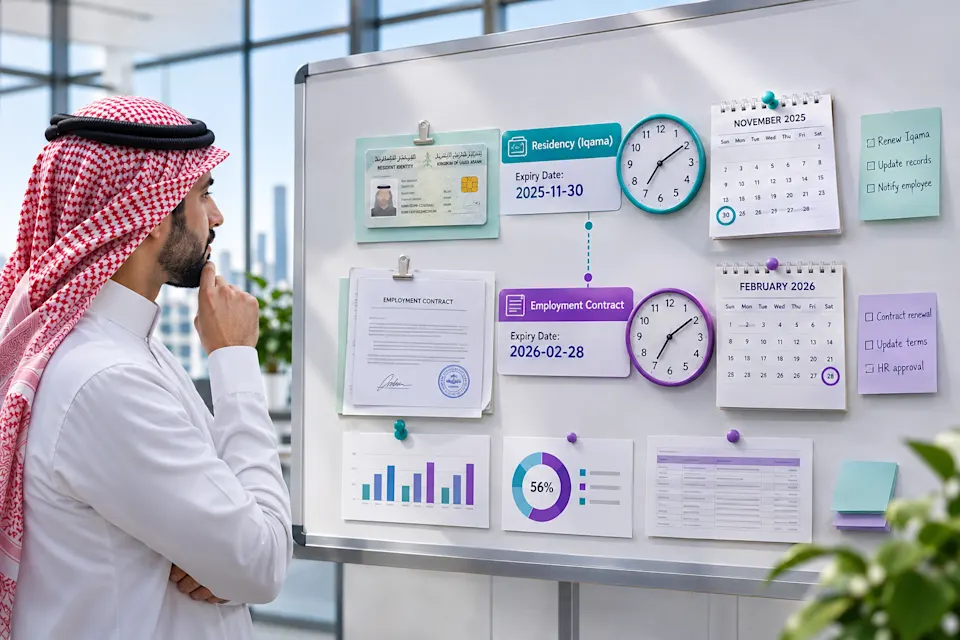
Every expat employee on your books carries two separate dates, not one. The first is the iqama (residency permit) expiry, run by the Directorate General of Passports and tracked through Absher and Muqeem. The second is the end date of the employment contract documented in Qiwa, run by the Ministry of Human Resources. Different systems, different owners, and they rarely land on the same day. Miss either one and a different penalty follows.
Call them the two clocks. Plenty of HR teams watch the iqama closely, then find out too late that the Qiwa contract lapsed or was never documented, which stalls the iqama renewal itself. This post explains the difference in plain terms, shows which clock triggers which fine, and then shows how to watch both from one register instead of two manual spreadsheets.
Key takeaways
Every expat employee has two clocks: the iqama expiry at Passports, and the Qiwa contract date at the Ministry of Human Resources. They move independently.
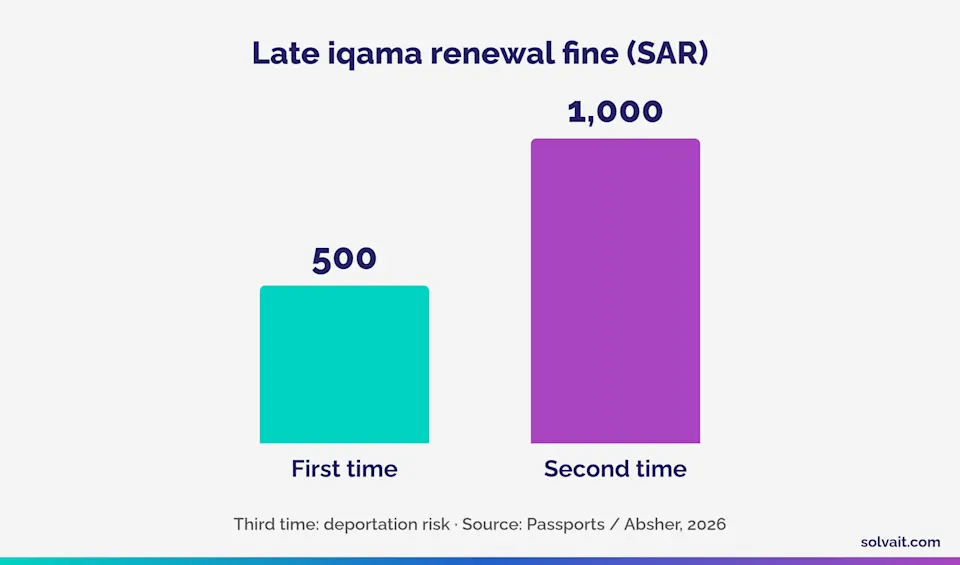
The iqama expiry fine for a late renewal starts around SAR 500 the first time and SAR 1,000 the second, and Passports(Jawazat) imposes it.
Since April 2026, only a Qiwa documented contract counts toward your Saudization rate, and iqama renewal is tied to that contract.
Tracking the two clocks in separate files is what causes most surprise fines. The fix is one register that alerts you before either date lapses.
Non-Saudis make up about three quarters of the private-sector workforce, according to GASTAT's 2025 labour market data. For a mid-size employer that is hundreds or thousands of dates, each with its own authority, system, and penalty. The whole story is about the Qiwa contract and the iqama, and who is watching which.
Why do you even have two clocks?
The iqama and the Qiwa contract are two different things, issued by two different bodies, for two different purposes.
The iqama is the legal residency permit. Passports issues and renews it, and you track it day to day through Absher for individuals and Muqeem for establishments. It usually carries a yearly expiry, and renewal depends on paying the fees and the labour levy.
The Qiwa contract is the employment contract documented electronically in the Qiwa platform, under the Ministry of Human Resources and Social Development. It has its own term and end date, and it is the official record of the work relationship. Your Saudization (Nitaqat) count is built on it, and iqama issuance and renewal are tied to it.
The catch is that the two dates do not sync. You might renew the iqama in March while the Qiwa contract ends in September. The employee looks clean on residency, then the contract quietly expires, or a salary change never gets documented, and the next renewal stalls. That gap is behind most of the fines managers describe as coming "out of nowhere".
Here is a real example. A contracting firm in Dammam with 180 expats kept its iqamas tidy in Muqeem. But one Qiwa contract expired two weeks before the iqama renewal was due. The system blocked the renewal until the contract was renewed and documented. One week of delay and a late payment, all from a clock nobody was looking at.
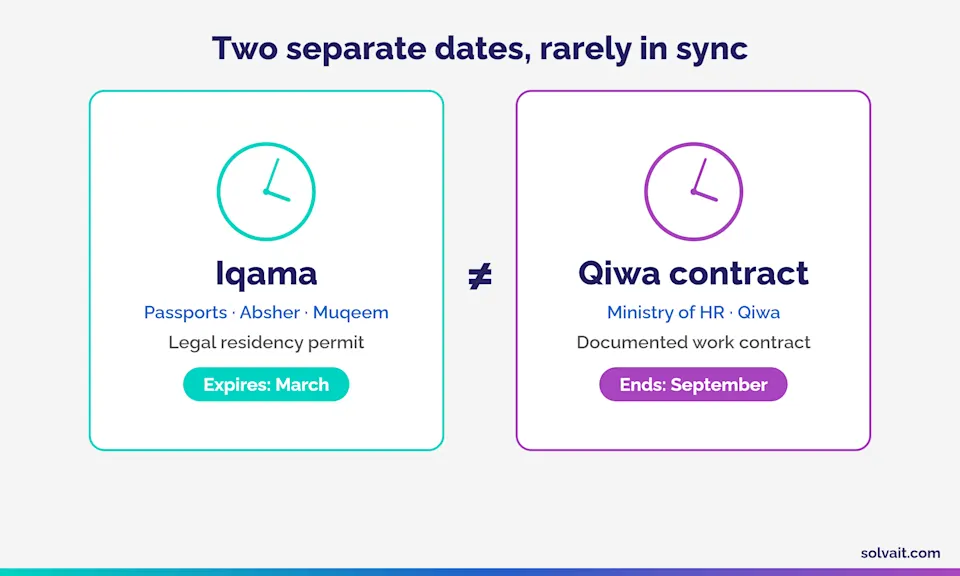
Here is the difference in one line each:
Item | Iqama | Qiwa contract |
|---|---|---|
Authority | Directorate General of Passports | Ministry of Human Resources (Qiwa) |
What expires | Legal residency permit | Documented employment contract |
Where you track it | Absher, Muqeem | Qiwa platform |
Effect of a lapse | Late iqama renewal fine | Saudization count stops, renewal stalls |
Who usually pays | The employer | The employer |
Look at the last row. In both cases the establishment carries the consequence, not the worker. That is exactly why watching both clocks sits squarely with HR.
Which clock triggers which fine?
Each clock has its own penalty, and it helps to know which is which before you reach it.
Late iqama: the Passports fine
When you are late to renew the iqama, Passports imposes a fine. The widely reported amounts are SAR 500 the first time and SAR 1,000 the second time, with deportation possible on a third offence. The exact official figure appears in Absher when you start the renewal, so treat that as the source of truth.
And the fine is not the whole cost. An expired iqama can freeze services linked to it: exit and re-entry, some banking transactions, and other renewals that require a valid iqama. A single day late can stall a whole chain of paperwork.
A lapsed Qiwa contract: Saudization and renewal
The Qiwa contract does not charge a daily fine like the iqama, but its effect runs deeper. Since April 2026, the Ministry of Human Resources counts only Qiwa documented contracts toward your Nitaqat rate. An undocumented contract means an employee who does not count toward your Saudization percentage, and that alone can push your establishment into a lower band and restrict its services.
The bigger point for daily tracking: iqama issuance and renewal depend on a valid, documented contract in Qiwa. If the contract expires or was never documented, the iqama renewal stalls even when the fees are ready. This is where the two clocks cross. The Qiwa clock can stop the iqama clock.
So, in practice: the iqama costs you money the moment you are late, and Qiwa costs you your Saudization and your ability to renew. The first is obvious. The second is more dangerous because it stays silent until you hit it.
How do you watch both clocks from one register?
The common method today is a manual tracker: a spreadsheet of names, iqama dates, and contract dates, updated by hand from Muqeem and from Qiwa. It works in a small company and breaks in a large one.
Why does it break? Because it depends on a person remembering to look. The dates keep moving: a new contract, a renewal, a sponsorship transfer, an unpaid leave that pushes the renewal out. Every change needs a manual update in two places, and every missed update becomes a fine months later.
Deloitte's 2025 Global Human Capital Trends estimates that managers spend close to 40% of their time on administrative tasks and immediate problem solving. Chasing iqama and contract dates is a direct slice of that lost time. And PwC's 2025 survey found that 75% of Middle East workers used AI at work over the past year, which is exactly the repetitive, date driven work that suits automation.
The alternative is simple in concept: one register that reads both clocks together and alerts you well before either date, not after it is missed. Instead of asking "who remembers to look?", the question becomes "what is the system flagging this week?".
Where Solvait fits
Solvait Agentic AI HR is Solvait's agentic HR platform. It runs the full HR lifecycle and adds autonomous agents that work under human oversight. One of them is the compliance agent, Mutaba'aa, built for the regulators specifically: Qiwa, Muqeem, Mudad, Nitaqat, and the Labour Law.
In practice, the agent watches each employee's iqama date and Qiwa contract date in one register, alerts before either comes due, and shows the action to take. The decision stays with your team. The agent monitors, suggests, and can hold a step when needed, and a human approves. That is what we mean by "the AI does the work, your team makes the calls".
To try the single-register idea on your real data, start from the Solvait AI HR page and see how both clocks collapse into one screen.
Solvait serves 300+ enterprise clients, with a 100% compliance rate on its platform, and holds ISO 27001 and Microsoft certified partner status. It was founded in Riyadh in 2010, with offices in Riyadh, Amman, and Cairo.
Ready to see both clocks in one place? Book a demo and we will show iqama and Qiwa contract tracking on your own company data.
FAQ
What is the difference between iqama expiry and the Qiwa contract date?
The iqama is a residency permit issued by Passports and tracked in Absher and Muqeem, with a yearly expiry. The Qiwa contract is the employment contract documented in the Qiwa platform under the Ministry of Human Resources, with its own term. The two dates are independent and rarely sync, so you track them together.
How much is the late iqama renewal fine in Saudi Arabia?
The widely reported amounts are SAR 500 the first time and SAR 1,000 the second, with deportation possible on repeat offences, imposed by Passports. Use the official figure shown in Absher at renewal, since it can change, and the employer usually bears it.
Does iqama renewal stop if the Qiwa contract expires?
Often, yes. Iqama issuance and renewal are tied to a valid, documented contract in Qiwa. If the contract expires or was never documented, the iqama renewal can stall even when the fees are ready, and the employee also stops counting toward your Nitaqat rate.
How do I track iqama and Qiwa contract dates without errors?
Keep both dates in one register that alerts you before either lapses, instead of two manual spreadsheets. Agentic HR platforms such as Solvait Agentic AI HR watch both clocks automatically through a compliance agent and alert the team before the deadline.
References
Deloitte - 2025 Global Human Capital Trends, 2025 (managers spend close to 40% of time on administrative tasks).
GASTAT - Labour Market Statistics, Q3 2025, 2025 (non-Saudi share of the workforce).
Qiwa, Ministry of Human Resources and Social Development - qiwa.sa, 2026 (employment-contract documentation and its link to Saudization).
Absher, Directorate General of Passports - absher.sa, 2026 (iqama renewal and the authority that imposes the fine).
PwC - Workforce Hopes and Fears 2025, 2025 (AI use at work in the Middle East).
Solvait - solvait.com, 2026 (300+ clients, 100% compliance rate, ISO 27001).
See agentic HR in action
Solvait AI HR and its agents prepare Saudi labor-law work so HR can review it before anything is submitted.
Tags
Related Posts

Track Iqama & Contract Expiries Before the Fines
A practical guide to tracking iqama and contract expiries in Saudi Arabia before they become fines: early alerts, and an agent that acts first.
Nov 3, 2026
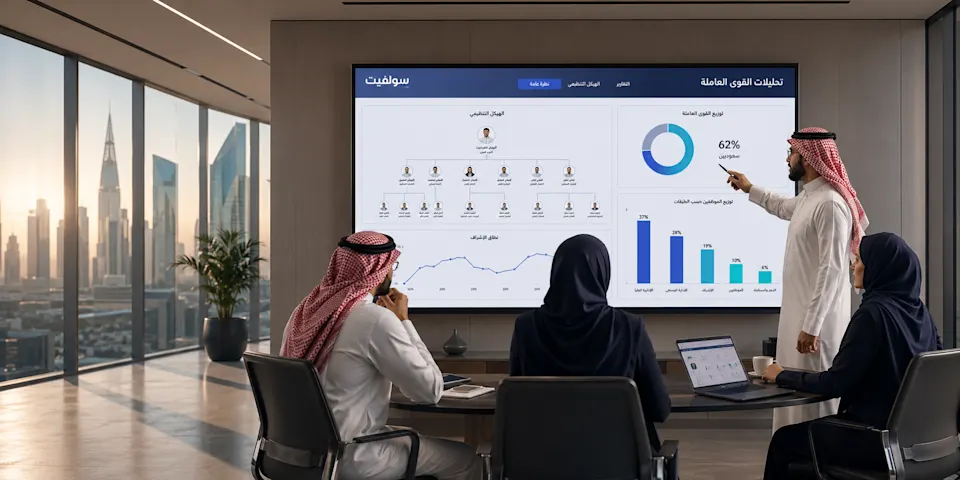
Org Structure Design for Saudization Goals | Solvait
Design a high performance org structure that hits your Saudization goals. A practical guide to spans, layers, and workforce analytics for Saudi teams.
Aug 26, 2026
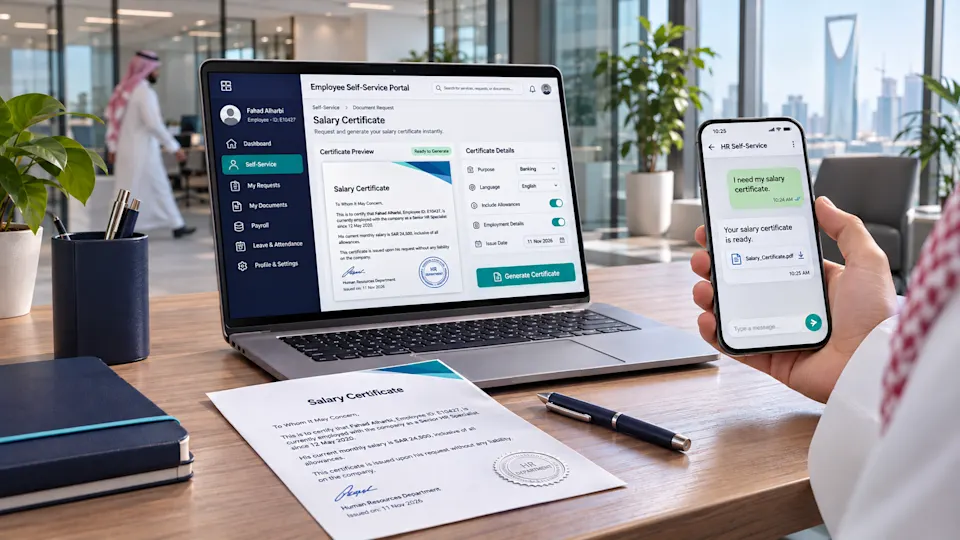
Salary Certificate Requests in Self Service | Solvait
Issue a salary certificate from self service in seconds, not days. Steps, required details, and manual vs agentic issuing in Saudi Arabia.
Nov 11, 2026