

How to Track Iqama and Contract Expiries Before They Become Fines
Tracking iqama and contract expiries means keeping one register of every employee document and its expiry date, with an alert that reaches you early enough to finish the renewal. The fine doesn't come from the document expiring. It comes from you noticing too late. When you know the date weeks ahead, renewal is a routine task. When you catch it after the fact, it's a violation, a service freeze, and an angry call from the employee.
The trouble is that most teams track these dates in an Excel sheet or in one person's head. That holds for ten employees, not for three hundred. Every new hire adds another iqama, another work permit, another contract, and another chance for one date to slip through the net. This guide shows how to build proactive tracking that catches the date before it becomes a fine, and how a modern HR platform takes the job off your desk entirely.
Key takeaways
The fine is the result of late detection, not of the expiry itself. Proactive tracking turns renewal from a crisis into a routine.
Spreadsheets break at scale: one date slips, and nobody notices until the penalty arrives.
Tracking iqama and contract expiry needs three things: one register, alerts with enough lead time, and a clear owner for each step.
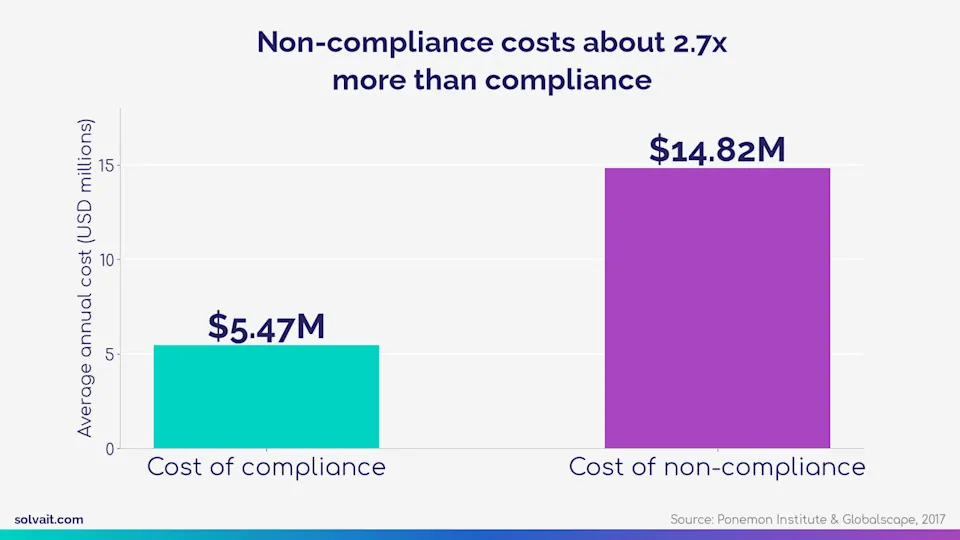
Preventing a violation is far cheaper than paying for it. Non compliance costs about 2.7 times what compliance costs, per Ponemon.
The newest layer is an agentic compliance agent that watches the dates and acts before the deadline, not after.
Why do expired iqamas and contracts turn into fines and risk?
Start with scale. Expatriate workers make up a large share of the Saudi labor market, and each one carries an iqama, a work permit, and a contract, each with a different expiry date. A 300 person company can be tracking well over a thousand sensitive dates a year. The number alone is enough to drop one.
Then come the regulations. Since 1 July 2025, the Ministry of Human Resources and Social Development sorts work permits into three tiers (high-skill, skilled, and basic) through the Qiwa platform, which means reviewing and updating the classification of every expatriate worker. With the Wage Protection System (WPS) and Nitaqat in the mix, compliance is interlinked: a late document can freeze an unrelated service.
This is where the real cost starts. A late iqama renewal exposes the company to escalating fines. Published sources report around SAR 500 for the first lapse and SAR 1,000 for the second, and the current figure should always be checked on Absher or Muqeem. More damaging, an expired document can freeze linked services: no exit or re-entry visa, and stalled employee transactions. Repeat violations also weigh on the establishment's standing with the authorities.
Why do manual spreadsheets fail in particular?
A spreadsheet doesn't alert you. It waits for you to open it. An alert that depends on someone remembering to open a file isn't an alert, it's a wish. The problem compounds because HR teams are already stretched: Gartner finds one HR full time employee per 58 employees on average, at roughly $2,810 of HR spend per employee a year. A team that size can't hand check a thousand dates every day.
The financial picture is well documented. In the Ponemon and Globalscape study, non compliance averaged $14.82 million against $5.47 million for maintaining compliance, so doing nothing costs about 2.7 times what prevention does. The fine is never the only line item. It comes with disrupted operations, lost productivity, and hours burned on fixing things after they break.
What does effective proactive expiry tracking look like?
A good system doesn't ask you to remember. It remembers for you, alerts at the right moment, and knows who owns the next step. It rests on four clear layers.
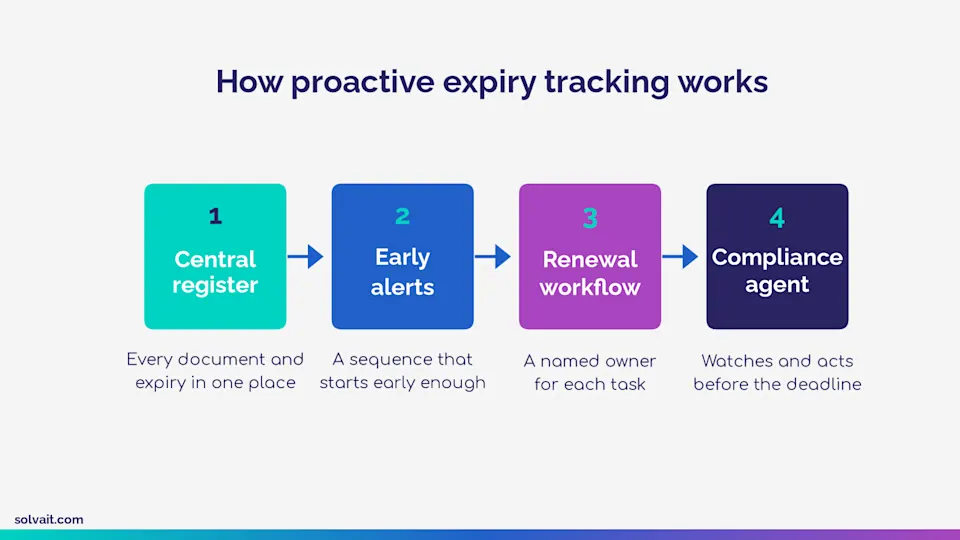
1. One register for every document. A single place that holds the iqama, work permit, contract, and certificates for each employee, with the expiry date. No scattered files, and no copy sitting on the laptop of someone who left.
2. Alerts with real lead time. Not one alert on the expiry day, but a sequence that starts early enough to finish the process. An iqama needs a longer runway than a training certificate, because its renewal runs through government steps.
3. A renewal workflow with a clear owner. Each alert opens a task for a named person, with known steps and a trackable status: in progress, waiting on a document, done. An alert with no owner dies in an inbox.
4. An intelligent compliance layer. Here is the newest piece. Instead of waiting for someone to open it, the system watches the dates continuously, surfaces what's approaching, and proposes the next step. That isn't a chatbot answering a question. It's an agent that monitors and acts under human oversight.
So how do the real options compare? Here is an honest look at the ways Saudi teams actually track these dates today.
Approach | Catches the date early? | Who it fits best |
|---|---|---|
Government portal alerts (Absher, Qiwa, Muqeem) | Partly, per transaction, not across your whole workforce | Any employer, as a safety net |
Spreadsheet plus manual reminders | Only if someone opens it in time | A handful of employees |
A general HR system with a date field | It stores the date, but the follow-up stays manual | Teams that already run one |
Solvait AI HR (Mutaba'aa agent) | Yes, it watches continuously and proposes the action | Teams tracking hundreds of dates |
Be fair about the simple options. For a company with a handful of employees, the free portal alerts and a tidy spreadsheet are genuinely enough. The case for a platform starts when the number of dates outgrows one person's attention.
What does everyone get wrong?
The common mistake is treating the alert as the finish line. An alert isn't a solution, it's the start of a task. Teams that bolt alerts onto their old spreadsheet still catch dates late, because the alert lands in a crowded inbox and never turns into action. The real value appears when every date is tied to an owner and a clear path, not to a reminder left hanging in the air.
How do you build a practical tracking framework?
You don't need a big project to start. You need a simple framework you can apply this week. Begin by defining what you track, then the right lead time for each type, then who owns each step.
Use this quick list as a starting point:
Document | Suggested alert lead time | Owner |
|---|---|---|
Iqama | 45 to 60 days | HR operations specialist |
Work permit (Qiwa) | 45 days | Compliance specialist |
Employment contract | 60 days | HR manager |
Professional or training certificate | 30 days | The employee's line manager |
GOSI subscriptions | Monthly recurring | Payroll team |
Adjust the windows to your own reality, but keep the principle: the more steps a renewal takes, the longer the lead time.
Where does a modern HR platform fit in?
This is exactly what a modern HR platform automates. Solvait AI HR is an agentic AI HR platform that runs the full HR lifecycle and adds agents that work under your team's oversight. Its compliance agent, Mutaba'aa, watches iqama and contract dates, Qiwa requirements, GOSI subscriptions, and Nitaqat bands, surfaces what's approaching, and proposes the action before it becomes a violation. The platform connects to the HR system you already use instead of asking you to replace it, and gathers every date into one platform the agents run under human oversight.The difference between this and a calendar reminder is small but decisive: a calendar waits, an agent follows up. And with Solvait's own track record (a 100% compliance rate, 300+ clients, and setup inside 30 days), tracking moves from a daily burden to a process that runs in the background.For a worked example from the contract and end-of-service world, see worked examples of end-of-service and resignation.Try it yourself: model the effect of a contract or end-of-service date precisely with Solvait's free end-of-service calculator.Ready to stop fines before they start? Book a demo with Solvait and see the compliance agent track your dates for you.
Frequently asked questions
How much is the fine for a late iqama renewal in Saudi Arabia?
Published sources report an escalating schedule starting around SAR 500 for the first lapse and SAR 1,000 for the second, with heavier risk on repeat. The figures change, and the only official reference is the Absher and Muqeem portals. The safe rule: renew well before expiry, because the cheapest fine is the one that never happens.
What is the difference between an AI chatbot in HR software and an agentic AI HR platform?
A chatbot answers a question when you ask, then stops. An agentic platform works without being asked: it watches dates and data continuously, flags what's approaching, and carries out the next step under human oversight. The first is a reply tool. The second is an agent that follows up and acts.
How can HR software identify errors before they become violations?
Instead of waiting for a manual review, the system checks data continuously against the rules: a date approaching, a missing subscription, a line that doesn't match the Wage Protection System. When it finds something off, it raises an early alert with the suggested action, so the issue is fixed before it reaches a fine or a wrong payslip.
Does the system integrate with Qiwa, GOSI, and Nitaqat?
A modern HR platform is built to mirror Saudi compliance requirements: work permits in Qiwa, GOSI subscriptions, Saudization bands in Nitaqat, and the Wage Protection System. More importantly, it connects to the HR system you already run instead of forcing a replacement, so dates and requirements sit in one place.
Who is responsible for renewing an expatriate employee's iqama?
Responsibility usually sits with the employer, which is why the HR team needs one register and early alerts. Leaving it to an employee's memory or a single spreadsheet is what turns a routine renewal into a costly violation.
References
McKinsey Global Institute: Agents, robots, and us: Skill partnerships in the age of AI, 2025 (about 57% of work hours are technically automatable today).
Gartner: HR Budget and Efficiency Benchmarks, 2024 (one HR FTE per 58 employees; roughly $2,810 HR spend per employee).
Ponemon Institute & Globalscape: The True Cost of Compliance with Data Protection Regulations, 2017 (non-compliance cost $14.82M versus $5.47M for compliance).
General Authority for Statistics (GASTAT): Labor Market Statistics Q3 2025, 2025 (Saudi unemployment and labor participation rates).
Arab News: Saudi Arabia rolls out skill-based work permits to attract global talent, 2025 (three-tier work-permit classification via Qiwa from 1 July 2025).
See agentic HR in action
Solvait AI HR and its agents prepare Saudi labor-law work so HR can review it before anything is submitted.
Tags
Related Posts

GOSI Automation Saudi Arabia: Calculate, File & Audit
Calculate, submit and audit GOSI contributions in Saudi Arabia accurately, without a dedicated compliance specialist, using agentic payroll automation.
Aug 24, 2026

Four Agents, One HR Department | Agentic HR
How agentic HR works: four agents (Compliance, Operations, Payroll, Concierge) over a deterministic engine, on Saudi Labor Law rules, from Solvait.
Aug 13, 2026

Agentic HR vs Automation vs Chatbots: A Plain Guide
Agentic HR is not automation and not a chatbot. A plain language guide to the difference, the four AI HR agents in Solvait AI HR, and when you need each.
Oct 20, 2026