

How the Job Description Generator Helped with Recruitment in Saudi Arabia
This is an illustrative case study, built on real recruiting patterns in the Saudi market rather than a single named customer. Its purpose is to show you how small saved minutes on each job description compound into a real difference across hundreds of hires. The core idea is simple: the job description is the first point of contact between you and a candidate, and improving it improves everything downstream.
Picture a recruiting team at a mid sized Saudi company, tasked with filling 200 roles during an expansion season. The team is small, and the roles range across sales, tech, operations, and support. The task is not impossible, but the first bottleneck shows up early: writing a good job description for each role eats more time than it seems.
Where it stalls: the job description itself
A weak description attracts the wrong candidate. A vague title, responsibilities copied from an old ad, and a generic skills list that separates no role from another. The result is a flood of unsuitable CVs, more time in screening, and a slower hire.
This is not just an opinion. McKinsey notes that generative AI will reshape recruiting in two meaningful ways, the first being helping managers write better job requirements by pulling out the skills required to succeed in the role, with a human in the loop to check the result. In other words, improving the job description is not a cosmetic detail. It is a leverage point in the whole hiring process.
And the Saudi context multiplies the importance. The labor market is expanding fast, with Saudis in the private sector reaching 2.47 million by the end of Q2 2025, and the Human Resources Development Fund supporting the hiring of 437,000 Saudis in 2024 alone, per the Ministry of Human Resources and Social Development. Hiring at that scale means dozens of job descriptions a week, and every minute saved on a description multiplies hundreds of times.
What changed: before and after
Before the tool, each job description started from a blank page or an old ad copied and edited. The estimated time for one good description was around 40 minutes, between drafting the title, ordering responsibilities, defining skills, and tuning to the local market.
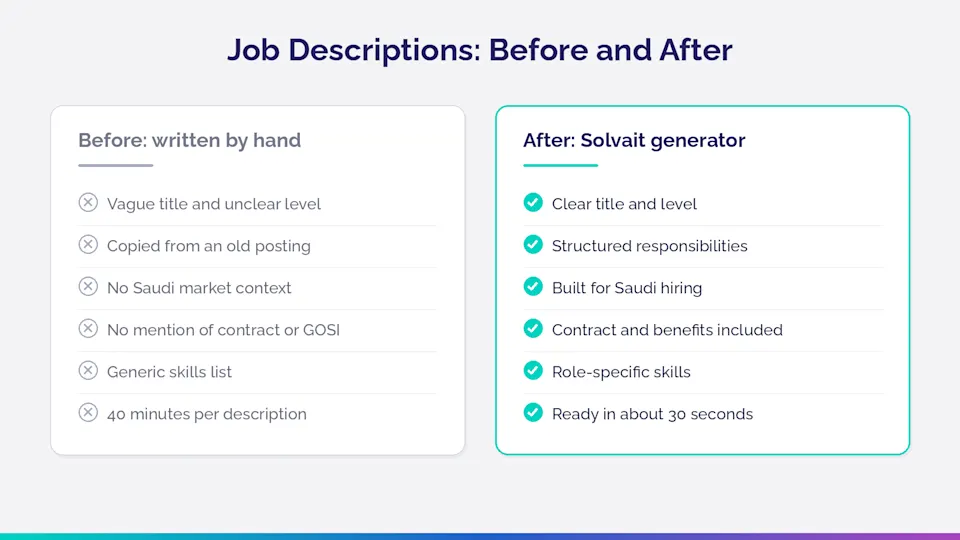
After introducing the job description generator into the workflow, the starting point changed. Instead of a blank page, the team starts from a structured draft: a clear title and seniority, ordered responsibilities, role specific skills, and alignment with the Saudi hiring context including a note on contract and benefits. The human role did not disappear. It moved from writing from scratch to reviewing and customizing, which is faster and sharper.
The time difference per description looks small: from around 40 minutes to under a minute for the first draft, then a few minutes to review. But multiply that saving by 200 roles, and you see how the team's time frees up for the part that actually needs a human: interviewing candidates, building the relationship, and making the hiring decision.
Why a good description matters more than it looks
The job description is not a formality. It is the first filter. When it is precise, it attracts the right candidate and turns away the wrong one before they reach the screening stage. That cuts the number of mismatched CVs, raises the match rate in later stages, and shortens the whole time to hire.
In the 200 hire scenario, the tool was not hiring instead of the team. It was removing the first bottleneck, so the rest flowed faster. The result is not "AI hired 200 people," but "the team hired 200 people because its tool took the repetitive work off their plate."
A fair point: the tool cannot fix a description for a role that is vague in its owner's mind. If the manager is not clear on what they want, no generator makes up for that clarity. The tool speeds up the drafting, but the quality of the input stays a human responsibility.
How to try it on your role now
The step is practical and simple. You enter the job title, get a structured draft in seconds, then review and customize it for your context. Try it now with the free job description generator from Solvait.
From one tool to a full recruiting system
The description generator solves the first step in hiring. But the full journey is longer: posting the role, receiving candidates, screening CVs, matching them to the description, and managing interviews through to the offer. Each step has a potential bottleneck.
This is where Solvait Attract, the talent acquisition platform built on Microsoft Dynamics 365, comes in. It takes the job description you created and builds an integrated hiring flow on top of it: posting, screening, matching, and candidate tracking through to the hire. The free tool shows you the power of the first step. The platform connects the whole journey.
And if you want to see how recruiting moves from scattered tools to one coherent flow, book a demo with Solvait.
FAQ
How do I write a professional job description?
Start with a clear title and seniority, then order the core responsibilities, define role specific rather than generic skills, and align the description with the local hiring market including contract and benefits. The free job description generator gives you a structured draft with these elements in seconds to review and customize.
Is the Solvait job description generator free?
Yes, it is a completely free tool with no subscription. You enter the job title and get a structured description draft instantly, ready to review and publish.
Does AI replace the recruiter?
No. The tool speeds up the repetitive part like the initial description draft, while the human decision, from interview to candidate selection, stays the recruiter's responsibility. The human is in the loop to review and customize, and the tool frees their time for what matters more.
How much time does the generator save?
Writing a good description by hand can take around 40 minutes, while the generator produces a first draft in under a minute, followed by a few minutes to review. The real value shows when the task repeats across dozens or hundreds of roles, where the saved time compounds.
References
- McKinsey & Company: Generative AI and the future of HR, 2023 (supports AI's role in writing job requirements).
- Ministry of Human Resources and Social Development: Growth and development in the Saudi labor market, 2025 (supports the employment figures).
- Human Resources Development Fund (via Gulf News): Support for hiring 437,000 Saudis in 2024, 2024 (supports the hiring scale).
Ready to see Solvait in action?
Book a personalized demo and see how Solvait's AI-powered HR platform can transform the way your team works.
Tags
Related Posts

Solvait’s Free Job Description Generator
Free AI tool to generate a professional, Saudi context job description in 60 seconds. No signup, no data captured. Try the JD generator today.
Jul 7, 2026

Build a Saudi Talent Pipeline Before You Need One
A practical guide to building a Saudi talent pipeline with AI: source early, nurture in tiers, and shortlist in hours when a role opens.
Jul 6, 2026

Why Your Job Ads Attract the Wrong Candidates (And the Fix)
A vague job description repels your best Saudi talent. See the common job description mistakes and how AI fixes them before you publish.
Jul 5, 2026