

Saudization in 2026: How to Hit Nitaqat Without Compromising Talent Quality
The trade off between localization percentage and hiring quality is imaginary, and it feels very real in the quarter you need visas. The team hires fast to lift the ratio, loses those same hires within six months, and lands back where it started having paid the recruitment cost twice.
The fix isn't lowering the target. It's reordering the steps. Sustainable Saudization starts with role design, runs through skills based matching, and lands in a structured first 90 days. The ratio is an output, not a separate goal.
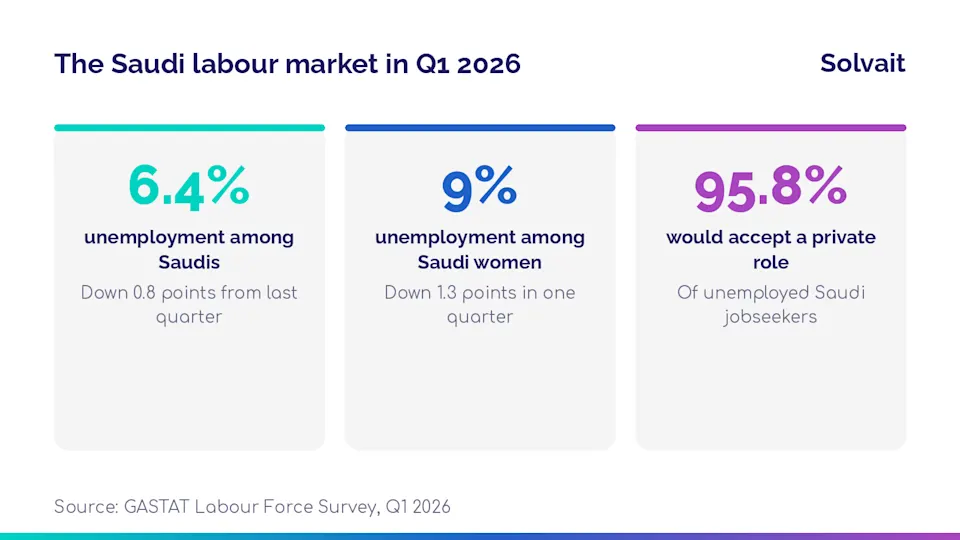
The market is also helping more than it did three years ago. According to the GASTAT Labour Force Survey for Q1 2026, unemployment among Saudi nationals fell to 6.4%, unemployment among Saudi women fell to 9%, and 95.8% of unemployed Saudis said they would accept a private sector role. Candidate scarcity is no longer the constraint. Match quality and decision speed are.
What changed in the rules
The Nitaqat Mutawar phase that began in April 2026, targeting more than 340,000 jobs over three years, moved compliance from the establishment level to the profession level. There are now 269 professions carrying their own localization decisions, several with minimum wage conditions and mandatory professional accreditation.
Profession | Required rate | Trigger |
Administrative support | 100% | 69 roles, from one employee up |
Procurement and supply chain | 70% | 12 roles, three employees or more |
Marketing and sales | 60% | Three or more workers in the role |
Accounting | 40%, rising annually to 70% | Five accountants or more |
Engineering | 30% | Five or more, with SCE accreditation |
Tourism | 40% | By covered activity |
The practical consequence: a company planning localization around one company wide number is planning with the wrong instrument. The right plan is built department by department, because the violation happens inside one department while the establishment stays comfortably Green.
Why fast Saudization collapses
A hire who resigns at month six costs you three times over. The ratio returns to where it was, the recruitment cost is paid again, and the department loses output through the vacancy and the ramp up.
Deloitte's 2026 Global Human Capital Trends report, drawing on roughly 9,000 leaders across 76 countries, found that 85% of leaders call it critical to build the organization's ability to adapt, while only 7% say they're leading on helping their workforce grow and adapt continuously. That gap between recognition and execution is the same gap between a ratio achieved in March and a ratio that collapses in September.
The recurring causes in the Saudi market will be familiar to any hiring manager:
A job description written for compliance, not for the role: The candidate reads generic responsibilities, arrives to different work, and starts looking again in month two.
Keyword matching: A candidate who described their experience in different words gets filtered out, while a candidate who knows how to write a CV gets through with thinner experience.
Unstructured onboarding: Ninety days with no clear goals and no manager with time to follow up. New joiners decide whether to stay during exactly this window.
An invisible path. A Saudi employee who can't see their next step inside the company can see it easily outside it.
Four layers that make Saudization a business decision
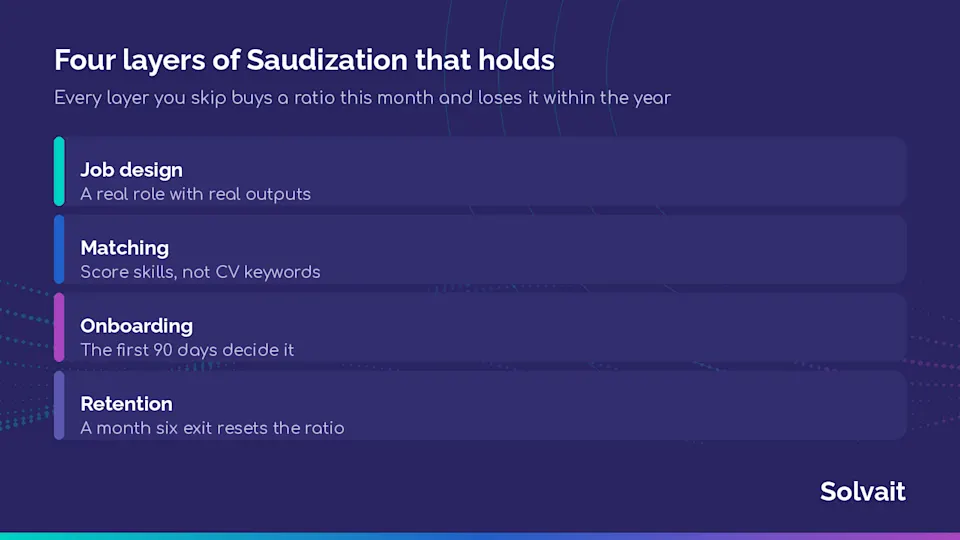
Layer one: role design. Write the job description around measurable outcomes for the next 12 months rather than a task list. A sharp description reduces applicant volume and raises applicant quality, which is the point.
Layer two: skills based matching. Compare every CV to the description at the level of skill and experience, not vocabulary. This is where agentic AI earns its place: the agent reads hundreds of CVs in minutes, ranks candidates with strengths and gaps for each, and leaves the decision with the recruiter. The tool ranks. The human decides.
Layer three: the first 90 days. Three clear goals, reviews in week two, week six and week twelve, and one named person responsible for orientation. It's the cheapest retention tool available to you.
Layer four: retention. Track Saudi turnover by department, not company wide. If one department loses people at twice the rate of its peers, the problem isn't localization. It's the management of that department.
One honest caveat: none of these layers speeds up hiring in month one. A good description and serious matching cost time up front. The return shows up in the twelve month retention rate, and that's the number that actually protects your band.
Where Solvait fits
Solvait Attract parses CVs and scores candidates against the job description with strengths, gaps and recommendations for each , which compresses first pass screening without replacing your team's judgment. The performance metrics and industry comparison module reports localization by department and profession, which is the level compliance is now measured at.
Before you post the next role, run it through the free job description generator and get a professional, Saudi context JD in 60 seconds. No signup.
If you want a localization plan built on your actual department data, book a Solvait demo .
FAQ
How do I raise Saudization without lowering hiring standards?
Start with roles where national supply is strong, write the description around clear outcomes, and use skills based matching instead of keyword filtering. Compromise usually comes from time pressure rather than talent scarcity, so shortening the screening cycle solves a large part of the problem.
Is the overall localization percentage enough for compliance in 2026?
No. There are 269 professions carrying their own decisions, calculated separately from your establishment classification. Your company can sit in the Green band and still be in violation in one department because its headcount in a covered profession crossed the trigger.
What is the biggest reason new national hires resign?
The gap between what the job ad promised and what the first month delivered, followed by the absence of structured onboarding in the first 90 days. Both are fixable before the hire, not after.
Do part time or contract workers count toward localization?
Yes, under defined conditions. Establishments can earn credit for part time or contract workers who meet the minimum monthly hours requirement. Verify the current application rules on Qiwa before building your plan around it.
How long does a hire take to improve the classification?
Not immediately. The classification uses a weighted average over a prior period, and an employee isn't counted at all until their Qiwa contract is documented and the wage condition is met. Plan for an effect that shows in weeks rather than days.
References
General Authority for Statistics: Labour Force Survey, Q1 2026 , 2026 (6.4% Saudi unemployment, 9% among Saudi women, 95.8% open to private sector)
Deloitte: 2026 Global Human Capital Trends , 2026 (85% call adaptability critical, only 7% are leading)
Middle East Briefing / Dezan Shira: Sector quotas in force in 2026 , 2026 (profession rates and triggers)
Ministry of Human Resources and Social Development: New Nitaqat Mutawar phase , 2026 (340,000 job target)
SHRM: State of AI in HR 2026 , 2026 (recruiting is the most mature AI use case inside HR)
Ready to see Solvait in action?
Book a personalized demo and see how Solvait's AI-powered HR platform can transform the way your team works.
Tags
Related Posts

Nitaqat 2026: The Green Zone Guide for Saudi HR
The 2026 Nitaqat phase raised the ratios, removed the Yellow band, and tied Saudization to Qiwa contracts. A practical guide to protecting your band.
Jul 26, 2026

Applicant Tracking System (ATS): Employer's Guide
An applicant tracking system reads and ranks CVs before a recruiter sees them. Here's how an ATS works from the employer's side .
Oct 21, 2026

CV to Job Match Score: What 60% Really Means
What a CV to job match score is, what a 60% ATS match really means for a hiring decision, and how AI resume screening ranks hundreds of CVs fairly.
Oct 15, 2026